Who Needs
Upset Prevention and Recovery Training
(UPRT)?
27 March 2012
Lakeland, FL USA
Janeen Kochan, Ph.D.
Aviation Research, Training, and Services
&
Paul ‘BJ’ Ransbury, MCFI-A
Aviation Performance Solutions
www.apstraining.com
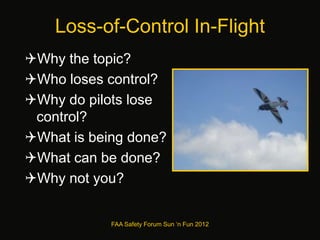
Loss-of-Control In-Flight
Why the topic?
Who loses control?
Why do pilots lose
control?
What is being done?
What can be done?
Why not you?
FAA Safety Forum Sun ‘n Fun 2012
What is Loss-of-Control In-Flight?
Flight that Occurs Outside of the Normal
Flight Envelope with an Inability of the
Pilot to Control the Aircraft.
ICAO: Loss of Aircraft Control While in Flight
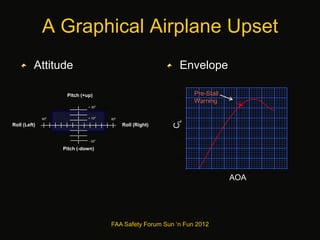
Defining an Airplane Upset*
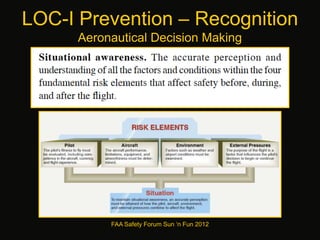
Attitude
Pitch attitude greater
than:
25 deg, nose up.
10 deg, nose down.
Bank angle greater than
45 deg.
Envelope
Within these
parameters, but flying
at airspeeds
inappropriate for the
conditions.
Implications
Stall (AOA)
Speed Divergence
L/Dmax (AOA)
Mach / Compressibility
* Airplane Upset Recovery Training Aid – Revision 2
FAA Safety Forum Sun ‘n Fun 2012
Roll (Right)Roll (Left)
Pitch (-down)
Pitch (+up)
+ 30
o
+ 25
o
+ 10o
- 10
o
60o
45
o
60
o
- 30
o
Attitude
A Graphical Airplane Upset
FAA Safety Forum Sun ‘n Fun 2012
Envelope
Pre-Stall
Warning
AOACL
Why the Topic?
FAA Safety Forum Sun ‘n Fun 2012
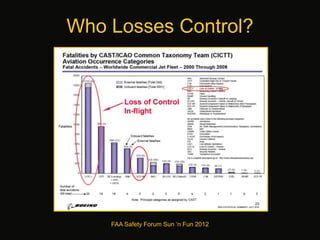
Who Losses Control?
FAA Safety Forum Sun ‘n Fun 2012
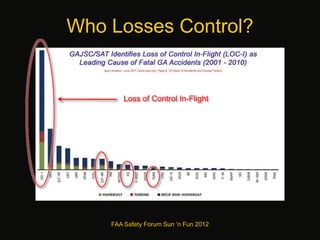
Who Losses Control?
Loss of Control In-Flight
FAA Safety Forum Sun ‘n Fun 2012
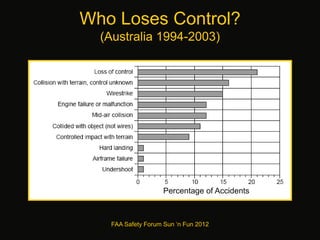
Who Loses Control?
(Australia 1994-2003)
Percentage of Accidents
FAA Safety Forum Sun ‘n Fun 2012
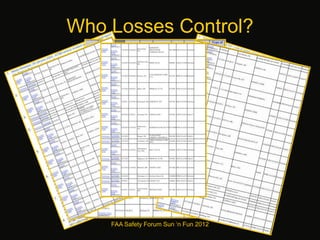
Who Losses Control?
FAA Safety Forum Sun ‘n Fun 2012
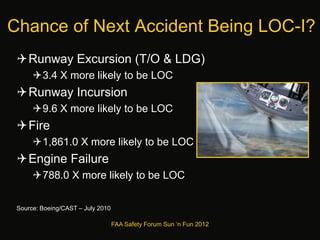
Chance of Next Accident Being LOC-I?
FAA Safety Forum Sun ‘n Fun 2012
Runway Excursion (T/O & LDG)
3.4 X more likely to be LOC
Runway Incursion
9.6 X more likely to be LOC
Fire
1,861.0 X more likely to be LOC
Engine Failure
788.0 X more likely to be LOC
Source: Boeing/CAST – July 2010
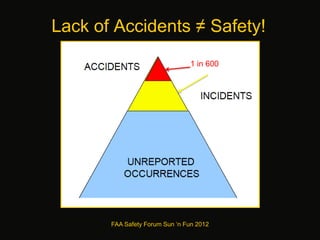
Lack of Accidents ≠ Safety!
1 in 600
FAA Safety Forum Sun ‘n Fun 2012
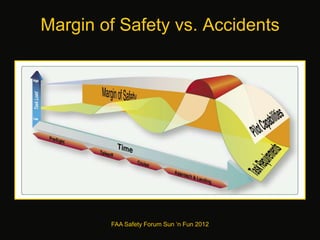
Margin of Safety vs. Accidents
FAA Safety Forum Sun ‘n Fun 2012
Why Pilots Lose Control?
Unexpected Events and Surprise
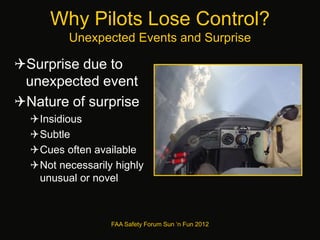
Surprise due to
unexpected event
Nature of surprise
Insidious
Subtle
Cues often available
Not necessarily highly
unusual or novel
FAA Safety Forum Sun ‘n Fun 2012
Why Pilots Lose Control?
Unexpected Events and Surprise
Expectations inconsistent with ongoing situation
Lack of cues and/or improper interpretation of cues
Erroneous probability estimations
Decision making becomes impaired and/or
delayed
Focus on event leads to an interruption of
ongoing activities
Interruption of ongoing activities can lead to…
FAA Safety Forum Sun ‘n Fun 2012
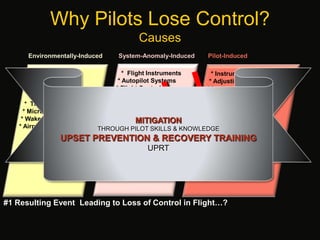
* Turbulence
* CAT
* Mountain Wave
* Windshear
* Thunderstorms
* Microbursts
* Wake Turbulence
* Airplane Icing
System-Anomaly-Induced Pilot-Induced
* Flight Instruments
* Autopilot Systems
* Flight Controls
* Instrument Crosscheck
* Adjusting Att & Power
* Inattention
* Distraction
* Vertigo or SD
* Pilot Incapacitation
* Improper use of A/P
* Pilot Technique
Environmentally-Induced
#1 Resulting Event Leading to Loss of Control in Flight…?
MITIGATION
THROUGH PILOT SKILLS & KNOWLEDGE
UPSET PREVENTION & RECOVERY TRAINING
UPRT
Why Pilots Lose Control?
Causes
What is Being Done?
Formal Requirements - Practical Test Standards
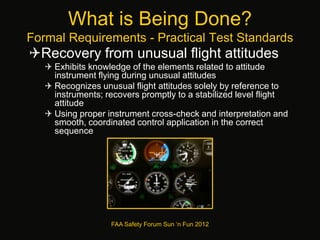
Recovery from unusual flight attitudes
 Exhibits knowledge of the elements related to attitude
instrument flying during unusual attitudes
 Recognizes unusual flight attitudes solely by reference to
instruments; recovers promptly to a stabilized level flight
attitude
 Using proper instrument cross-check and interpretation and
smooth, coordinated control application in the correct
sequence
FAA Safety Forum Sun ‘n Fun 2012
What is Being Done?
Formal Recommendations
 FITS (FAA/Industry Training
Standard) – for technically
advanced piston or light jet
aircraft
 NBAA Training Guidelines for
Single Pilot Operations of Very
Light Jets and Technically
Advanced Aircraft
 Industry Airplane Upset
Training Aid, Rev. 2 – training
curriculum for air carrier
operations
FAA Safety Forum Sun ‘n Fun 2012
What is Being Done?
Formal Research and Practice
Industry Bodies
ICAO
ICATEE
RAeS
UPRTA
GAJSC
PL 111-216
FAA Safety Forum Sun ‘n Fun 2012
Underway …
MPL (ICAO)
KLM Flight
Academy
Bombardier
Leading Edge
Intervention
Upset Prevention & Recovery Training
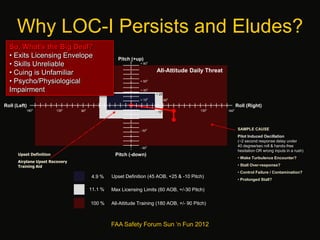
100 %
All-Attitude Daily Threat
All-Attitude Training (180 AOB, +/- 90 Pitch)
11.1 % Max Licensing Limits (60 AOB, +/-30 Pitch)
4.9 %
Upset Definition
Airplane Upset Recovery
Training Aid
Upset Definition (45 AOB, +25 & -10 Pitch)
Roll (Right)Roll (Left)
Pitch (-down)
Pitch (+up)
+ 90
o
+ 50o
+ 30o
+ 25
o
+ 10
o
- 10
o
- 50
o
- 90
o
60
o
90o
180o
180
o
135
o
135
o
SAMPLE CAUSE
Pilot Induced Oscillation
(~2 second response delay under
40 degree/sec roll & hands-free
hesitation OR wrong inputs in a rush)
• Wake Turbulence Encounter?
• Stall Over-response?
• Control Failure / Contamination?
• Prolonged Stall?
45
o
So, What’s the Big Deal?
• Exits Licensing Envelope
• Skills Unreliable
• Cuing is Unfamiliar
• Psycho/Physiological
Impairment
FAA Safety Forum Sun ‘n Fun 2012
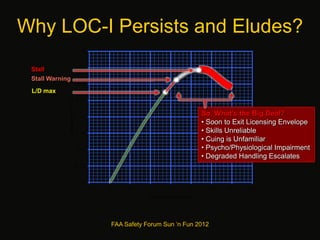
Why LOC-I Persists and Eludes?
So, What’s the Big Deal?
• Soon to Exit Licensing Envelope
• Skills Unreliable
• Cuing is Unfamiliar
• Psycho/Physiological Impairment
• Degraded Handling Escalates
L/D max
Stall
Stall Warning
Why LOC-I Persists and Eludes?
FAA Safety Forum Sun ‘n Fun 2012
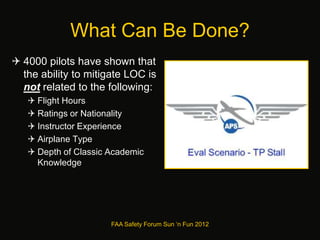
What Can Be Done?
 4000 pilots have shown that
the ability to mitigate LOC is
not related to the following:
 Flight Hours
 Ratings or Nationality
 Instructor Experience
 Airplane Type
 Depth of Classic Academic
Knowledge
FAA Safety Forum Sun ‘n Fun 2012
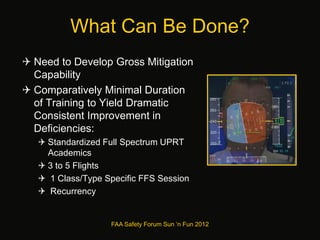
What Can Be Done?
 Need to Develop Gross Mitigation
Capability
 Comparatively Minimal Duration
of Training to Yield Dramatic
Consistent Improvement in
Deficiencies:
 Standardized Full Spectrum UPRT
Academics
 3 to 5 Flights
 1 Class/Type Specific FFS Session
 Recurrency
FAA Safety Forum Sun ‘n Fun 2012
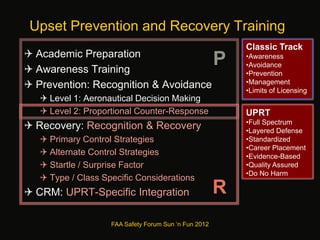
Upset Prevention and Recovery Training
 Academic Preparation
 Awareness Training
 Prevention: Recognition & Avoidance
 Level 1: Aeronautical Decision Making
 Level 2: Proportional Counter-Response
 Recovery: Recognition & Recovery
 Primary Control Strategies
 Alternate Control Strategies
 Startle / Surprise Factor
 Type / Class Specific Considerations
 CRM: UPRT-Specific Integration
Classic Track
•Awareness
•Avoidance
•Prevention
•Management
•Limits of Licensing
UPRT
•Full Spectrum
•Layered Defense
•Standardized
•Career Placement
•Evidence-Based
•Quality Assured
•Do No Harm
P
R
FAA Safety Forum Sun ‘n Fun 2012
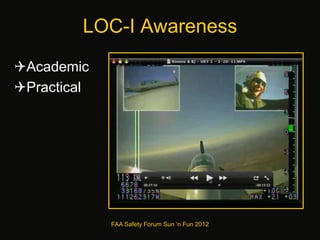
LOC-I Awareness
Academic
Practical
FAA Safety Forum Sun ‘n Fun 2012
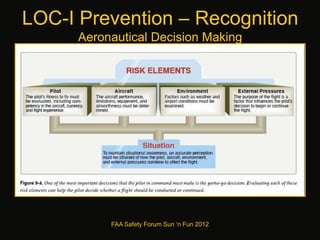
LOC-I Prevention – Recognition
Aeronautical Decision Making
FAA Safety Forum Sun ‘n Fun 2012
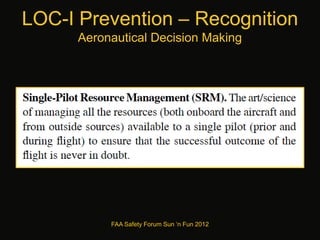
LOC-I Prevention – Recognition
Aeronautical Decision Making
FAA Safety Forum Sun ‘n Fun 2012
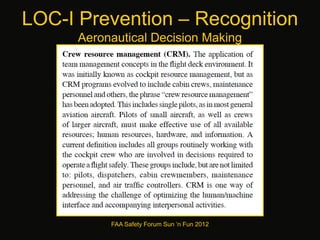
LOC-I Prevention – Recognition
Aeronautical Decision Making
FAA Safety Forum Sun ‘n Fun 2012
LOC-I Prevention – Recognition
Aeronautical Decision Making
FAA Safety Forum Sun ‘n Fun 2012
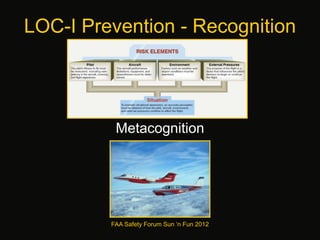
LOC-I Prevention - Recognition
Metacognition
FAA Safety Forum Sun ‘n Fun 2012
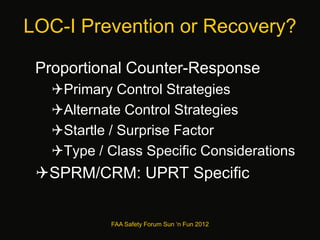
LOC-I Prevention or Recovery?
Proportional Counter-Response
Primary Control Strategies
Alternate Control Strategies
Startle / Surprise Factor
Type / Class Specific Considerations
SPRM/CRM: UPRT Specific
FAA Safety Forum Sun ‘n Fun 2012
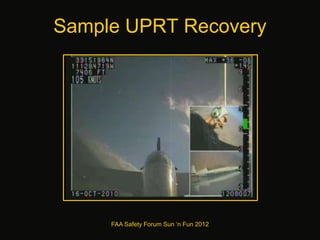
Sample UPRT Recovery
FAA Safety Forum Sun ‘n Fun 2012
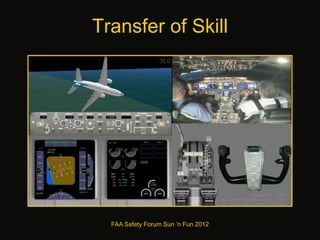
Transfer of Skill
FAA Safety Forum Sun ‘n Fun 2012
Who Needs Upset Prevention and
Recovery Training?
Why Not You?
Buyer beware
Instructor
qualifications
Resources
FAA Safety
Standdown
FAA Safety Briefing
FAA Safety Forum Sun ‘n Fun 2012
Who Needs
Upset Prevention and Recovery Training
(UPRT)?
27 March 2012
Lakeland, FL USA
Janeen Kochan, Ph.D.
Aviation Research, Training, and Services
&
Paul ‘BJ’ Ransbury, MCFI-A
Aviation Performance Solutions
www.apstraining.com

Upset Prevention and Recovery

  • 1.
    Who Needs Upset Preventionand Recovery Training (UPRT)? 27 March 2012 Lakeland, FL USA Janeen Kochan, Ph.D. Aviation Research, Training, and Services & Paul ‘BJ’ Ransbury, MCFI-A Aviation Performance Solutions www.apstraining.com
  • 2.
    Loss-of-Control In-Flight Why thetopic? Who loses control? Why do pilots lose control? What is being done? What can be done? Why not you? FAA Safety Forum Sun ‘n Fun 2012
  • 3.
    What is Loss-of-ControlIn-Flight? Flight that Occurs Outside of the Normal Flight Envelope with an Inability of the Pilot to Control the Aircraft. ICAO: Loss of Aircraft Control While in Flight
  • 4.
    Defining an AirplaneUpset* Attitude Pitch attitude greater than: 25 deg, nose up. 10 deg, nose down. Bank angle greater than 45 deg. Envelope Within these parameters, but flying at airspeeds inappropriate for the conditions. Implications Stall (AOA) Speed Divergence L/Dmax (AOA) Mach / Compressibility * Airplane Upset Recovery Training Aid – Revision 2 FAA Safety Forum Sun ‘n Fun 2012
  • 5.
    Roll (Right)Roll (Left) Pitch(-down) Pitch (+up) + 30 o + 25 o + 10o - 10 o 60o 45 o 60 o - 30 o Attitude A Graphical Airplane Upset FAA Safety Forum Sun ‘n Fun 2012 Envelope Pre-Stall Warning AOACL
  • 6.
    Why the Topic? FAASafety Forum Sun ‘n Fun 2012
  • 7.
    Who Losses Control? FAASafety Forum Sun ‘n Fun 2012
  • 8.
    Who Losses Control? Lossof Control In-Flight FAA Safety Forum Sun ‘n Fun 2012
  • 9.
    Who Loses Control? (Australia1994-2003) Percentage of Accidents FAA Safety Forum Sun ‘n Fun 2012
  • 10.
    Who Losses Control? FAASafety Forum Sun ‘n Fun 2012
  • 11.
    Chance of NextAccident Being LOC-I? FAA Safety Forum Sun ‘n Fun 2012 Runway Excursion (T/O & LDG) 3.4 X more likely to be LOC Runway Incursion 9.6 X more likely to be LOC Fire 1,861.0 X more likely to be LOC Engine Failure 788.0 X more likely to be LOC Source: Boeing/CAST – July 2010
  • 12.
    Lack of Accidents≠ Safety! 1 in 600 FAA Safety Forum Sun ‘n Fun 2012
  • 13.
    Margin of Safetyvs. Accidents FAA Safety Forum Sun ‘n Fun 2012
  • 14.
    Why Pilots LoseControl? Unexpected Events and Surprise Surprise due to unexpected event Nature of surprise Insidious Subtle Cues often available Not necessarily highly unusual or novel FAA Safety Forum Sun ‘n Fun 2012
  • 15.
    Why Pilots LoseControl? Unexpected Events and Surprise Expectations inconsistent with ongoing situation Lack of cues and/or improper interpretation of cues Erroneous probability estimations Decision making becomes impaired and/or delayed Focus on event leads to an interruption of ongoing activities Interruption of ongoing activities can lead to… FAA Safety Forum Sun ‘n Fun 2012
  • 16.
    * Turbulence * CAT *Mountain Wave * Windshear * Thunderstorms * Microbursts * Wake Turbulence * Airplane Icing System-Anomaly-Induced Pilot-Induced * Flight Instruments * Autopilot Systems * Flight Controls * Instrument Crosscheck * Adjusting Att & Power * Inattention * Distraction * Vertigo or SD * Pilot Incapacitation * Improper use of A/P * Pilot Technique Environmentally-Induced #1 Resulting Event Leading to Loss of Control in Flight…? MITIGATION THROUGH PILOT SKILLS & KNOWLEDGE UPSET PREVENTION & RECOVERY TRAINING UPRT Why Pilots Lose Control? Causes
  • 17.
    What is BeingDone? Formal Requirements - Practical Test Standards Recovery from unusual flight attitudes  Exhibits knowledge of the elements related to attitude instrument flying during unusual attitudes  Recognizes unusual flight attitudes solely by reference to instruments; recovers promptly to a stabilized level flight attitude  Using proper instrument cross-check and interpretation and smooth, coordinated control application in the correct sequence FAA Safety Forum Sun ‘n Fun 2012
  • 18.
    What is BeingDone? Formal Recommendations  FITS (FAA/Industry Training Standard) – for technically advanced piston or light jet aircraft  NBAA Training Guidelines for Single Pilot Operations of Very Light Jets and Technically Advanced Aircraft  Industry Airplane Upset Training Aid, Rev. 2 – training curriculum for air carrier operations FAA Safety Forum Sun ‘n Fun 2012
  • 19.
    What is BeingDone? Formal Research and Practice Industry Bodies ICAO ICATEE RAeS UPRTA GAJSC PL 111-216 FAA Safety Forum Sun ‘n Fun 2012 Underway … MPL (ICAO) KLM Flight Academy Bombardier Leading Edge Intervention Upset Prevention & Recovery Training
  • 20.
    100 % All-Attitude DailyThreat All-Attitude Training (180 AOB, +/- 90 Pitch) 11.1 % Max Licensing Limits (60 AOB, +/-30 Pitch) 4.9 % Upset Definition Airplane Upset Recovery Training Aid Upset Definition (45 AOB, +25 & -10 Pitch) Roll (Right)Roll (Left) Pitch (-down) Pitch (+up) + 90 o + 50o + 30o + 25 o + 10 o - 10 o - 50 o - 90 o 60 o 90o 180o 180 o 135 o 135 o SAMPLE CAUSE Pilot Induced Oscillation (~2 second response delay under 40 degree/sec roll & hands-free hesitation OR wrong inputs in a rush) • Wake Turbulence Encounter? • Stall Over-response? • Control Failure / Contamination? • Prolonged Stall? 45 o So, What’s the Big Deal? • Exits Licensing Envelope • Skills Unreliable • Cuing is Unfamiliar • Psycho/Physiological Impairment FAA Safety Forum Sun ‘n Fun 2012 Why LOC-I Persists and Eludes?
  • 21.
    So, What’s theBig Deal? • Soon to Exit Licensing Envelope • Skills Unreliable • Cuing is Unfamiliar • Psycho/Physiological Impairment • Degraded Handling Escalates L/D max Stall Stall Warning Why LOC-I Persists and Eludes? FAA Safety Forum Sun ‘n Fun 2012
  • 22.
    What Can BeDone?  4000 pilots have shown that the ability to mitigate LOC is not related to the following:  Flight Hours  Ratings or Nationality  Instructor Experience  Airplane Type  Depth of Classic Academic Knowledge FAA Safety Forum Sun ‘n Fun 2012
  • 23.
    What Can BeDone?  Need to Develop Gross Mitigation Capability  Comparatively Minimal Duration of Training to Yield Dramatic Consistent Improvement in Deficiencies:  Standardized Full Spectrum UPRT Academics  3 to 5 Flights  1 Class/Type Specific FFS Session  Recurrency FAA Safety Forum Sun ‘n Fun 2012
  • 24.
    Upset Prevention andRecovery Training  Academic Preparation  Awareness Training  Prevention: Recognition & Avoidance  Level 1: Aeronautical Decision Making  Level 2: Proportional Counter-Response  Recovery: Recognition & Recovery  Primary Control Strategies  Alternate Control Strategies  Startle / Surprise Factor  Type / Class Specific Considerations  CRM: UPRT-Specific Integration Classic Track •Awareness •Avoidance •Prevention •Management •Limits of Licensing UPRT •Full Spectrum •Layered Defense •Standardized •Career Placement •Evidence-Based •Quality Assured •Do No Harm P R FAA Safety Forum Sun ‘n Fun 2012
  • 25.
  • 26.
    LOC-I Prevention –Recognition Aeronautical Decision Making FAA Safety Forum Sun ‘n Fun 2012
  • 27.
    LOC-I Prevention –Recognition Aeronautical Decision Making FAA Safety Forum Sun ‘n Fun 2012
  • 28.
    LOC-I Prevention –Recognition Aeronautical Decision Making FAA Safety Forum Sun ‘n Fun 2012
  • 29.
    LOC-I Prevention –Recognition Aeronautical Decision Making FAA Safety Forum Sun ‘n Fun 2012
  • 30.
    LOC-I Prevention -Recognition Metacognition FAA Safety Forum Sun ‘n Fun 2012
  • 31.
    LOC-I Prevention orRecovery? Proportional Counter-Response Primary Control Strategies Alternate Control Strategies Startle / Surprise Factor Type / Class Specific Considerations SPRM/CRM: UPRT Specific FAA Safety Forum Sun ‘n Fun 2012
  • 32.
    Sample UPRT Recovery FAASafety Forum Sun ‘n Fun 2012
  • 33.
    Transfer of Skill FAASafety Forum Sun ‘n Fun 2012
  • 34.
    Who Needs UpsetPrevention and Recovery Training? Why Not You? Buyer beware Instructor qualifications Resources FAA Safety Standdown FAA Safety Briefing FAA Safety Forum Sun ‘n Fun 2012
  • 35.
    Who Needs Upset Preventionand Recovery Training (UPRT)? 27 March 2012 Lakeland, FL USA Janeen Kochan, Ph.D. Aviation Research, Training, and Services & Paul ‘BJ’ Ransbury, MCFI-A Aviation Performance Solutions www.apstraining.com

Editor's Notes

  • #5 For discussion purposes, the following unintentional conditions generally describe an airplane upset:• Pitch attitude greater than 25 deg nose up.• Pitch attitude greater than 10 deg nose down.• Bank angle greater than 45 deg.• Within the above parameters, but flying at airspeeds inappropriate for the conditions.A pilot must not wait until the airplane is in a fully developed and definable upset before taking corrective action to return to stabilized flight path parameters.The amount and rate of control input to counter a developing upset must be proportional to the amount and rate of pitch, roll, and/or yaw experienced.
  • #6 Focus on any pilot, any airplane.
  • #13 Point that for every accident there are approximately 600 incidents and for each incident thousands of “it almost happened.”
  • #20 Need to fill this in – I cannot find the email with the whole list. But even with all of this LOC persists…
  • #23 Need to fill this in – I cannot find the email with the whole list.
  • #32 Videos and/or photo
  • #33 Videos and/or photo
  • #34 Videos and/or photo