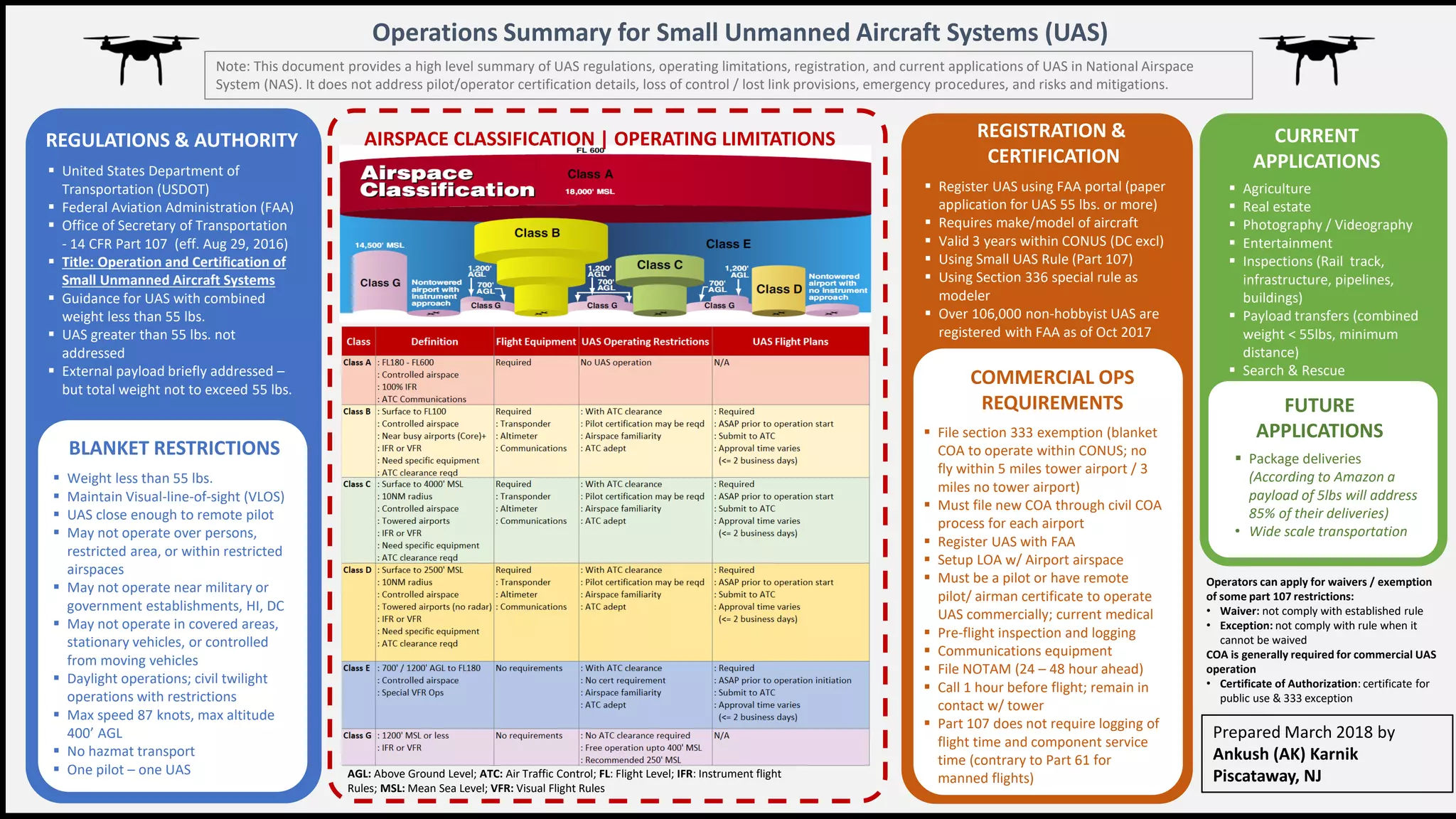
Operations Summary for Small Unmanned Aircraft Systems (UAS)
REGISTRATION &
CERTIFICATION
AIRSPACE CLASSIFICATION | OPERATING LIMITATIONSREGULATIONS & AUTHORITY
▪ United States Department of
Transportation (USDOT)
▪ Federal Aviation Administration (FAA)
▪ Office of Secretary of Transportation
- 14 CFR Part 107 (eff. Aug 29, 2016)
▪ Title: Operation and Certification of
Small Unmanned Aircraft Systems
▪ Guidance for UAS with combined
weight less than 55 lbs.
▪ UAS greater than 55 lbs. not
addressed
▪ External payload briefly addressed –
but total weight not to exceed 55 lbs.
▪ Weight less than 55 lbs.
▪ Visual line of sign only (VLOS)
▪ May not operate in restricted air
spaces, over persons, covered
structures
▪ Daylight operations permitted; civil
twilight operations – timing and
equipment restrictions
▪ Max ground speed 100 mph (87
knots)
▪ Below 400 AGL
BLANKET RESTRICTIONS
▪ Weight less than 55 lbs.
▪ Maintain Visual-line-of-sight (VLOS)
▪ UAS close enough to remote pilot
▪ May not operate over persons,
restricted area, or within restricted
airspaces
▪ May not operate near military or
government establishments, HI, DC
▪ May not operate in covered areas,
stationary vehicles, or controlled
from moving vehicles
▪ Daylight operations; civil twilight
operations with restrictions
▪ Max speed 87 knots, max altitude
400’ AGL
▪ No hazmat transport
▪ One pilot – one UAS
COMMERCIAL OPS
REQUIREMENTS
▪ File section 333 exemption (blanket
COA to operate within CONUS; no
fly within 5 miles tower airport / 3
miles no tower airport)
▪ Must file new COA through civil COA
process for each airport
▪ Register UAS with FAA
▪ Setup LOA w/ Airport airspace
▪ Must be a pilot or have remote
pilot/ airman certificate to operate
UAS commercially; current medical
▪ Pre-flight inspection and logging
▪ Communications equipment
▪ File NOTAM (24 – 48 hour ahead)
▪ Call 1 hour before flight; remain in
contact w/ tower
▪ Part 107 does not require logging of
flight time and component service
time (contrary to Part 61 for
manned flights)
CURRENT
APPLICATIONS
FUTURE
APPLICATIONS
▪ Agriculture
▪ Real estate
▪ Photography / Videography
▪ Entertainment
▪ Inspections (Rail track,
infrastructure, pipelines,
buildings)
▪ Payload transfers (combined
weight < 55lbs, minimum
distance)
▪ Search & Rescue
Prepared March 2018 by
Ankush (AK) Karnik
Piscataway, NJ
▪ Package deliveries
(According to Amazon a
payload of 5lbs will address
85% of their deliveries)
• Wide scale transportation
Note: This document provides a high level summary of UAS regulations, operating limitations, registration, and current applications of UAS in National Airspace
System (NAS). It does not address pilot/operator certification details, loss of control / lost link provisions, emergency procedures, and risks and mitigations.
▪ Register UAS using FAA portal (paper
application for UAS 55 lbs. or more)
▪ Requires make/model of aircraft
▪ Valid 3 years within CONUS (DC excl)
▪ Using Small UAS Rule (Part 107)
▪ Using Section 336 special rule as
modeler
▪ Over 106,000 non-hobbyist UAS are
registered with FAA as of Oct 2017
Operators can apply for waivers / exemption
of some part 107 restrictions:
• Waiver: not comply with established rule
• Exception: not comply with rule when it
cannot be waived
COA is generally required for commercial UAS
operation
• Certificate of Authorization: certificate for
public use & 333 exception
AGL: Above Ground Level; ATC: Air Traffic Control; FL: Flight Level; IFR: Instrument flight
Rules; MSL: Mean Sea Level; VFR: Visual Flight Rules

Unmanned Aerial Systems Operational Summary - FAA

  • 1.
    Operations Summary forSmall Unmanned Aircraft Systems (UAS) REGISTRATION & CERTIFICATION AIRSPACE CLASSIFICATION | OPERATING LIMITATIONSREGULATIONS & AUTHORITY ▪ United States Department of Transportation (USDOT) ▪ Federal Aviation Administration (FAA) ▪ Office of Secretary of Transportation - 14 CFR Part 107 (eff. Aug 29, 2016) ▪ Title: Operation and Certification of Small Unmanned Aircraft Systems ▪ Guidance for UAS with combined weight less than 55 lbs. ▪ UAS greater than 55 lbs. not addressed ▪ External payload briefly addressed – but total weight not to exceed 55 lbs. ▪ Weight less than 55 lbs. ▪ Visual line of sign only (VLOS) ▪ May not operate in restricted air spaces, over persons, covered structures ▪ Daylight operations permitted; civil twilight operations – timing and equipment restrictions ▪ Max ground speed 100 mph (87 knots) ▪ Below 400 AGL BLANKET RESTRICTIONS ▪ Weight less than 55 lbs. ▪ Maintain Visual-line-of-sight (VLOS) ▪ UAS close enough to remote pilot ▪ May not operate over persons, restricted area, or within restricted airspaces ▪ May not operate near military or government establishments, HI, DC ▪ May not operate in covered areas, stationary vehicles, or controlled from moving vehicles ▪ Daylight operations; civil twilight operations with restrictions ▪ Max speed 87 knots, max altitude 400’ AGL ▪ No hazmat transport ▪ One pilot – one UAS COMMERCIAL OPS REQUIREMENTS ▪ File section 333 exemption (blanket COA to operate within CONUS; no fly within 5 miles tower airport / 3 miles no tower airport) ▪ Must file new COA through civil COA process for each airport ▪ Register UAS with FAA ▪ Setup LOA w/ Airport airspace ▪ Must be a pilot or have remote pilot/ airman certificate to operate UAS commercially; current medical ▪ Pre-flight inspection and logging ▪ Communications equipment ▪ File NOTAM (24 – 48 hour ahead) ▪ Call 1 hour before flight; remain in contact w/ tower ▪ Part 107 does not require logging of flight time and component service time (contrary to Part 61 for manned flights) CURRENT APPLICATIONS FUTURE APPLICATIONS ▪ Agriculture ▪ Real estate ▪ Photography / Videography ▪ Entertainment ▪ Inspections (Rail track, infrastructure, pipelines, buildings) ▪ Payload transfers (combined weight < 55lbs, minimum distance) ▪ Search & Rescue Prepared March 2018 by Ankush (AK) Karnik Piscataway, NJ ▪ Package deliveries (According to Amazon a payload of 5lbs will address 85% of their deliveries) • Wide scale transportation Note: This document provides a high level summary of UAS regulations, operating limitations, registration, and current applications of UAS in National Airspace System (NAS). It does not address pilot/operator certification details, loss of control / lost link provisions, emergency procedures, and risks and mitigations. ▪ Register UAS using FAA portal (paper application for UAS 55 lbs. or more) ▪ Requires make/model of aircraft ▪ Valid 3 years within CONUS (DC excl) ▪ Using Small UAS Rule (Part 107) ▪ Using Section 336 special rule as modeler ▪ Over 106,000 non-hobbyist UAS are registered with FAA as of Oct 2017 Operators can apply for waivers / exemption of some part 107 restrictions: • Waiver: not comply with established rule • Exception: not comply with rule when it cannot be waived COA is generally required for commercial UAS operation • Certificate of Authorization: certificate for public use & 333 exception AGL: Above Ground Level; ATC: Air Traffic Control; FL: Flight Level; IFR: Instrument flight Rules; MSL: Mean Sea Level; VFR: Visual Flight Rules