Jesse Hallenbeck, CFI
Goals  To walk away with… A refreshed memory  Some new tools in the toolbox  To reflect on past experiences, and ideas gained from those experiences  To be a safer pilot!
Overview  ADM  Why!? Concept  Use  Pilotage  Definition and Concept  Basic Process  Practical Use
Overview  (continued) Putting the pieces together  How are ADM and Pilotage intertwined? What principals of ADM are involved when planning a flight? What are some operation pitfalls that relate to ADM?  Resources to use in Flight Planning
ADM Defined Definition (AC 60-22)  “… a systematic approach to the mental process used by aircraft pilots to consistently determine the best course of action in response to a given set of circumstances” Steps for good decision making are  Identifying personal attitudes hazardous to safe flight  Learning behavior modification techniques Learning how to recognize and cope with stress  Developing risk assessment skills  Using all resources in a multi-crew situation  Evaluating the effectiveness of ones ADM skills
 
Why ADM?! 80%
ADM Concept  Provides a structured framework to decision making Helps to both reduce and manage risk by helping the pilot first recognize the risk  In short:  It is what a pilot intends to do based on the latest information he or she has.
Use  Everything  Flight planning  Operation of the aircraft  Emergency situations  Etc.
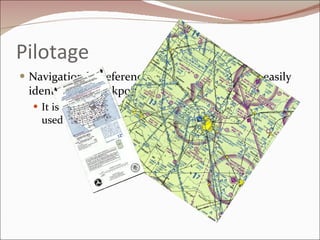
Pilotage  Navigation by reference to landmarks or other easily identifiable checkpoints  It is the most common form of navigation and is often used in conjunction with other forms of navigation
Basic Process First and Foremost you have correct and  current  charts Unfold and lay out your charts, giving yourself lots of room to work  Allows you to get the big picture of your overall trip Give consideration to the many different factors that can affect your route of flight  Terrain  Airspace  Checkpoints  Etc.  How does this relate to the concepts of ADM???
Basic Process  (Continued) Plot your initial course and refine it as necessary  Use a plotter to measure your course in nautical miles  ENSURE you are using the correct scale!  Your goal is to fly the course your drew on the chart  Requires you to constantly maintain your situational awareness  Use wind correction as needed to maintain your selected course
Practical Use  One of the oldest forms of navigation  Used during the earliest days of aviation  Easiest to use  You, Your map, and the World  Often times the most enjoyable to use  You get to enjoy the view!
An example…
Putting the pieces together  ADM often focuses on four main factors when talking abut flight planning  P  –  P ilot  A  –  A ircraft V  –  En v ironment E  –   E xternal Factors
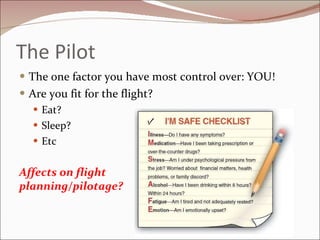
The Pilot  The one factor you have most control over: YOU!  Are you fit for the flight?  Eat? Sleep? Etc Affects on flight planning/pilotage?
The Aircraft  Is the aircraft Suitable for the flight being conducted? Weight limits  Structural limitations  Equipment installed (instruments and the like)  More importantly, are YOU suitable to the airplane?  Are you thoroughly familiar with the AFM/POH? Do you have the emergency procedures memorized?  V Speeds?  Affects on flight planning/pilotage?
The Environment  Offers the most variables of the four factors  Weather  Terrain  Airport  Airspace  Night vs. Day  Visual Illusions  Affects on flight planning/pilotage?
External Pressures  Anything external to the flight itself that places more pressure on you to complete the flight  Friend waiting for you  Big event where you are going  “ Get-there-itus” and/or ego  Eager to please, even with a reduction in safety  Affects on flight planning/pilotage?
Remember to DECIDE… D –  Detect E -   Estimate C -  Choose I -  Identify D -   Do E -  Evaluate
Operational Pitfalls  Scud Running  Get-There-Itis  Continuing VFR into IMC  Loss of SA Flying outside the Envelope
Resources  Google Earth http://earth.google.com Sky Vector  http://skyvector.com Air-Nav  http://www.airnav.com FAA.gov  http://www.faa.gov AIM  http://www.faa.gov/air_traffic/publications/ATpubs/AIM/
Questions?

ADM and Pilotage

  • 1.
  • 2.
    Goals Towalk away with… A refreshed memory Some new tools in the toolbox To reflect on past experiences, and ideas gained from those experiences To be a safer pilot!
  • 3.
    Overview ADM Why!? Concept Use Pilotage Definition and Concept Basic Process Practical Use
  • 4.
    Overview (continued)Putting the pieces together How are ADM and Pilotage intertwined? What principals of ADM are involved when planning a flight? What are some operation pitfalls that relate to ADM? Resources to use in Flight Planning
  • 5.
    ADM Defined Definition(AC 60-22) “… a systematic approach to the mental process used by aircraft pilots to consistently determine the best course of action in response to a given set of circumstances” Steps for good decision making are Identifying personal attitudes hazardous to safe flight Learning behavior modification techniques Learning how to recognize and cope with stress Developing risk assessment skills Using all resources in a multi-crew situation Evaluating the effectiveness of ones ADM skills
  • 6.
  • 7.
  • 8.
    ADM Concept Provides a structured framework to decision making Helps to both reduce and manage risk by helping the pilot first recognize the risk In short: It is what a pilot intends to do based on the latest information he or she has.
  • 9.
    Use Everything Flight planning Operation of the aircraft Emergency situations Etc.
  • 10.
    Pilotage Navigationby reference to landmarks or other easily identifiable checkpoints It is the most common form of navigation and is often used in conjunction with other forms of navigation
  • 11.
    Basic Process Firstand Foremost you have correct and current charts Unfold and lay out your charts, giving yourself lots of room to work Allows you to get the big picture of your overall trip Give consideration to the many different factors that can affect your route of flight Terrain Airspace Checkpoints Etc. How does this relate to the concepts of ADM???
  • 12.
    Basic Process (Continued) Plot your initial course and refine it as necessary Use a plotter to measure your course in nautical miles ENSURE you are using the correct scale! Your goal is to fly the course your drew on the chart Requires you to constantly maintain your situational awareness Use wind correction as needed to maintain your selected course
  • 13.
    Practical Use One of the oldest forms of navigation Used during the earliest days of aviation Easiest to use You, Your map, and the World Often times the most enjoyable to use You get to enjoy the view!
  • 14.
  • 15.
    Putting the piecestogether ADM often focuses on four main factors when talking abut flight planning P – P ilot A – A ircraft V – En v ironment E – E xternal Factors
  • 16.
    The Pilot The one factor you have most control over: YOU! Are you fit for the flight? Eat? Sleep? Etc Affects on flight planning/pilotage?
  • 17.
    The Aircraft Is the aircraft Suitable for the flight being conducted? Weight limits Structural limitations Equipment installed (instruments and the like) More importantly, are YOU suitable to the airplane? Are you thoroughly familiar with the AFM/POH? Do you have the emergency procedures memorized? V Speeds? Affects on flight planning/pilotage?
  • 18.
    The Environment Offers the most variables of the four factors Weather Terrain Airport Airspace Night vs. Day Visual Illusions Affects on flight planning/pilotage?
  • 19.
    External Pressures Anything external to the flight itself that places more pressure on you to complete the flight Friend waiting for you Big event where you are going “ Get-there-itus” and/or ego Eager to please, even with a reduction in safety Affects on flight planning/pilotage?
  • 20.
    Remember to DECIDE…D – Detect E - Estimate C - Choose I - Identify D - Do E - Evaluate
  • 21.
    Operational Pitfalls Scud Running Get-There-Itis Continuing VFR into IMC Loss of SA Flying outside the Envelope
  • 22.
    Resources GoogleEarth http://earth.google.com Sky Vector http://skyvector.com Air-Nav http://www.airnav.com FAA.gov http://www.faa.gov AIM http://www.faa.gov/air_traffic/publications/ATpubs/AIM/
  • 23.