Prepared By : Mazadul Hasan sheshir
ID: 2010000400008
13th
Batch (session 2009-2013)
Department : Wet Processing Technology
Email: mazadulhasan@yahoo.com
Blog : www. Textilelab.blogspot.com (visit)
Southeast University
Department Of Textile Engineering
I/A 251,252 Tejgaon Dhaka Bangladesh
Prepared By :
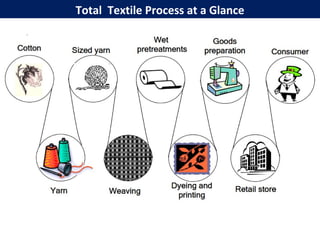
Total Textile Process at a Glance
The whole presentation has been divided into 3 parts
according to our practical experience. The steps followed in
the garment factory.
The 3 parts are:
1. Pattern and Marker making
2. Fabric spreading
3. Fabric cutting
Our focused topic is:
Requirements of fabric spreading
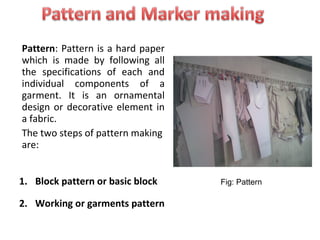
Pattern: Pattern is a hard paper
which is made by following all
the specifications of each and
individual components of a
garment. It is an ornamental
design or decorative element in
a fabric.
The two steps of pattern making
are:
1. Block pattern or basic block
2. Working or garments pattern
Fig: Pattern
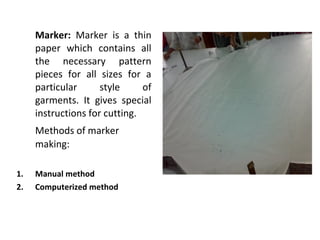
Marker: Marker is a thin
paper which contains all
the necessary pattern
pieces for all sizes for a
particular style of
garments. It gives special
instructions for cutting.
Methods of marker
making:
1. Manual method
2. Computerized method
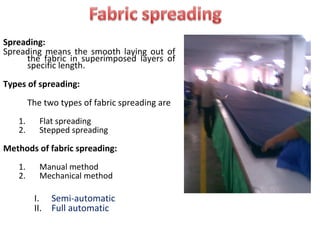
Spreading:
Spreading means the smooth laying out of
the fabric in superimposed layers of
specific length.
Types of spreading:
The two types of fabric spreading are
1. Flat spreading
2. Stepped spreading
Methods of fabric spreading:
1. Manual method
2. Mechanical method
I. Semi-automatic
II. Full automatic
1. Fabric must be flat
2. Correct ply tension
3. Alignment of fabric ply
4. Correct ply direction and lay stability
5. Elimination of static electricity
6. Elimination of fabric flaws
7. Easy separation of the cut lay into bundles
8. Avoidance of fusion of plies during cutting
9. Avoidance of distortion in spread
10. Matching checks and stripes
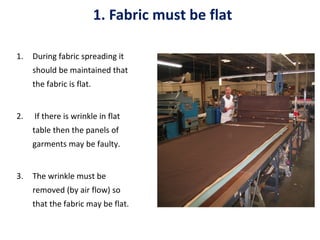
1. Fabric must be flat
1. During fabric spreading it
should be maintained that
the fabric is flat.
2. If there is wrinkle in flat
table then the panels of
garments may be faulty.
3. The wrinkle must be
removed (by air flow) so
that the fabric may be flat.
2.Correct ply tension:
The ply tension of the fabric should
be proper. If the tension is low,
there will be ridges in the plies and
if the tension is too high, the fabric
may shrink after cutting and
sewing. Spreading in spreading
machine will give uniform tension.
3.Alignment of fabric ply:
Fabric spreading is done according to length and width of
marker. Every ply should comprise at least width of the
marker plan but should have the minimum possible extra
outside those measurements
4.Correct ply direction and lay stability:
These two factors depend on fabric type, pattern shape and
spreading equipments that are available. When the pattern
pieces have been positioned in a particular direction in the
marker plan, it is the essential that the fabric is spread
according the direction. Symmetrical patterns pieces are
placed in the same way up or face to face.
5. Elimination of static electricity:
If spreading is done by manmade fabrics, static electricity may
generate. It can be eliminated by reducing friction or increasing
humidity of the room. Anti-static paper may be used to reduce the
static electricity generation.
6. Elimination of fabric flaws:
The flaws of fabric must be indicated during spreading and
necessary steps to be taken to remove these faults. The general
two steps to remove the flaws are
a. Splicing
b. Over lapping
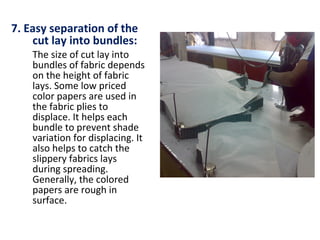
7. Easy separation of the
cut lay into bundles:
The size of cut lay into
bundles of fabric depends
on the height of fabric
lays. Some low priced
color papers are used in
the fabric plies to
displace. It helps each
bundle to prevent shade
variation for displacing. It
also helps to catch the
slippery fabrics lays
during spreading.
Generally, the colored
papers are rough in
surface.
8. Avoidance of fusion of plies during cutting:
The heat generated when the fabric lays are cut by using cutting
knife due to the friction fabric and knife. Generally, those fabrics are
melted due to heat generation to the fabric lays which are made by
thermoplastic fibres. To prevent this defect, some anti-fusion papers
are used with the gaps of fabric plies during spreading.
9. Avoidance of distortion in spread:
The fabric may be creased and folded due to the friction in the
bottom of lay by base plate of knife during cutting with straight knife
or shifting of fabric lay. As a result, defected pattern may occur. To
remove this defect, fabric lay is made on the smooth paper so that,
there is less possibility of friction between fabric and table.
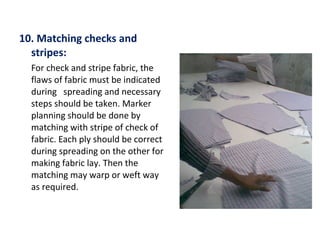
10. Matching checks and
stripes:
For check and stripe fabric, the
flaws of fabric must be indicated
during spreading and necessary
steps should be taken. Marker
planning should be done by
matching with stripe of check of
fabric. Each ply should be correct
during spreading on the other for
making fabric lay. Then the
matching may warp or weft way
as required.
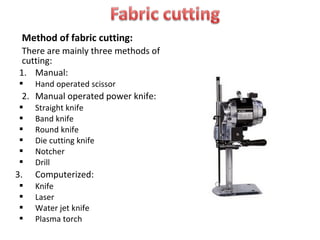
Method of fabric cutting:
There are mainly three methods of
cutting:
1. Manual:
 Hand operated scissor
2. Manual operated power knife:
 Straight knife
 Band knife
 Round knife
 Die cutting knife
 Notcher
 Drill
3. Computerized:
 Knife
 Laser
 Water jet knife
 Plasma torch
1. Yarn Manufacturing Technology
Link : http://www.facebook.com/pages/Yarn-Manufacturing-
Technology/485014954866808
2. Fabric Manufacturing Technology
Link : http://www.facebook.com/pages/Fabric-Manufacturing-
Technology/459520217425605
3. Garments Manufacturing Technology
Link : http://www.facebook.com/pages/Garments-Manufacturing-
Technology/472364799463126
3. Wet processing Technology
Link : http://www.facebook.com/pages/Wet-Processing-Technology-
Dyeing-/468645219825404
4. Fashion-Design-and-Technology
Link : http://www.facebook.com/pages/Fashion-Design-and-
Technology/587655294583875?ref=ts&fref=ts
My Facebook Textile related Pages
http://www.textilelab.blogspot.com (Visit )

Garments manufacturing process

  • 2.
    Prepared By :Mazadul Hasan sheshir ID: 2010000400008 13th Batch (session 2009-2013) Department : Wet Processing Technology Email: mazadulhasan@yahoo.com Blog : www. Textilelab.blogspot.com (visit) Southeast University Department Of Textile Engineering I/A 251,252 Tejgaon Dhaka Bangladesh Prepared By :
  • 3.
  • 4.
    The whole presentationhas been divided into 3 parts according to our practical experience. The steps followed in the garment factory. The 3 parts are: 1. Pattern and Marker making 2. Fabric spreading 3. Fabric cutting Our focused topic is: Requirements of fabric spreading
  • 5.
    Pattern: Pattern isa hard paper which is made by following all the specifications of each and individual components of a garment. It is an ornamental design or decorative element in a fabric. The two steps of pattern making are: 1. Block pattern or basic block 2. Working or garments pattern Fig: Pattern
  • 6.
    Marker: Marker isa thin paper which contains all the necessary pattern pieces for all sizes for a particular style of garments. It gives special instructions for cutting. Methods of marker making: 1. Manual method 2. Computerized method
  • 7.
    Spreading: Spreading means thesmooth laying out of the fabric in superimposed layers of specific length. Types of spreading: The two types of fabric spreading are 1. Flat spreading 2. Stepped spreading Methods of fabric spreading: 1. Manual method 2. Mechanical method I. Semi-automatic II. Full automatic
  • 8.
    1. Fabric mustbe flat 2. Correct ply tension 3. Alignment of fabric ply 4. Correct ply direction and lay stability 5. Elimination of static electricity 6. Elimination of fabric flaws 7. Easy separation of the cut lay into bundles 8. Avoidance of fusion of plies during cutting 9. Avoidance of distortion in spread 10. Matching checks and stripes
  • 9.
    1. Fabric mustbe flat 1. During fabric spreading it should be maintained that the fabric is flat. 2. If there is wrinkle in flat table then the panels of garments may be faulty. 3. The wrinkle must be removed (by air flow) so that the fabric may be flat.
  • 10.
    2.Correct ply tension: Theply tension of the fabric should be proper. If the tension is low, there will be ridges in the plies and if the tension is too high, the fabric may shrink after cutting and sewing. Spreading in spreading machine will give uniform tension.
  • 11.
    3.Alignment of fabricply: Fabric spreading is done according to length and width of marker. Every ply should comprise at least width of the marker plan but should have the minimum possible extra outside those measurements 4.Correct ply direction and lay stability: These two factors depend on fabric type, pattern shape and spreading equipments that are available. When the pattern pieces have been positioned in a particular direction in the marker plan, it is the essential that the fabric is spread according the direction. Symmetrical patterns pieces are placed in the same way up or face to face.
  • 12.
    5. Elimination ofstatic electricity: If spreading is done by manmade fabrics, static electricity may generate. It can be eliminated by reducing friction or increasing humidity of the room. Anti-static paper may be used to reduce the static electricity generation. 6. Elimination of fabric flaws: The flaws of fabric must be indicated during spreading and necessary steps to be taken to remove these faults. The general two steps to remove the flaws are a. Splicing b. Over lapping
  • 13.
    7. Easy separationof the cut lay into bundles: The size of cut lay into bundles of fabric depends on the height of fabric lays. Some low priced color papers are used in the fabric plies to displace. It helps each bundle to prevent shade variation for displacing. It also helps to catch the slippery fabrics lays during spreading. Generally, the colored papers are rough in surface.
  • 14.
    8. Avoidance offusion of plies during cutting: The heat generated when the fabric lays are cut by using cutting knife due to the friction fabric and knife. Generally, those fabrics are melted due to heat generation to the fabric lays which are made by thermoplastic fibres. To prevent this defect, some anti-fusion papers are used with the gaps of fabric plies during spreading. 9. Avoidance of distortion in spread: The fabric may be creased and folded due to the friction in the bottom of lay by base plate of knife during cutting with straight knife or shifting of fabric lay. As a result, defected pattern may occur. To remove this defect, fabric lay is made on the smooth paper so that, there is less possibility of friction between fabric and table.
  • 15.
    10. Matching checksand stripes: For check and stripe fabric, the flaws of fabric must be indicated during spreading and necessary steps should be taken. Marker planning should be done by matching with stripe of check of fabric. Each ply should be correct during spreading on the other for making fabric lay. Then the matching may warp or weft way as required.
  • 16.
    Method of fabriccutting: There are mainly three methods of cutting: 1. Manual:  Hand operated scissor 2. Manual operated power knife:  Straight knife  Band knife  Round knife  Die cutting knife  Notcher  Drill 3. Computerized:  Knife  Laser  Water jet knife  Plasma torch
  • 19.
    1. Yarn ManufacturingTechnology Link : http://www.facebook.com/pages/Yarn-Manufacturing- Technology/485014954866808 2. Fabric Manufacturing Technology Link : http://www.facebook.com/pages/Fabric-Manufacturing- Technology/459520217425605 3. Garments Manufacturing Technology Link : http://www.facebook.com/pages/Garments-Manufacturing- Technology/472364799463126 3. Wet processing Technology Link : http://www.facebook.com/pages/Wet-Processing-Technology- Dyeing-/468645219825404 4. Fashion-Design-and-Technology Link : http://www.facebook.com/pages/Fashion-Design-and- Technology/587655294583875?ref=ts&fref=ts My Facebook Textile related Pages http://www.textilelab.blogspot.com (Visit )