














Company profile
PREPARED BY KIBROM G/HER
ID NO 0501631
Internship report October 2016
• Company profile
Almeda textile factory (ALTEX) is one of the non-governmental entities that
were situated seven kilometers from center of Adwa or seventeen kilometers
from center of Axum at main road Adwa to Axum and 1006 kilometers from
Adis Ababa and 233 kilometers from Mekelle, capital city of Tigray region.
Almeda textile plc. (Private limited company) Almeda is one of companies of
the EFFORT (Endowment fund for rehabilitation of Tigray) with an objective
to enhance the investment opportunity.
Almeda textiles private limited company (ALTEX) is a private company
established in accordance with the commercial code of Ethiopia with a share
capital of 180,000,000 Birr in 1989.
Almeda textile is the biggest textile manufacturing company in the country. It
has 100 million birr sales volume that is 70% sales in local market and 30%
volume in global market
• OBJECTIVES OF THE COMPANY
o The company is established to accomplish the
following business
 To produce threads yarns and all kinds of cloths from
cotton, polyester and cotton and polyester blend
 To produce clothing materials for personnel and house hold
uses
 To engage in agricultural activities where becomes
necessary for the realization of its business
 To engage generally in any other trade necessary or
conducive to the achievement of its business.
• MISSION OF THE COMPANY
• The mission statement originates from
the “TOTAL CUSTOMER SATISFACTION”
for the value added products based on
Research and development and creating
a hub for excellence in the textile field
in Africa in general and Ethiopia in
particular.
VISSION OF THE COMPANY:
• Develop Almeda as a
reference for Ethiopian
Textile and Garmenting
industry and create the
conditioned that Almeda
can become leader in the
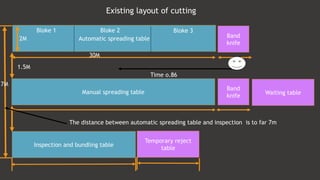
Ethiopian market in terms
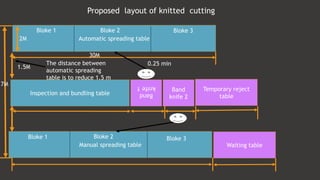
of export and local market
sales.
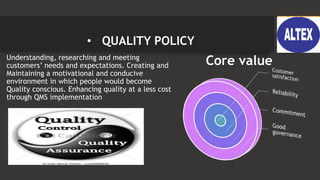
• QUALITY POLICY
• Understanding, researching and meeting
customers’ needs and expectations. Creating and
Maintaining a motivational and conducive
environment in which people would become
Quality conscious. Enhancing quality at a less cost
through QMS implementation
Core value
Raw material and accessories suppliers
• In Almeda textile plc. They use different types of raw material and accessories in order
to satisfy customer based on the customer demand. as we know ALTEX is integrated
company the production starters from spinning up to garment they use different raw
materials and accessories by inputting from local or from other country.
• The main input for the textile production
• Cotton: - Ommo, middle awash, Hiwot at Dansha in Humera, Gambella, Afar
• Polyester: -Korea, Turkey, and China
• Accessories suppliers
• In ALMEDA garmenting section accessories can be imported from different areas as per quality
quantity and availability of the material. For e.g.. If the product is for local customer it may be
purchase from ADISS ABEBA, but if the product is for exporting they import from high quality
accessory suppler. Mostly accessories for local product purchase from MRKATO market like MELS,
Bethlehem, accessory supplier
• Chemical suppliers
• They used different chemicals in garment department for washing, bleaching and other activates
the main supplier for this chemicals Bezama and Ekosy
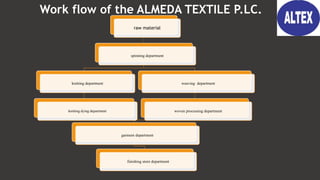
Work flow of the ALMEDA TEXTILE P.LC.
raw material
spinning department
knitting department
knitting dying department
weaving department
woven processing department
garment department
finishing store department
Work flow of altex
Spinning department
Spinning is the process which
converts raw fiber into yarn or
thread. The fibers are prepared
and then drawn out and twisted
to form the yarn, which is then
wound onto a bobbin or cone.
The spinning process is entirely
dry, although some yarns may be
dyed and finished as a final
customer
Weaving department
there are three sections; winding,
warping, sizing and weaving.
Winding; to increase the strength of
thread in warping. The department
is designed to produce different
variety of fabric ranging from simple
plain to complex design of fabric.
The designed production Capacity of
this department is 28,000 meters of
fabric.
PROCESSING department
the processing machines have the
capability to process both reactive
dyeing and pigment prints. The
main process performed in this
department are dying, bleaching
and printing. It’s yearly design
capacity is 15 million meter
Different sheeting (Dyed, printing
and bleached)
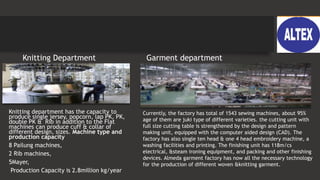
Knitting Department
Knitting department has the capacity to
produce single jersey, popcorn, lap PK, PK,
double PK & Rib in addition to the Flat
machines can produce cuff & collar of
different design, sizes. Machine type and
production capacity
8 Pailung machines,
2 Rib machines,
5Mayer,
Production Capacity is 2.8million kg/year
Garment department
Currently, the factory has total of 1543 sewing machines, about 95%
age of them are juki type of different varieties. the cutting unit with
full size cutting table is strengthened by the design and pattern
making unit, equipped with the computer aided design (CAD). The
factory has also single ten head & one 4 head embroidery machine, a
washing facilities and printing. The finishing unit has 118m/cs
electrical, &steam ironing equipment, and packing and other finishing
devices. Almeda garment factory has now all the necessary technology
for the production of different woven &knitting garment.
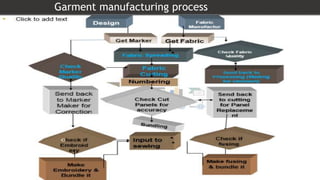
Garment manufacturing process
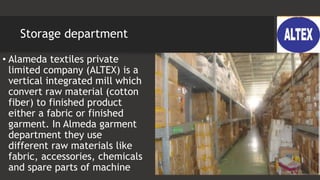
Storage department
• Alameda textiles private
limited company (ALTEX) is a
vertical integrated mill which
convert raw material (cotton
fiber) to finished product
either a fabric or finished
garment. In Almeda garment
department they use
different raw materials like
fabric, accessories, chemicals
and spare parts of machine
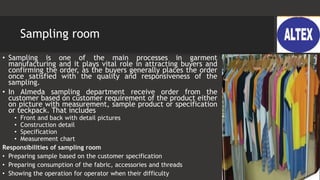
Sampling room
• Sampling is one of the main processes in garment
manufacturing and it plays vital role in attracting buyers and
confirming the order, as the buyers generally places the order
once satisfied with the quality and responsiveness of the
sampling.
• In Almeda sampling department receive order from the
customer based on customer requirement of the product either
on picture with measurement, sample product or specification
or teckpack. That includes
• Front and back with detail pictures
• Construction detail
• Specification
• Measurement chart
Responsibilities of sampling room
• Preparing sample based on the customer specification
• Preparing consumption of the fabric, accessories and threads
• Showing the operation for operator when their difficulty
CAD SYSTEM IN ALMEDA
LECTERA DIGITIZER
is a device used to convert hard pattern to soft copy and also to make grading is the
way that used to scanner out its like a table which the pattern put , there is mouse
which it used to sense the line of the hard pattern on the place in to the computer
screen . Generally Almeda garment factory can make grading by using this digitizer
Plotter
is a device used to make marker making in simple methods
through paper then this paper used to cut the fabric. Using this
plotter has more Efficiency than that of manual.
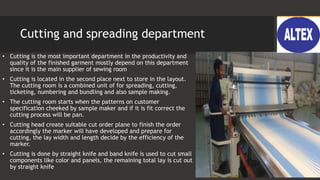
Cutting and spreading department
• Cutting is the most important department in the productivity and
quality of the finished garment mostly depend on this department
since it is the main supplier of sewing room
• Cutting is located in the second place next to store in the layout.
The cutting room is a combined unit of for spreading, cutting,
ticketing, numbering and bundling and also sample making.
• The cutting room starts when the patterns on customer
specification cheeked by sample maker and if it is fit correct the
cutting process will be pan.
• Cutting head create suitable cut order plane to finish the order
accordingly the marker will have developed and prepare for
cutting, the lay width and length decide by the efficiency of the
marker.
• Cutting is done by straight knife and band knife is used to cut small
components like color and panels, the remaining total lay is cut out
by straight knife
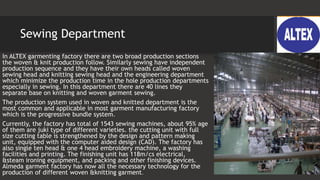
Sewing Department
In ALTEX garmenting factory there are two broad production sections
the woven & knit production follow. Similarly sewing have independent
production sequence and they have their own heads called woven
sewing head and knitting sewing head and the engineering department
which minimize the production time in the hole production departments
especially in sewing. In this department there are 40 lines they
separate base on knitting and woven garment sewing.
The production system used in woven and knitted department is the
most common and applicable in most garment manufacturing factory
which is the progressive bundle system.
Currently, the factory has total of 1543 sewing machines, about 95% age
of them are juki type of different varieties. the cutting unit with full
size cutting table is strengthened by the design and pattern making
unit, equipped with the computer aided design (CAD). The factory has
also single ten head & one 4 head embroidery machine, a washing
facilities and printing. The finishing unit has 118m/cs electrical,
&steam ironing equipment, and packing and other finishing devices.
Almeda garment factory has now all the necessary technology for the
production of different woven &knitting garment.
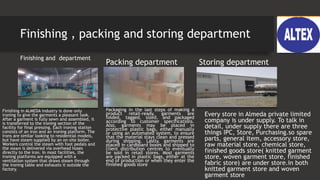
Finishing , packing and storing department
Finishing and department
Finishing in ALMEDA industry is done only
ironing to give the garments a pleasant look.
After a garment is fully sewn and assembled, it
is transferred to the ironing section of the
facility for final pressing. Each ironing station
consists of an iron and an ironing platform. The
irons are similar looking to residential models,
but have steam supplied by an on-site boiler.
Workers control the steam with foot pedals and
the steam is delivered via overhead hoses
directly to the iron. In most facilities, the
ironing platforms are equipped with a
ventilation system that draws steam through
the ironing table and exhausts it outside the
factory.
Packing department
Packaging In the last steps of making a
product retail-ready, garments are
folded, tagged, sized, and packaged
according to customer specifications.
Also, garments may be placed in
protective plastic bags, either manually
or using an automated system, to ensure
that the material stays clean and pressed
during shipping. Lastly, garments are
placed in cardboard boxes and shipped to
client distribution centres to eventually
be sold in retail stores. Most garments
are packed in plastic bags, either at the
end of production or when they enter the
finished goods store
Storing department
Every store in Almeda private limited
company is under supply. To talk in
detail, under supply there are three
things IPC, Store, Purchasing.so spare
parts, general item, accessory store,
raw material store, chemical store,
finished goods store( knitted garment
store, woven garment store, finished
fabric store) are under store.in both
knitted garment store and woven
garment store
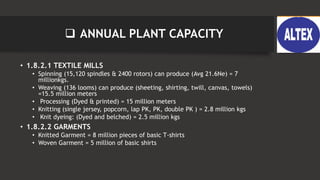
 ANNUAL PLANT CAPACITY
• 1.8.2.1 TEXTILE MILLS
• Spinning (15,120 spindles & 2400 rotors) can produce (Avg 21.6Ne) = 7
millionkgs.
• Weaving (136 looms) can produce (sheeting, shirting, twill, canvas, towels)
=15.5 million meters
• Processing (Dyed & printed) = 15 million meters
• Knitting (single jersey, popcorn, lap PK, PK, double PK ) = 2.8 million kgs
• Knit dyeing: (Dyed and belched) = 2.5 million kgs
• 1.8.2.2 GARMENTS
• Knitted Garment = 8 million pieces of basic T-shirts
• Woven Garment = 5 million of basic shirts
COMPANY MAIN PRODUCTE
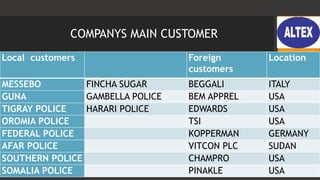
COMPANYS MAIN CUSTOMER
Local customers Foreign
customers
Location
MESSEBO FINCHA SUGAR BEGGALI ITALY
GUNA GAMBELLA POLICE BEM APPREL USA
TIGRAY POLICE HARARI POLICE EDWARDS USA
OROMIA POLICE TSI USA
FEDERAL POLICE KOPPERMAN GERMANY
AFAR POLICE VITCON PLC SUDAN
SOUTHERN POLICE CHAMPRO USA
SOMALIA POLICE PINAKLE USA
PROJECT TITLE
INVESTIGATING AND MINIMIZING LEAN WASTE THROUGH
VALUE STREAM MAPPING IN ALMEDA GARMENT FLOOR.
PREPARED BY KIBROM G/HER
ID NO 0501631
Internship report October 2016
• Back ground of the study
ӂWaste is unnecessary for any kind of industry because it raises the manufacturing cost of
products. For the customer waste is anything that cannot create any value. By effective lean
production system, it becomes possible to decline the generation of wastes and increase the
productivity in any industries
ӂThis research is an attempt to identify the applicability of one of the most important Lean
Manufacturing tool called “Value Stream Mapping (VSM)” in Almeda garment production
floor.
ӂA value stream is all the steps, both value added and non-value added activates to complete a
product from the beginning to the end
ӂIn this study value stream mapping has been done in a specific product in knitted garment value
stream has been done in current state and non-value added activity was separated.
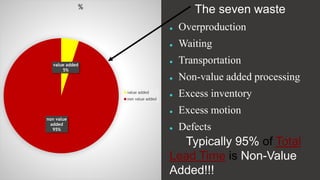
value added
5%
non value
added
95%
%
value added
non value added
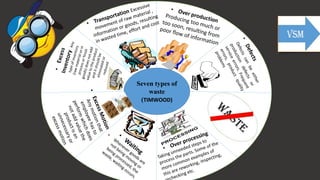
The seven waste
 Overproduction
 Waiting
 Transportation
 Non-value added processing
 Excess inventory
 Excess motion
 Defects
Typically 95% of Total
Lead Time is Non-Value
Added!!!
• Problem statements
• Waste is unnecessary for any kind of industry because it raises the
manufacturing cost of products. In ALMEDA production floor also they
have lean wastes of “TIMWOOD”. These wastes cannot be dedicated it is
not visual for ours eyes but increasing the lead time of the production
and it also increase the production cost of the product. Which leads to
increase non-value added time simultaneously decrease the value added
time. if they investigated and minimizing those wastes we can reduce
the production time and production cost in order to investigated and
minimizing I have to use one of lean too “VALUE STREAM MAPPING” of
the products The Target is to minimize those wastes in the production
floor and investigating the lean waste also to minimizing lean wastes by
using leans tools.
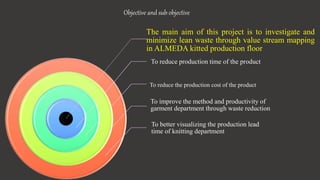
The main aim of this project is to investigate and
minimize lean waste through value stream mapping
in ALMEDA kitted production floor
To reduce production time of the product
To reduce the production cost of the product
To improve the method and productivity of
garment department through waste reduction
To better visualizing the production lead
time of knitting department
Objective and sub objective
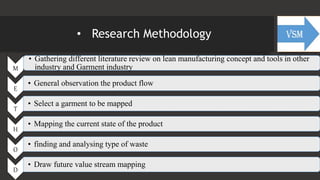
• Research Methodology
M
• Gathering different literature review on lean manufacturing concept and tools in other
industry and Garment industry
E
• General observation the product flow
T
• Select a garment to be mapped
H
• Mapping the current state of the product
O
• finding and analysing type of waste
D
• Draw future value stream mapping
scope of the study
• The study has been conducted in ALTEX
textile plc in knitting garment for a polo
shirt style and its done on lead time of
production starting from knitted fabric
temporary storage, cutting, sewing and
finishing department. to examine the
waste level
Value added activates
those activities that, in the eyes of the
final customer, make a product or
service more valuable . Like sewing
cutting and finishing
Non value added activates
those activities which, in the eyes of the
final customer, do not make a product or
service more valuable like transporting ,
rechecking etc
Necessary non-value
adding activity
Necessary non-value adding
activity: those activities that,
in the eyes of the final
customer, do not make a
product or service more
valuable but are necessary
LITERATURE REVIEW
What is lean
 Lean Manufacturing can be defined as "A systematic approach to identifying and
eliminating waste through continuous improvement by flowing the product at the
demand of the customer." Taiichi Ohno
`
Seven types of
waste
(TIMWOOD)
• WHAT IS VSM?
 Value Stream Mapping (VSM) is a tool of lean manufacturing that helps to understand the
flow of material and information as products make their way through the value stream. The value
stream includes the value adding and non-value adding activities that are required to bring a
product from raw material through delivery to the customer. In other words, Value Stream
Mapping is an outline of a product's manufacturing life cycle that identifies each step throughout
the production process. It represents a visual information of material flow for a particular product
family (Rother M. and Shook J 1999.)
Value: Creating or making something of value that a customer is willing to pay for.
Stream: Sequential flow of activities needed to create work unit and deliver to customer.
Mapping :mapping a product's production path (materials and information) from "door to
door".
WHY VSM
IS SO
IMPORTANT
c/t time minute 1.94 c/t time minute 17 c/t time minute 1.72
working h/r 7.33 working h/r 7.33 working h/r 7.33
no of operater 14 no of operater 34 no of operater 11
no of shift 1 no of shift 1 no of shift 1
actual tiime in min 255 actual tiime in min 194 actual tiime in min 9.47
# quantity 665 # quantity 10 # quantity 1pc
non value added time 5514 99.58%
value added time 20.66 0.37%
Unavoidable 2.5 0.05%
total lead time 5537.16
production planning and control
cutting sewing
customer
2
1.8
19.4
1.772932331
9.47
total lead time per pices 40.9572
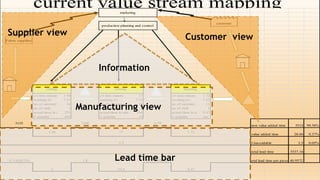
current value stream mapping
4.714285714
2.5
finishing
Fabric suppliers
1.94 17 1.72
1200 11793135
marketing
Supplier view Customer view
Information
Manufacturing view
Lead time bar
data analysis
•In Almeda textile p.l.c in kitted department from
temporary fabric storage up to finished department
huge inventory and high lead time between the
departments so decide to analyses the lead time
through one of lean manufacturing tool called “value
stream mapping “by choosing one product or style
Steps
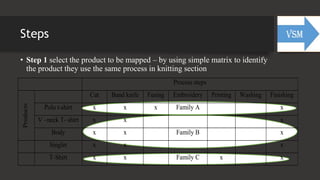
• Step 1 select the product to be mapped – by using simple matrix to identify
the product they use the same process in knitting section
Process steps
Products
Cut Band knife Fusing Embroidery Printing Washing Finishing
Polo t-shirt x x x Family A x
V –neck T- shirt x x x
Body x x Family B x
Singlet x x x
T-Shirt x x Family C x x
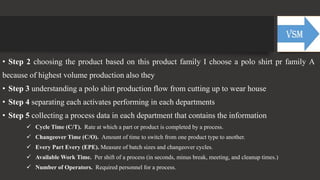
• Step 2 choosing the product based on this product family I choose a polo shirt pr family A
because of highest volume production also they
• Step 3 understanding a polo shirt production flow from cutting up to wear house
• Step 4 separating each activates performing in each departments
• Step 5 collecting a process data in each department that contains the information
 Cycle Time (C/T). Rate at which a part or product is completed by a process.
 Changeover Time (C/O). Amount of time to switch from one product type to another.
 Every Part Every (EPE). Measure of batch sizes and changeover cycles.
 Available Work Time. Per shift of a process (in seconds, minus break, meeting, and cleanup times.)
 Number of Operators. Required personnel for a process.
cutting
c/t time minute 1.94
working h/r 7.33
no of operator 14
no of shift 1
actual tiime in min 233.019
# quantity 665
sewing
c/t time minute 17
working h/r 7.33
no of operator 34
no of shift 1
actual tiime in min 194
# quantity 10
finishing
c/t time minute 1.72
working h/r 7.33
no of operater 11
no of shift 1
actual tiime in min 9.47
# quantity 1pc
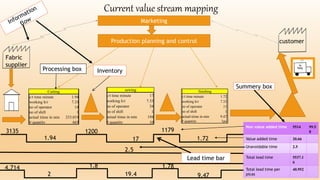
Marketing
Production planning and control
Fabric
supplier
customer
Non value added time 5514 99.5
8
Value added time 20.66
Unavoidable time 2.5
Total lead time 5537.1
6
Total lead time per
picas
40.952
Current value stream mapping
3135 1200 1179
1.94 17 1.72
2.5
Cutting sewing
Processing box
4.714
2
1.8
19.4
1.78
9.47
Inventory
Lead time bar
Summery box
Cutting finishing
Current waste in different section
 The observed data and the current state map of the processes revealed some
wastes in the flow. I assessed the company’s current practice towards wastes
analyzed the percentage of the major wastes in sewing, cutting and finishing
process
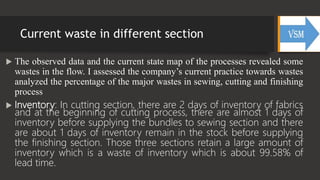
 Inventory: In cutting section, there are 2 days of inventory of fabrics
and at the beginning of cutting process, there are almost 1 days of
inventory before supplying the bundles to sewing section and there
are about 1 days of inventory remain in the stock before supplying
the finishing section. Those three sections retain a large amount of
inventory which is a waste of inventory which is about 99.58% of
lead time.
existing proposed vsm
time 3135 1140
3135
1140
0
500
1000
1500
2000
2500
3000
3500AxisTitle
Axis Title
time
time Linear (time )
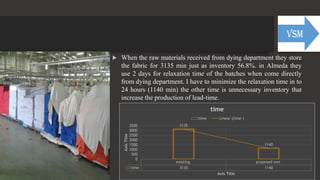
 When the raw materials received from dying department they store
the fabric for 3135 min just as inventory 56.8%. in Almeda they
use 2 days for relaxation time of the batches when come directly
from dying department. I have to minimize the relaxation time in to
24 hours (1140 min) the other time is unnecessary inventory that
increase the production of lead-time.
cutting inventory
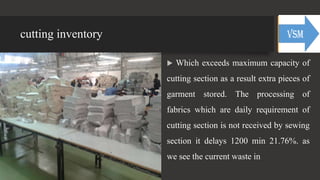
 Which exceeds maximum capacity of
cutting section as a result extra pieces of
garment stored. The processing of
fabrics which are daily requirement of
cutting section is not received by sewing
section it delays 1200 min 21.76%. as
we see the current waste in
finished garment inventory
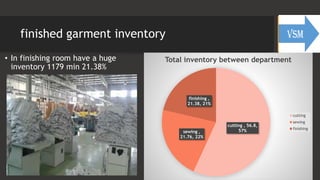
• In finishing room have a huge
inventory 1179 min 21.38%
cutting , 56.8,
57%sewing ,
21.76, 22%
finishing ,
21.38, 21%
Total inventory between department
cutting
sewing
finishing
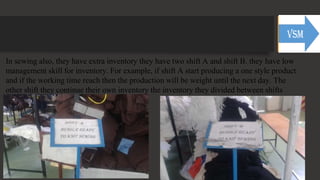
In sewing also, they have extra inventory they have two shift A and shift B. they have low
management skill for inventory. For example, if shift A start producing a one style product
and if the working time reach then the production will be weight until the next day. The
other shift they continue their own inventory the inventory they divided between shifts
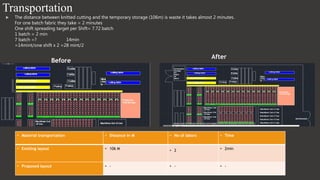
 The distance between knitted cutting and the temporary storage (106m) is waste it takes almost 2 minutes.
For one batch fabric they take = 2 minutes
One shift spreading target per Shift= 7.72 batch
1 batch = 2 min
7 batch =? 14min
=14mint/one shift x 2 =28 mint/2
Before
After
Transportation
• Material transportation • Distance in M • No of labors • Time
• Existing layout • 106 M • 2 • 2min
• Proposed layout • - • - • -
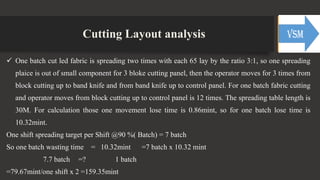
Cutting Layout analysis
 One batch cut led fabric is spreading two times with each 65 lay by the ratio 3:1, so one spreading
plaice is out of small component for 3 bloke cutting panel, then the operator moves for 3 times from
block cutting up to band knife and from band knife up to control panel. For one batch fabric cutting
and operator moves from block cutting up to control panel is 12 times. The spreading table length is
30M. For calculation those one movement lose time is 0.86mint, so for one batch lose time is
10.32mint.
One shift spreading target per Shift @90 %( Batch) = 7 batch
So one batch wasting time = 10.32mint =7 batch x 10.32 mint
7.7 batch =? 1 batch
=79.67mint/one shift x 2 =159.35mint
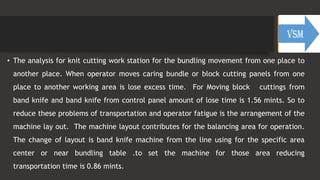
• The analysis for knit cutting work station for the bundling movement from one place to
another place. When operator moves caring bundle or block cutting panels from one
place to another working area is lose excess time. For Moving block cuttings from
band knife and band knife from control panel amount of lose time is 1.56 mints. So to
reduce these problems of transportation and operator fatigue is the arrangement of the
machine lay out. The machine layout contributes for the balancing area for operation.
The change of layout is band knife machine from the line using for the specific area
center or near bundling table .to set the machine for those area reducing
transportation time is 0.86 mints.
Existing layout of cutting
Automatic spreading table Band
knife
Manual spreading table
Band
knife
Waiting table
Inspection and bundling table
Temporary reject
table
2M
1.5M
7M
30M
Time o.86
Bloke 1 Bloke 2 Bloke 3
The distance between automatic spreading table and inspection is to far 7m
Proposed layout of knitted cutting
Automatic spreading table
Band
knife1
Manual spreading table
Band
knife 2
Waiting table
Inspection and bundling table
Temporary reject
table
2M
1.5M
7M
30M
Bloke 1 Bloke 2 Bloke 3
The distance between
automatic spreading
table is to reduce 1.5 m
0.25 min
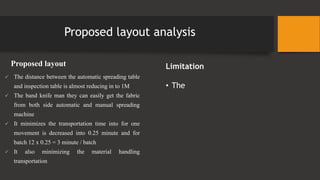
Proposed layout analysis
Proposed layout
 The distance between the automatic spreading table
and inspection table is almost reducing in to 1M
 The band knife man they can easily get the fabric
from both side automatic and manual spreading
machine
 It minimizes the transportation time into for one
movement is decreased into 0.25 minute and for
batch 12 x 0.25 = 3 minute / batch
 It also minimizing the material handling
transportation
Limitation
• The
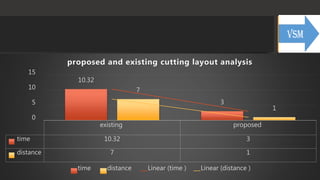
existing proposed
time 10.32 3
distance 7 1
10.32
3
7
1
0
5
10
15
proposed and existing cutting layout analysis
time distance Linear (time ) Linear (distance )
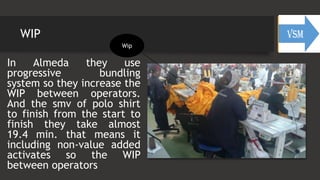
WIP
In Almeda they use
progressive bundling
system so they increase the
WIP between operators.
And the smv of polo shirt
to finish from the start to
finish they take almost
19.4 min. that means it
including non-value added
activates so the WIP
between operators
Wip
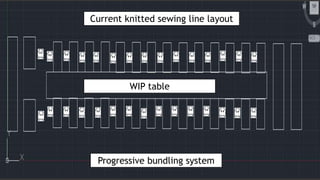
Current knitted sewing line layout
Progressive bundling system
WIP table
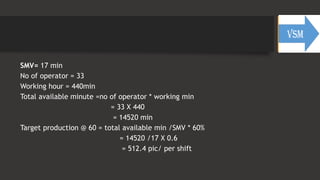
SMV= 17 min
No of operator = 33
Working hour = 440min
Total available minute =no of operator * working min
= 33 X 440
= 14520 min
Target production @ 60 = total available min /SMV * 60%
= 14520 /17 X 0.6
= 512.4 pic/ per shift
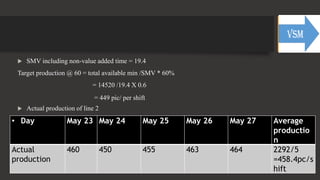
 SMV including non-value added time = 19.4
Target production @ 60 = total available min /SMV * 60%
= 14520 /19.4 X 0.6
= 449 pic/ per shift
 Actual production of line 2
• Day May 23 May 24 May 25 May 26 May 27 Average
productio
n
Actual
production
460 450 455 463 464 2292/5
=458.4pc/s
hift
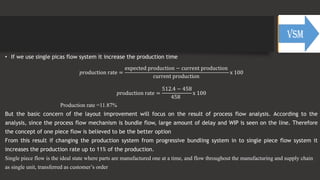
• If we use single picas flow system it increase the production time
𝑝roduction rate =
expected production − current production
current production
x 100
𝑝roduction rate =
512.4 − 458
458
x 100
Production rate =11.87%
But the basic concern of the layout improvement will focus on the result of process flow analysis. According to the
analysis, since the process flow mechanism is bundle flow, large amount of delay and WIP is seen on the line. Therefore
the concept of one piece flow is believed to be the better option
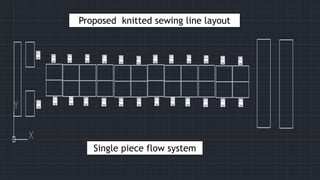
From this result if changing the production system from progressive bundling system in to single piece flow system it
increases the production rate up to 11% of the production.
Single piece flow is the ideal state where parts are manufactured one at a time, and flow throughout the manufacturing and supply chain
as single unit, transferred as customer’s order
Proposed knitted sewing line layout
Single piece flow system
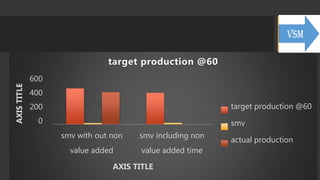
0
200
400
600
smv with out non
value added
smv including non
value added time
AXISTITLE
AXIS TITLE
target production @60
smv
actual production
Waste of motion
• In knitting cutting department, the operator performs as the
way he desires. They don’t have standard operator procedure.
Waste of motion is a significant factor within the seven wastes
identified, and every effort should be made to remove it from
the production process. This will increase efficiencies while
making work easier for all involved. Movement is not
necessarily work, but it costs in time and money. In order to
reduce we have to Develop standard operating procedures.
And we have to train the operator based on standard operating
procedure
32
33
34
35
36
37
38
39
40
41
42
existing proposed
the production lead time for polo shirt
time Linear (time )
Conclusion
• From this research is to study the lean manufacturing principles and understand the current demand of the knitted
department. In this study the suitable lean tools and principle are used to analyzed the (TIMWOOD) waste through
VALUE STREAM MAPING and which minimize the process wastages such as work in progress(WIP), through put
time, change over time, transportation, production space and loss of productivity in ALTEX P.LC. The problem of
higher WIP is addressed through single piece flow principle. In addition to this, VSM can indirectly supports for
minimizing the working area transportation, through put time, setup time, and waste of motion.
• From this study 99.58% of the production lead time is spent in unnecessary inventory from this result it also
increases the production cost and production lead time. if minimizing the unnecessary inventory and other waste it
minimizes the production lead time and it also increase the productivity of the company. In this current production lead
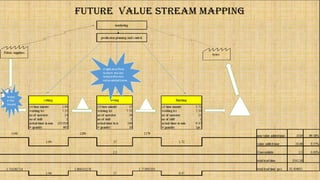
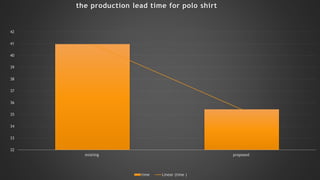
time for one pcs it takes 40 minute if we applying the proposed VSM it almost takes 35 minute.
• From this study value stream mapping is a very important tool to investigate and how the company performed and
what improvement needs for the next process.
• Current
vsm
• Proposed
vsm
• Future
vsm
• Continues improvement
Eliminatingwaste
Chapter 3
Internship experience
• Improving my Theoretical Skills
• The internship was very helpful in upgrading the theoretical knowledge
• I have performed many practical activities so this helped me to improve my theoretical skill.
• Improving my practical skills
• Practical skills relate to the application of knowledge, theory and/or skills students have
developed in higher education to complete ‘real life’ tasks.
• I gain different practical skills from the floor
• Time study
• Preparation of pattern
• The implementation of CAD system in marking
• How they operate the digitizer and plotter
• Operation break down of garment
• How they operate special machine like automatic welt pocket, bar tack,
Improving interpersonal communication skill
• I develop my communication between two or more individuals. This can include all
aspect of communication like listening, persuading, asserting, nonverbal
communication and more. The communication skill that I developed during my
internship helped me to approach sort of people who are from different aspects
disciplines and regions and it show me the way how to approach professionals who
are on the field.
• Uses of interpersonal communication
• It increases participation or assistance in obtaining information and completing tasks with in a
given schedule or program.
• To give and collect information.
• To form contacts and maintain relationship.
• To express personals needs and understand the needs of others.
• To make decision and solve problem.
• To anticipate and predict behavior.
Improving my leadership skills
• Leader ship is organizing a group of people to achieve a common
goal. It also means that you are willing to take on a responsibility
make choice for yourself. An effective leader needs to be able to
create more leaders on his or her team. Because if you want to be
able to have the people following you stand up and get notice, so
they intern have other people following.
Improving my work ethics skill
• Work ethics is a set of moral principle like: getting to work on
time, being self-directed, having initiative, have a positive
attitude with your follow workers and the customers, performing
high quality work, not being a clock watcher and most of all
knowing how to be loyal to the company, and the people you work
with.
Improving my work ethics skill
• Work ethics is a set of moral principle like: getting to work on
time, being self-directed, having initiative, have a positive
attitude with your follow workers and the customers, performing
high quality work, not being a clock watcher and most of all
knowing how to be loyal to the company, and the people you work
with.
Improving my entrepreneurship skill
• Entrepreneurship is the act of being an entrepreneur, which can
be defined as one who under take innovations finance and
business acumen in an effort to transform innovation in to
economic goods. This may result in new organization or may be a
part of revitalizing mature organization in response to a perceive
opportunity.

Value stream mapping in ethiopian garemnt industry

  • 1.
    Company profile PREPARED BYKIBROM G/HER ID NO 0501631 Internship report October 2016
  • 2.
    • Company profile Almedatextile factory (ALTEX) is one of the non-governmental entities that were situated seven kilometers from center of Adwa or seventeen kilometers from center of Axum at main road Adwa to Axum and 1006 kilometers from Adis Ababa and 233 kilometers from Mekelle, capital city of Tigray region. Almeda textile plc. (Private limited company) Almeda is one of companies of the EFFORT (Endowment fund for rehabilitation of Tigray) with an objective to enhance the investment opportunity. Almeda textiles private limited company (ALTEX) is a private company established in accordance with the commercial code of Ethiopia with a share capital of 180,000,000 Birr in 1989. Almeda textile is the biggest textile manufacturing company in the country. It has 100 million birr sales volume that is 70% sales in local market and 30% volume in global market
  • 3.
    • OBJECTIVES OFTHE COMPANY o The company is established to accomplish the following business  To produce threads yarns and all kinds of cloths from cotton, polyester and cotton and polyester blend  To produce clothing materials for personnel and house hold uses  To engage in agricultural activities where becomes necessary for the realization of its business  To engage generally in any other trade necessary or conducive to the achievement of its business.
  • 4.
    • MISSION OFTHE COMPANY • The mission statement originates from the “TOTAL CUSTOMER SATISFACTION” for the value added products based on Research and development and creating a hub for excellence in the textile field in Africa in general and Ethiopia in particular.
  • 5.
    VISSION OF THECOMPANY: • Develop Almeda as a reference for Ethiopian Textile and Garmenting industry and create the conditioned that Almeda can become leader in the Ethiopian market in terms of export and local market sales.
  • 6.
    • QUALITY POLICY •Understanding, researching and meeting customers’ needs and expectations. Creating and Maintaining a motivational and conducive environment in which people would become Quality conscious. Enhancing quality at a less cost through QMS implementation Core value
  • 7.
    Raw material andaccessories suppliers • In Almeda textile plc. They use different types of raw material and accessories in order to satisfy customer based on the customer demand. as we know ALTEX is integrated company the production starters from spinning up to garment they use different raw materials and accessories by inputting from local or from other country. • The main input for the textile production • Cotton: - Ommo, middle awash, Hiwot at Dansha in Humera, Gambella, Afar • Polyester: -Korea, Turkey, and China • Accessories suppliers • In ALMEDA garmenting section accessories can be imported from different areas as per quality quantity and availability of the material. For e.g.. If the product is for local customer it may be purchase from ADISS ABEBA, but if the product is for exporting they import from high quality accessory suppler. Mostly accessories for local product purchase from MRKATO market like MELS, Bethlehem, accessory supplier • Chemical suppliers • They used different chemicals in garment department for washing, bleaching and other activates the main supplier for this chemicals Bezama and Ekosy
  • 9.
    Work flow ofthe ALMEDA TEXTILE P.LC. raw material spinning department knitting department knitting dying department weaving department woven processing department garment department finishing store department
  • 10.
    Work flow ofaltex Spinning department Spinning is the process which converts raw fiber into yarn or thread. The fibers are prepared and then drawn out and twisted to form the yarn, which is then wound onto a bobbin or cone. The spinning process is entirely dry, although some yarns may be dyed and finished as a final customer Weaving department there are three sections; winding, warping, sizing and weaving. Winding; to increase the strength of thread in warping. The department is designed to produce different variety of fabric ranging from simple plain to complex design of fabric. The designed production Capacity of this department is 28,000 meters of fabric. PROCESSING department the processing machines have the capability to process both reactive dyeing and pigment prints. The main process performed in this department are dying, bleaching and printing. It’s yearly design capacity is 15 million meter Different sheeting (Dyed, printing and bleached)
  • 11.
    Knitting Department Knitting departmenthas the capacity to produce single jersey, popcorn, lap PK, PK, double PK & Rib in addition to the Flat machines can produce cuff & collar of different design, sizes. Machine type and production capacity 8 Pailung machines, 2 Rib machines, 5Mayer, Production Capacity is 2.8million kg/year Garment department Currently, the factory has total of 1543 sewing machines, about 95% age of them are juki type of different varieties. the cutting unit with full size cutting table is strengthened by the design and pattern making unit, equipped with the computer aided design (CAD). The factory has also single ten head & one 4 head embroidery machine, a washing facilities and printing. The finishing unit has 118m/cs electrical, &steam ironing equipment, and packing and other finishing devices. Almeda garment factory has now all the necessary technology for the production of different woven &knitting garment.
  • 12.
  • 13.
    Storage department • Alamedatextiles private limited company (ALTEX) is a vertical integrated mill which convert raw material (cotton fiber) to finished product either a fabric or finished garment. In Almeda garment department they use different raw materials like fabric, accessories, chemicals and spare parts of machine
  • 14.
    Sampling room • Samplingis one of the main processes in garment manufacturing and it plays vital role in attracting buyers and confirming the order, as the buyers generally places the order once satisfied with the quality and responsiveness of the sampling. • In Almeda sampling department receive order from the customer based on customer requirement of the product either on picture with measurement, sample product or specification or teckpack. That includes • Front and back with detail pictures • Construction detail • Specification • Measurement chart Responsibilities of sampling room • Preparing sample based on the customer specification • Preparing consumption of the fabric, accessories and threads • Showing the operation for operator when their difficulty
  • 15.
    CAD SYSTEM INALMEDA LECTERA DIGITIZER is a device used to convert hard pattern to soft copy and also to make grading is the way that used to scanner out its like a table which the pattern put , there is mouse which it used to sense the line of the hard pattern on the place in to the computer screen . Generally Almeda garment factory can make grading by using this digitizer Plotter is a device used to make marker making in simple methods through paper then this paper used to cut the fabric. Using this plotter has more Efficiency than that of manual.
  • 16.
    Cutting and spreadingdepartment • Cutting is the most important department in the productivity and quality of the finished garment mostly depend on this department since it is the main supplier of sewing room • Cutting is located in the second place next to store in the layout. The cutting room is a combined unit of for spreading, cutting, ticketing, numbering and bundling and also sample making. • The cutting room starts when the patterns on customer specification cheeked by sample maker and if it is fit correct the cutting process will be pan. • Cutting head create suitable cut order plane to finish the order accordingly the marker will have developed and prepare for cutting, the lay width and length decide by the efficiency of the marker. • Cutting is done by straight knife and band knife is used to cut small components like color and panels, the remaining total lay is cut out by straight knife
  • 17.
    Sewing Department In ALTEXgarmenting factory there are two broad production sections the woven & knit production follow. Similarly sewing have independent production sequence and they have their own heads called woven sewing head and knitting sewing head and the engineering department which minimize the production time in the hole production departments especially in sewing. In this department there are 40 lines they separate base on knitting and woven garment sewing. The production system used in woven and knitted department is the most common and applicable in most garment manufacturing factory which is the progressive bundle system. Currently, the factory has total of 1543 sewing machines, about 95% age of them are juki type of different varieties. the cutting unit with full size cutting table is strengthened by the design and pattern making unit, equipped with the computer aided design (CAD). The factory has also single ten head & one 4 head embroidery machine, a washing facilities and printing. The finishing unit has 118m/cs electrical, &steam ironing equipment, and packing and other finishing devices. Almeda garment factory has now all the necessary technology for the production of different woven &knitting garment.
  • 18.
    Finishing , packingand storing department Finishing and department Finishing in ALMEDA industry is done only ironing to give the garments a pleasant look. After a garment is fully sewn and assembled, it is transferred to the ironing section of the facility for final pressing. Each ironing station consists of an iron and an ironing platform. The irons are similar looking to residential models, but have steam supplied by an on-site boiler. Workers control the steam with foot pedals and the steam is delivered via overhead hoses directly to the iron. In most facilities, the ironing platforms are equipped with a ventilation system that draws steam through the ironing table and exhausts it outside the factory. Packing department Packaging In the last steps of making a product retail-ready, garments are folded, tagged, sized, and packaged according to customer specifications. Also, garments may be placed in protective plastic bags, either manually or using an automated system, to ensure that the material stays clean and pressed during shipping. Lastly, garments are placed in cardboard boxes and shipped to client distribution centres to eventually be sold in retail stores. Most garments are packed in plastic bags, either at the end of production or when they enter the finished goods store Storing department Every store in Almeda private limited company is under supply. To talk in detail, under supply there are three things IPC, Store, Purchasing.so spare parts, general item, accessory store, raw material store, chemical store, finished goods store( knitted garment store, woven garment store, finished fabric store) are under store.in both knitted garment store and woven garment store
  • 19.
     ANNUAL PLANTCAPACITY • 1.8.2.1 TEXTILE MILLS • Spinning (15,120 spindles & 2400 rotors) can produce (Avg 21.6Ne) = 7 millionkgs. • Weaving (136 looms) can produce (sheeting, shirting, twill, canvas, towels) =15.5 million meters • Processing (Dyed & printed) = 15 million meters • Knitting (single jersey, popcorn, lap PK, PK, double PK ) = 2.8 million kgs • Knit dyeing: (Dyed and belched) = 2.5 million kgs • 1.8.2.2 GARMENTS • Knitted Garment = 8 million pieces of basic T-shirts • Woven Garment = 5 million of basic shirts
  • 20.
  • 21.
    COMPANYS MAIN CUSTOMER Localcustomers Foreign customers Location MESSEBO FINCHA SUGAR BEGGALI ITALY GUNA GAMBELLA POLICE BEM APPREL USA TIGRAY POLICE HARARI POLICE EDWARDS USA OROMIA POLICE TSI USA FEDERAL POLICE KOPPERMAN GERMANY AFAR POLICE VITCON PLC SUDAN SOUTHERN POLICE CHAMPRO USA SOMALIA POLICE PINAKLE USA
  • 22.
    PROJECT TITLE INVESTIGATING ANDMINIMIZING LEAN WASTE THROUGH VALUE STREAM MAPPING IN ALMEDA GARMENT FLOOR. PREPARED BY KIBROM G/HER ID NO 0501631 Internship report October 2016
  • 23.
    • Back groundof the study ӂWaste is unnecessary for any kind of industry because it raises the manufacturing cost of products. For the customer waste is anything that cannot create any value. By effective lean production system, it becomes possible to decline the generation of wastes and increase the productivity in any industries ӂThis research is an attempt to identify the applicability of one of the most important Lean Manufacturing tool called “Value Stream Mapping (VSM)” in Almeda garment production floor. ӂA value stream is all the steps, both value added and non-value added activates to complete a product from the beginning to the end ӂIn this study value stream mapping has been done in a specific product in knitted garment value stream has been done in current state and non-value added activity was separated.
  • 24.
    value added 5% non value added 95% % valueadded non value added The seven waste  Overproduction  Waiting  Transportation  Non-value added processing  Excess inventory  Excess motion  Defects Typically 95% of Total Lead Time is Non-Value Added!!!
  • 25.
    • Problem statements •Waste is unnecessary for any kind of industry because it raises the manufacturing cost of products. In ALMEDA production floor also they have lean wastes of “TIMWOOD”. These wastes cannot be dedicated it is not visual for ours eyes but increasing the lead time of the production and it also increase the production cost of the product. Which leads to increase non-value added time simultaneously decrease the value added time. if they investigated and minimizing those wastes we can reduce the production time and production cost in order to investigated and minimizing I have to use one of lean too “VALUE STREAM MAPPING” of the products The Target is to minimize those wastes in the production floor and investigating the lean waste also to minimizing lean wastes by using leans tools.
  • 26.
    The main aimof this project is to investigate and minimize lean waste through value stream mapping in ALMEDA kitted production floor To reduce production time of the product To reduce the production cost of the product To improve the method and productivity of garment department through waste reduction To better visualizing the production lead time of knitting department Objective and sub objective
  • 27.
    • Research Methodology M •Gathering different literature review on lean manufacturing concept and tools in other industry and Garment industry E • General observation the product flow T • Select a garment to be mapped H • Mapping the current state of the product O • finding and analysing type of waste D • Draw future value stream mapping
  • 28.
    scope of thestudy • The study has been conducted in ALTEX textile plc in knitting garment for a polo shirt style and its done on lead time of production starting from knitted fabric temporary storage, cutting, sewing and finishing department. to examine the waste level
  • 29.
    Value added activates thoseactivities that, in the eyes of the final customer, make a product or service more valuable . Like sewing cutting and finishing Non value added activates those activities which, in the eyes of the final customer, do not make a product or service more valuable like transporting , rechecking etc Necessary non-value adding activity Necessary non-value adding activity: those activities that, in the eyes of the final customer, do not make a product or service more valuable but are necessary LITERATURE REVIEW What is lean  Lean Manufacturing can be defined as "A systematic approach to identifying and eliminating waste through continuous improvement by flowing the product at the demand of the customer." Taiichi Ohno
  • 30.
  • 31.
    • WHAT ISVSM?  Value Stream Mapping (VSM) is a tool of lean manufacturing that helps to understand the flow of material and information as products make their way through the value stream. The value stream includes the value adding and non-value adding activities that are required to bring a product from raw material through delivery to the customer. In other words, Value Stream Mapping is an outline of a product's manufacturing life cycle that identifies each step throughout the production process. It represents a visual information of material flow for a particular product family (Rother M. and Shook J 1999.) Value: Creating or making something of value that a customer is willing to pay for. Stream: Sequential flow of activities needed to create work unit and deliver to customer. Mapping :mapping a product's production path (materials and information) from "door to door".
  • 32.
  • 33.
    c/t time minute1.94 c/t time minute 17 c/t time minute 1.72 working h/r 7.33 working h/r 7.33 working h/r 7.33 no of operater 14 no of operater 34 no of operater 11 no of shift 1 no of shift 1 no of shift 1 actual tiime in min 255 actual tiime in min 194 actual tiime in min 9.47 # quantity 665 # quantity 10 # quantity 1pc non value added time 5514 99.58% value added time 20.66 0.37% Unavoidable 2.5 0.05% total lead time 5537.16 production planning and control cutting sewing customer 2 1.8 19.4 1.772932331 9.47 total lead time per pices 40.9572 current value stream mapping 4.714285714 2.5 finishing Fabric suppliers 1.94 17 1.72 1200 11793135 marketing Supplier view Customer view Information Manufacturing view Lead time bar
  • 34.
    data analysis •In Almedatextile p.l.c in kitted department from temporary fabric storage up to finished department huge inventory and high lead time between the departments so decide to analyses the lead time through one of lean manufacturing tool called “value stream mapping “by choosing one product or style
  • 35.
    Steps • Step 1select the product to be mapped – by using simple matrix to identify the product they use the same process in knitting section Process steps Products Cut Band knife Fusing Embroidery Printing Washing Finishing Polo t-shirt x x x Family A x V –neck T- shirt x x x Body x x Family B x Singlet x x x T-Shirt x x Family C x x
  • 36.
    • Step 2choosing the product based on this product family I choose a polo shirt pr family A because of highest volume production also they • Step 3 understanding a polo shirt production flow from cutting up to wear house • Step 4 separating each activates performing in each departments • Step 5 collecting a process data in each department that contains the information  Cycle Time (C/T). Rate at which a part or product is completed by a process.  Changeover Time (C/O). Amount of time to switch from one product type to another.  Every Part Every (EPE). Measure of batch sizes and changeover cycles.  Available Work Time. Per shift of a process (in seconds, minus break, meeting, and cleanup times.)  Number of Operators. Required personnel for a process.
  • 37.
    cutting c/t time minute1.94 working h/r 7.33 no of operator 14 no of shift 1 actual tiime in min 233.019 # quantity 665 sewing c/t time minute 17 working h/r 7.33 no of operator 34 no of shift 1 actual tiime in min 194 # quantity 10 finishing c/t time minute 1.72 working h/r 7.33 no of operater 11 no of shift 1 actual tiime in min 9.47 # quantity 1pc Marketing Production planning and control Fabric supplier customer Non value added time 5514 99.5 8 Value added time 20.66 Unavoidable time 2.5 Total lead time 5537.1 6 Total lead time per picas 40.952 Current value stream mapping 3135 1200 1179 1.94 17 1.72 2.5 Cutting sewing Processing box 4.714 2 1.8 19.4 1.78 9.47 Inventory Lead time bar Summery box Cutting finishing
  • 38.
    Current waste indifferent section  The observed data and the current state map of the processes revealed some wastes in the flow. I assessed the company’s current practice towards wastes analyzed the percentage of the major wastes in sewing, cutting and finishing process  Inventory: In cutting section, there are 2 days of inventory of fabrics and at the beginning of cutting process, there are almost 1 days of inventory before supplying the bundles to sewing section and there are about 1 days of inventory remain in the stock before supplying the finishing section. Those three sections retain a large amount of inventory which is a waste of inventory which is about 99.58% of lead time.
  • 39.
    existing proposed vsm time3135 1140 3135 1140 0 500 1000 1500 2000 2500 3000 3500AxisTitle Axis Title time time Linear (time )  When the raw materials received from dying department they store the fabric for 3135 min just as inventory 56.8%. in Almeda they use 2 days for relaxation time of the batches when come directly from dying department. I have to minimize the relaxation time in to 24 hours (1140 min) the other time is unnecessary inventory that increase the production of lead-time.
  • 40.
    cutting inventory  Whichexceeds maximum capacity of cutting section as a result extra pieces of garment stored. The processing of fabrics which are daily requirement of cutting section is not received by sewing section it delays 1200 min 21.76%. as we see the current waste in
  • 41.
    finished garment inventory •In finishing room have a huge inventory 1179 min 21.38% cutting , 56.8, 57%sewing , 21.76, 22% finishing , 21.38, 21% Total inventory between department cutting sewing finishing
  • 42.
    In sewing also,they have extra inventory they have two shift A and shift B. they have low management skill for inventory. For example, if shift A start producing a one style product and if the working time reach then the production will be weight until the next day. The other shift they continue their own inventory the inventory they divided between shifts
  • 43.
     The distancebetween knitted cutting and the temporary storage (106m) is waste it takes almost 2 minutes. For one batch fabric they take = 2 minutes One shift spreading target per Shift= 7.72 batch 1 batch = 2 min 7 batch =? 14min =14mint/one shift x 2 =28 mint/2 Before After Transportation • Material transportation • Distance in M • No of labors • Time • Existing layout • 106 M • 2 • 2min • Proposed layout • - • - • -
  • 44.
    Cutting Layout analysis One batch cut led fabric is spreading two times with each 65 lay by the ratio 3:1, so one spreading plaice is out of small component for 3 bloke cutting panel, then the operator moves for 3 times from block cutting up to band knife and from band knife up to control panel. For one batch fabric cutting and operator moves from block cutting up to control panel is 12 times. The spreading table length is 30M. For calculation those one movement lose time is 0.86mint, so for one batch lose time is 10.32mint. One shift spreading target per Shift @90 %( Batch) = 7 batch So one batch wasting time = 10.32mint =7 batch x 10.32 mint 7.7 batch =? 1 batch =79.67mint/one shift x 2 =159.35mint
  • 45.
    • The analysisfor knit cutting work station for the bundling movement from one place to another place. When operator moves caring bundle or block cutting panels from one place to another working area is lose excess time. For Moving block cuttings from band knife and band knife from control panel amount of lose time is 1.56 mints. So to reduce these problems of transportation and operator fatigue is the arrangement of the machine lay out. The machine layout contributes for the balancing area for operation. The change of layout is band knife machine from the line using for the specific area center or near bundling table .to set the machine for those area reducing transportation time is 0.86 mints.
  • 46.
    Existing layout ofcutting Automatic spreading table Band knife Manual spreading table Band knife Waiting table Inspection and bundling table Temporary reject table 2M 1.5M 7M 30M Time o.86 Bloke 1 Bloke 2 Bloke 3 The distance between automatic spreading table and inspection is to far 7m
  • 47.
    Proposed layout ofknitted cutting Automatic spreading table Band knife1 Manual spreading table Band knife 2 Waiting table Inspection and bundling table Temporary reject table 2M 1.5M 7M 30M Bloke 1 Bloke 2 Bloke 3 Bloke 1 Bloke 2 Bloke 3 The distance between automatic spreading table is to reduce 1.5 m 0.25 min
  • 48.
    Proposed layout analysis Proposedlayout  The distance between the automatic spreading table and inspection table is almost reducing in to 1M  The band knife man they can easily get the fabric from both side automatic and manual spreading machine  It minimizes the transportation time into for one movement is decreased into 0.25 minute and for batch 12 x 0.25 = 3 minute / batch  It also minimizing the material handling transportation Limitation • The
  • 49.
    existing proposed time 10.323 distance 7 1 10.32 3 7 1 0 5 10 15 proposed and existing cutting layout analysis time distance Linear (time ) Linear (distance )
  • 50.
    WIP In Almeda theyuse progressive bundling system so they increase the WIP between operators. And the smv of polo shirt to finish from the start to finish they take almost 19.4 min. that means it including non-value added activates so the WIP between operators Wip
  • 51.
    Current knitted sewingline layout Progressive bundling system WIP table
  • 52.
    SMV= 17 min Noof operator = 33 Working hour = 440min Total available minute =no of operator * working min = 33 X 440 = 14520 min Target production @ 60 = total available min /SMV * 60% = 14520 /17 X 0.6 = 512.4 pic/ per shift
  • 53.
     SMV includingnon-value added time = 19.4 Target production @ 60 = total available min /SMV * 60% = 14520 /19.4 X 0.6 = 449 pic/ per shift  Actual production of line 2 • Day May 23 May 24 May 25 May 26 May 27 Average productio n Actual production 460 450 455 463 464 2292/5 =458.4pc/s hift
  • 54.
    • If weuse single picas flow system it increase the production time 𝑝roduction rate = expected production − current production current production x 100 𝑝roduction rate = 512.4 − 458 458 x 100 Production rate =11.87% But the basic concern of the layout improvement will focus on the result of process flow analysis. According to the analysis, since the process flow mechanism is bundle flow, large amount of delay and WIP is seen on the line. Therefore the concept of one piece flow is believed to be the better option From this result if changing the production system from progressive bundling system in to single piece flow system it increases the production rate up to 11% of the production. Single piece flow is the ideal state where parts are manufactured one at a time, and flow throughout the manufacturing and supply chain as single unit, transferred as customer’s order
  • 55.
    Proposed knitted sewingline layout Single piece flow system
  • 56.
    0 200 400 600 smv with outnon value added smv including non value added time AXISTITLE AXIS TITLE target production @60 target production @60 smv actual production
  • 57.
    Waste of motion •In knitting cutting department, the operator performs as the way he desires. They don’t have standard operator procedure. Waste of motion is a significant factor within the seven wastes identified, and every effort should be made to remove it from the production process. This will increase efficiencies while making work easier for all involved. Movement is not necessarily work, but it costs in time and money. In order to reduce we have to Develop standard operating procedures. And we have to train the operator based on standard operating procedure
  • 59.
    32 33 34 35 36 37 38 39 40 41 42 existing proposed the productionlead time for polo shirt time Linear (time )
  • 60.
    Conclusion • From thisresearch is to study the lean manufacturing principles and understand the current demand of the knitted department. In this study the suitable lean tools and principle are used to analyzed the (TIMWOOD) waste through VALUE STREAM MAPING and which minimize the process wastages such as work in progress(WIP), through put time, change over time, transportation, production space and loss of productivity in ALTEX P.LC. The problem of higher WIP is addressed through single piece flow principle. In addition to this, VSM can indirectly supports for minimizing the working area transportation, through put time, setup time, and waste of motion. • From this study 99.58% of the production lead time is spent in unnecessary inventory from this result it also increases the production cost and production lead time. if minimizing the unnecessary inventory and other waste it minimizes the production lead time and it also increase the productivity of the company. In this current production lead time for one pcs it takes 40 minute if we applying the proposed VSM it almost takes 35 minute. • From this study value stream mapping is a very important tool to investigate and how the company performed and what improvement needs for the next process.
  • 61.
    • Current vsm • Proposed vsm •Future vsm • Continues improvement Eliminatingwaste
  • 63.
    Chapter 3 Internship experience •Improving my Theoretical Skills • The internship was very helpful in upgrading the theoretical knowledge • I have performed many practical activities so this helped me to improve my theoretical skill. • Improving my practical skills • Practical skills relate to the application of knowledge, theory and/or skills students have developed in higher education to complete ‘real life’ tasks. • I gain different practical skills from the floor • Time study • Preparation of pattern • The implementation of CAD system in marking • How they operate the digitizer and plotter • Operation break down of garment • How they operate special machine like automatic welt pocket, bar tack,
  • 64.
    Improving interpersonal communicationskill • I develop my communication between two or more individuals. This can include all aspect of communication like listening, persuading, asserting, nonverbal communication and more. The communication skill that I developed during my internship helped me to approach sort of people who are from different aspects disciplines and regions and it show me the way how to approach professionals who are on the field. • Uses of interpersonal communication • It increases participation or assistance in obtaining information and completing tasks with in a given schedule or program. • To give and collect information. • To form contacts and maintain relationship. • To express personals needs and understand the needs of others. • To make decision and solve problem. • To anticipate and predict behavior.
  • 65.
    Improving my leadershipskills • Leader ship is organizing a group of people to achieve a common goal. It also means that you are willing to take on a responsibility make choice for yourself. An effective leader needs to be able to create more leaders on his or her team. Because if you want to be able to have the people following you stand up and get notice, so they intern have other people following.
  • 66.
    Improving my workethics skill • Work ethics is a set of moral principle like: getting to work on time, being self-directed, having initiative, have a positive attitude with your follow workers and the customers, performing high quality work, not being a clock watcher and most of all knowing how to be loyal to the company, and the people you work with.
  • 67.
    Improving my workethics skill • Work ethics is a set of moral principle like: getting to work on time, being self-directed, having initiative, have a positive attitude with your follow workers and the customers, performing high quality work, not being a clock watcher and most of all knowing how to be loyal to the company, and the people you work with.
  • 68.
    Improving my entrepreneurshipskill • Entrepreneurship is the act of being an entrepreneur, which can be defined as one who under take innovations finance and business acumen in an effort to transform innovation in to economic goods. This may result in new organization or may be a part of revitalizing mature organization in response to a perceive opportunity.