






BAHIR DAR UNIVERSITY
ETHIOPIAN INSTIUTE OF TEXTILE AND FASHION TECHNOLOGY
(EITEX)
GAP Inc. Quality Assurance manual
Prepared by
►KIBROM G/HER
M.Sc. Fashion Technology Nov 10,2018
WELCOM
E
Prepared by Kibrom G/her
about
history
Subsidiari
es
Custom
er
Product
s
Product
s
about
history
Subsidiari
es
Custom
er
Product
s
Product
s • Gap Inc. was founded in
August 21, 1969
• by Donald and Doris
Fisher
• San Francisco, California
• The gap referring the
generation gap between
the boomer and silent
generation
“I created Gap with a simple idea: to make it easier to find a
pair of jeans. We remain committed to that basic principle.” -
Don Fisher, Gap Inc. Founder and Chairman Emeritus
Donald and Doris Fisher
about
Subsidiari
es
Custom
er
Product
Product
s
2016–
present
3
1986–
2016
2
1969–1986
1
Logo
about
history
Subsidiari
es
Custom
er
Product
Product
s
Gap Incorporate (GAP Inc.). is one of the
world’s leading global specialty apparel
retailers, offering clothing, accessories, and
personal care products for men, women,
children, and babies under its brands – Gap,
Banana Republic, Old Navy and Athleta
about
history
Subsidiari
es
Custom
er
Product
s
Product
s
• WOMEN
• MEN
• MATERNITY
• GIRLS
• BOYS
• TODDLER
• BABY
about
history
timeline
Custom
er
Product
s
Product
s
Men Categories
• Jeans
• Pants
• Shorts
• Swim
• Outerwear & Blazers
• T-Shirts & Polos
• Graphic T-Shirts
• Shirts
• Sweaters
• Sweatshirts & Hoodies
• Underwear
WOMEN CATEGORIES
• Jeans
• Pants
• Skirts
• Dresses & Jumpsuits
• Shorts
• Shirts
• Sweater
• T-Shirts & Tops
• Sweatshirts
• Outerwear & Blazers
• Swim
GIRLS &BOYS CATEGORIES
•JEANS
•PANTS
•T-SHIRTS & GRAPHICS
•SHIRTS & POLOS
•SWEATERS
•SWEATSHIRTS & SWEATPANTS
•OUTERWEAR & JACKETS
•COLD WEATHER ACCESSORIES
•UNIFORM
•SHORTS
•SWIM
•SLEEPWEAR
•SHOES
•BACKPACKS & ACCESSORIES
•SOCKS & UNDERWEAR
about
history
timeline
Custom
er
Product
s
Product
s
Gap Inc.’s Quality policy
“Gap Inc.'s policies on quality of apparel products are
develops by define various measure and by setting
standard that vendor to meet or exceed when shipping
every purchase order to GAP Inc.”
Gap Inc.’s A.Q.L. Standards
• Gap Inc.’s A.Q.L. standards when evaluating a vendor’s
manufacturing process during shipment audits are as follows:
 0.1 for evaluating Critical Visual Defects
 0.25 for OCR/Ticket Defects
 4.0 or 2.5 for evaluating Major Visual Defects (varies by division)
 6.5 for evaluating Minor Visual Defects
 6.5 for evaluating Major Measurement Defects
Critical Defects
• A Critical Defect is defined as anything potentially harmful to the
product user.
• A Critical Defect can be,
 broken needles
 loose components or other foreign items which are potentially harmful.
 Improper or inaccurate country of origin or fiber
 The AQL for evaluating Critical Measurement Defects is 0.1.
In-process Inspection
• The purpose of an In-Process inspection is to check the following:
• Raw Materials, Marker Layout, Spreading ,Cutting And Sewing, Wet Processing Screen
Printing, Pressing And Other Embellishments. .
• The number of defects found during a cutting, measurement or visual
inspection should be noted on the various In-Process reports. In order
to identify the potential problems
• In-Process Inspection Forms
1. In-Process Inspection Report 2. In-Process Audit Worksheet
Formats
Cutting Inspection Procedures
•The following are QA procedures when performing
an In-Process cutting inspection:
 Verify and record fabric test reports.
 Before and After cutting, perform visual and
measurement
Trim & Sewing Inspection Procedures
• The following are QA procedures when performing an In-Process inspection:
 All fabric/components/trims/labels should be checked against
production approved standards, and must reflect correct
origin and fiber/component content. Review and record all
required Gap, Inc. fabric/component/product test reports.
 Verify needle control and safety procedures are being followed.
 Measure placement and size of pattern pieces against specification
sheet.
 Check seam construction, thread color and size against
specification sheet.
cont.………
•Example : Knitting panel inspection must be
conducted at the intervals listed below depending on
the size of a program:
1. Up to 5,000 pieces. At least one in-Process audit must be
conducted when the knitting of 20% of the panels completed.
2.5,001 to 10,000 pieces. At least two In-Process audits must be
conducted when the knitting of 20% and 50% completed.
3. Above 10,000 pieces. At least three In-Process audits must be
Shipment Inspection
• The purpose of A shipment inspection is to determine the quality of an order by its
visual appearance, measurement to specifications and packing execution.
• The shipment inspection is performed before the finished product is shipped. This
is done in order to minimize the arrival of defective product to GAP INC
Shipment inspection forms
• At relevant stages of the shipment inspection use the following forms.
• Visual inspection report
• Box audit worksheet (optional)
• Finished product measurement sheet Formats
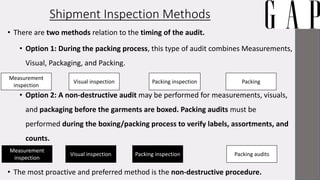
Shipment Inspection Methods
• There are two methods relation to the timing of the audit.
• Option 1: During the packing process, this type of audit combines Measurements,
Visual, Packaging, and Packing.
• Option 2: A non-destructive audit may be performed for measurements, visuals,
and packaging before the garments are boxed. Packing audits must be
performed during the boxing/packing process to verify labels, assortments, and
counts.
• The most proactive and preferred method is the non-destructive procedure.
Measurement
inspection
Visual inspection Packing inspection Packing
Measurement
inspection
Visual inspection Packing inspection Packing audits
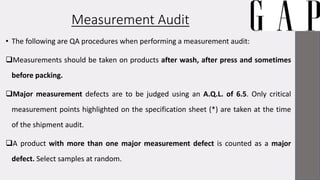
Measurement Audit
• The following are QA procedures when performing a measurement audit:
Measurements should be taken on products after wash, after press and sometimes
before packing.
Major measurement defects are to be judged using an A.Q.L. of 6.5. Only critical
measurement points highlighted on the specification sheet (*) are taken at the time
of the shipment audit.
A product with more than one major measurement defect is counted as a major
defect. Select samples at random.
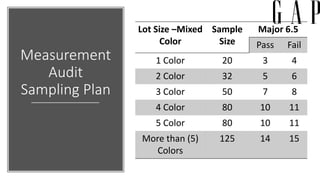
Measurement
Audit
Sampling Plan
Lot Size –Mixed
Color
Sample
Size
Major 6.5
Pass Fail
1 Color 20 3 4
2 Color 32 5 6
3 Color 50 7 8
4 Color 80 10 11
5 Color 80 10 11
More than (5)
Colors
125 14 15
Pass/Fail Levels for Minor Measurement
Defects
For woven and knit items, 10% of measurement points pass if
found to be out of tolerance, but not exceeding the grade
• (e.g. If there are 9 measurement points on a pant and 32
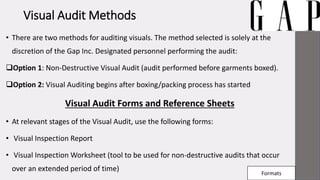
Visual Audit Methods
• There are two methods for auditing visuals. The method selected is solely at the
discretion of the Gap Inc. Designated personnel performing the audit:
Option 1: Non-Destructive Visual Audit (audit performed before garments boxed).
Option 2: Visual Auditing begins after boxing/packing process has started
Visual Audit Forms and Reference Sheets
• At relevant stages of the Visual Audit, use the following forms:
• Visual Inspection Report
• Visual Inspection Worksheet (tool to be used for non-destructive audits that occur
over an extended period of time)
Formats
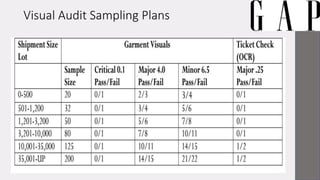
Visual Audit Sampling Plans
Visual Audit Procedures
• When this visual audit procedure is employed, the Gap representative must insure immediate
corrective action
1. Critical visual defects are based on an A.Q.L. of 0.1 for all divisions. Critical visual defects are
defined as defects that may cause bodily injury to the wearer. One critical defect found
during the shipment audit would cause the audit to fail. All the goods in a fail audit must be
re-inspected 100% by factory to remove all critical defective items prior to been audited
again by Gap field auditor or its appointed agent.
2. OCR/Ticket/Label Check is based on a 0.25 AQL.
3. Major visual defects are based upon an A.Q.L. of 4.0 for Gap Divisions and Old Navy,2.5 for
Banana Republic
4. Minor visual defects are based upon an A.Q.L. of 6.5 for all divisions
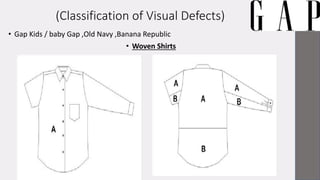
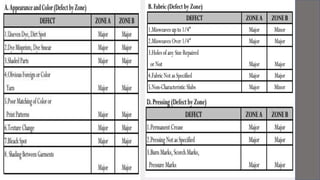
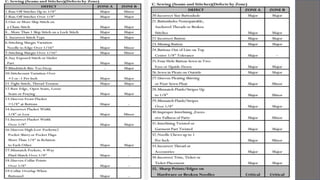
(Classification of Visual Defects)
• Gap Kids / baby Gap ,Old Navy ,Banana Republic
• Woven Shirts
Pack Audit
Gap Inc. QA or those designated by Gap Inc. to perform shipment audits, will be responsible for a 10%
assessment of this factory/vendor audit.
Major Defects for Pack Audits
a) Incorrect quantity
b) Carton labeling errors
c) Incorrect Pre-Pack
• · Assortments
• · Amounts
• · Pre-Pack Stickers
d) Carton not as specified (size and construction)
e) Crushed or damaged cartons
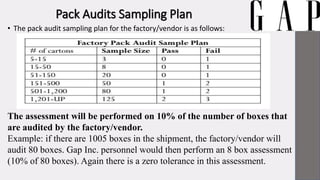
Pack Audits Sampling Plan
• The pack audit sampling plan for the factory/vendor is as follows:
The assessment will be performed on 10% of the number of boxes that
are audited by the factory/vendor.
Example: if there are 1005 boxes in the shipment, the factory/vendor will
audit 80 boxes. Gap Inc. personnel would then perform an 8 box assessment
(10% of 80 boxes). Again there is a zero tolerance in this assessment.
Safety Procedures
• It is mandatory that all raw materials, trim components, and actual production garments be
evaluated by a Gap, Inc. approved testing laboratory. The following are QA procedures when
performing a Safety audit:
• Check factory Needle Control Procedure Log; sign and date log.
• Check needle detector if factory has one. Check date of machine’s last service and calibration. Test
machine and it’s sensitivity adjustment.
• Check for lock-stitch button machines. If they have lock-stitch, verify they have enough machines to
handle production requirements, using the Pull Test.
• Check snap equipment and parts to make sure they are on the approved list of suppliers. Make sure
pneumatic and electric press equipment is made by an approved snap vendor.
• Hand/foot press or flywheel equipment is not allowed. Refer to the Snap Attachment SOP for further
instruction.
Broken Needle Standards
The following are Needle procedures for vendors when manufacturing garment:
When needles break, every effort must be made to locate all fragments.
 If all fragments cannot be found, component or garment must be
destroyed.
 Breakage must be recorded in the broken needle log.
 Broken or used needles should not be around machines or on factory floor.
 Pins, staples, wire or metal clips should not be used in the bundling,
sewing or laundry process.
Reference
• Quality Assurance Manual, ©Gap Inc., February 2001 Doreen Maller
Vice President, Technical Services/Product Integrity/Global QA
• www.gapinc.com
Gap inc. quality assurance manual

Gap inc. quality assurance manual

  • 1.
    BAHIR DAR UNIVERSITY ETHIOPIANINSTIUTE OF TEXTILE AND FASHION TECHNOLOGY (EITEX) GAP Inc. Quality Assurance manual Prepared by ►KIBROM G/HER M.Sc. Fashion Technology Nov 10,2018
  • 2.
    WELCOM E Prepared by KibromG/her about history Subsidiari es Custom er Product s Product s
  • 3.
    about history Subsidiari es Custom er Product s Product s • GapInc. was founded in August 21, 1969 • by Donald and Doris Fisher • San Francisco, California • The gap referring the generation gap between the boomer and silent generation “I created Gap with a simple idea: to make it easier to find a pair of jeans. We remain committed to that basic principle.” - Don Fisher, Gap Inc. Founder and Chairman Emeritus Donald and Doris Fisher
  • 4.
  • 5.
    about history Subsidiari es Custom er Product Product s Gap Incorporate (GAPInc.). is one of the world’s leading global specialty apparel retailers, offering clothing, accessories, and personal care products for men, women, children, and babies under its brands – Gap, Banana Republic, Old Navy and Athleta
  • 6.
  • 7.
    about history timeline Custom er Product s Product s Men Categories • Jeans •Pants • Shorts • Swim • Outerwear & Blazers • T-Shirts & Polos • Graphic T-Shirts • Shirts • Sweaters • Sweatshirts & Hoodies • Underwear WOMEN CATEGORIES • Jeans • Pants • Skirts • Dresses & Jumpsuits • Shorts • Shirts • Sweater • T-Shirts & Tops • Sweatshirts • Outerwear & Blazers • Swim GIRLS &BOYS CATEGORIES •JEANS •PANTS •T-SHIRTS & GRAPHICS •SHIRTS & POLOS •SWEATERS •SWEATSHIRTS & SWEATPANTS •OUTERWEAR & JACKETS •COLD WEATHER ACCESSORIES •UNIFORM •SHORTS •SWIM •SLEEPWEAR •SHOES •BACKPACKS & ACCESSORIES •SOCKS & UNDERWEAR
  • 8.
  • 9.
    Gap Inc.’s Qualitypolicy “Gap Inc.'s policies on quality of apparel products are develops by define various measure and by setting standard that vendor to meet or exceed when shipping every purchase order to GAP Inc.”
  • 10.
    Gap Inc.’s A.Q.L.Standards • Gap Inc.’s A.Q.L. standards when evaluating a vendor’s manufacturing process during shipment audits are as follows:  0.1 for evaluating Critical Visual Defects  0.25 for OCR/Ticket Defects  4.0 or 2.5 for evaluating Major Visual Defects (varies by division)  6.5 for evaluating Minor Visual Defects  6.5 for evaluating Major Measurement Defects
  • 11.
    Critical Defects • ACritical Defect is defined as anything potentially harmful to the product user. • A Critical Defect can be,  broken needles  loose components or other foreign items which are potentially harmful.  Improper or inaccurate country of origin or fiber  The AQL for evaluating Critical Measurement Defects is 0.1.
  • 12.
    In-process Inspection • Thepurpose of an In-Process inspection is to check the following: • Raw Materials, Marker Layout, Spreading ,Cutting And Sewing, Wet Processing Screen Printing, Pressing And Other Embellishments. . • The number of defects found during a cutting, measurement or visual inspection should be noted on the various In-Process reports. In order to identify the potential problems • In-Process Inspection Forms 1. In-Process Inspection Report 2. In-Process Audit Worksheet Formats
  • 13.
    Cutting Inspection Procedures •Thefollowing are QA procedures when performing an In-Process cutting inspection:  Verify and record fabric test reports.  Before and After cutting, perform visual and measurement
  • 14.
    Trim & SewingInspection Procedures • The following are QA procedures when performing an In-Process inspection:  All fabric/components/trims/labels should be checked against production approved standards, and must reflect correct origin and fiber/component content. Review and record all required Gap, Inc. fabric/component/product test reports.  Verify needle control and safety procedures are being followed.  Measure placement and size of pattern pieces against specification sheet.  Check seam construction, thread color and size against specification sheet.
  • 15.
    cont.……… •Example : Knittingpanel inspection must be conducted at the intervals listed below depending on the size of a program: 1. Up to 5,000 pieces. At least one in-Process audit must be conducted when the knitting of 20% of the panels completed. 2.5,001 to 10,000 pieces. At least two In-Process audits must be conducted when the knitting of 20% and 50% completed. 3. Above 10,000 pieces. At least three In-Process audits must be
  • 16.
    Shipment Inspection • Thepurpose of A shipment inspection is to determine the quality of an order by its visual appearance, measurement to specifications and packing execution. • The shipment inspection is performed before the finished product is shipped. This is done in order to minimize the arrival of defective product to GAP INC Shipment inspection forms • At relevant stages of the shipment inspection use the following forms. • Visual inspection report • Box audit worksheet (optional) • Finished product measurement sheet Formats
  • 17.
    Shipment Inspection Methods •There are two methods relation to the timing of the audit. • Option 1: During the packing process, this type of audit combines Measurements, Visual, Packaging, and Packing. • Option 2: A non-destructive audit may be performed for measurements, visuals, and packaging before the garments are boxed. Packing audits must be performed during the boxing/packing process to verify labels, assortments, and counts. • The most proactive and preferred method is the non-destructive procedure. Measurement inspection Visual inspection Packing inspection Packing Measurement inspection Visual inspection Packing inspection Packing audits
  • 18.
    Measurement Audit • Thefollowing are QA procedures when performing a measurement audit: Measurements should be taken on products after wash, after press and sometimes before packing. Major measurement defects are to be judged using an A.Q.L. of 6.5. Only critical measurement points highlighted on the specification sheet (*) are taken at the time of the shipment audit. A product with more than one major measurement defect is counted as a major defect. Select samples at random.
  • 19.
    Measurement Audit Sampling Plan Lot Size–Mixed Color Sample Size Major 6.5 Pass Fail 1 Color 20 3 4 2 Color 32 5 6 3 Color 50 7 8 4 Color 80 10 11 5 Color 80 10 11 More than (5) Colors 125 14 15
  • 20.
    Pass/Fail Levels forMinor Measurement Defects For woven and knit items, 10% of measurement points pass if found to be out of tolerance, but not exceeding the grade • (e.g. If there are 9 measurement points on a pant and 32
  • 21.
    Visual Audit Methods •There are two methods for auditing visuals. The method selected is solely at the discretion of the Gap Inc. Designated personnel performing the audit: Option 1: Non-Destructive Visual Audit (audit performed before garments boxed). Option 2: Visual Auditing begins after boxing/packing process has started Visual Audit Forms and Reference Sheets • At relevant stages of the Visual Audit, use the following forms: • Visual Inspection Report • Visual Inspection Worksheet (tool to be used for non-destructive audits that occur over an extended period of time) Formats
  • 22.
  • 23.
    Visual Audit Procedures •When this visual audit procedure is employed, the Gap representative must insure immediate corrective action 1. Critical visual defects are based on an A.Q.L. of 0.1 for all divisions. Critical visual defects are defined as defects that may cause bodily injury to the wearer. One critical defect found during the shipment audit would cause the audit to fail. All the goods in a fail audit must be re-inspected 100% by factory to remove all critical defective items prior to been audited again by Gap field auditor or its appointed agent. 2. OCR/Ticket/Label Check is based on a 0.25 AQL. 3. Major visual defects are based upon an A.Q.L. of 4.0 for Gap Divisions and Old Navy,2.5 for Banana Republic 4. Minor visual defects are based upon an A.Q.L. of 6.5 for all divisions
  • 24.
    (Classification of VisualDefects) • Gap Kids / baby Gap ,Old Navy ,Banana Republic • Woven Shirts
  • 27.
    Pack Audit Gap Inc.QA or those designated by Gap Inc. to perform shipment audits, will be responsible for a 10% assessment of this factory/vendor audit. Major Defects for Pack Audits a) Incorrect quantity b) Carton labeling errors c) Incorrect Pre-Pack • · Assortments • · Amounts • · Pre-Pack Stickers d) Carton not as specified (size and construction) e) Crushed or damaged cartons
  • 28.
    Pack Audits SamplingPlan • The pack audit sampling plan for the factory/vendor is as follows: The assessment will be performed on 10% of the number of boxes that are audited by the factory/vendor. Example: if there are 1005 boxes in the shipment, the factory/vendor will audit 80 boxes. Gap Inc. personnel would then perform an 8 box assessment (10% of 80 boxes). Again there is a zero tolerance in this assessment.
  • 29.
    Safety Procedures • Itis mandatory that all raw materials, trim components, and actual production garments be evaluated by a Gap, Inc. approved testing laboratory. The following are QA procedures when performing a Safety audit: • Check factory Needle Control Procedure Log; sign and date log. • Check needle detector if factory has one. Check date of machine’s last service and calibration. Test machine and it’s sensitivity adjustment. • Check for lock-stitch button machines. If they have lock-stitch, verify they have enough machines to handle production requirements, using the Pull Test. • Check snap equipment and parts to make sure they are on the approved list of suppliers. Make sure pneumatic and electric press equipment is made by an approved snap vendor. • Hand/foot press or flywheel equipment is not allowed. Refer to the Snap Attachment SOP for further instruction.
  • 30.
    Broken Needle Standards Thefollowing are Needle procedures for vendors when manufacturing garment: When needles break, every effort must be made to locate all fragments.  If all fragments cannot be found, component or garment must be destroyed.  Breakage must be recorded in the broken needle log.  Broken or used needles should not be around machines or on factory floor.  Pins, staples, wire or metal clips should not be used in the bundling, sewing or laundry process.
  • 31.
    Reference • Quality AssuranceManual, ©Gap Inc., February 2001 Doreen Maller Vice President, Technical Services/Product Integrity/Global QA • www.gapinc.com

Editor's Notes

  • #11 What is A.Q.L.? Acceptable Quality Level is the quality level, which, for purposes of sampling inspection, is the limit of a satisfactory manufacturing process.
  • #12 Visual If a Critical Visual Defect is found during an audit, the audit automatically fails and requires the entire lot to be inspected. All Critical Visual Defects must be removed before the lot can be submitted for a second audit. If a critical measurement defect is found during an audit, the audit automatically fails and requires the entire lot to be inspected is greater than tolerance on the plus (+) side will be considered a critical measurement defect that is less than tolerance on the minus (-) side, are not considered Critical defects but as minors or majors as stated in the measurement audit procedures.