BAHIR DAR UNIVERSITY
ETHIOPIAN INSTIUTE OF TEXTILE AND FASHION TECHNOLOGY
(EITEX)
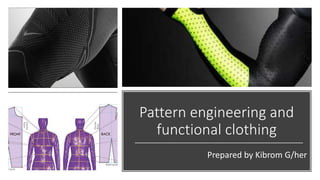
Pattern engineering and functional clothing
Prepared by
►KIBROM G/HER
M.Sc. Fashion Technology
Jan 31,2019
Pattern engineering and
functional clothing
Prepared by Kibrom G/her
Content
Introduction
Factor affecting pattern engineering
Functional clothing
Conclusion
Reference
Introduction
• Clothing is used for covering human body to fulfill the requirements
of those bodies with the object of protection, decoration and
identification. But also, garment can be used for a specific purpose
or function. The process of designing of a functional clothing depend
on the end user requirements.
• Pattern engineering for functional clothing involves applying of
patterns to modify and develop pattern technical, scientific and
mathematical knowledge with the objective of developing a garment
which meets the function specific requirements, is comfortable to
wear and contributes to maximize the efficiency and performance of
the wearer.
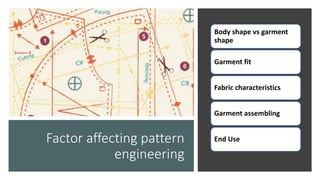
Factor affecting pattern
engineering
Body shape vs garment
shape
Garment fit
Fabric characteristics
Garment assembling
End Use
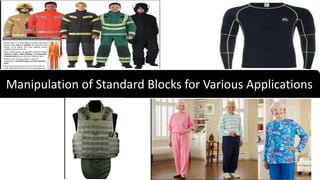
Manipulation of Standard Blocks for Various Applications
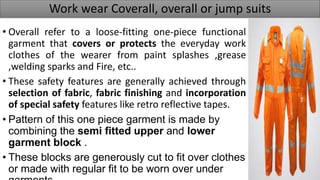
Work wear Coverall, overall or jump suits
• Overall refer to a loose-fitting one-piece functional
garment that covers or protects the everyday work
clothes of the wearer from paint splashes ,grease
,welding sparks and Fire, etc..
• These safety features are generally achieved through
selection of fabric, fabric finishing and incorporation
of special safety features like retro reflective tapes.
• Pattern of this one piece garment is made by
combining the semi fitted upper and lower
garment block .
• These blocks are generously cut to fit over clothes
or made with regular fit to be worn over under
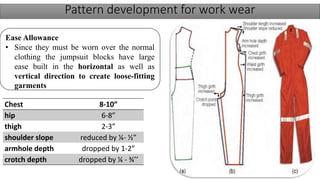
Pattern development for work wear
Ease Allowance
• Since they must be worn over the normal
clothing the jumpsuit blocks have large
ease built in the horizontal as well as
vertical direction to create loose-fitting
garments
Chest 8-10”
hip 6-8”
thigh 2-3”
shoulder slope reduced by ¼- ½”
armhole depth dropped by 1-2”
crotch depth dropped by ¼ - ¾’’
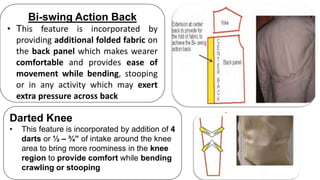
Bi-swing Action Back
• This feature is incorporated by
providing additional folded fabric on
the back panel which makes wearer
comfortable and provides ease of
movement while bending, stooping
or in any activity which may exert
extra pressure across back
Darted Knee
• This feature is incorporated by addition of 4
darts or ½ – ¾” of intake around the knee
area to bring more roominess in the knee
region to provide comfort while bending
crawling or stooping
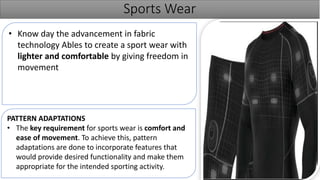
• Know day the advancement in fabric
technology Ables to create a sport wear with
lighter and comfortable by giving freedom in
movement
Sports Wear
PATTERN ADAPTATIONS
• The key requirement for sports wear is comfort and
ease of movement. To achieve this, pattern
adaptations are done to incorporate features that
would provide desired functionality and make them
appropriate for the intended sporting activity.
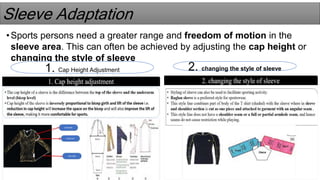
Sleeve Adaptation
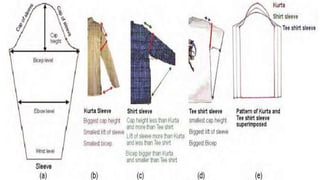
•Sports persons need a greater range and freedom of motion in the
sleeve area. This can often be achieved by adjusting the cap height or
changing the style of sleeve
1. Cap Height Adjustment 2. changing the style of sleeve
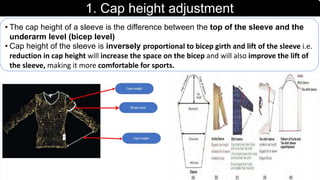
• The cap height of a sleeve is the difference between the top of the sleeve and the
underarm level (bicep level)
• Cap height of the sleeve is inversely proportional to bicep girth and lift of the sleeve i.e.
reduction in cap height will increase the space on the bicep and will also improve the lift of
the sleeve, making it more comfortable for sports.
1. Cap height adjustment
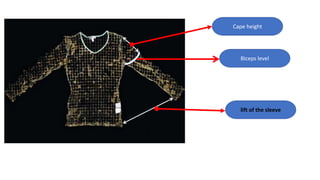
Cape height
lift of the sleeve
Biceps level
2. changing the style of sleeve
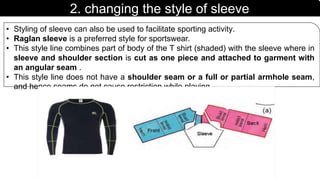
• Styling of sleeve can also be used to facilitate sporting activity.
• Raglan sleeve is a preferred style for sportswear.
• This style line combines part of body of the T shirt (shaded) with the sleeve where in
sleeve and shoulder section is cut as one piece and attached to garment with
an angular seam .
• This style line does not have a shoulder seam or a full or partial armhole seam,
and hence seams do not cause restriction while playing.
Bullet Proof Jacket
• The quality and precision in design, fit,
silhouette, material, and construction
can be critical in saving life of an
individual in this specialized functional
garment
• A lot of pattern manipulation is required
to meet the desired specifications. Bullet
proof jackets are required to have enough
room between the shell and lining so
that the typical features like hard armor
panel, soft armor panel and trauma
pads can be accommodated
Pattern manipulation
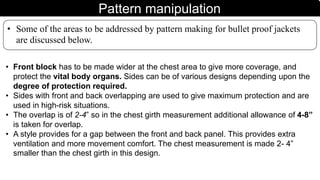
• Some of the areas to be addressed by pattern making for bullet proof jackets
are discussed below.
• Front block has to be made wider at the chest area to give more coverage, and
protect the vital body organs. Sides can be of various designs depending upon the
degree of protection required.
• Sides with front and back overlapping are used to give maximum protection and are
used in high-risk situations.
• The overlap is of 2-4” so in the chest girth measurement additional allowance of 4-8”
is taken for overlap.
• A style provides for a gap between the front and back panel. This provides extra
ventilation and more movement comfort. The chest measurement is made 2- 4”
smaller than the chest girth in this design.
Clothing for Elderly
• The design of clothing for the elderly requires
attention to the bodily changes resulting from
ageing and incorporating functional adjustment
which would make garments more comfortable,
easily usable, enhance safety and adapt to their
limitations in movement.
• Stooping posture of their body leads to garment hanging in front and
riding high from the back
• To accommodate this, the center back (CB) length in the pattern is
increased by 2-4’’
• Comfort of movement is provided by incorporating yokes, gathers
and pleats
• Sleeves are also made with reduced cap height to increase comfort on
bicep and improve lift
Conclusion
•pattern engineering as the first step of planning a
purposeful, efficient and aesthetic functional garment.
•It shows how the techniques of pattern engineering
can be used to find solutions to challenges posed by
the anthropometry of the human body
•These techniques are used to generate the blueprint of
a functional garment incorporating all functional and
aesthetic components.
1. Armstrong Helen Joseph, Patternmaking for Fashion Design, 4th
end (Pearson Education & Dorling Kindersley, Delhi, India),
2009.
2. Mahjabeen Ahmad, Standardization of reduction allowance for
stretch fabrics, Research Project (NIFT New Delhi) 2010.
3. Martin Shoben & Janet Ward, Pattern Cutting and Making Up,
rev edn, (Butterworth-Heinemann), 1987
4. Winifred Aldrich, Metric Pattern Cutting, 3rd edn (Blackwell
Science Ltd, UK), 1994.
5. Kothari Piyush & Mahajan Rahul, Development of Bulletproof
Jacket for Indian Military at Yamuna International, NOIDA,
Diploma Project (NIFT, New Delhi), 2005
6. Trehan Noopur, Clothing for the Elderly Consumer, Masters
References
Thank you Question time

Pattern engineering and functional clothing

  • 1.
    BAHIR DAR UNIVERSITY ETHIOPIANINSTIUTE OF TEXTILE AND FASHION TECHNOLOGY (EITEX) Pattern engineering and functional clothing Prepared by ►KIBROM G/HER M.Sc. Fashion Technology Jan 31,2019
  • 2.
    Pattern engineering and functionalclothing Prepared by Kibrom G/her
  • 3.
    Content Introduction Factor affecting patternengineering Functional clothing Conclusion Reference
  • 4.
    Introduction • Clothing isused for covering human body to fulfill the requirements of those bodies with the object of protection, decoration and identification. But also, garment can be used for a specific purpose or function. The process of designing of a functional clothing depend on the end user requirements. • Pattern engineering for functional clothing involves applying of patterns to modify and develop pattern technical, scientific and mathematical knowledge with the objective of developing a garment which meets the function specific requirements, is comfortable to wear and contributes to maximize the efficiency and performance of the wearer.
  • 5.
    Factor affecting pattern engineering Bodyshape vs garment shape Garment fit Fabric characteristics Garment assembling End Use
  • 6.
    Manipulation of StandardBlocks for Various Applications
  • 7.
    Work wear Coverall,overall or jump suits • Overall refer to a loose-fitting one-piece functional garment that covers or protects the everyday work clothes of the wearer from paint splashes ,grease ,welding sparks and Fire, etc.. • These safety features are generally achieved through selection of fabric, fabric finishing and incorporation of special safety features like retro reflective tapes. • Pattern of this one piece garment is made by combining the semi fitted upper and lower garment block . • These blocks are generously cut to fit over clothes or made with regular fit to be worn over under
  • 8.
    Pattern development forwork wear Ease Allowance • Since they must be worn over the normal clothing the jumpsuit blocks have large ease built in the horizontal as well as vertical direction to create loose-fitting garments Chest 8-10” hip 6-8” thigh 2-3” shoulder slope reduced by ¼- ½” armhole depth dropped by 1-2” crotch depth dropped by ¼ - ¾’’
  • 9.
    Bi-swing Action Back •This feature is incorporated by providing additional folded fabric on the back panel which makes wearer comfortable and provides ease of movement while bending, stooping or in any activity which may exert extra pressure across back Darted Knee • This feature is incorporated by addition of 4 darts or ½ – ¾” of intake around the knee area to bring more roominess in the knee region to provide comfort while bending crawling or stooping
  • 10.
    • Know daythe advancement in fabric technology Ables to create a sport wear with lighter and comfortable by giving freedom in movement Sports Wear PATTERN ADAPTATIONS • The key requirement for sports wear is comfort and ease of movement. To achieve this, pattern adaptations are done to incorporate features that would provide desired functionality and make them appropriate for the intended sporting activity.
  • 11.
    Sleeve Adaptation •Sports personsneed a greater range and freedom of motion in the sleeve area. This can often be achieved by adjusting the cap height or changing the style of sleeve 1. Cap Height Adjustment 2. changing the style of sleeve
  • 12.
    • The capheight of a sleeve is the difference between the top of the sleeve and the underarm level (bicep level) • Cap height of the sleeve is inversely proportional to bicep girth and lift of the sleeve i.e. reduction in cap height will increase the space on the bicep and will also improve the lift of the sleeve, making it more comfortable for sports. 1. Cap height adjustment
  • 13.
    Cape height lift ofthe sleeve Biceps level
  • 15.
    2. changing thestyle of sleeve • Styling of sleeve can also be used to facilitate sporting activity. • Raglan sleeve is a preferred style for sportswear. • This style line combines part of body of the T shirt (shaded) with the sleeve where in sleeve and shoulder section is cut as one piece and attached to garment with an angular seam . • This style line does not have a shoulder seam or a full or partial armhole seam, and hence seams do not cause restriction while playing.
  • 17.
    Bullet Proof Jacket •The quality and precision in design, fit, silhouette, material, and construction can be critical in saving life of an individual in this specialized functional garment • A lot of pattern manipulation is required to meet the desired specifications. Bullet proof jackets are required to have enough room between the shell and lining so that the typical features like hard armor panel, soft armor panel and trauma pads can be accommodated
  • 18.
    Pattern manipulation • Someof the areas to be addressed by pattern making for bullet proof jackets are discussed below. • Front block has to be made wider at the chest area to give more coverage, and protect the vital body organs. Sides can be of various designs depending upon the degree of protection required. • Sides with front and back overlapping are used to give maximum protection and are used in high-risk situations. • The overlap is of 2-4” so in the chest girth measurement additional allowance of 4-8” is taken for overlap. • A style provides for a gap between the front and back panel. This provides extra ventilation and more movement comfort. The chest measurement is made 2- 4” smaller than the chest girth in this design.
  • 19.
    Clothing for Elderly •The design of clothing for the elderly requires attention to the bodily changes resulting from ageing and incorporating functional adjustment which would make garments more comfortable, easily usable, enhance safety and adapt to their limitations in movement.
  • 20.
    • Stooping postureof their body leads to garment hanging in front and riding high from the back • To accommodate this, the center back (CB) length in the pattern is increased by 2-4’’ • Comfort of movement is provided by incorporating yokes, gathers and pleats • Sleeves are also made with reduced cap height to increase comfort on bicep and improve lift
  • 21.
    Conclusion •pattern engineering asthe first step of planning a purposeful, efficient and aesthetic functional garment. •It shows how the techniques of pattern engineering can be used to find solutions to challenges posed by the anthropometry of the human body •These techniques are used to generate the blueprint of a functional garment incorporating all functional and aesthetic components.
  • 22.
    1. Armstrong HelenJoseph, Patternmaking for Fashion Design, 4th end (Pearson Education & Dorling Kindersley, Delhi, India), 2009. 2. Mahjabeen Ahmad, Standardization of reduction allowance for stretch fabrics, Research Project (NIFT New Delhi) 2010. 3. Martin Shoben & Janet Ward, Pattern Cutting and Making Up, rev edn, (Butterworth-Heinemann), 1987 4. Winifred Aldrich, Metric Pattern Cutting, 3rd edn (Blackwell Science Ltd, UK), 1994. 5. Kothari Piyush & Mahajan Rahul, Development of Bulletproof Jacket for Indian Military at Yamuna International, NOIDA, Diploma Project (NIFT, New Delhi), 2005 6. Trehan Noopur, Clothing for the Elderly Consumer, Masters References
  • 23.