Welcome
To
My
Presentation
Presentation on
Industrial Training
Presented By:-
KHALED MD. RIDWAN
ID:-131-038-0-145
BATCH:-131(AMT-1)
B. Sc (Hon’s) on Apparel Manufacture &
Technology
HISTORY
• Pioneer in the garments sector since 1984.
• One of the largest apparel manufacturer in Bangladesh.
• Turn over :US $ 115 million for year the 2008 financial
year.
• 21 factories, 18,000 skilled workers & 6500 machines.
• 1.8 million sq. ft. of production , store and office area .
• Twice received “President’s best performance trophy”.
• Chosen as “Vendor of the Year” for Wal-Mart Canada for
last 3 consecutive years for the dept. of 23 & 26.
HISTORY
• International supplier of the year award: Wal-Mart (USA)
for the year 2004 & 2006.
• International supplier of the year award: 2007 & 2008
(from WM).
• International supplier of the year 2006 , for CSI .
• Number 1 vendor for GAP , in knits , out of the
subcontinent .
• Only vendor from Bangladesh to get Awarded Global
supplier of the year Trophy from Wal-Mart for the year
2007. Award presented by Mr. EDWIN KEY ( SVP & COO).
MANUFACTURING UNITS
• Ayesha Clothing Co. Ltd.
• Ayesha Fashion Ltd.
• Ayesha Washing Ltd.
• Aswad Knitting & Dyeing
Ltd.
• Aswad Garments unit.
• Al-Hamra Garments Ltd.
• Amazan Garments Ltd.
• Designer Line Pvt. Ltd.
• Marina Apparels Ltd.
• MK Dresses Ltd.
• Nafa Apparels Ltd.
• NKK Sweater Ltd.
• NKK Knitwear Ltd.
• Palmal Styles Ltd.
• Palmal Knitwear Factory Ltd.
• Palmal Dresses Ltd.
• Palmal Garments Ltd.
• Progati Fashion wear Ltd.
• Palmal Embroidery Ltd.
• Palmal Garments Hosiery
Ltd.
• Safaa Sweaters Ltd.
• Safaa Garments sewing unit.
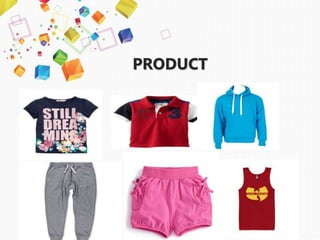
PRODUCT
BUYER
DEPARTMENTS
• Merchandising Department
• Sample Section
• Store section
• Lab test section
• Cutting section
• Sewing section
• Quality section
• Finishing section
• Final inspection section
• Compliance section
• Washing section
• Embroidery section
• Mechanical & Electrical section etc.
MERCHANDISING
• The person who does the
merchandising is a merchandiser. So,
we can say that merchandiser is a
person who engages himself or herself
in sourcing, costing, arranging &
promotion sales of any commodities as
per required standard.
THE RESPONSIBILITIES OF A
SMART MERCHANDISER
• Sourcing for future orders/Buyers
• New Order
• Confirmed Order
• Running Order.
BUSINESS DEVELOPMENT
PROCEDURE
• Buyer Selection
• Know about the nature of buyer
• First E-mail to the buyer
• Collect audit pass report from buyer
• Offer to buyer for visit the company
• Company arrange a meeting with
buyer for business
BUSINESS DEVELOPMENT PROCEDURE
• Sampling stage
• Price negotiation
• Price conforms and order place from buyer
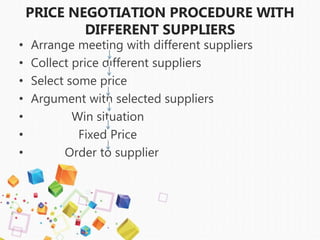
PRICE NEGOTIATION PROCEDURE WITH
DIFFERENT SUPPLIERS
• Arrange meeting with different suppliers
• Collect price different suppliers
• Select some price
• Argument with selected suppliers
• Win situation
• Fixed Price
• Order to supplier
SAMPLE
• Sample is nothing but a representation by
which a person can understand the
production, qualities, performance etc.
Sample can ensure a buyer as well as to
the customer about the pre and post
condition of the required product. It can
lead the market and the business as well.
• SAMPLING MAY BE DONE BY TWO
WAYS:-
• 1. Sampling after confirmation of price.
• 2. Sampling before confirmation of price.
DETAILS ATTACHED TO THE
GARMENT SAMPLE
• Ref no.
• Color
• Fabric
• Composition
• Description
• Quantity
• Style no/ size
TYPES
• Proto
• Fit sample
• Size set sample
• Top of production
• Salesman sample(sms)
• Preproduction sample
• Shipment sample
STORE ROOM
• A store room in which items are stored
• A room in which stores are kept
• Room or space for storage
TYPES
• Fabric store
• Trims & accessories store
• Finished goods store
DEFECTIVE MUCK UP FOR
ACCESSORIES
• Color bleed
• Double print
• Un clear letter
• Cut pcs problem
• Spot
• Wrong design
• Without print
IMPORTANCE OF STORE ROOM
MANAGEMENT
• Helps to smoothly run the industry
• Helps to ensure the quality of the product
• Helps to ensure timely delivery
• Helps to increase the productivity of the industry
• Helps to make industry profitable
• Helps to make the customer satisfied
• Helps to increase market share.
•
LAB TEST SECTION
• To confirm the actual quality of any fabric,
fabric testing has great importance. Types of tests
required for the fabric is confirmed by the buyer It may
vary from one buyer to another. As its importance, this
article has shown a details discussion on fabric testing.
• LIST OF SOME COMMON FABRIC TESTS
• G S M
• Torque
• Shrinkage
• Color fastness
• Fabric inspection
CUTTING ROOM
Garment production starts with the cutting
process. In this process, fabric is being cut into
components (shapes or patterns of different
garment parts, i.e. front, back, sleeve, collar
shapes etc.
METHODS OF MARKER MAKING
There are two different methods of marker
making followed in apparel industry Those
are-
(a) Manual method
(b) Computerized method
MARKER TYPES
• Regular-one garment’s one way.
• Line-when running shade appear in the
fabric,then garments part are placed in
line wise.
• Group- when running shade appear in
the fabric. Then garments part are
placed in group wise.
• One way- where all garments parts are
placed in one way.
Fabric spreading process
• Manual method and
• Mechanical method/automatic.
• ADVANTAGES OF MANUAL FABRIC
SPREADING
• Easy to operate.
• Investment low.
• Suitable for small scale garment industry.
SEWING SECTION
• After receive the garments
components from cutting section, all
the garments parts are joined and
sewn as sequentially. Obviously all the
components are sewn respects on
buyer requirement.
• Sewing section is the most important
department of a garment
manufacturing industry.
COMMON CAUSES AND REMEDIES OF
SEWING PROBLEMS
• Skipped stitch
• Unbalance stitch
• Variable stitch density
• Frequent thread breakage
• Problem of puckers
• Damage of fabrics on seam line
QUALITY
• This is fulfilling the customer
requirement and end user satisfaction.
There are a number of factors on which
quality fitness of garment industry is
based such as - performance,
reliability, durability, visual and
perceived quality of the garment.
DEFECT
• This is not fulfilling the customer
requirement and end user satisfaction.
Garment defects are also well known as
reject. Different types of defects are
found in the garment industry. In
garments industry these defects are
dependent upon the classification of
defects.
• TYPES
• CRITICAL
• MAJOR
• MINOR
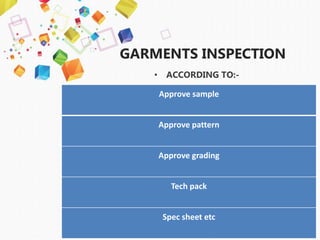
GARMENTS INSPECTION
• ACCORDING TO:-
Approve sample
Approve pattern
Approve grading
Tech pack
Spec sheet etc
GARMENT FINISHING
• Finishing is the last stage of packed
garments those are ready for sale.
Therefore, it is one of the most
important stage in whole
garments manufacturing process In a
garment industry section involves with
garment washing, checking, final
inspection, pressing, packing, etc.
Proper finishing process can be
improved quality of garments and
make on time order shipment.
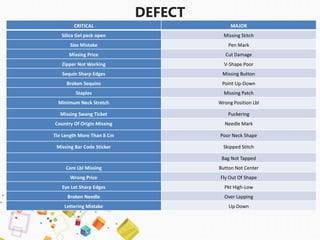
DEFECT
CRITICAL MAJOR
Silica Gel pack open Missing Stitch
Size Mistake Pen Mark
Missing Price Cut Damage
Zipper Not Working V-Shape Poor
Sequin Sharp Edges Missing Button
Broken Sequins Point Up-Down
Staples Missing Patch
Minimum Neck Stretch Wrong Position Lbl
Missing Swang Ticket Puckering
Country Of Origin Missing Needle Mark
Tie Length More Than 8 Cm Poor Neck Shape
Missing Bar Code Sticker Skipped Stitch
Bag Not Tapped
Care Lbl Missing Button Not Center
Wrong Price Fly Out Of Shape
Eye Let Sharp Edges Pkt High-Low
Broken Needle Over Lapping
Lettering Mistake Up Down
FINAL INSPECTION
• Final Inspection Is The Last Steps Of
Garment Inspection System. In This
Stage Complete Garments Are
Inspected By Buyer. Different Parts Of
Garments Are Inspected In This Stage
Such As Garments Main Fabric,
Accessories, Trims, Label, Fabric Faults
Etc. There Are Various Systems For
Final Inspection In The Garment
industry. Final Inspection Is Very
Important For An Export Order
Shipment.
GARMENTS WASH
• We are living in the fashionable era. Everyone
wants to wear a fashionable garments. As a
result the people can make the difference with
others. A basic garments and washed garments
is totally difference to look. At present, knitted
washed item is a hot-cake for the young
generation.
WASHING PROCESS
• Order receive
↓
• R & D department
↓
• Sample development
↓
• Q.C check(before wash)
↓
• Bulk production
↓
• Hydro
↓
• Dryer
↓
• Q.C check(after wash)
↓
• Waiting for delivery
TYPES
Dry process
• Hand scraping
• Whicker
• Chevron
• Tacking
• P.p spray
• Dye spray
• Pest spray
• Crinkle
• Destroy
• Grinding
• Resin coating
Wet process
• Normal wash
• Garments wash with softener silicon
• Enzyme wash
• Bleach wash
• Enzyme bleach wash
• Stone wash
• Enzyme stone wash
• Burn-out
• Acid
• Towel
• Reactive dye
• Direct dye
• Pigment dye
• Fluorescent dye
• Tie dye
• Dip dye
EMBROIDERY
• Embroidery is the handicraft of
decorating fabric or other materials
with needle and thread or yarn.
Embroidery may also incorporate other
materials such as, pearls, beads, quills,
and sequins. There are different types
of embroidery used in garments
TYPES
• Chenille embroidery
• Satin
• Tatami
• Applique
• Cross
• Run Etc.
DEVELOPMENT PROCESS
• Receive(art paper)
↓
• Design develop
↓
• Approval
↓
• Sample making
↓
• Bulk production
↓
• Quality check
↓
• Repair fault area
↓
• Ready for delivery
COMPLIANCE
• To get order ,a industry must follow some law
that is compliance .it’s the prime issue.
Compliance ensure all labor rights & facilities
according to the buyer code of conduct. The aim
of compliance is to maintain strictly the labor
law.
Different international
organization provide different
certificate based on garments
activities, such as:-
• ACCORD
• ALLIANCE
• BSCI
• WRAP
• LETIS
KEY ISSUES OF HR&
COMPLIANCE:
• Child labor.
• Forced labor.
• Harassment & abuse.
• Health & safety.
• Compensation & benefits.
• Working hours.
• Discrimination.
• Discipline.
• Trade union & collective bargaining.
• Environment.
BENEFITS TO THE WORKERS
• Palmal offering following benefits to the workers
• Festival bonus
• Performance bonus
• Doctor
• Free medicine
• Welfare fund
• Cultural program scheme
• Group insurance
• Transportation facilities.
• 8 hours working in a day etc
Industrial training(palmal)

Industrial training(palmal)

  • 2.
  • 3.
  • 4.
    Presented By:- KHALED MD.RIDWAN ID:-131-038-0-145 BATCH:-131(AMT-1) B. Sc (Hon’s) on Apparel Manufacture & Technology
  • 5.
    HISTORY • Pioneer inthe garments sector since 1984. • One of the largest apparel manufacturer in Bangladesh. • Turn over :US $ 115 million for year the 2008 financial year. • 21 factories, 18,000 skilled workers & 6500 machines. • 1.8 million sq. ft. of production , store and office area . • Twice received “President’s best performance trophy”. • Chosen as “Vendor of the Year” for Wal-Mart Canada for last 3 consecutive years for the dept. of 23 & 26.
  • 6.
    HISTORY • International supplierof the year award: Wal-Mart (USA) for the year 2004 & 2006. • International supplier of the year award: 2007 & 2008 (from WM). • International supplier of the year 2006 , for CSI . • Number 1 vendor for GAP , in knits , out of the subcontinent . • Only vendor from Bangladesh to get Awarded Global supplier of the year Trophy from Wal-Mart for the year 2007. Award presented by Mr. EDWIN KEY ( SVP & COO).
  • 7.
    MANUFACTURING UNITS • AyeshaClothing Co. Ltd. • Ayesha Fashion Ltd. • Ayesha Washing Ltd. • Aswad Knitting & Dyeing Ltd. • Aswad Garments unit. • Al-Hamra Garments Ltd. • Amazan Garments Ltd. • Designer Line Pvt. Ltd. • Marina Apparels Ltd. • MK Dresses Ltd. • Nafa Apparels Ltd. • NKK Sweater Ltd. • NKK Knitwear Ltd. • Palmal Styles Ltd. • Palmal Knitwear Factory Ltd. • Palmal Dresses Ltd. • Palmal Garments Ltd. • Progati Fashion wear Ltd. • Palmal Embroidery Ltd. • Palmal Garments Hosiery Ltd. • Safaa Sweaters Ltd. • Safaa Garments sewing unit.
  • 8.
  • 9.
  • 10.
    DEPARTMENTS • Merchandising Department •Sample Section • Store section • Lab test section • Cutting section • Sewing section • Quality section • Finishing section • Final inspection section • Compliance section • Washing section • Embroidery section • Mechanical & Electrical section etc.
  • 11.
    MERCHANDISING • The personwho does the merchandising is a merchandiser. So, we can say that merchandiser is a person who engages himself or herself in sourcing, costing, arranging & promotion sales of any commodities as per required standard.
  • 12.
    THE RESPONSIBILITIES OFA SMART MERCHANDISER • Sourcing for future orders/Buyers • New Order • Confirmed Order • Running Order.
  • 13.
    BUSINESS DEVELOPMENT PROCEDURE • BuyerSelection • Know about the nature of buyer • First E-mail to the buyer • Collect audit pass report from buyer • Offer to buyer for visit the company • Company arrange a meeting with buyer for business
  • 14.
    BUSINESS DEVELOPMENT PROCEDURE •Sampling stage • Price negotiation • Price conforms and order place from buyer
  • 15.
    PRICE NEGOTIATION PROCEDUREWITH DIFFERENT SUPPLIERS • Arrange meeting with different suppliers • Collect price different suppliers • Select some price • Argument with selected suppliers • Win situation • Fixed Price • Order to supplier
  • 16.
    SAMPLE • Sample isnothing but a representation by which a person can understand the production, qualities, performance etc. Sample can ensure a buyer as well as to the customer about the pre and post condition of the required product. It can lead the market and the business as well. • SAMPLING MAY BE DONE BY TWO WAYS:- • 1. Sampling after confirmation of price. • 2. Sampling before confirmation of price.
  • 17.
    DETAILS ATTACHED TOTHE GARMENT SAMPLE • Ref no. • Color • Fabric • Composition • Description • Quantity • Style no/ size
  • 18.
    TYPES • Proto • Fitsample • Size set sample • Top of production • Salesman sample(sms) • Preproduction sample • Shipment sample
  • 19.
    STORE ROOM • Astore room in which items are stored • A room in which stores are kept • Room or space for storage TYPES • Fabric store • Trims & accessories store • Finished goods store
  • 20.
    DEFECTIVE MUCK UPFOR ACCESSORIES • Color bleed • Double print • Un clear letter • Cut pcs problem • Spot • Wrong design • Without print
  • 21.
    IMPORTANCE OF STOREROOM MANAGEMENT • Helps to smoothly run the industry • Helps to ensure the quality of the product • Helps to ensure timely delivery • Helps to increase the productivity of the industry • Helps to make industry profitable • Helps to make the customer satisfied • Helps to increase market share. •
  • 22.
    LAB TEST SECTION •To confirm the actual quality of any fabric, fabric testing has great importance. Types of tests required for the fabric is confirmed by the buyer It may vary from one buyer to another. As its importance, this article has shown a details discussion on fabric testing. • LIST OF SOME COMMON FABRIC TESTS • G S M • Torque • Shrinkage • Color fastness • Fabric inspection
  • 23.
    CUTTING ROOM Garment productionstarts with the cutting process. In this process, fabric is being cut into components (shapes or patterns of different garment parts, i.e. front, back, sleeve, collar shapes etc. METHODS OF MARKER MAKING There are two different methods of marker making followed in apparel industry Those are- (a) Manual method (b) Computerized method
  • 24.
    MARKER TYPES • Regular-onegarment’s one way. • Line-when running shade appear in the fabric,then garments part are placed in line wise. • Group- when running shade appear in the fabric. Then garments part are placed in group wise. • One way- where all garments parts are placed in one way.
  • 25.
    Fabric spreading process •Manual method and • Mechanical method/automatic. • ADVANTAGES OF MANUAL FABRIC SPREADING • Easy to operate. • Investment low. • Suitable for small scale garment industry.
  • 26.
    SEWING SECTION • Afterreceive the garments components from cutting section, all the garments parts are joined and sewn as sequentially. Obviously all the components are sewn respects on buyer requirement. • Sewing section is the most important department of a garment manufacturing industry.
  • 27.
    COMMON CAUSES ANDREMEDIES OF SEWING PROBLEMS • Skipped stitch • Unbalance stitch • Variable stitch density • Frequent thread breakage • Problem of puckers • Damage of fabrics on seam line
  • 28.
    QUALITY • This isfulfilling the customer requirement and end user satisfaction. There are a number of factors on which quality fitness of garment industry is based such as - performance, reliability, durability, visual and perceived quality of the garment.
  • 29.
    DEFECT • This isnot fulfilling the customer requirement and end user satisfaction. Garment defects are also well known as reject. Different types of defects are found in the garment industry. In garments industry these defects are dependent upon the classification of defects. • TYPES • CRITICAL • MAJOR • MINOR
  • 30.
    GARMENTS INSPECTION • ACCORDINGTO:- Approve sample Approve pattern Approve grading Tech pack Spec sheet etc
  • 31.
    GARMENT FINISHING • Finishingis the last stage of packed garments those are ready for sale. Therefore, it is one of the most important stage in whole garments manufacturing process In a garment industry section involves with garment washing, checking, final inspection, pressing, packing, etc. Proper finishing process can be improved quality of garments and make on time order shipment.
  • 32.
    DEFECT CRITICAL MAJOR Silica Gelpack open Missing Stitch Size Mistake Pen Mark Missing Price Cut Damage Zipper Not Working V-Shape Poor Sequin Sharp Edges Missing Button Broken Sequins Point Up-Down Staples Missing Patch Minimum Neck Stretch Wrong Position Lbl Missing Swang Ticket Puckering Country Of Origin Missing Needle Mark Tie Length More Than 8 Cm Poor Neck Shape Missing Bar Code Sticker Skipped Stitch Bag Not Tapped Care Lbl Missing Button Not Center Wrong Price Fly Out Of Shape Eye Let Sharp Edges Pkt High-Low Broken Needle Over Lapping Lettering Mistake Up Down
  • 33.
    FINAL INSPECTION • FinalInspection Is The Last Steps Of Garment Inspection System. In This Stage Complete Garments Are Inspected By Buyer. Different Parts Of Garments Are Inspected In This Stage Such As Garments Main Fabric, Accessories, Trims, Label, Fabric Faults Etc. There Are Various Systems For Final Inspection In The Garment industry. Final Inspection Is Very Important For An Export Order Shipment.
  • 34.
    GARMENTS WASH • Weare living in the fashionable era. Everyone wants to wear a fashionable garments. As a result the people can make the difference with others. A basic garments and washed garments is totally difference to look. At present, knitted washed item is a hot-cake for the young generation.
  • 35.
    WASHING PROCESS • Orderreceive ↓ • R & D department ↓ • Sample development ↓ • Q.C check(before wash) ↓ • Bulk production ↓ • Hydro ↓ • Dryer ↓ • Q.C check(after wash) ↓ • Waiting for delivery
  • 36.
    TYPES Dry process • Handscraping • Whicker • Chevron • Tacking • P.p spray • Dye spray • Pest spray • Crinkle • Destroy • Grinding • Resin coating Wet process • Normal wash • Garments wash with softener silicon • Enzyme wash • Bleach wash • Enzyme bleach wash • Stone wash • Enzyme stone wash • Burn-out • Acid • Towel • Reactive dye • Direct dye • Pigment dye • Fluorescent dye • Tie dye • Dip dye
  • 37.
    EMBROIDERY • Embroidery isthe handicraft of decorating fabric or other materials with needle and thread or yarn. Embroidery may also incorporate other materials such as, pearls, beads, quills, and sequins. There are different types of embroidery used in garments
  • 38.
    TYPES • Chenille embroidery •Satin • Tatami • Applique • Cross • Run Etc.
  • 39.
    DEVELOPMENT PROCESS • Receive(artpaper) ↓ • Design develop ↓ • Approval ↓ • Sample making ↓ • Bulk production ↓ • Quality check ↓ • Repair fault area ↓ • Ready for delivery
  • 40.
    COMPLIANCE • To getorder ,a industry must follow some law that is compliance .it’s the prime issue. Compliance ensure all labor rights & facilities according to the buyer code of conduct. The aim of compliance is to maintain strictly the labor law.
  • 41.
    Different international organization providedifferent certificate based on garments activities, such as:- • ACCORD • ALLIANCE • BSCI • WRAP • LETIS
  • 42.
    KEY ISSUES OFHR& COMPLIANCE: • Child labor. • Forced labor. • Harassment & abuse. • Health & safety. • Compensation & benefits. • Working hours. • Discrimination. • Discipline. • Trade union & collective bargaining. • Environment.
  • 43.
    BENEFITS TO THEWORKERS • Palmal offering following benefits to the workers • Festival bonus • Performance bonus • Doctor • Free medicine • Welfare fund • Cultural program scheme • Group insurance • Transportation facilities. • 8 hours working in a day etc