Application area of Computer Technology in Apparel Manufacturing
This document discusses the application of computers in apparel manufacturing. It covers:
1. Major applications of computers in the textile industry including research and development, production planning, quality control, and more.
2. The purposes of applying computers in textiles which are to understand computer systems in textile processing, learn programming and software tools, and apply computer knowledge to textile processes.
3. The scope of computer-based technology for textile applications includes CAD for design, CAM for manufacturing, CIM for integrated manufacturing, CAE for engineering, and CAT for testing. E-textiles that integrate electronics into fabrics are also discussed.
Application area of Computer Technology in Apparel Manufacturing
1.
Application of Computersin
Apparel Manufacturing
Aiasha Siddiqua
Lecturer
Ahsanullah University of Science and Technology
Email- aiashasiddiqua2852@gmail.com
aiashasiddiqua.te@aust.edu
2.
Computer application indifferent sectors of textile technology:
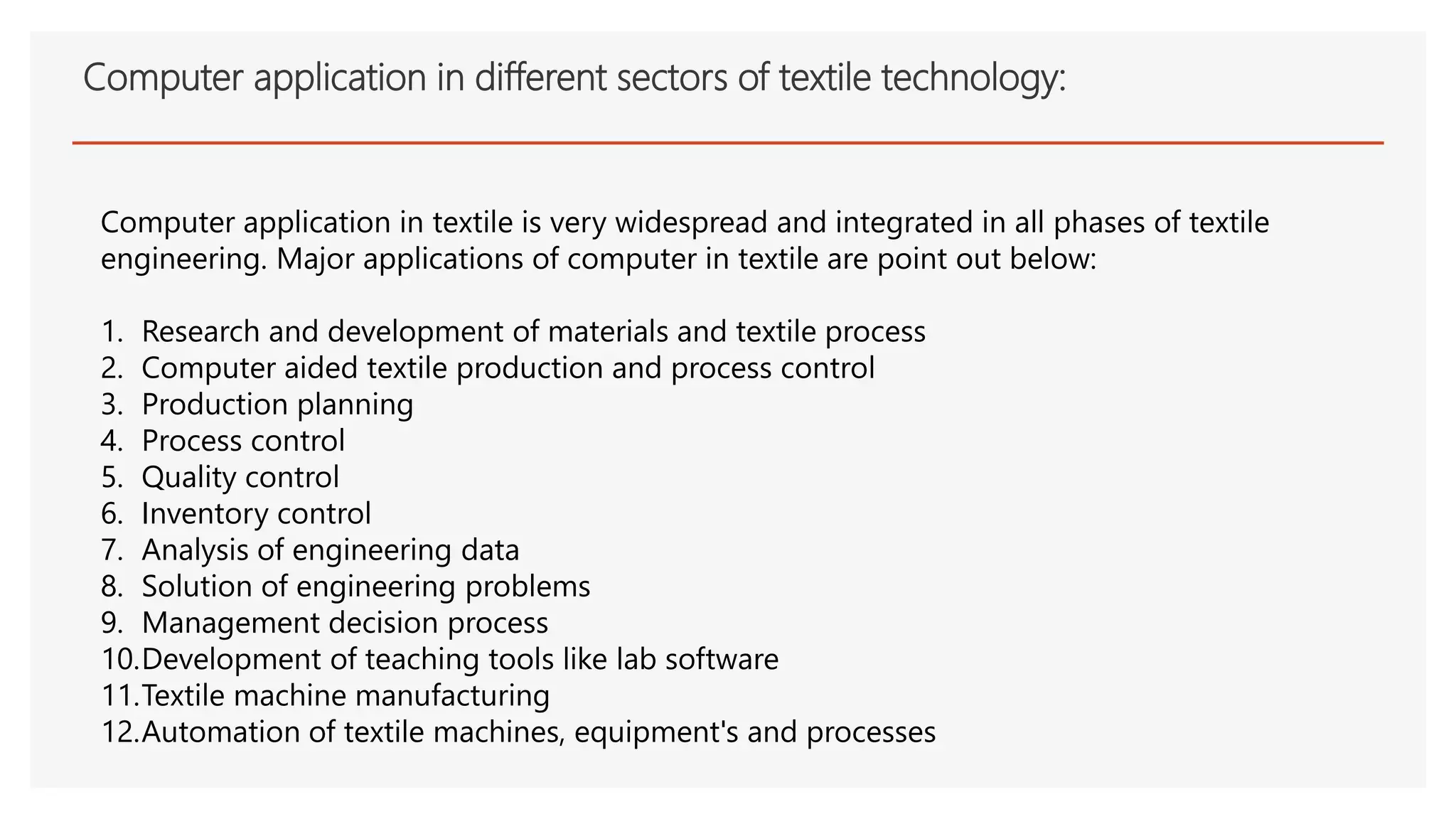
Computer application in textile is very widespread and integrated in all phases of textile
engineering. Major applications of computer in textile are point out below:
1. Research and development of materials and textile process
2. Computer aided textile production and process control
3. Production planning
4. Process control
5. Quality control
6. Inventory control
7. Analysis of engineering data
8. Solution of engineering problems
9. Management decision process
10.Development of teaching tools like lab software
11.Textile machine manufacturing
12.Automation of textile machines, equipment's and processes
3.
Purposes of applicationof computer in textile (ACT):
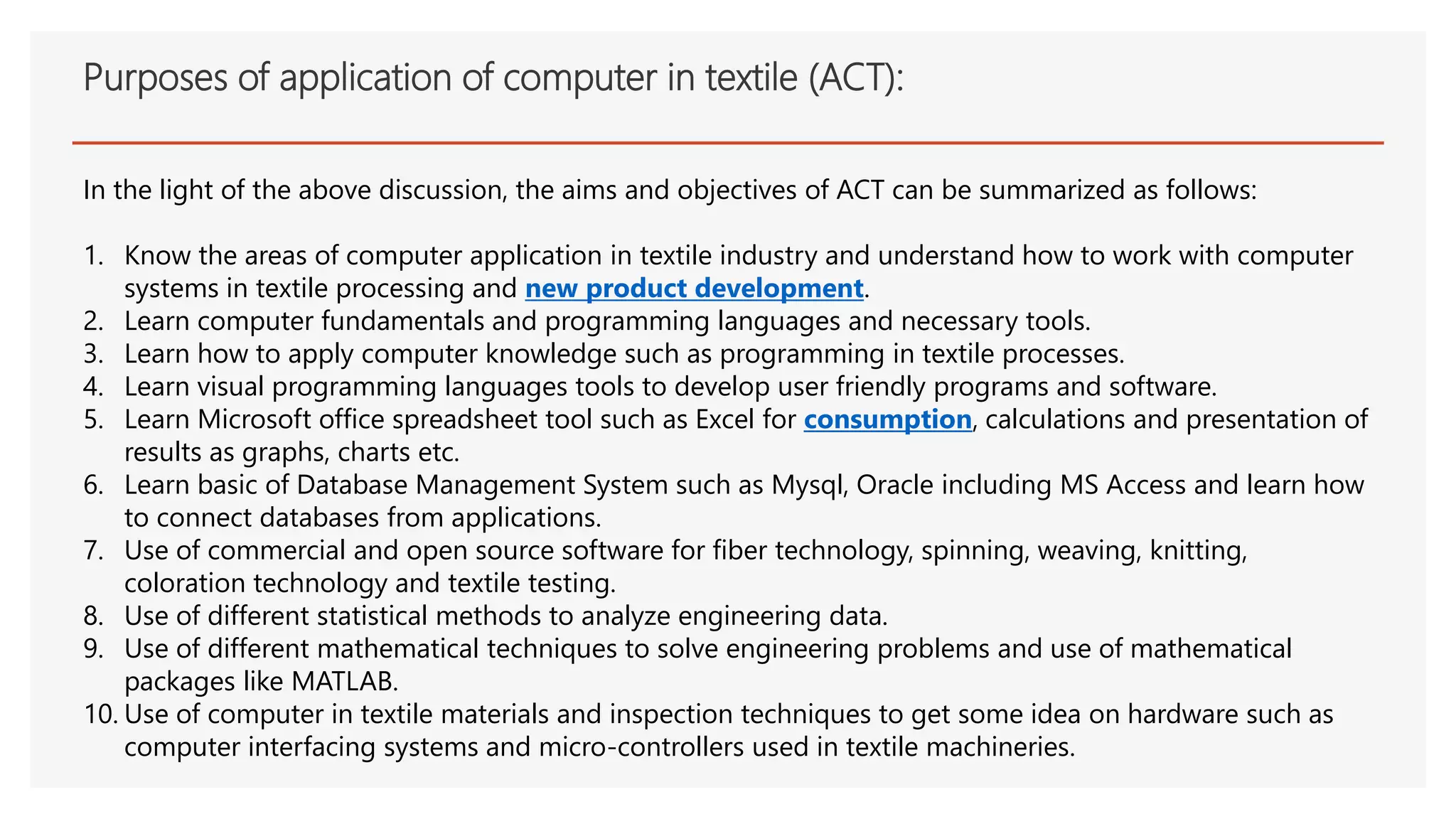
In the light of the above discussion, the aims and objectives of ACT can be summarized as follows:
1. Know the areas of computer application in textile industry and understand how to work with computer
systems in textile processing and new product development.
2. Learn computer fundamentals and programming languages and necessary tools.
3. Learn how to apply computer knowledge such as programming in textile processes.
4. Learn visual programming languages tools to develop user friendly programs and software.
5. Learn Microsoft office spreadsheet tool such as Excel for consumption, calculations and presentation of
results as graphs, charts etc.
6. Learn basic of Database Management System such as Mysql, Oracle including MS Access and learn how
to connect databases from applications.
7. Use of commercial and open source software for fiber technology, spinning, weaving, knitting,
coloration technology and textile testing.
8. Use of different statistical methods to analyze engineering data.
9. Use of different mathematical techniques to solve engineering problems and use of mathematical
packages like MATLAB.
10. Use of computer in textile materials and inspection techniques to get some idea on hardware such as
computer interfacing systems and micro-controllers used in textile machineries.
4.
Scope of ComputerBased Technology for Textile Application:
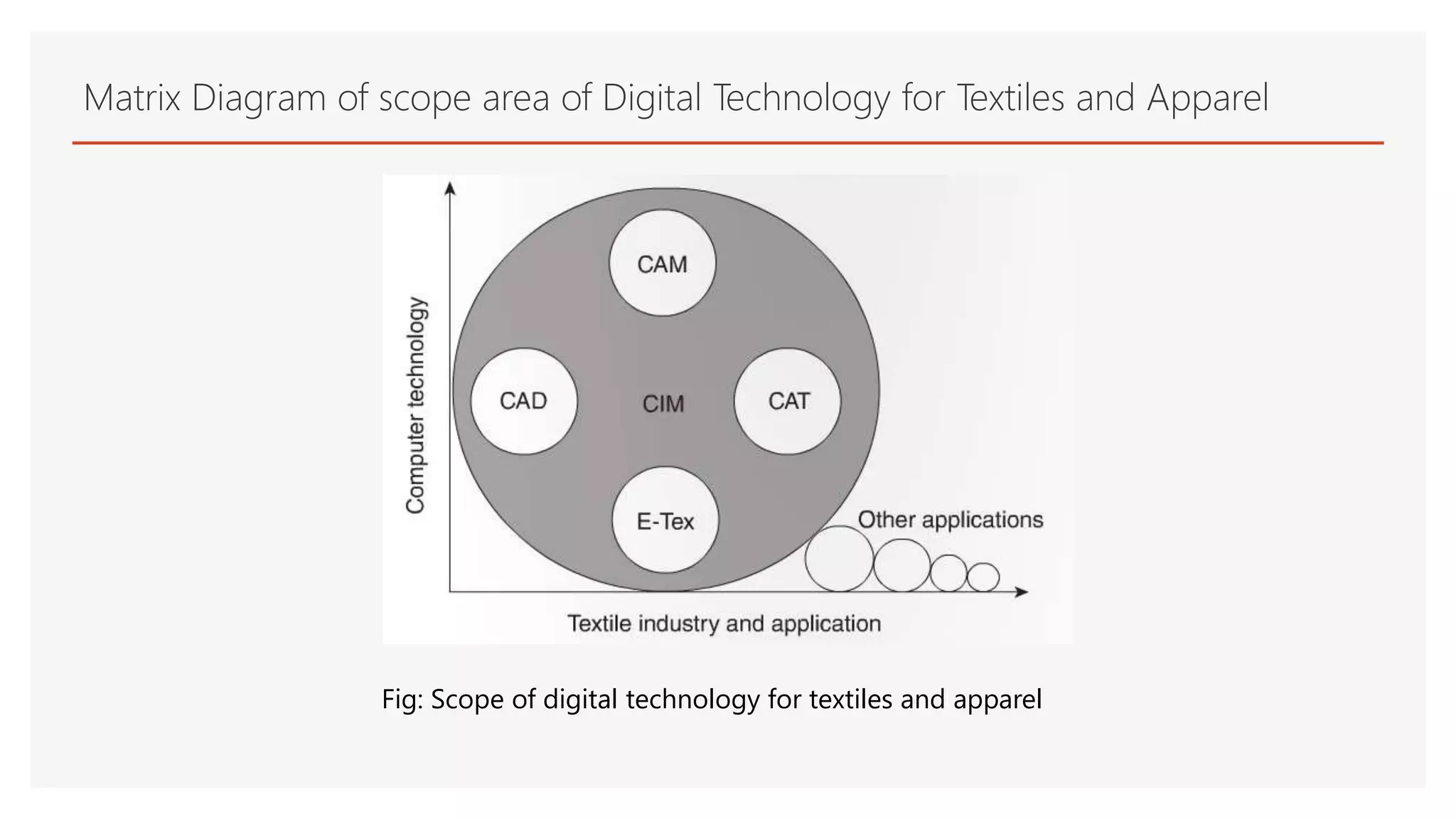
Just as in many other textile industries, computer based technology in
textile application may be divided into many branches and sub-branches
in terms of its applications. Generally there are three terms that are
frequently used:
[1] CAD (Computer Aided Design)
[2] CAM (Computer Aided Manufacturing)
[3] CIM (Computer Integrated Manufacturing)
Furthermore,
[4] CAT (Computer Aided Testing)
[5] CAE (Computer Aided Engineering); is also used.
5.
CAD (Computer AidedDesign):
CAD has become particularly important for textiles and apparel design. It has been widely used in the
design of yarns, fabric and garments. CAD technology enables the textile designers to develop and
demonstrate samples on the computer screen and to simulate the appearance of textile products without
wasting materials and manufacturing process. The development of CAD technology over the past decades
has the advantages of lower product development costs and greatly shortened design cycle with increased
creative variation. These achievements have encouraged and simplified garments and textile
manufacturing, material utilization, easier customization and mass production.
3D CAD software for clothing industry
1. Modaris 3D Fit from Lectra,
2. Virtual fashion from Reyes Infografica,
3. Vidya from Assyst-Bullmer,
4. Accumark Vstitcher from Gerber,
5. 3D Runway from Optitex
2D CAD software for clothing industry
1. GRAFIS from Software Dr. K. Fridrich (Developed
by Germany)
2. TUKACAD from Tukatech (Developed by USA),
3. Fashion CAD from CAD CAM Solutions
(Developed by Australia),
4. Modaris from Lectra (Developed by France),
5. Accumark from Gerber Technology (Developed by
USA).
6.
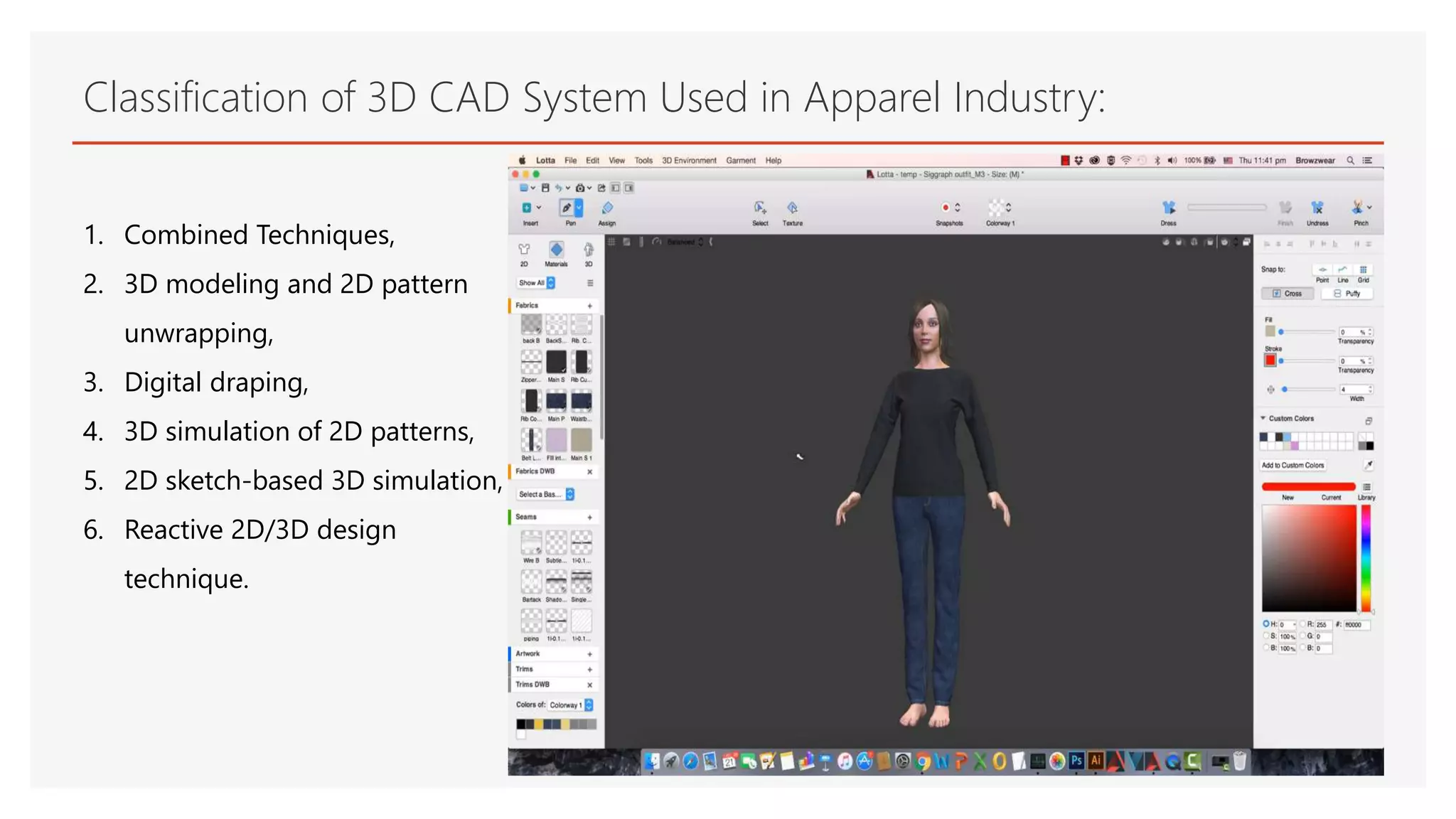
Classification of 3DCAD System Used in Apparel Industry:
1. Combined Techniques,
2. 3D modeling and 2D pattern
unwrapping,
3. Digital draping,
4. 3D simulation of 2D patterns,
5. 2D sketch-based 3D simulation,
6. Reactive 2D/3D design
technique.
7.
CAM (Computer AidedManufacturing)
CAM can be defined as the computer technology used for controlling textile manufacturing process.
Computer based textile machines are used to support spinning, weaving, knitting, printing or finishing
processes through programmable controllers, industrial computers, data gateways, cell controllers, data
acquisition, batch controllers and drive master controllers. CAM is one of the key parts of CIM system.
For example-
PRODUCTS:
SOFTWARE
AccuMark
AccuMark Made-to-Measure
AccuNest
ComposiNest
YuniquePLM
YuniquePLM Consulting
YuniquePLM FS
OMEGA
CUTTERS
GERBERcutters
Gerber MCT Cutter
enVision
GS Plus Series
DIGITIZERS & PLOTTERS
GERBERdigitizers
GERBERplotters
SPREADERS
GERBERspreaders
PRINTER
GERBER EDGE FX
SIGN & GRAPHICS MATERIAL
GerberColor Foils
Cast Premium Vinyl
ImagePerfect Large Format
SERVICE & SUPPLIES
CIM (Computer IntegratedManufacturing):
CIM is the manufacturing approach of using computers to control the entire production process,
typically relying on closed loop control processes and based on real time input of from sensors. This
allows individual processes to exchange information with each other and to in initiate actions including
planning, management and production. The final target of CIM is mainly to provide a digital platform of
process control and information communication for textile design, manufacturing, testing, quality
control and final product marketing/ retailing. Through CIM, manufacturing can be faster and less error
prone; as well as easy to manage.
Example: ERP (Enterprise Resource Planning).
10.
CAE (Computer AidedEngineering):
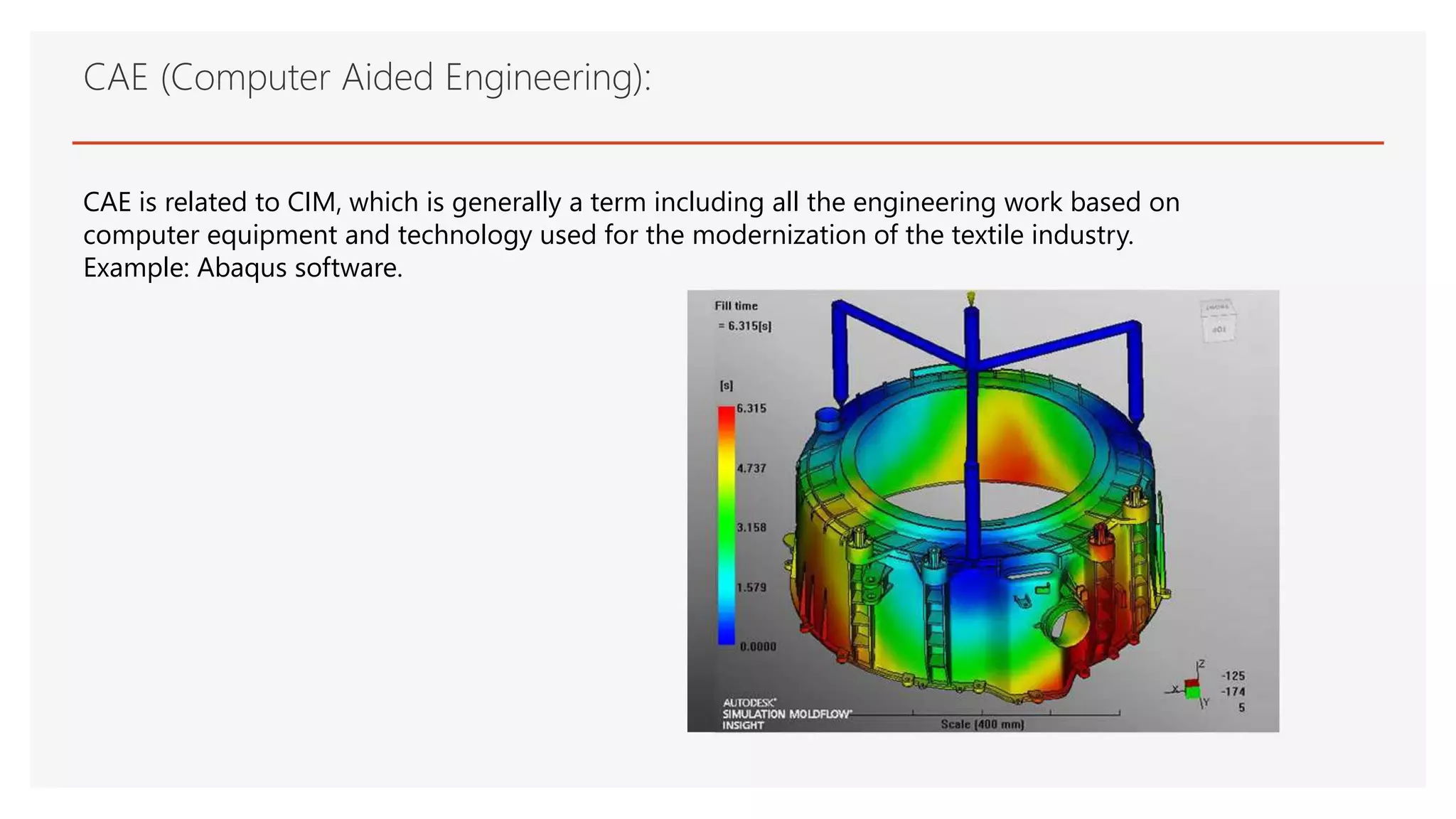
CAE is related to CIM, which is generally a term including all the engineering work based on
computer equipment and technology used for the modernization of the textile industry.
Example: Abaqus software.
11.
CAT (Computer AidedTesting):
CAT provides a digital and automatic solution for
quality testing, evaluation and control of textile
processing and products by using computer related
testing techniques, such as computer vision and
artificial intelligence. In the textile industry, testing
traditionally relies on heavily subjective estimation
without objective testing instruments. CAT
technology and methods have been used to replace
these traditional subjective evaluation methods.
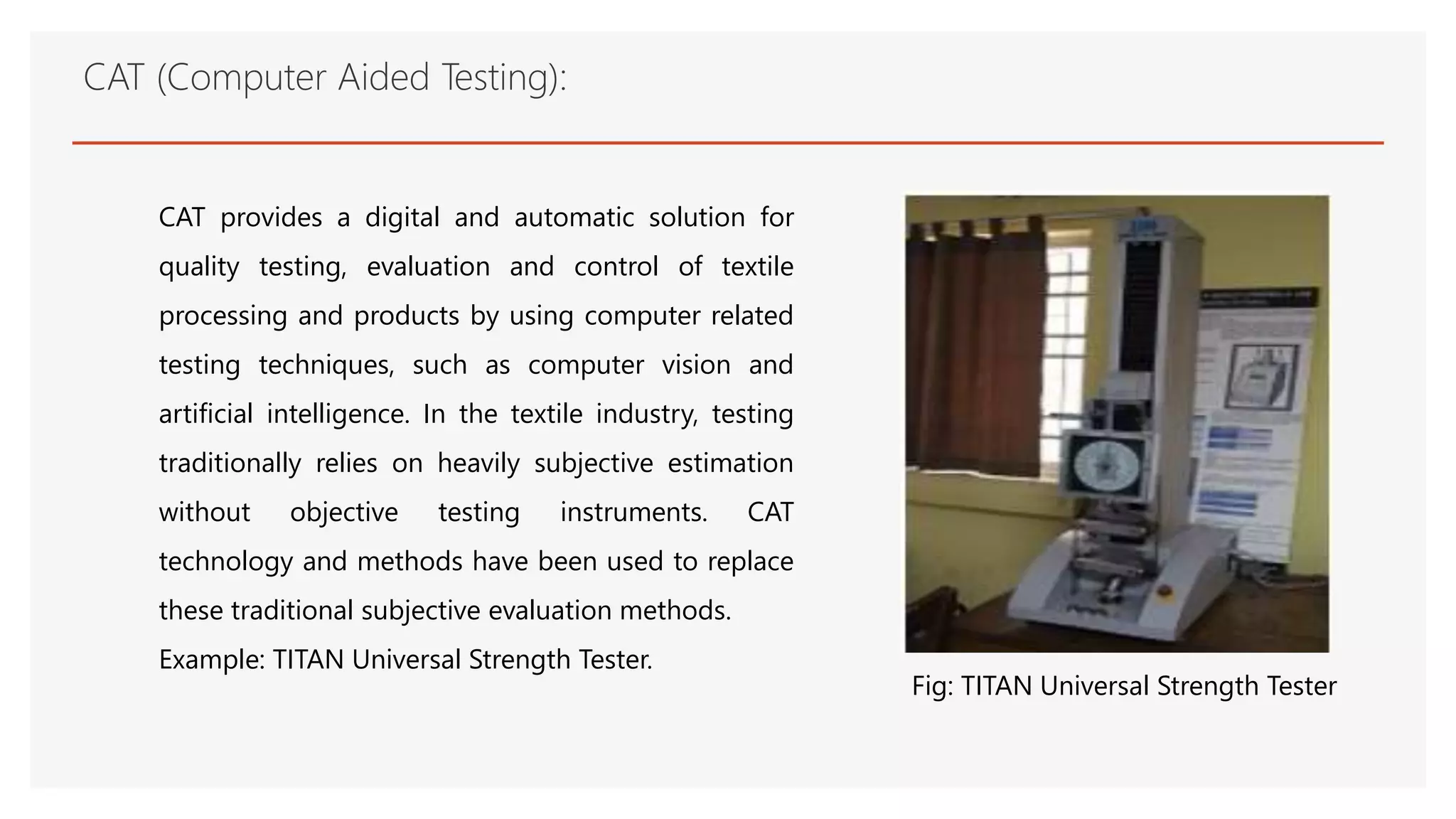
Example: TITAN Universal Strength Tester.
Fig: TITAN Universal Strength Tester
12.
Other Applications:
Textile productscan also be components of
electrical devices and sensors used for data
acquisition and information media, and
could be developed as intelligent sensing,
monitoring and control units worn on the
human body. We call these “E-Textiles”.
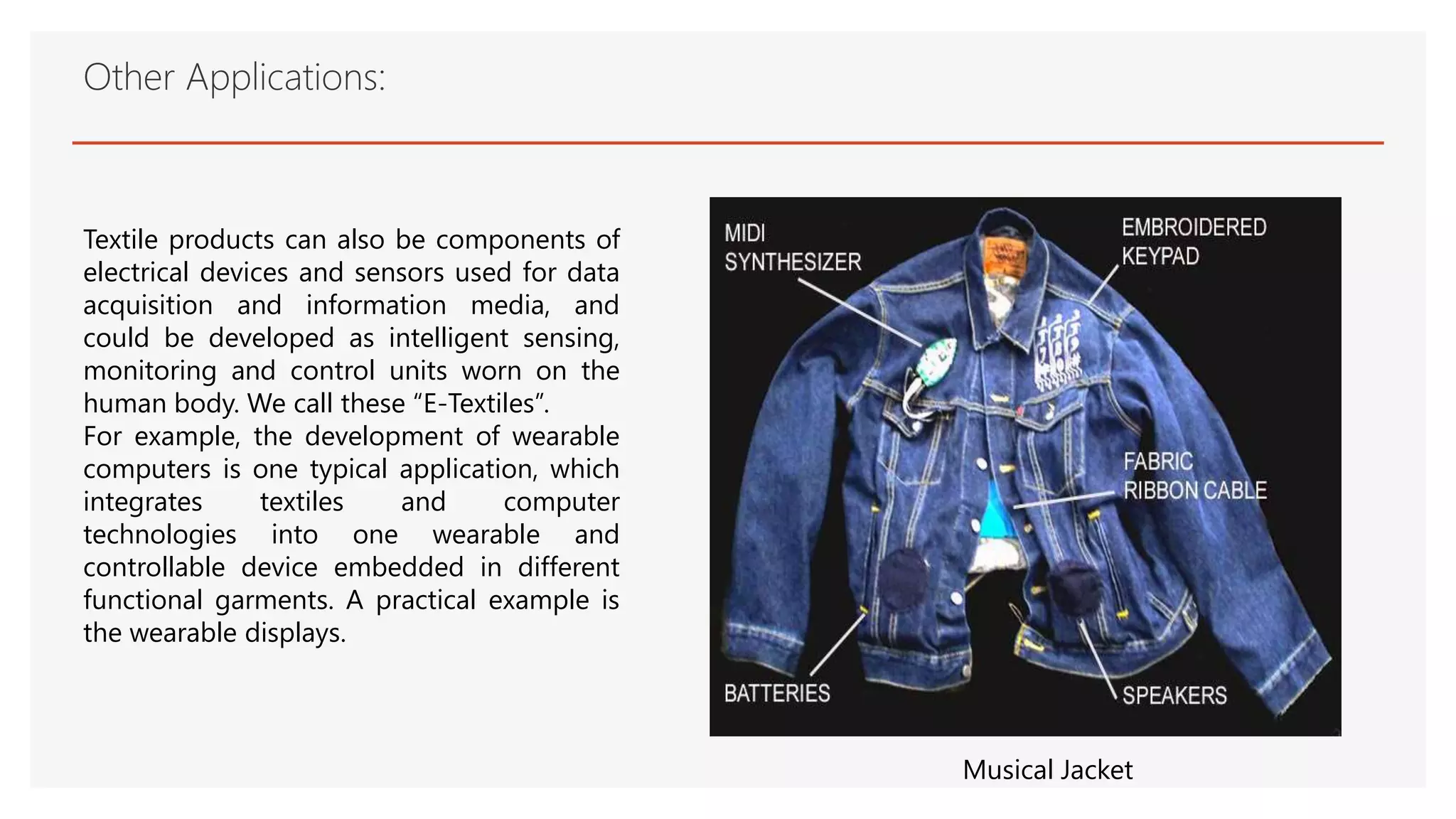
For example, the development of wearable
computers is one typical application, which
integrates textiles and computer
technologies into one wearable and
controllable device embedded in different
functional garments. A practical example is
the wearable displays.
Musical Jacket
13.
Other Applications:
E-textiles constitutea new direction for computer based technology which has undergone rapid
development in recent years. The integration and embedding of electronic sensors and controlling
units can offer clothes higher level of functionality than common garments. It can provide information
exchange between wearer and monitoring system. Thus an E-Textile solution can establish a wearable
computational liked system and wearable electronic textiles can be worn in everyday situations.
Computer and textile products will be merged seamlessly in the future.
Thus digital technology for textiles is broad in its scope. It refers to the utilization of
computer hardware, software, networking, robotics, wearable sensing, monitoring and controlling
technology directly or indirectly for textiles.
14.
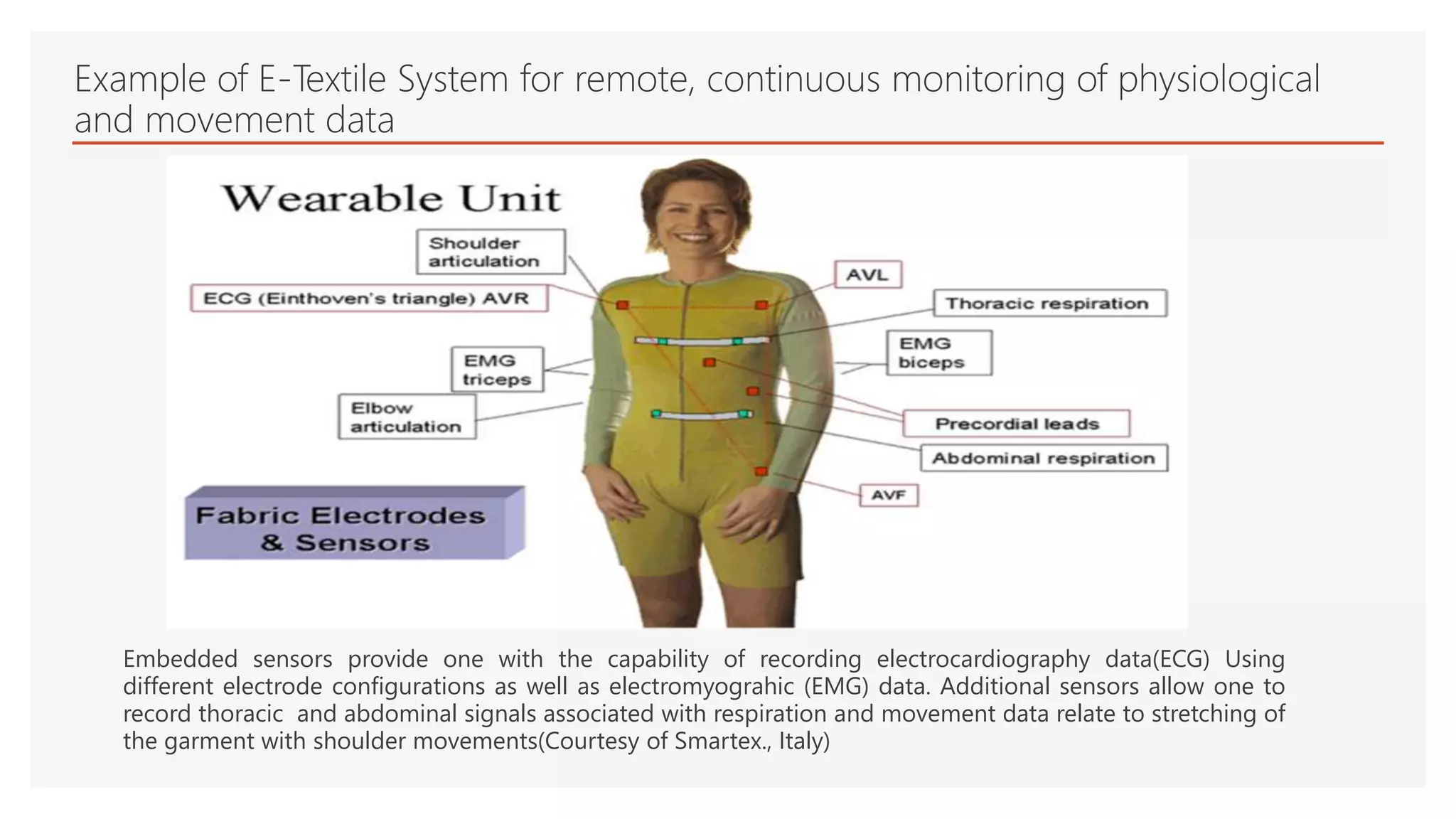
Example of E-TextileSystem for remote, continuous monitoring of physiological
and movement data
Embedded sensors provide one with the capability of recording electrocardiography data(ECG) Using
different electrode configurations as well as electromyograhic (EMG) data. Additional sensors allow one to
record thoracic and abdominal signals associated with respiration and movement data relate to stretching of
the garment with shoulder movements(Courtesy of Smartex., Italy)
15.
Matrix Diagram ofscope area of Digital Technology for Textiles and Apparel
Fig: Scope of digital technology for textiles and apparel