Prepared by:
Md. Mozibur Rahman
ID: 112-323-007
Atish Dipankar University of Science and Technology
Departments of Textile Engineering
House-83, Road-4, Block-B, Banani, Dhaka-1213
What Is Apparel Merchandising?
Apparel Merchandising is all about costing of
apparels, selecting and ordering latest trendy
materials, styles, sizes and overall apparel
specifications to the manufacturers according
to the main buyer’s requirement. The people
who manage this whole apparel merchandising
process is called apparel merchandiser
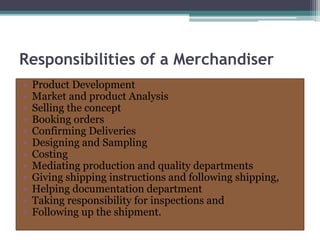
Responsibilities of a Merchandiser
• Product Development
• Market and product Analysis
• Selling the concept
• Booking orders
• Confirming Deliveries
• Designing and Sampling
• Costing
• Mediating production and quality departments
• Giving shipping instructions and following shipping,
• Helping documentation department
• Taking responsibility for inspections and
• Following up the shipment.
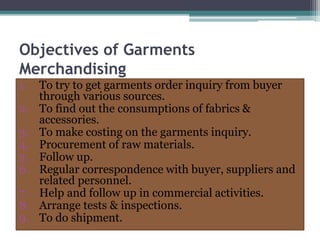
Objectives of Garments
Merchandising
1. To try to get garments order inquiry from buyer
through various sources.
2. To find out the consumptions of fabrics &
accessories.
3. To make costing on the garments inquiry.
4. Procurement of raw materials.
5. Follow up.
6. Regular correspondence with buyer, suppliers and
related personnel.
7. Help and follow up in commercial activities.
8. Arrange tests & inspections.
9. To do shipment.
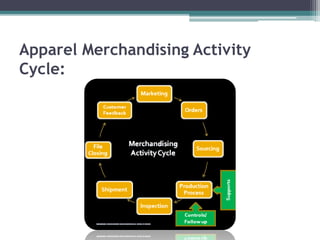
Apparel Merchandising Activity
Cycle:
Work flow of Garments
Merchandising
• To collect buyers addresses.
• To establish contact with the buyers sending formal letters/profile.
• Receiving buyer’s response and providing price quotation along with making of sample as counter/approval.
• Receiving samples comments from the buyer.
• Receiving Purchase Order from buyer.
• To furnish the pro-forma invoice and sending the buyer.
• Receiving the master L/C & verify clauses of the L/C both in technical and commercial point of view.
• To estimate time schedule for the exports of those garments as per L/C.
• To confirm floor booking of the order with factory.
• Taking necessary steps to develop lab-dips of the materials (FAB & ACC)
• To confirm transfer authentication of the L/C in favor of fact.
• Pushing the factory taking initial procurement to open the back-to-back L/C by bank.
• Searching reliable fabric and accessories sources and finalize supplying of the required materials relevant to the order.
• To monitor the shipment of raw materials and arrival in the factory.
• To monitor of the supplying materials while receiving factory.
• To order the test cutting with quality.
• To check/inspect/advise for the bulk production.
• To monitor production, quality and delivery.
• To advise factory if buyer change any instruction both in technical/commercial point of view to the order.
• To maintain continuous liaison with his or her controlling authorities.
• Arrange inspections.
• Sea vessel / air ship booking & insurance
• Shipment
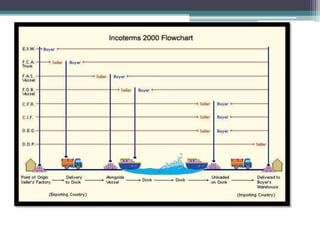
Different Types of order placed by
buyers
• FOB(free on board) Order
• FOA(Free on Air) Order
• C& F(Cost & Freight) Order
• CIF(Cost Insurance & Freight) Order
• CIFC(Cost Insurance & Freight & Commission)
Order
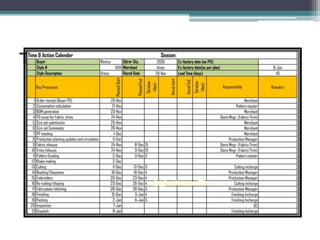
TIME AND ACTION CALENDAR
SAMPLE
The samples decide the ability of an exporter. The
buyer will access the exporter and his organization
only by the samples. If the samples are of good
quality and with reasonable price naturally the
buyers will be forced to place the order. So it is
essential that the samples should be innovative and
with optimum quality. The purpose of sampling is
not only to get bulk orders and also give some
additional benefits to the exporters. By doing
sampling the exporter can estimate the yarn
consumption for developing the fabric, a clear idea
on costing more ever the manufacturing difficulties.
Types of Sample
• Salesmen samples or promotional samples
• Photo samples
• fit samples
• Pre-production samples
• Size-set sample
• Production samples
• Shipment samples
Consumption & Costing
Knit garments consumption:
Fabric Consumption:
Before calculate the fabric consumption, we must
need the followings information as mentioned
below:
1) Measurement chart with technical spec.
2) Style Description.
3) Fabric Description.
4) Fabrics width/weight.
5) Washing shrinkage if any.
Calculation:
{(Body length + Sleeve length +
Sewing Allowance) X (1/2 Chest
+ Sewing Allowance)}X 2 X GSM X 12 /
10000000 + Wastage (For 12 pcs of garments)
Woven Garments Consumption:
Fabric Consumption:
Formula = Length X Width / Fabric width X
Fabric Unit
Cost of Manufacturing (CM) Calculation:
COST OF MAKING (CM) ={(Monthly total
expenditure of the following factory / 26) / (Qty
of running Machine of your factory of the
following month) X (Number of machine to
complete the layout)} / [{(Production capacity
per hr from the existing layout, excluding alter &
reject) X 8}] X 12 / (Dollar conversion rate)
CBM calculation:
The cubic volume occupied by a shipment in
Cubic Meters is referred to as the shipments
CBM. To calculate CBM we first need to know
the length, width and height of the carton in cm.
If carton measurement is in inch, we have to
convert measurement in inch. Simply multiply
length, width and height to find cubic centimeter
and divide by 1000000 to find cubic meter
(CBM). formula as follows:
CBM= (LENGTH in cm X WIDTH in cm X
HEIGHT IN cm/1000000)
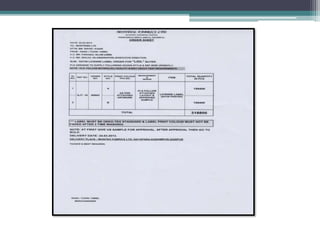
BOOKING
Booking is the order sheet given from the
manufacturer to the suppliers. After getting the
master LC from the buyer the manufacturer,
Merchandisers are supposed to make the
booking and send the suppliers. By booking
merchandisers procure the raw materials e.g.
fabric, accessories and trims.
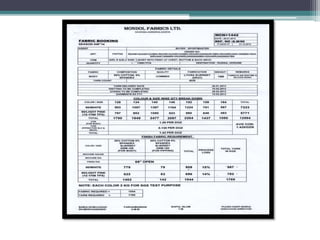
Fabric booking:
Knit fabric booking is done mentioning the
following criteria:
Composition: 100% cotton, 95% cotton 5%
spandex etc
Construction: S/J, 1x1 rib etc
GSM: 140 gsm, 180 gsm etc
Quantity in Weight: e.g. 5000 kg
Color: Red, White, Blue etc
Woven fabric booking is done mentioning the
following criteria:
Composition: 100% cotton, 95% cotton 5%
spandex etc
Construction: e.g. 40 X40 /120 X 60
Width: e.g. 44”, 46”
Quantity in length: e.g. 10000 yards
Color: Red, White, Blue etc
Follow up and updates
Merchandiser’s follow up tasks:
1. Product Package Analysis for Merchandising Follow up and
Procurement Planning.
2. Preparation of Time and Action Calendar for
Merchandising Follow up.
3. Follow up of all BB L/C on receipt of Master L/C in respect
of Yarn, Knitting, Dyeing, Printing, Embroidery, Value-
addition works and Accessories.
6. Follow up of Procurement of Yarn. Fabric and accessories.
8. Follow up of Lab-dip Preparation, Submission and
Approval.
10. Follow up of Dyeing, Finishing.
11. Follow up Cutting in respect of Production and Finishing requirement.
12. Follow up of Accessories Development, Submission, Approval,
Procurement and Inventory.
13. Follow up of all Samples, Pattern Correction, Graded Nest, Size Set and
arrangement of Pre-production Meeting.
14. Follow up and Arrangement of all Inspection as per Buyer’s
requirement.
15. Follow up of all Lab-Test of Garments and Accessories.
16. Monitor Final Inspection and Transportation of Cargo to Port with
proper Load Calculation on time.
17. Monitor submission of Documents and Realization of Payment as per
shipped qty and approved price.
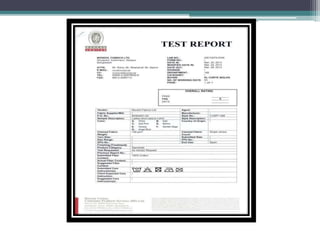
INSPECTION
After making of the garments, merchandisers are
supposed to arrange pre-final and final
inspection.
Inspection can be carried out in several ways:
▫ Inspection by buyer
▫ Inspection by buying house
▫ Inspection by third party
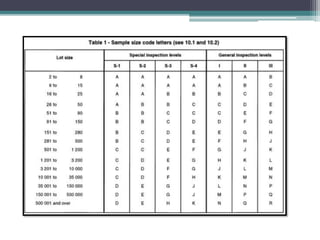
AQL:
AQL is Acceptable quality limit. A statistical
measurement of the maximum number of defective
goods considered acceptable in a particular sample
size. If the acceptable quality level (AQL) is not
reached for a particular sampling of goods,
manufacturers will review the various parameters in
the production process to determine the areas
causing the defects. AQL chart is used to inspect
garments.
Commercial documents
• Proforma invoice (PI)
• Purchase order (PO)
• Bill of lading
• Insurance document
• Certificate of origin
• Packing list
• Air way bill
• Commercial invoice etc
Cash-in-Advance
With this payment method, the exporter can avoid credit risk,
since payment is received prior to the transfer of ownership of
the goods. There are three types of cash- in advance- payment
method: wire transfer, credit card, and payment by check.
Letters of Credit
Letters of credit (LCs) are among the most secure instruments
available to international traders. An LC is a commitment by a
bank on behalf of the buyer that payment will be made to the
exporter provided that the terms and conditions have been
met, as verified through the presentation of all required
documents. The buyer pays its bank to render this service. An
LC is useful when reliable credit information about a foreign
buyer is difficult to obtain, but you are satisfied with the
creditworthiness of your buyer’s foreign bank. An LC also
protects the buyer since no payment obligation arises until the
goods have been shipped or delivered as promised. The letters
of credit can take many forms: irrevocable or revocable,
confirmed, or special (transferable, revolving or
standby).
Documentary Collections
A documentary collection is a transaction whereby
the exporter entrusts the collection of a payment to
the remitting bank (exporter’s bank), which sends
documents to a collecting bank (importer’s bank),
along with instructions for payment. Funds are
received from the importer and remitted to the
exporter through the banks involved in the
collection in exchange for those documents.
Documentary collections involve the use of a draft
that requires the importer to pay the face amount
either on sight (document against payment—
D/P) or on a specified date in the future
(document against acceptance—D/A).
Open Account
An open account transaction means that the goods
are shipped and delivered before payment is due,
usually in 30 to 90 days. Obviously, this is the most
advantageous option to the importer in cash flow
and cost terms, but it is consequently the highest
risk option for an exporter. Due to the intense
competition for export markets, foreign buyers often
press exporters for open account terms since the
extension of credit by the seller to the buyer is more
common abroad. Therefore, exporters who are
reluctant to extend credit may face the possibility of
the loss of the sale to their competitors.
Conclusion
Merchandising is undoubtly the most impostant
section of a garments industry. Merchandisers
coordinates between all the sections. So a good
garments merchandiser should have concepts
about every section of the textile.
Activities of merchandiser

Activities of merchandiser

  • 2.
    Prepared by: Md. MoziburRahman ID: 112-323-007 Atish Dipankar University of Science and Technology Departments of Textile Engineering House-83, Road-4, Block-B, Banani, Dhaka-1213
  • 3.
    What Is ApparelMerchandising? Apparel Merchandising is all about costing of apparels, selecting and ordering latest trendy materials, styles, sizes and overall apparel specifications to the manufacturers according to the main buyer’s requirement. The people who manage this whole apparel merchandising process is called apparel merchandiser
  • 4.
    Responsibilities of aMerchandiser • Product Development • Market and product Analysis • Selling the concept • Booking orders • Confirming Deliveries • Designing and Sampling • Costing • Mediating production and quality departments • Giving shipping instructions and following shipping, • Helping documentation department • Taking responsibility for inspections and • Following up the shipment.
  • 5.
    Objectives of Garments Merchandising 1.To try to get garments order inquiry from buyer through various sources. 2. To find out the consumptions of fabrics & accessories. 3. To make costing on the garments inquiry. 4. Procurement of raw materials. 5. Follow up. 6. Regular correspondence with buyer, suppliers and related personnel. 7. Help and follow up in commercial activities. 8. Arrange tests & inspections. 9. To do shipment.
  • 6.
  • 7.
    Work flow ofGarments Merchandising • To collect buyers addresses. • To establish contact with the buyers sending formal letters/profile. • Receiving buyer’s response and providing price quotation along with making of sample as counter/approval. • Receiving samples comments from the buyer. • Receiving Purchase Order from buyer. • To furnish the pro-forma invoice and sending the buyer. • Receiving the master L/C & verify clauses of the L/C both in technical and commercial point of view. • To estimate time schedule for the exports of those garments as per L/C. • To confirm floor booking of the order with factory. • Taking necessary steps to develop lab-dips of the materials (FAB & ACC) • To confirm transfer authentication of the L/C in favor of fact. • Pushing the factory taking initial procurement to open the back-to-back L/C by bank. • Searching reliable fabric and accessories sources and finalize supplying of the required materials relevant to the order. • To monitor the shipment of raw materials and arrival in the factory. • To monitor of the supplying materials while receiving factory. • To order the test cutting with quality. • To check/inspect/advise for the bulk production. • To monitor production, quality and delivery. • To advise factory if buyer change any instruction both in technical/commercial point of view to the order. • To maintain continuous liaison with his or her controlling authorities. • Arrange inspections. • Sea vessel / air ship booking & insurance • Shipment
  • 11.
    Different Types oforder placed by buyers • FOB(free on board) Order • FOA(Free on Air) Order • C& F(Cost & Freight) Order • CIF(Cost Insurance & Freight) Order • CIFC(Cost Insurance & Freight & Commission) Order
  • 13.
  • 14.
    SAMPLE The samples decidethe ability of an exporter. The buyer will access the exporter and his organization only by the samples. If the samples are of good quality and with reasonable price naturally the buyers will be forced to place the order. So it is essential that the samples should be innovative and with optimum quality. The purpose of sampling is not only to get bulk orders and also give some additional benefits to the exporters. By doing sampling the exporter can estimate the yarn consumption for developing the fabric, a clear idea on costing more ever the manufacturing difficulties.
  • 15.
    Types of Sample •Salesmen samples or promotional samples • Photo samples • fit samples • Pre-production samples • Size-set sample • Production samples • Shipment samples
  • 16.
    Consumption & Costing Knitgarments consumption: Fabric Consumption: Before calculate the fabric consumption, we must need the followings information as mentioned below: 1) Measurement chart with technical spec. 2) Style Description. 3) Fabric Description. 4) Fabrics width/weight. 5) Washing shrinkage if any.
  • 17.
    Calculation: {(Body length +Sleeve length + Sewing Allowance) X (1/2 Chest + Sewing Allowance)}X 2 X GSM X 12 / 10000000 + Wastage (For 12 pcs of garments) Woven Garments Consumption: Fabric Consumption: Formula = Length X Width / Fabric width X Fabric Unit
  • 18.
    Cost of Manufacturing(CM) Calculation: COST OF MAKING (CM) ={(Monthly total expenditure of the following factory / 26) / (Qty of running Machine of your factory of the following month) X (Number of machine to complete the layout)} / [{(Production capacity per hr from the existing layout, excluding alter & reject) X 8}] X 12 / (Dollar conversion rate)
  • 19.
    CBM calculation: The cubicvolume occupied by a shipment in Cubic Meters is referred to as the shipments CBM. To calculate CBM we first need to know the length, width and height of the carton in cm. If carton measurement is in inch, we have to convert measurement in inch. Simply multiply length, width and height to find cubic centimeter and divide by 1000000 to find cubic meter (CBM). formula as follows: CBM= (LENGTH in cm X WIDTH in cm X HEIGHT IN cm/1000000)
  • 20.
    BOOKING Booking is theorder sheet given from the manufacturer to the suppliers. After getting the master LC from the buyer the manufacturer, Merchandisers are supposed to make the booking and send the suppliers. By booking merchandisers procure the raw materials e.g. fabric, accessories and trims.
  • 21.
    Fabric booking: Knit fabricbooking is done mentioning the following criteria: Composition: 100% cotton, 95% cotton 5% spandex etc Construction: S/J, 1x1 rib etc GSM: 140 gsm, 180 gsm etc Quantity in Weight: e.g. 5000 kg Color: Red, White, Blue etc
  • 23.
    Woven fabric bookingis done mentioning the following criteria: Composition: 100% cotton, 95% cotton 5% spandex etc Construction: e.g. 40 X40 /120 X 60 Width: e.g. 44”, 46” Quantity in length: e.g. 10000 yards Color: Red, White, Blue etc
  • 25.
    Follow up andupdates Merchandiser’s follow up tasks: 1. Product Package Analysis for Merchandising Follow up and Procurement Planning. 2. Preparation of Time and Action Calendar for Merchandising Follow up. 3. Follow up of all BB L/C on receipt of Master L/C in respect of Yarn, Knitting, Dyeing, Printing, Embroidery, Value- addition works and Accessories. 6. Follow up of Procurement of Yarn. Fabric and accessories. 8. Follow up of Lab-dip Preparation, Submission and Approval. 10. Follow up of Dyeing, Finishing.
  • 26.
    11. Follow upCutting in respect of Production and Finishing requirement. 12. Follow up of Accessories Development, Submission, Approval, Procurement and Inventory. 13. Follow up of all Samples, Pattern Correction, Graded Nest, Size Set and arrangement of Pre-production Meeting. 14. Follow up and Arrangement of all Inspection as per Buyer’s requirement. 15. Follow up of all Lab-Test of Garments and Accessories. 16. Monitor Final Inspection and Transportation of Cargo to Port with proper Load Calculation on time. 17. Monitor submission of Documents and Realization of Payment as per shipped qty and approved price.
  • 27.
    INSPECTION After making ofthe garments, merchandisers are supposed to arrange pre-final and final inspection. Inspection can be carried out in several ways: ▫ Inspection by buyer ▫ Inspection by buying house ▫ Inspection by third party
  • 29.
    AQL: AQL is Acceptablequality limit. A statistical measurement of the maximum number of defective goods considered acceptable in a particular sample size. If the acceptable quality level (AQL) is not reached for a particular sampling of goods, manufacturers will review the various parameters in the production process to determine the areas causing the defects. AQL chart is used to inspect garments.
  • 31.
    Commercial documents • Proformainvoice (PI) • Purchase order (PO) • Bill of lading • Insurance document • Certificate of origin • Packing list • Air way bill • Commercial invoice etc
  • 32.
    Cash-in-Advance With this paymentmethod, the exporter can avoid credit risk, since payment is received prior to the transfer of ownership of the goods. There are three types of cash- in advance- payment method: wire transfer, credit card, and payment by check. Letters of Credit Letters of credit (LCs) are among the most secure instruments available to international traders. An LC is a commitment by a bank on behalf of the buyer that payment will be made to the exporter provided that the terms and conditions have been met, as verified through the presentation of all required documents. The buyer pays its bank to render this service. An LC is useful when reliable credit information about a foreign buyer is difficult to obtain, but you are satisfied with the creditworthiness of your buyer’s foreign bank. An LC also protects the buyer since no payment obligation arises until the goods have been shipped or delivered as promised. The letters of credit can take many forms: irrevocable or revocable, confirmed, or special (transferable, revolving or standby).
  • 33.
    Documentary Collections A documentarycollection is a transaction whereby the exporter entrusts the collection of a payment to the remitting bank (exporter’s bank), which sends documents to a collecting bank (importer’s bank), along with instructions for payment. Funds are received from the importer and remitted to the exporter through the banks involved in the collection in exchange for those documents. Documentary collections involve the use of a draft that requires the importer to pay the face amount either on sight (document against payment— D/P) or on a specified date in the future (document against acceptance—D/A).
  • 34.
    Open Account An openaccount transaction means that the goods are shipped and delivered before payment is due, usually in 30 to 90 days. Obviously, this is the most advantageous option to the importer in cash flow and cost terms, but it is consequently the highest risk option for an exporter. Due to the intense competition for export markets, foreign buyers often press exporters for open account terms since the extension of credit by the seller to the buyer is more common abroad. Therefore, exporters who are reluctant to extend credit may face the possibility of the loss of the sale to their competitors.
  • 35.
    Conclusion Merchandising is undoubtlythe most impostant section of a garments industry. Merchandisers coordinates between all the sections. So a good garments merchandiser should have concepts about every section of the textile.