GARMENT FINISHING
Garment finishing is responsible for adding beauty to the garment. Proper finishing could
provide better look to the garment, change the feel of the fabric and bring about a change to
the texture of the fabric.
INTRODUCTION
Processing of garments is gaining popularity now-a-days. Apart from washing and cleaning,
it can impart artistic and innovative look to garments especially denim fabric. It is being
considered as value addition element to the garments. Various finishing’s like anti-microbial,
wrinkle-free, water resistant, moisture management; laser coating etc. can be achieved
through wet processing of garments. The compass of fashion is directed towards denim;
therefore innovative visual and wash effects are experimented on this fabric.
PACKING SYSTEM
Packaging systems are an organized set of machines involving several technologies that fill
and seal the products or commodities for convenient storage and transportation. The systems
include packaging materials and machines to perform filling, forming, cleaning, and
wrapping, sealing and packing operations. The packaging system also includes associated
machinery for counting, sorting, and accumulating process. The packaging systems are
operated either manually or automatically. Various packaging materials including bags,
cartons, drums, cartridges, blister packs, pallets, etc. are used in the packaging systems.
Sealing methods of packaging systems involve caps, glues, staples, corks and heat seals.
Different types of packaging systems are available to suit different items.
Types
Some of the major types of industrial packaging systems are listed below:
• Vacuum packaging systems
• Shrink packaging systems
• Hermetic packaging systems
Based on the operation, the packaging systems are classified as given below:
• Automated packaging systems
• Semi-automatic packaging systems
• Manual packaging systems
Features
Following are the features of packaging systems:
• High speed packaging
• Increases productivity
• Repeatability
• Easy to operate
• Extremely reliable
• Maximum flexibility
• Cost effective
Applications
The applications for different types of packaging systems are listed below:
• Vacuum packaging systems are applied in garment industry to handle thick and bulky
clothes like jeans, overcoats, suits, pillows, blazers, blankets, etc.
• Automated and semi-automatic packaging systems are used for packing automotive
and machine parts, electrical parts, electronic parts, jewelry, gifts and novelties, disposable
health care products, hardware items, fasteners, connectors, craft kits, cosmetics and beauty
aids
• Manual packaging systems are suitable for packing products like puffy foods, potato
chips, popcorns, candy, jelly, rice dumpling, medicines or drugs and CDs
• Shrink packaging systems are applied for medical instruments, books and magazines,
stainless steel bars, molding parts, filters, toys etc.
Garment finishing
1. SPOTTING
Paint, Oil and Grease (POG) spotting agents are used to remove spots from garments by
professional textile cleaners. They are sprayed on spots before and after garments are
processed through the garment cleaning machine.
POG spotting agents containing trichloroethylene (TCE) and per- chloroethylene (PERC) are
used widely by the garment cleaning industry.
2. SPOTTING PROCESSES HAZARDS
TCE and PERC are carcinogens and are heavily regulated in California. Spotters and other
employees in garment cleaning plants are exposed to these dangerous chemicals
Use of these spotting agents will make the waste streams generated by the non-PERC
garment cleaning processes hazardous.
3. FOLDING
Creases result from applying pressure to folds
If we wrap a piece of paper around a cylinder, it will be easy to straighten again. If we make
a fold in the paper, it will be more difficult. If we apply pressure along the fold, the crease
will be even more pronounced. Clothing is no different.
4.IMPROPER FOLDING
1) Folds that will "set", producing creases.
2) Garments moving (rubbing) against one another, producing wrinkles (tiny folds) in the
fabric that will also "set".
5. SHIRT FOLDING MACHINE.
This machine is specially designed for the packing of shirts. The main benefit of this table is
correct and smooth shaping of shirt collars and easy packing. It has the capacity of giving an
output of 300 to 400 shirts per shift of 8 hrs.
FEATURES: - Competitive price
Adjustable head for choosing collar size.
Button guard for perfect center line and elegant shirt fold
pressed shirt collar to be round and smooth
Stainless steel folding plate.
6. ADVANCED TECHNOLOGY
Sensors will detect clear materials.All motors are controlled by frequency inverters to ensure:
-Precise folds - Smooth start of all drive systems - Reduced maintenance by eliminating the
need for brake motors
7. JAM-PREVENTION SYSTEM
The folder will automatically reject any missed piece that is likely to result in a jam in order
to provide uninterrupted operation.
If a jam does occur, the PLC will only shut off the actual section where the jam occurred.
The items that were already in the machine in front of the jam will be folded and clear the
machine in order to minimize any down time.
8. PACKING& PACKAGING REQUIREMENTS
Ensure the carton is strong and secure enough to protect the contents in the normal transport
and distribution processes according to the standards
Ensure the contents of the carton are packed as per instructions
Ensure the labeling/marking are as per requirements
Eliminate the outer shipper carton where inners are the distribution unit
Ensure the carton does not display any misleading information or unrelated printed matter, -
for example, brands or product names unrelated to the cartons content.
9. It is important to:
Use the correct size carton for the goods you need to pack to minimize free space in carton
Ensure that packages form a stable unit load
Ensure that cartons are adequately sealed to support the content
Do not use brown paper wrapping
DO NOT use any form of strapping
DO NOT use carton stapling
10. HANGERS
The hangers must be secured with a cable tie. All film specifications remain the same as for
pre-made bags. The supplier must ensure that the heat setting is adequate to seal the bags
sufficiently without overheating and weakening the bag strength.
Garments to hang loose in bags. Bottom edge of garment is to remain above bottom edge of
bag. Hanger opening is to face left.
NOTE: Garments must have no more that 6cm to 12cm excess at the bottom heat-sealed or
taped closed.
11. FLAT BED FUSING PRESSES
The flat bed fusing press has been designed with versatility and ease of use very much in
mind.
Its large 120cm x 50cm heated top p late makes it suitable for use in the manufacture of
many different types of garments & textiles.
With a temperature range of up to 200C, it can be used with a wide selection of today s
modern fusible interlinings (& heat transfers etc.)
12. OPEN SIDED ROLLER FUSING PRESSES
Up to 45cm fusing width
Endless fusing length
Conveyer belt fusing system
Silicone rubber pressure roller
Open sided to allow wider items
20 to 200C temperature
Compact & affordable
1.5Kg/cm pressure.
Independent belt tracking system.
13. STEAM IRON
It is comfortable and easy to use, with its design meeting the requirements of prolonged
industrial use.
As well as its 1kW heating element & useful 225mm long base plate, operators can choose
from two different iron handle styles.
The standard M28/11 steam iron features a traditional cork style handle and the optional
M28/1 model features an ergonomic handle. Both have a well positioned micro switch for
easy operation.
14. FINISHERS FOR DIFFERENT GARMENTS UNIVERSAL FINISHER
This universal finisher is the preferred equipment for small to middle sized laundries and
textile care plants.
It is available in a steam heated version.
Spin-dry shirts, blouses, smocks or dustcoats are finished quickly without
Creases by the high performance silent hot-air fan.
Dry garments, such as jackets, coats, etc., can also be finished on this machine.
The individual functions are called step by step on the kicker plate.
15. SHIRT FINISHER
Shirt Finisher provides an excellent and complete finish for washed, pre-treated or wet
processed shirts.
The shirts are placed on hangers, buttoned or unbuttoned prior to the finishing operation.
Seam tensioning elements, custom shaped shoulder forms, electrically heated pressing plates
for the shirt pocket, the integrated suction plate and stretch-control are standard features.
16. FORM FINISHER FOR DRESSES & SHIRTS
The height and shoulder width (270-450 mm/ 10.6-17.7 in.) of the dress form is adjustable
and the sleeves can be closed with a zip.
The individual dress forms turn through 360 degrees and can be exchanged within seconds.
Base Unit with extremely strong hot and cold air fan.
Infinitely adjustable volume of air for easy treatment
Flight and heavy knitwear.
A special form for skirts is mounted over an adapter on the VEIT 8308 base unit.
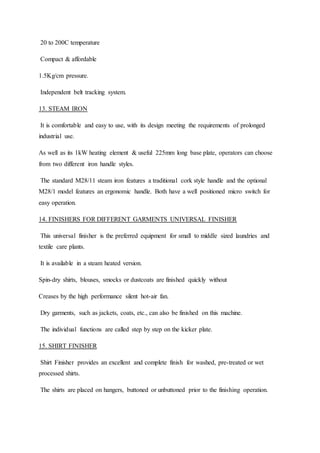
Garments Finishing:
Applies of pressing, folding & packing of garments.
Garments finishing m/c
Pressing
Pressing is a finishing process done by a cloth to heat and pressure with or without steam to
remove creases and to impart a flat appearance to the cloth or garments. In garment industries
pressing is also called ironing. After completing pressing the garments have to be folded.
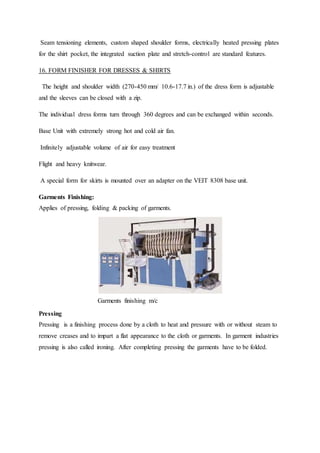
Folding
After completing pressing, the garments are folded with a predetermine area. Garments are
folded according to the buyers direction, requirements in a standard area.
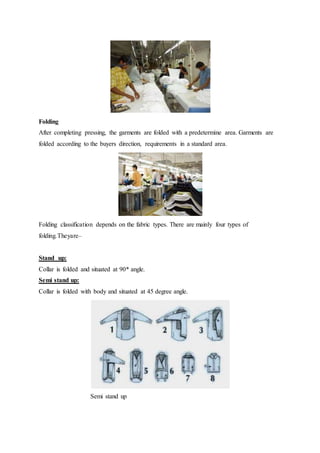
Folding classification depends on the fabric types. There are mainly four types of
folding.Theyare–
Stand up:
Collar is folded and situated at 90* angle.
Semi stand up:
Collar is folded with body and situated at 45 degree angle.
Semi stand up
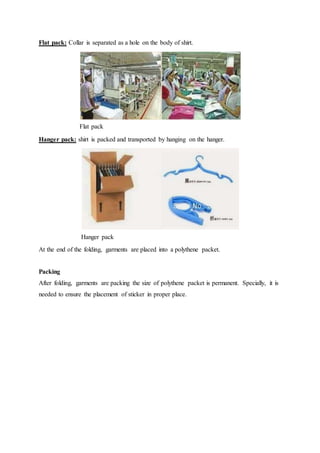
Flat pack: Collar is separated as a hole on the body of shirt.
Flat pack
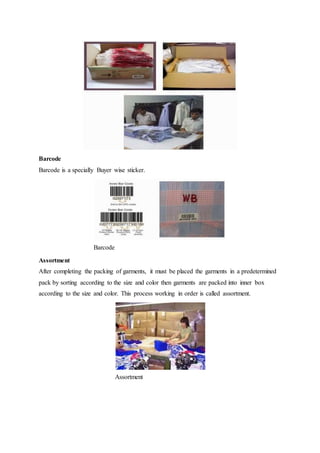
Hanger pack: shirt is packed and transported by hanging on the hanger.
Hanger pack
At the end of the folding, garments are placed into a polythene packet.
Packing
After folding, garments are packing the size of polythene packet is permanent. Specially, it is
needed to ensure the placement of sticker in proper place.
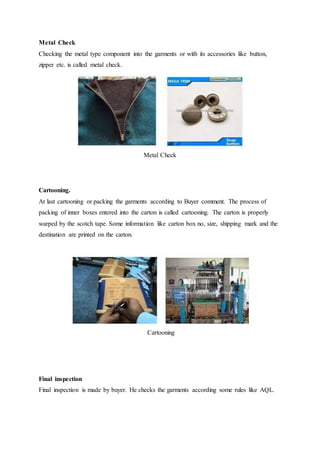
Barcode
Barcode is a specially Buyer wise sticker.
Barcode
Assortment
After completing the packing of garments, it must be placed the garments in a predetermined
pack by sorting according to the size and color then garments are packed into inner box
according to the size and color. This process working in order is called assortment.
Assortment
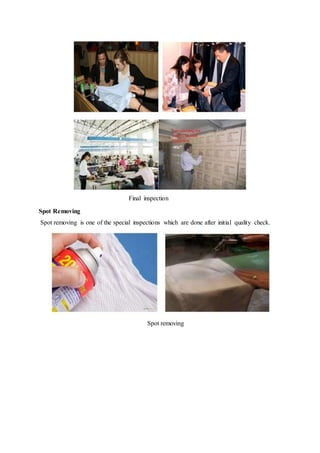
Metal Check
Checking the metal type component into the garments or with its accessories like button,
zipper etc. is called metal check.
Metal Check
Cartooning.
At last cartooning or packing the garments according to Buyer comment. The process of
packing of inner boxes entered into the carton is called cartooning. The carton is properly
warped by the scotch tape. Some information like carton box no, size, shipping mark and the
destination are printed on the carton.
Cartooning
Final inspection
Final inspection is made by buyer. He checks the garments according some rules like AQL.
Final inspection
Spot Removing
Spot removing is one of the special inspections which are done after initial quality check.
Spot removing

Case stdy....packing office

  • 1.
    GARMENT FINISHING Garment finishingis responsible for adding beauty to the garment. Proper finishing could provide better look to the garment, change the feel of the fabric and bring about a change to the texture of the fabric. INTRODUCTION Processing of garments is gaining popularity now-a-days. Apart from washing and cleaning, it can impart artistic and innovative look to garments especially denim fabric. It is being considered as value addition element to the garments. Various finishing’s like anti-microbial, wrinkle-free, water resistant, moisture management; laser coating etc. can be achieved through wet processing of garments. The compass of fashion is directed towards denim; therefore innovative visual and wash effects are experimented on this fabric. PACKING SYSTEM Packaging systems are an organized set of machines involving several technologies that fill and seal the products or commodities for convenient storage and transportation. The systems include packaging materials and machines to perform filling, forming, cleaning, and wrapping, sealing and packing operations. The packaging system also includes associated machinery for counting, sorting, and accumulating process. The packaging systems are operated either manually or automatically. Various packaging materials including bags, cartons, drums, cartridges, blister packs, pallets, etc. are used in the packaging systems. Sealing methods of packaging systems involve caps, glues, staples, corks and heat seals. Different types of packaging systems are available to suit different items. Types Some of the major types of industrial packaging systems are listed below: • Vacuum packaging systems • Shrink packaging systems • Hermetic packaging systems
  • 2.
    Based on theoperation, the packaging systems are classified as given below: • Automated packaging systems • Semi-automatic packaging systems • Manual packaging systems Features Following are the features of packaging systems: • High speed packaging • Increases productivity • Repeatability • Easy to operate • Extremely reliable • Maximum flexibility • Cost effective Applications The applications for different types of packaging systems are listed below: • Vacuum packaging systems are applied in garment industry to handle thick and bulky clothes like jeans, overcoats, suits, pillows, blazers, blankets, etc. • Automated and semi-automatic packaging systems are used for packing automotive and machine parts, electrical parts, electronic parts, jewelry, gifts and novelties, disposable health care products, hardware items, fasteners, connectors, craft kits, cosmetics and beauty aids • Manual packaging systems are suitable for packing products like puffy foods, potato chips, popcorns, candy, jelly, rice dumpling, medicines or drugs and CDs • Shrink packaging systems are applied for medical instruments, books and magazines, stainless steel bars, molding parts, filters, toys etc.
  • 3.
    Garment finishing 1. SPOTTING Paint,Oil and Grease (POG) spotting agents are used to remove spots from garments by professional textile cleaners. They are sprayed on spots before and after garments are processed through the garment cleaning machine. POG spotting agents containing trichloroethylene (TCE) and per- chloroethylene (PERC) are used widely by the garment cleaning industry. 2. SPOTTING PROCESSES HAZARDS TCE and PERC are carcinogens and are heavily regulated in California. Spotters and other employees in garment cleaning plants are exposed to these dangerous chemicals Use of these spotting agents will make the waste streams generated by the non-PERC garment cleaning processes hazardous. 3. FOLDING Creases result from applying pressure to folds If we wrap a piece of paper around a cylinder, it will be easy to straighten again. If we make a fold in the paper, it will be more difficult. If we apply pressure along the fold, the crease will be even more pronounced. Clothing is no different. 4.IMPROPER FOLDING 1) Folds that will "set", producing creases. 2) Garments moving (rubbing) against one another, producing wrinkles (tiny folds) in the fabric that will also "set". 5. SHIRT FOLDING MACHINE. This machine is specially designed for the packing of shirts. The main benefit of this table is correct and smooth shaping of shirt collars and easy packing. It has the capacity of giving an output of 300 to 400 shirts per shift of 8 hrs.
  • 4.
    FEATURES: - Competitiveprice Adjustable head for choosing collar size. Button guard for perfect center line and elegant shirt fold pressed shirt collar to be round and smooth Stainless steel folding plate. 6. ADVANCED TECHNOLOGY Sensors will detect clear materials.All motors are controlled by frequency inverters to ensure: -Precise folds - Smooth start of all drive systems - Reduced maintenance by eliminating the need for brake motors 7. JAM-PREVENTION SYSTEM The folder will automatically reject any missed piece that is likely to result in a jam in order to provide uninterrupted operation. If a jam does occur, the PLC will only shut off the actual section where the jam occurred. The items that were already in the machine in front of the jam will be folded and clear the machine in order to minimize any down time. 8. PACKING& PACKAGING REQUIREMENTS Ensure the carton is strong and secure enough to protect the contents in the normal transport and distribution processes according to the standards Ensure the contents of the carton are packed as per instructions Ensure the labeling/marking are as per requirements Eliminate the outer shipper carton where inners are the distribution unit Ensure the carton does not display any misleading information or unrelated printed matter, - for example, brands or product names unrelated to the cartons content. 9. It is important to: Use the correct size carton for the goods you need to pack to minimize free space in carton Ensure that packages form a stable unit load
  • 5.
    Ensure that cartonsare adequately sealed to support the content Do not use brown paper wrapping DO NOT use any form of strapping DO NOT use carton stapling 10. HANGERS The hangers must be secured with a cable tie. All film specifications remain the same as for pre-made bags. The supplier must ensure that the heat setting is adequate to seal the bags sufficiently without overheating and weakening the bag strength. Garments to hang loose in bags. Bottom edge of garment is to remain above bottom edge of bag. Hanger opening is to face left. NOTE: Garments must have no more that 6cm to 12cm excess at the bottom heat-sealed or taped closed. 11. FLAT BED FUSING PRESSES The flat bed fusing press has been designed with versatility and ease of use very much in mind. Its large 120cm x 50cm heated top p late makes it suitable for use in the manufacture of many different types of garments & textiles. With a temperature range of up to 200C, it can be used with a wide selection of today s modern fusible interlinings (& heat transfers etc.) 12. OPEN SIDED ROLLER FUSING PRESSES Up to 45cm fusing width Endless fusing length Conveyer belt fusing system Silicone rubber pressure roller Open sided to allow wider items
  • 6.
    20 to 200Ctemperature Compact & affordable 1.5Kg/cm pressure. Independent belt tracking system. 13. STEAM IRON It is comfortable and easy to use, with its design meeting the requirements of prolonged industrial use. As well as its 1kW heating element & useful 225mm long base plate, operators can choose from two different iron handle styles. The standard M28/11 steam iron features a traditional cork style handle and the optional M28/1 model features an ergonomic handle. Both have a well positioned micro switch for easy operation. 14. FINISHERS FOR DIFFERENT GARMENTS UNIVERSAL FINISHER This universal finisher is the preferred equipment for small to middle sized laundries and textile care plants. It is available in a steam heated version. Spin-dry shirts, blouses, smocks or dustcoats are finished quickly without Creases by the high performance silent hot-air fan. Dry garments, such as jackets, coats, etc., can also be finished on this machine. The individual functions are called step by step on the kicker plate. 15. SHIRT FINISHER Shirt Finisher provides an excellent and complete finish for washed, pre-treated or wet processed shirts. The shirts are placed on hangers, buttoned or unbuttoned prior to the finishing operation.
  • 7.
    Seam tensioning elements,custom shaped shoulder forms, electrically heated pressing plates for the shirt pocket, the integrated suction plate and stretch-control are standard features. 16. FORM FINISHER FOR DRESSES & SHIRTS The height and shoulder width (270-450 mm/ 10.6-17.7 in.) of the dress form is adjustable and the sleeves can be closed with a zip. The individual dress forms turn through 360 degrees and can be exchanged within seconds. Base Unit with extremely strong hot and cold air fan. Infinitely adjustable volume of air for easy treatment Flight and heavy knitwear. A special form for skirts is mounted over an adapter on the VEIT 8308 base unit. Garments Finishing: Applies of pressing, folding & packing of garments. Garments finishing m/c Pressing Pressing is a finishing process done by a cloth to heat and pressure with or without steam to remove creases and to impart a flat appearance to the cloth or garments. In garment industries pressing is also called ironing. After completing pressing the garments have to be folded.
  • 8.
    Folding After completing pressing,the garments are folded with a predetermine area. Garments are folded according to the buyers direction, requirements in a standard area. Folding classification depends on the fabric types. There are mainly four types of folding.Theyare– Stand up: Collar is folded and situated at 90* angle. Semi stand up: Collar is folded with body and situated at 45 degree angle. Semi stand up
  • 9.
    Flat pack: Collaris separated as a hole on the body of shirt. Flat pack Hanger pack: shirt is packed and transported by hanging on the hanger. Hanger pack At the end of the folding, garments are placed into a polythene packet. Packing After folding, garments are packing the size of polythene packet is permanent. Specially, it is needed to ensure the placement of sticker in proper place.
  • 10.
    Barcode Barcode is aspecially Buyer wise sticker. Barcode Assortment After completing the packing of garments, it must be placed the garments in a predetermined pack by sorting according to the size and color then garments are packed into inner box according to the size and color. This process working in order is called assortment. Assortment
  • 11.
    Metal Check Checking themetal type component into the garments or with its accessories like button, zipper etc. is called metal check. Metal Check Cartooning. At last cartooning or packing the garments according to Buyer comment. The process of packing of inner boxes entered into the carton is called cartooning. The carton is properly warped by the scotch tape. Some information like carton box no, size, shipping mark and the destination are printed on the carton. Cartooning Final inspection Final inspection is made by buyer. He checks the garments according some rules like AQL.
  • 12.
    Final inspection Spot Removing Spotremoving is one of the special inspections which are done after initial quality check. Spot removing