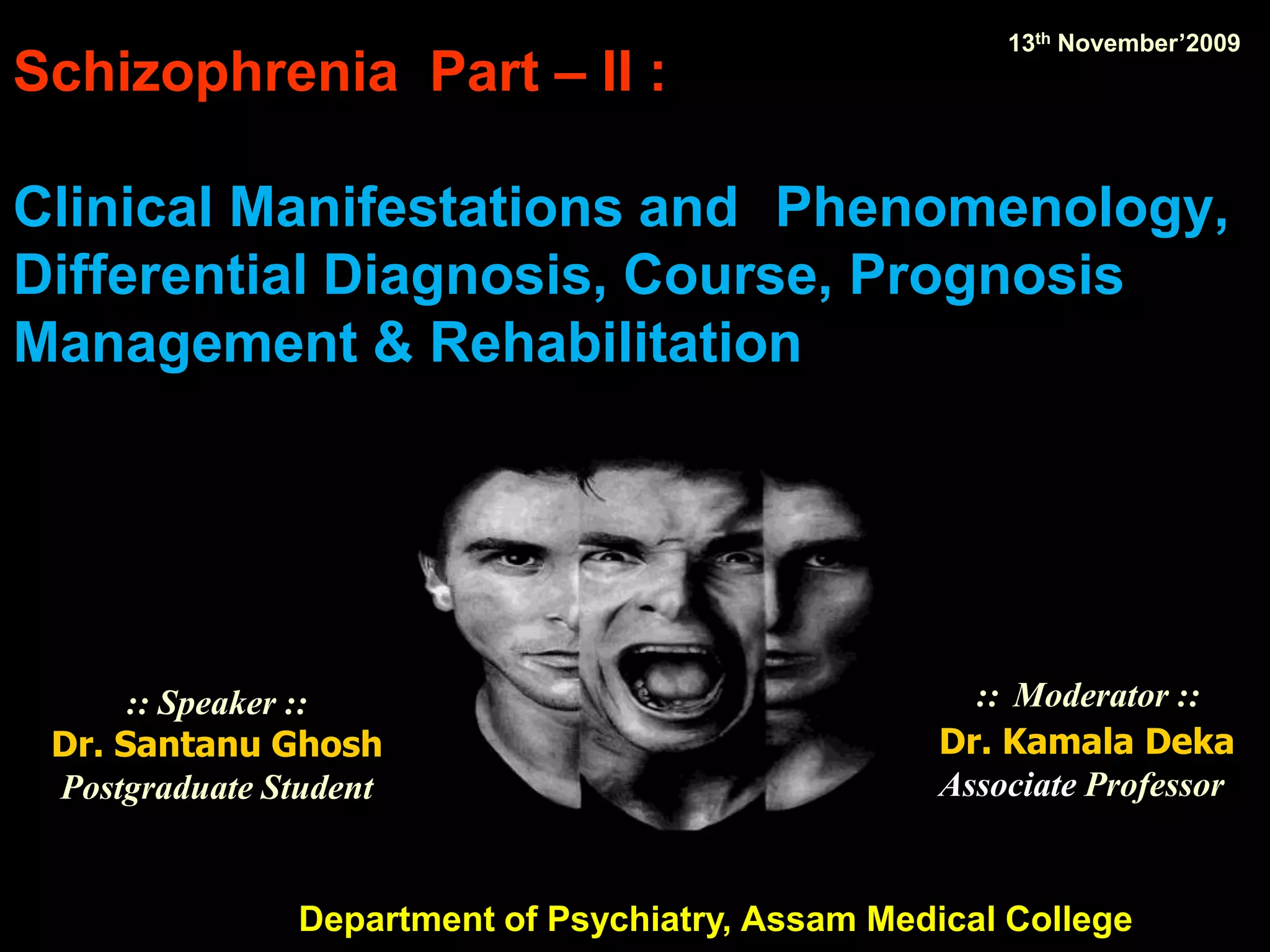
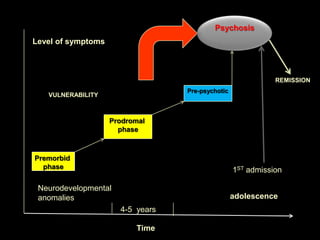
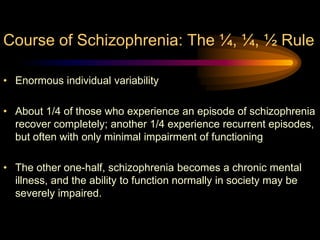
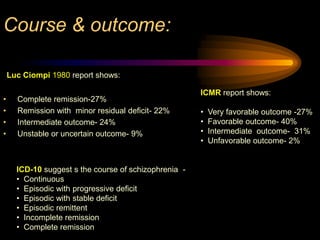
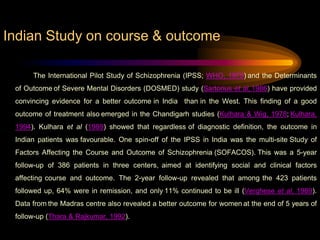




Schizophrenia  Part – II :Clinical Manifestations and 	Phenomenology, Differential Diagnosis, Course, Prognosis Management & Rehabilitation13th November’2009::Moderator ::Dr. Kamala DekaAssociate Professor :: Speaker ::Dr. Santanu GhoshPostgraduate StudentDepartment of Psychiatry, Assam Medical College
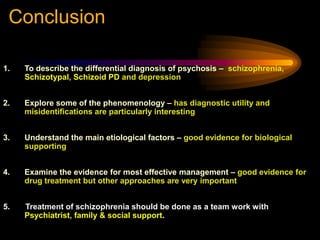
Layout of presentation:IntroductionClinical ManifestationPhenomenologyDifferential DiagnosisCoursePrognosisManagement RehabilitationConclusionTake home messageBibliography
Introduction          Schizophrenia is a stress-related, neurobiological disorder characterized by disturbances in the form and content of an individual's thought and perceptual processes, affect and social and instrumental role behavior. The pervasive impact of schizophrenia across perceptual, cognitive, emotional and behavioral domains, as well as the heterogeneity within those domains require a multimodal and comprehensive approach to treatment and rehabilitation which involves the individual and his or her environment. A multidimensional and interactive model that includes stress, vulnerability, and protective factors best guides the types of interventions for treating and rehabilitating persons with schizophrenia.
 Clinical Manifestation
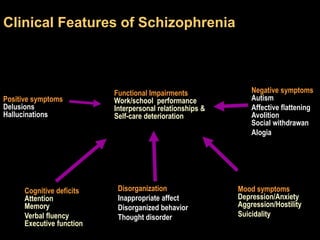
Clinical Features of SchizophreniaNegative symptomsAutismAffective flatteningAvolitionSocial withdrawanAlogiaFunctional ImpairmentsWork/school  performanceInterpersonal relationships &Self-care deteriorationPositive symptomsDelusionsHallucinationsMood symptomsDepression/AnxietyAggression/HostilitySuicidalityDisorganizationInappropriate affectDisorganized behaviorThought disorderCognitive deficitsAttentionMemoryVerbal fluencyExecutive function
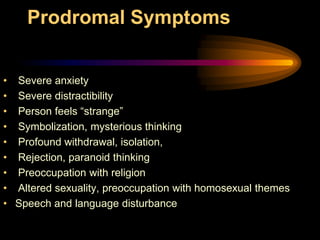
Prodromal Symptoms Severe anxiety Severe distractibility Person feels “strange” Symbolization, mysterious thinking Profound withdrawal, isolation, Rejection, paranoid thinking Preoccupation with religion Altered sexuality, preoccupation with homosexual themesSpeech and language disturbance
  Phenomenology
Concept of Phenomenology:Phenomenology can be defined as the study of events or phenomena, either psychological or physical, by means of empathy & immaculate clinical observation, but without embellishing those events or phenomena with explanation of cause or function.
In psychiatry, phenomenology is the way of understanding & describing the psychological phenomena, involved in various psychopathological states.Phenomenology of Schizophrenia:(Historical Overview)Emil Kraepelintranslated Morel’s “demenceprecoce” into “dementia praecox”, to emphasize the distinct cognitive decline (dementia) & early onset (praecox) of the disorder.
EugenBleulercoined the term “schizophrenia”to mean “splitting” of the psychic functions. Bleuler made a distinction between the fundamental & accessory symptoms of schizophrenia. The fundamentalsymptoms of Bleuler, which were also designated as the four “A”sare-Disturbance of Association (e.g, looseness),Affective disturbance(eg, flattening),Autism (i.e. withdrawn from reality into an inner fantasy world) &Ambivalence.
Phenomenology of Schizophrenia:(Historical Overview)Bleulerviewed some of the most frequent & striking symptoms were accessory (or secondary). These include- hallucinations, delusions, catatonia & abnormal behavior.
 Adolf Meyersaw schizophrenia & other mental disorders as reactions to life stress & he called these “schizophreniform reaction”.
Harry Stack Sullivanemphasized social isolation as a cause & a symptom of schizophrenia.
Wolfgang Blankenburg– ‘loss of common sense’Phenomenology of Schizophrenia:(Historical Overview)Ernst Kretschmercompiled data to support the idea that schizophrenia occurs more in persons with asthenicbody built.
Gabriel Langfeldtproposed a distinction between “true schizophrenia” having insidious onset, derealization, depersonalization, autism, emotional blunting and poor outcome; from “schizophreniform states”
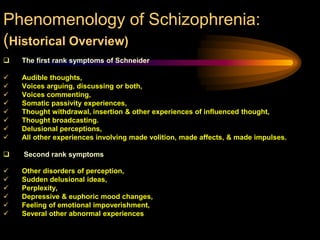
Eugene Minkowski      – ‘Loss of vital contact with reality’      – Compensatory ‘morbid rationalism’/‘hypertrophy of intellect’       – ‘Pragmatic dementia’Kurt Schneidertried to make the diagnosis more reliable by identifying a group of symptoms characteristic of schizophrenia, but rare in other disordersPhenomenology of Schizophrenia:(Historical Overview)The first rank symptoms of Schneider
Audible thoughts,
Voices arguing, discussing or both,
Voices commenting,
Somatic passivity experiences,
Thought withdrawal, insertion & other experiences of influenced thought,
Thought broadcasting.
Delusional perceptions,
All other experiences involving made volition, made affects, & made impulses.
 Second rank symptoms
Other disorders of perception,
Sudden delusional ideas,
Perplexity,
Depressive & euphoric mood changes,
Feeling of emotional impoverishment,
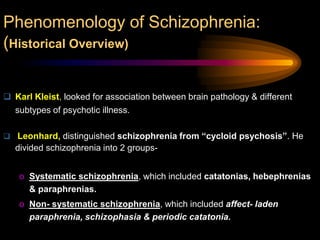
Several other abnormal experiences Phenomenology of Schizophrenia:(Historical Overview)Karl Kleist, looked for association between brain pathology & different subtypes of psychotic illness.
Leonhard, distinguished schizophrenia from “cycloid psychosis”. He divided schizophrenia into 2 groups-
Systematic schizophrenia, which included catatonias, hebephrenias & paraphrenias.
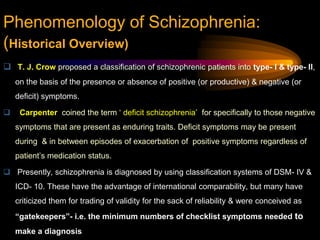
Non- systematic schizophrenia, which included affect- laden paraphrenia, schizophasia & periodic catatonia.Phenomenology of Schizophrenia:(Historical Overview)T. J. Crowproposed a classification of schizophrenic patients into type- I & type- II, on the basis of the presence or absence of positive (or productive) & negative (or deficit) symptoms.
Carpentercoined the term ‘ deficit schizophrenia’  for specifically to those negative symptoms that are present as enduring traits. Deficit symptoms may be present during  & in between episodes of exacerbation of  positive symptoms regardless of patient’s medication status.
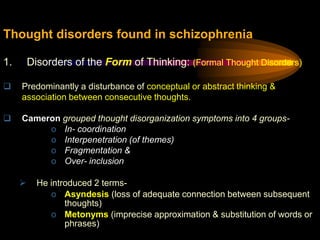
 Presently, schizophrenia is diagnosed by using classification systems of DSM- IV & ICD- 10. These have the advantage of international comparability, but many have criticized them for trading of validity for the sack of reliability & were conceived as “gatekeepers”- i.e. the minimum numbers of checklist symptoms needed to make a diagnosis.Thought disorders found in schizophrenia1.     Disorders of the Form of Thinking: (Formal Thought Disorders)Predominantly a disturbance ofconceptual or abstract thinking & association between consecutive thoughts.
Camerongrouped thought disorganization symptoms into 4 groups-
In- coordination
Interpenetration (of themes)
Fragmentation &
Over- inclusion
He introduced 2 terms-
Asyndesis(loss of adequate connection between subsequent thoughts)
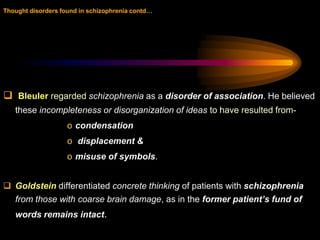
Metonyms (imprecise approximation & substitution of words or phrases)Thought disorders found in schizophrenia contd…Bleuler regarded schizophrenia as a disorder of association. He believed these incompleteness or disorganization of ideasto have resulted from-
condensation
displacement&
misuse of symbols.
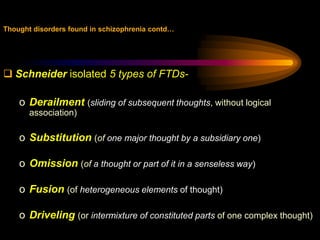
Goldsteindifferentiated concrete thinking of patients with schizophrenia from those with coarse brain damage, as in the former patient’s fund of words remains intact.Thought disorders found in schizophrenia contd…Schneiderisolated 5 types of FTDs-
Derailment(sliding of subsequent thoughts, without logical association)
Substitution(ofone major thought by a subsidiary one)
Omission(of a thought or part of it in a senseless way)
Fusion(of heterogeneous elements of thought)
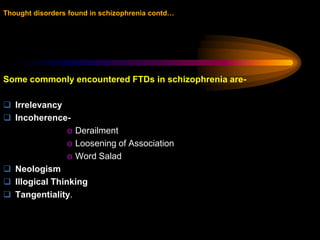
Driveling(or intermixture of constituted partsof one complex thought)Thought disorders found in schizophrenia contd…Some commonly encountered FTDs in schizophrenia are-Irrelevancy
Incoherence-
Derailment
Loosening of Association
Word Salad
Neologism
Illogical Thinking
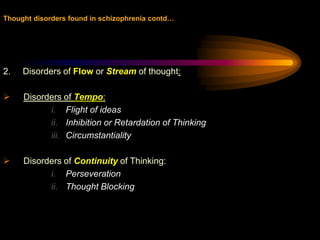
Tangentiality. Thought disorders found in schizophrenia contd…2.     Disorders of Flow or Stream of thought:Disorders of Tempo:Flight of ideasInhibition or Retardation of ThinkingCircumstantialityDisorders of Continuity of Thinking:PerseverationThought Blocking
Thought disorders found in schizophrenia contd…3.       Disorders of Possession of Thought:Obsessions & Compulsions
Thought Alienation ExperiencesThoughtinsertionThought BroadcastingThought Withdrawal or Deprivation
Thought disorders found in schizophrenia contd…4.   Disorders of the Content of Thinking:Delusions, Ideas& Overvalued Ideasdepending upon the degree of conviction upon the falsely held beliefs.
Delusions are false, unshakablebelief held , which can not be correctedby any means of reasoning & are not keeping with the patient’s socio- cultural background.Thought disorders found in schizophrenia contd…From phenomenological point of view, delusions are classified into- Primary Delusions: Ultimately un- understandable. Occurs de- novo & does not allow empathy. Conrad termed “Apophany”.3 types were described by Schneider-Delusional Mood or Atmosphere
Sudden Delusional Idea (Autochthonous Delusion)
Delusional Perception (Characteristic 2-memberedness)
Secondary Delusions:Understandablein context of other morbid experiences, physical or psychological. Some suggest “Projection” in its formation. Freud suggested “Latent Homosexuality”.Thought disorders found in schizophrenia contd…Depending upon the content, delusions are-Delusions of Persecution
Delusions of Jealousy
Delusions of Love
Delusions of Influence or Control
Delusions of infidelity
Somatic or HypochondriacalDelusions
Delusions of Grandeur (sometimes in paranoid schizophrenia)Misidentifications Capgras syndrome (Capgras and Reboul-Lachaux, 1923)    An uncommon syndrome in which the patient believes that a person to whom they are close, usually a family member, has been replaced by exact double.     Associated with paranoid, suspicious beliefsIntermetamorphosis(Courbon and Tusques, 1932)    Characterized by Delusion that people have swapped    identities while maintaining the same appearance .      Involves a false recognition of both appearance and identity
Misidentification contd…Fregoli delusion or Fregoli syndromeThe is a rare disorder in which a person holds a delusional belief that different people are in fact a single person who changes appearance or is in disguise. The syndrome may be related to a brain lesion, and is often of a paranoid nature with the delusional person believing themselves persecuted by the person they believe is in disguise.The condition is named after the Italian actor Leopoldo Fregoli who was renowned for his ability to make quick changes of appearance during his stage act.
Disorders of Speech:Stammering & Stuttering-occasionally in acute schizophrenia (especially early onset).
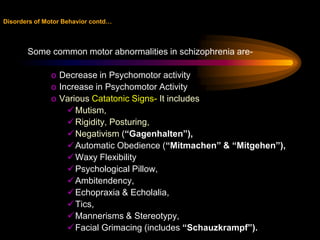
Mutism- in catatonic stupor, guarded paranoid patients & also in drug induced akinesia.
Vorbeireden or talking past the point (in hebephrenic schizophrenia).
Neologism- in catatonic & hebephrenic schizophrenia.
Speech Confusion-in chronic schizophrenics (Bleuler termed “schizophasia”).
Echolalia- in catatonic patients.
Alogia- in negative or deficit schizophrenia.
Coprophrasia(involuntary use of obscene or vulgar language).
Pressure of Speech & Poverty of Speech.Disorders of perception:I.     Sensory Distortions:  It includes- Changes inIntensity (Hypoaesthesia or Hyperaesthesia)
Quality (Xanthopsia, Chloropsia, Erythopsia)
Spatial Form (Dysmegalopsia- micropsiaormacropsia)

Schizophrenia

  • 1.
    Schizophrenia Part– II :Clinical Manifestations and Phenomenology, Differential Diagnosis, Course, Prognosis Management & Rehabilitation13th November’2009::Moderator ::Dr. Kamala DekaAssociate Professor :: Speaker ::Dr. Santanu GhoshPostgraduate StudentDepartment of Psychiatry, Assam Medical College
  • 2.
    Layout of presentation:IntroductionClinicalManifestationPhenomenologyDifferential DiagnosisCoursePrognosisManagement RehabilitationConclusionTake home messageBibliography
  • 3.
    Introduction Schizophrenia is a stress-related, neurobiological disorder characterized by disturbances in the form and content of an individual's thought and perceptual processes, affect and social and instrumental role behavior. The pervasive impact of schizophrenia across perceptual, cognitive, emotional and behavioral domains, as well as the heterogeneity within those domains require a multimodal and comprehensive approach to treatment and rehabilitation which involves the individual and his or her environment. A multidimensional and interactive model that includes stress, vulnerability, and protective factors best guides the types of interventions for treating and rehabilitating persons with schizophrenia.
  • 4.
  • 5.
    Clinical Features ofSchizophreniaNegative symptomsAutismAffective flatteningAvolitionSocial withdrawanAlogiaFunctional ImpairmentsWork/school performanceInterpersonal relationships &Self-care deteriorationPositive symptomsDelusionsHallucinationsMood symptomsDepression/AnxietyAggression/HostilitySuicidalityDisorganizationInappropriate affectDisorganized behaviorThought disorderCognitive deficitsAttentionMemoryVerbal fluencyExecutive function
  • 6.
    Prodromal Symptoms Severeanxiety Severe distractibility Person feels “strange” Symbolization, mysterious thinking Profound withdrawal, isolation, Rejection, paranoid thinking Preoccupation with religion Altered sexuality, preoccupation with homosexual themesSpeech and language disturbance
  • 7.
  • 8.
    Concept of Phenomenology:Phenomenologycan be defined as the study of events or phenomena, either psychological or physical, by means of empathy & immaculate clinical observation, but without embellishing those events or phenomena with explanation of cause or function.
  • 9.
    In psychiatry, phenomenologyis the way of understanding & describing the psychological phenomena, involved in various psychopathological states.Phenomenology of Schizophrenia:(Historical Overview)Emil Kraepelintranslated Morel’s “demenceprecoce” into “dementia praecox”, to emphasize the distinct cognitive decline (dementia) & early onset (praecox) of the disorder.
  • 10.
    EugenBleulercoined the term“schizophrenia”to mean “splitting” of the psychic functions. Bleuler made a distinction between the fundamental & accessory symptoms of schizophrenia. The fundamentalsymptoms of Bleuler, which were also designated as the four “A”sare-Disturbance of Association (e.g, looseness),Affective disturbance(eg, flattening),Autism (i.e. withdrawn from reality into an inner fantasy world) &Ambivalence.
  • 11.
    Phenomenology of Schizophrenia:(HistoricalOverview)Bleulerviewed some of the most frequent & striking symptoms were accessory (or secondary). These include- hallucinations, delusions, catatonia & abnormal behavior.
  • 12.
    Adolf Meyersawschizophrenia & other mental disorders as reactions to life stress & he called these “schizophreniform reaction”.
  • 13.
    Harry Stack Sullivanemphasizedsocial isolation as a cause & a symptom of schizophrenia.
  • 14.
    Wolfgang Blankenburg– ‘lossof common sense’Phenomenology of Schizophrenia:(Historical Overview)Ernst Kretschmercompiled data to support the idea that schizophrenia occurs more in persons with asthenicbody built.
  • 15.
    Gabriel Langfeldtproposed adistinction between “true schizophrenia” having insidious onset, derealization, depersonalization, autism, emotional blunting and poor outcome; from “schizophreniform states”
  • 16.
    Eugene Minkowski – ‘Loss of vital contact with reality’ – Compensatory ‘morbid rationalism’/‘hypertrophy of intellect’ – ‘Pragmatic dementia’Kurt Schneidertried to make the diagnosis more reliable by identifying a group of symptoms characteristic of schizophrenia, but rare in other disordersPhenomenology of Schizophrenia:(Historical Overview)The first rank symptoms of Schneider
  • 17.
  • 18.
  • 19.
  • 20.
  • 21.
    Thought withdrawal, insertion& other experiences of influenced thought,
  • 22.
  • 23.
  • 24.
    All other experiencesinvolving made volition, made affects, & made impulses.
  • 25.
    Second ranksymptoms
  • 26.
  • 27.
  • 28.
  • 29.
  • 30.
    Feeling of emotionalimpoverishment,
  • 31.
    Several other abnormalexperiences Phenomenology of Schizophrenia:(Historical Overview)Karl Kleist, looked for association between brain pathology & different subtypes of psychotic illness.
  • 32.
    Leonhard, distinguished schizophreniafrom “cycloid psychosis”. He divided schizophrenia into 2 groups-
  • 33.
    Systematic schizophrenia, whichincluded catatonias, hebephrenias & paraphrenias.
  • 34.
    Non- systematic schizophrenia,which included affect- laden paraphrenia, schizophasia & periodic catatonia.Phenomenology of Schizophrenia:(Historical Overview)T. J. Crowproposed a classification of schizophrenic patients into type- I & type- II, on the basis of the presence or absence of positive (or productive) & negative (or deficit) symptoms.
  • 35.
    Carpentercoined the term‘ deficit schizophrenia’ for specifically to those negative symptoms that are present as enduring traits. Deficit symptoms may be present during & in between episodes of exacerbation of positive symptoms regardless of patient’s medication status.
  • 36.
    Presently, schizophreniais diagnosed by using classification systems of DSM- IV & ICD- 10. These have the advantage of international comparability, but many have criticized them for trading of validity for the sack of reliability & were conceived as “gatekeepers”- i.e. the minimum numbers of checklist symptoms needed to make a diagnosis.Thought disorders found in schizophrenia1. Disorders of the Form of Thinking: (Formal Thought Disorders)Predominantly a disturbance ofconceptual or abstract thinking & association between consecutive thoughts.
  • 37.
  • 38.
  • 39.
  • 40.
  • 41.
  • 42.
  • 43.
    Asyndesis(loss of adequateconnection between subsequent thoughts)
  • 44.
    Metonyms (imprecise approximation& substitution of words or phrases)Thought disorders found in schizophrenia contd…Bleuler regarded schizophrenia as a disorder of association. He believed these incompleteness or disorganization of ideasto have resulted from-
  • 45.
  • 46.
  • 47.
  • 48.
    Goldsteindifferentiated concrete thinkingof patients with schizophrenia from those with coarse brain damage, as in the former patient’s fund of words remains intact.Thought disorders found in schizophrenia contd…Schneiderisolated 5 types of FTDs-
  • 49.
    Derailment(sliding of subsequentthoughts, without logical association)
  • 50.
  • 51.
    Omission(of a thoughtor part of it in a senseless way)
  • 52.
  • 53.
    Driveling(or intermixture ofconstituted partsof one complex thought)Thought disorders found in schizophrenia contd…Some commonly encountered FTDs in schizophrenia are-Irrelevancy
  • 54.
  • 55.
  • 56.
  • 57.
  • 58.
  • 59.
  • 60.
    Tangentiality. Thought disordersfound in schizophrenia contd…2. Disorders of Flow or Stream of thought:Disorders of Tempo:Flight of ideasInhibition or Retardation of ThinkingCircumstantialityDisorders of Continuity of Thinking:PerseverationThought Blocking
  • 61.
    Thought disorders foundin schizophrenia contd…3. Disorders of Possession of Thought:Obsessions & Compulsions
  • 62.
    Thought Alienation ExperiencesThoughtinsertionThoughtBroadcastingThought Withdrawal or Deprivation
  • 63.
    Thought disorders foundin schizophrenia contd…4. Disorders of the Content of Thinking:Delusions, Ideas& Overvalued Ideasdepending upon the degree of conviction upon the falsely held beliefs.
  • 64.
    Delusions are false,unshakablebelief held , which can not be correctedby any means of reasoning & are not keeping with the patient’s socio- cultural background.Thought disorders found in schizophrenia contd…From phenomenological point of view, delusions are classified into- Primary Delusions: Ultimately un- understandable. Occurs de- novo & does not allow empathy. Conrad termed “Apophany”.3 types were described by Schneider-Delusional Mood or Atmosphere
  • 65.
    Sudden Delusional Idea(Autochthonous Delusion)
  • 66.
  • 67.
    Secondary Delusions:Understandablein contextof other morbid experiences, physical or psychological. Some suggest “Projection” in its formation. Freud suggested “Latent Homosexuality”.Thought disorders found in schizophrenia contd…Depending upon the content, delusions are-Delusions of Persecution
  • 68.
  • 69.
  • 70.
  • 71.
  • 72.
  • 73.
    Delusions of Grandeur(sometimes in paranoid schizophrenia)Misidentifications Capgras syndrome (Capgras and Reboul-Lachaux, 1923) An uncommon syndrome in which the patient believes that a person to whom they are close, usually a family member, has been replaced by exact double. Associated with paranoid, suspicious beliefsIntermetamorphosis(Courbon and Tusques, 1932) Characterized by Delusion that people have swapped identities while maintaining the same appearance . Involves a false recognition of both appearance and identity
  • 74.
    Misidentification contd…Fregoli delusionor Fregoli syndromeThe is a rare disorder in which a person holds a delusional belief that different people are in fact a single person who changes appearance or is in disguise. The syndrome may be related to a brain lesion, and is often of a paranoid nature with the delusional person believing themselves persecuted by the person they believe is in disguise.The condition is named after the Italian actor Leopoldo Fregoli who was renowned for his ability to make quick changes of appearance during his stage act.
  • 75.
    Disorders of Speech:Stammering& Stuttering-occasionally in acute schizophrenia (especially early onset).
  • 76.
    Mutism- in catatonicstupor, guarded paranoid patients & also in drug induced akinesia.
  • 77.
    Vorbeireden or talkingpast the point (in hebephrenic schizophrenia).
  • 78.
    Neologism- in catatonic& hebephrenic schizophrenia.
  • 79.
    Speech Confusion-in chronicschizophrenics (Bleuler termed “schizophasia”).
  • 80.
  • 81.
    Alogia- in negativeor deficit schizophrenia.
  • 82.
    Coprophrasia(involuntary use ofobscene or vulgar language).
  • 83.
    Pressure of Speech& Poverty of Speech.Disorders of perception:I. Sensory Distortions: It includes- Changes inIntensity (Hypoaesthesia or Hyperaesthesia)
  • 84.
  • 85.
    Spatial Form (Dysmegalopsia-micropsiaormacropsia)