NEUROPSYCHIATRY AND
ANTIPSYCHOTICS
By
EkamEmefiele
(Med. Student)
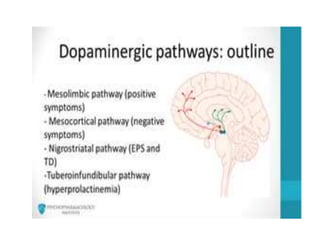
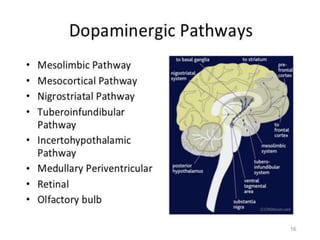
Dopamine pathways relevant to antipsychotic
pharmacology in the treatment of schizophrenia are:
 Mesolimbic pathway
 Mesocortical pathway
 Nigrostriatal pathway
 Tuberoinfundibular pathway
By blocking these pathways, antipsychotics can produce
both therapeutic and adverse effects.
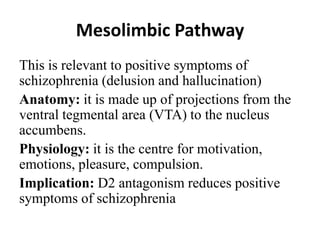
Mesolimbic Pathway
This is relevant to positive symptoms of
schizophrenia (delusion and hallucination)
Anatomy: it is made up of projections from the
ventral tegmental area (VTA) to the nucleus
accumbens.
Physiology: it is the centre for motivation,
emotions, pleasure, compulsion.
Implication: D2 antagonism reduces positive
symptoms of schizophrenia
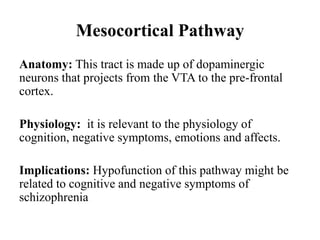
Mesocortical Pathway
Anatomy: This tract is made up of dopaminergic
neurons that projects from the VTA to the pre-frontal
cortex.
Physiology: it is relevant to the physiology of
cognition, negative symptoms, emotions and affects.
Implications: Hypofunction of this pathway might be
related to cognitive and negative symptoms of
schizophrenia
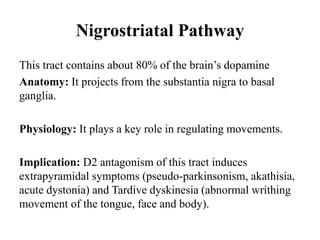
Nigrostriatal Pathway
This tract contains about 80% of the brain’s dopamine
Anatomy: It projects from the substantia nigra to basal
ganglia.
Physiology: It plays a key role in regulating movements.
Implication: D2 antagonism of this tract induces
extrapyramidal symptoms (pseudo-parkinsonism, akathisia,
acute dystonia) and Tardive dyskinesia (abnormal writhing
movement of the tongue, face and body).
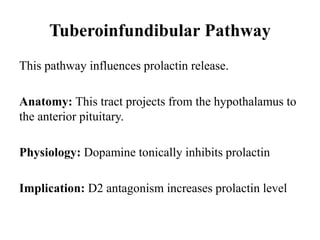
Tuberoinfundibular Pathway
This pathway influences prolactin release.
Anatomy: This tract projects from the hypothalamus to
the anterior pituitary.
Physiology: Dopamine tonically inhibits prolactin
Implication: D2 antagonism increases prolactin level
Antipsychotics
Psychosis
Psychosis is a thought disorder characterized by
disturbances of reality and perception, impaired
cognitive functioning, and inappropriate or diminished
affect (mood).
Psychosis denotes many mental disorders.
Schizophrenia is a particular kind of psychosis
characterized mainly by a clear sensorium but a marked
thinking disturbance.
Substances that can induce psychotic
symptom
These includes;
 Alcohol
 Cannabis (Marijuana)
 Cocaine
 Amphetamines
 L. dopa
Schizophrenia
• It is a thought disorder.
• The disorder is characterized by a divorcement from
reality in the mind of the person (psychosis).
• Pathogenesis is unknown.
• Onset of schizophrenia is in the late teens early
twenties.
• Genetic predisposition -- Familial incidence.
• Multiple genes are involved.
• Afflicts 1% of the population worldwide.
• May or may not be present with anatomical changes
Symptoms
Positive Symptoms :
Hallucinations, delusions, paranoia, excited motor
behaviour.
Negative Symptoms :
Slow thought or speech, social withdrawal, emotional
blunting, cognitive deficits, extreme inattentiveness or
lack of motivation to interact with the environment.
Antipsychotic Medications (APMs)
 Used to treat manifestations of psychosis and other
psychiatry disorders
 Precise mechanism of action is unknown, however
APMs blocks several populations of dopamine (D2,
D4) receptors in the brain.
 The newer APMs also block serotonin (5-HT2)
receptors, a property that may be associated with
increased efficacy.
 APMs also variably blocks central and peripheral
cholinergic, histamine and alpha receptors
Classification of antipsychotic
drugs• PHARMACOLOGICAL CLASSIFICATION
– FIRST-GENERATION ANTIPSYCHOTIC (low potency)
• Chlorpromazine
• Prochlorperazine
• Thioridazine
– FIRST-GENERATION ANTIPSYCHOTIC (high potency)
• Fluphenazine (Modecate)
• Haloperidol (Haldol)
• Pimozide
• Thiothixene
• Zuclopenthixol (Clopixol)
– SECOND GENERATION ANTIPSYCHOTIC
• Aripiprazole • Asenapine
• Clozapine • Iloperidone
• Lurasidone • Olanzapine
• Quetiapine • Paliperidone
• Risperidone • Ziprasidone
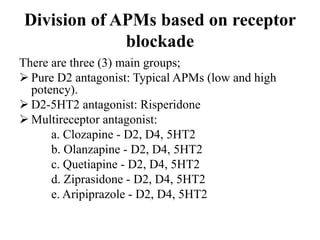
Division of APMs based on receptor
blockade
There are three (3) main groups;
 Pure D2 antagonist: Typical APMs (low and high
potency).
 D2-5HT2 antagonist: Risperidone
 Multireceptor antagonist:
a. Clozapine - D2, D4, 5HT2
b. Olanzapine - D2, D4, 5HT2
c. Quetiapine - D2, D4, 5HT2
d. Ziprasidone - D2, D4, 5HT2
e. Aripiprazole - D2, D4, 5HT2
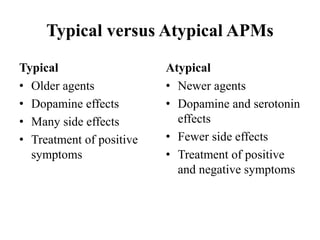
Typical versus Atypical APMs
Typical
• Older agents
• Dopamine effects
• Many side effects
• Treatment of positive
symptoms
Atypical
• Newer agents
• Dopamine and serotonin
effects
• Fewer side effects
• Treatment of positive
and negative symptoms
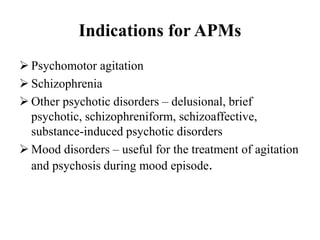
Indications for APMs
 Psychomotor agitation
 Schizophrenia
 Other psychotic disorders – delusional, brief
psychotic, schizophreniform, schizoaffective,
substance-induced psychotic disorders
 Mood disorders – useful for the treatment of agitation
and psychosis during mood episode.
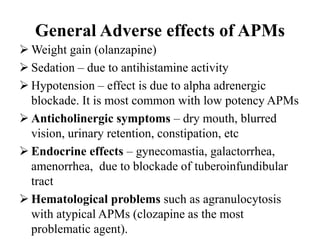
General Adverse effects of APMs
 Weight gain (olanzapine)
 Sedation – due to antihistamine activity
 Hypotension – effect is due to alpha adrenergic
blockade. It is most common with low potency APMs
 Anticholinergic symptoms – dry mouth, blurred
vision, urinary retention, constipation, etc
 Endocrine effects – gynecomastia, galactorrhea,
amenorrhea, due to blockade of tuberoinfundibular
tract
 Hematological problems such as agranulocytosis
with atypical APMs (clozapine as the most
problematic agent).
Neurologic effects
 Pseudoparkinsonism: It is characterized by muscle rigidity,
shuffling gait, masklike facial expression, resting tremor.
 Acute dystonia: Prolonged muscle spasm. More common in
men younger than 40yrs. It may mimic seizure
 Akathisia: Subjective feeling of motor restlessness.
 Tardive dyskinesia: A disorder that involves involuntary,
repetitive movements of the muscles of the tongue, face and
body. You treat with low potency or atypical APMs.
 Neuroleptic malignant syndrome: A rare but
potentially life-threatening reaction to APMs. It
causes fever, muscular rigidity, altered mental status,
excessive sweating, salivation, increased BP and
pulse rate. It is treated by stopping the agent and
providing medical support.
Thank You

Antipsychotics presentation

  • 1.
  • 4.
    Dopamine pathways relevantto antipsychotic pharmacology in the treatment of schizophrenia are:  Mesolimbic pathway  Mesocortical pathway  Nigrostriatal pathway  Tuberoinfundibular pathway By blocking these pathways, antipsychotics can produce both therapeutic and adverse effects.
  • 5.
    Mesolimbic Pathway This isrelevant to positive symptoms of schizophrenia (delusion and hallucination) Anatomy: it is made up of projections from the ventral tegmental area (VTA) to the nucleus accumbens. Physiology: it is the centre for motivation, emotions, pleasure, compulsion. Implication: D2 antagonism reduces positive symptoms of schizophrenia
  • 6.
    Mesocortical Pathway Anatomy: Thistract is made up of dopaminergic neurons that projects from the VTA to the pre-frontal cortex. Physiology: it is relevant to the physiology of cognition, negative symptoms, emotions and affects. Implications: Hypofunction of this pathway might be related to cognitive and negative symptoms of schizophrenia
  • 7.
    Nigrostriatal Pathway This tractcontains about 80% of the brain’s dopamine Anatomy: It projects from the substantia nigra to basal ganglia. Physiology: It plays a key role in regulating movements. Implication: D2 antagonism of this tract induces extrapyramidal symptoms (pseudo-parkinsonism, akathisia, acute dystonia) and Tardive dyskinesia (abnormal writhing movement of the tongue, face and body).
  • 8.
    Tuberoinfundibular Pathway This pathwayinfluences prolactin release. Anatomy: This tract projects from the hypothalamus to the anterior pituitary. Physiology: Dopamine tonically inhibits prolactin Implication: D2 antagonism increases prolactin level
  • 9.
  • 10.
    Psychosis Psychosis is athought disorder characterized by disturbances of reality and perception, impaired cognitive functioning, and inappropriate or diminished affect (mood). Psychosis denotes many mental disorders. Schizophrenia is a particular kind of psychosis characterized mainly by a clear sensorium but a marked thinking disturbance.
  • 11.
    Substances that caninduce psychotic symptom These includes;  Alcohol  Cannabis (Marijuana)  Cocaine  Amphetamines  L. dopa
  • 12.
    Schizophrenia • It isa thought disorder. • The disorder is characterized by a divorcement from reality in the mind of the person (psychosis). • Pathogenesis is unknown. • Onset of schizophrenia is in the late teens early twenties. • Genetic predisposition -- Familial incidence. • Multiple genes are involved. • Afflicts 1% of the population worldwide. • May or may not be present with anatomical changes
  • 13.
    Symptoms Positive Symptoms : Hallucinations,delusions, paranoia, excited motor behaviour. Negative Symptoms : Slow thought or speech, social withdrawal, emotional blunting, cognitive deficits, extreme inattentiveness or lack of motivation to interact with the environment.
  • 14.
    Antipsychotic Medications (APMs) Used to treat manifestations of psychosis and other psychiatry disorders  Precise mechanism of action is unknown, however APMs blocks several populations of dopamine (D2, D4) receptors in the brain.  The newer APMs also block serotonin (5-HT2) receptors, a property that may be associated with increased efficacy.  APMs also variably blocks central and peripheral cholinergic, histamine and alpha receptors
  • 15.
    Classification of antipsychotic drugs•PHARMACOLOGICAL CLASSIFICATION – FIRST-GENERATION ANTIPSYCHOTIC (low potency) • Chlorpromazine • Prochlorperazine • Thioridazine – FIRST-GENERATION ANTIPSYCHOTIC (high potency) • Fluphenazine (Modecate) • Haloperidol (Haldol) • Pimozide • Thiothixene • Zuclopenthixol (Clopixol)
  • 16.
    – SECOND GENERATIONANTIPSYCHOTIC • Aripiprazole • Asenapine • Clozapine • Iloperidone • Lurasidone • Olanzapine • Quetiapine • Paliperidone • Risperidone • Ziprasidone
  • 17.
    Division of APMsbased on receptor blockade There are three (3) main groups;  Pure D2 antagonist: Typical APMs (low and high potency).  D2-5HT2 antagonist: Risperidone  Multireceptor antagonist: a. Clozapine - D2, D4, 5HT2 b. Olanzapine - D2, D4, 5HT2 c. Quetiapine - D2, D4, 5HT2 d. Ziprasidone - D2, D4, 5HT2 e. Aripiprazole - D2, D4, 5HT2
  • 18.
    Typical versus AtypicalAPMs Typical • Older agents • Dopamine effects • Many side effects • Treatment of positive symptoms Atypical • Newer agents • Dopamine and serotonin effects • Fewer side effects • Treatment of positive and negative symptoms
  • 19.
    Indications for APMs Psychomotor agitation  Schizophrenia  Other psychotic disorders – delusional, brief psychotic, schizophreniform, schizoaffective, substance-induced psychotic disorders  Mood disorders – useful for the treatment of agitation and psychosis during mood episode.
  • 20.
    General Adverse effectsof APMs  Weight gain (olanzapine)  Sedation – due to antihistamine activity  Hypotension – effect is due to alpha adrenergic blockade. It is most common with low potency APMs  Anticholinergic symptoms – dry mouth, blurred vision, urinary retention, constipation, etc  Endocrine effects – gynecomastia, galactorrhea, amenorrhea, due to blockade of tuberoinfundibular tract  Hematological problems such as agranulocytosis with atypical APMs (clozapine as the most problematic agent).
  • 21.
    Neurologic effects  Pseudoparkinsonism:It is characterized by muscle rigidity, shuffling gait, masklike facial expression, resting tremor.  Acute dystonia: Prolonged muscle spasm. More common in men younger than 40yrs. It may mimic seizure  Akathisia: Subjective feeling of motor restlessness.  Tardive dyskinesia: A disorder that involves involuntary, repetitive movements of the muscles of the tongue, face and body. You treat with low potency or atypical APMs.
  • 22.
     Neuroleptic malignantsyndrome: A rare but potentially life-threatening reaction to APMs. It causes fever, muscular rigidity, altered mental status, excessive sweating, salivation, increased BP and pulse rate. It is treated by stopping the agent and providing medical support.
  • 23.