Crisbert I. Cualteros, MD
Aka. enteric fever a systemic infection by S.  typhi  or  S. paratyphi.   Both are pathogenic exclusively in humans a severe multisystemic illness characterized by:  classic prolonged fever sustained bacteremia w/o endothelial or endocardial involvement. bacterial invasion and multiplication w/in the mononuclear phagocytic cells of the liver, spleen, lymph nodes, and Peyer patches
potentially fatal if untreated MOT: typically infected with  S typhi  and  S paratyphi  through food and beverages contaminated by a chronic stool carrier Less c ommonly , carriers shed bacteria in urine. Px maybe infected by drinking sewage-contaminated water or by eating contaminated shellfish or faultily canned meat
Salmonellae  gram-negative, flagellate, nonspore former, facultative anaerobic bacilli that ferment glucose, reduce nitrate to nitrite, and synthesize peritrichous flagella when motile.  S typhi  has O and H antigens,  an envelope (K) antigen, and a LPS macromolecular complex called  endotoxin  that forms the outer portion of the cell wall
Pathophysiology: ingestion by the host 4-14 days incubation  S typhi  invades through the gut mucosa in terminal ileum S typhi crosses intestinal mucosa Enters mesenteric lymph nodes Into blood stream via lymphatics
IP:  S. typhoid - averages 7-14 (range, 3-30) days. S. paratyphoid  - ranges from 1-10 days.  During the incubation period, 10-20% of patients have transient diarrhea (enterocolitis) that usually resolves before the onset of the full-fledged disease.
High grade fever Coated tongue  Anorexia  Vomiting Hepatosplenomegaly Diarrhea Abdominal pain Rash(rose spots)
Mostly moderately anemic. CBC inc ESR and dec Platelet count lymphopenia.  Most inc prothrombin time (PT) and activated partial thromboplastin time Dec. fibrinogen levels  Elev (2x) Liver transaminase values and serum bilirubin levels Mild hyponatremia and hypokalemia .
DIAGNOSIS : Blood,Urine,Stool The most sensitive method of isolating  S typhi  is obtaining a BMA culture. Widal test. Monoclonal antibodies.
Histologic Findings:  The hallmark  infiltration of tissues by macrophages (typhoid cells)   that contain bacteria, erythrocytes, and degenerated lymphocytes. Aggregates of these macrophages are called  typhoid nodules , found in the intestine, mesenteric LN, spleen, liver, and bone marrow some in kidneys, testes, and parotid glands.
In the intestines,  4 classic pathologic stages  occur : the course of infection:  (1)  hyperplastic changes ,  (2)  necrosis of the intestinal mucosa ,  (3)  sloughing of the mucosa , and  (4)  the development of ulcers.  The ulcers may perforate into the peritoneal cavity.
Mesenteric LN , sinusoids are enlarged and distended by large collections of macrophages and RES.  Spleen  is enlarged, red, soft, and congested; its serosal surface may have a fibrinous exudate.  Gallbladder  is hyperemic and may show evidence of cholecystitis.
Liver:  liver biopsy specimen from a person with typhoid often shows cloudy swelling, balloon degeneration with vacuolation of hepatocytes, moderate fatty change, and focal typhoid nodules. Intact typhoid bacilli can be observed at these sites.
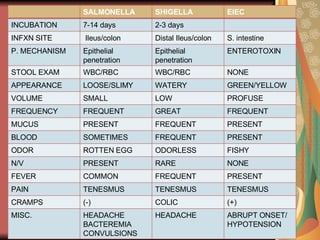
SALMONELLA SHIGELLA EIEC INCUBATION 7-14 days 2-3 days INFXN SITE Ileus/colon Distal Ileus/colon S. intestine P. MECHANISM Epithelial penetration Epithelial penetration ENTEROTOXIN STOOL EXAM WBC/RBC WBC/RBC NONE APPEARANCE LOOSE/SLIMY WATERY GREEN/YELLOW VOLUME SMALL LOW PROFUSE FREQUENCY FREQUENT GREAT FREQUENT MUCUS PRESENT FREQUENT PRESENT BLOOD SOMETIMES FREQUENT PRESENT ODOR ROTTEN EGG ODORLESS FISHY N/V PRESENT RARE NONE FEVER COMMON FREQUENT PRESENT PAIN  TENESMUS TENESMUS TENESMUS CRAMPS (-) COLIC (+) MISC. HEADACHE BACTEREMIA CONVULSIONS HEADACHE ABRUPT ONSET/ HYPOTENSION
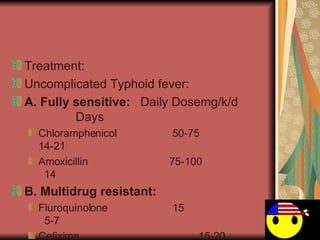
Treatment: Uncomplicated Typhoid fever: A. Fully sensitive: Daily Dosemg/k/d   Days Chloramphenicol  50-75   14-21 Amoxicillin   75-100   14 B. Multidrug resistant: Fluroquinolone 15 5-7 Cefixime   15-20 7-14 C. Quinolone resistant: Azithromycin   8-10   7 Ceftriaxone 75    10-14
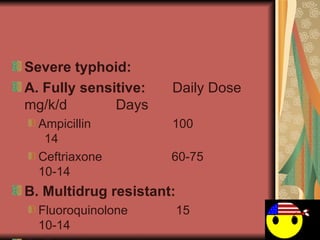
Severe typhoid: A. Fully sensitive: Daily Dose mg/k/d   Days Ampicillin 100 14 Ceftriaxone   60-75   10-14 B. Multidrug resistant: Fluoroquinolone  15   10-14 C. Quinolone resistant : Ceftriaxone   60-75   10-14
Prognosis:  Generally, the mortality rate untreated disease is 10-20%. In properly treated disease, < 1%. 10% and 20% treated w antibiotics have a relapse after initial recovery.  A relapse typically occurs approx 1 wk after therapy is discontinued.  The blood culture results are again positive, and high serum levels of H, O, and Vi antibodies and rose spots may reappear. A relapse generally is milder and shorter than the initial illness.
Prevention: Oral live attenuated preparation Ty21A strain of S. Typhi  Vi Capsular polyssacharide
Thank you!!

Typhoid Fever

  • 1.
  • 2.
    Aka. enteric fevera systemic infection by S. typhi or S. paratyphi. Both are pathogenic exclusively in humans a severe multisystemic illness characterized by: classic prolonged fever sustained bacteremia w/o endothelial or endocardial involvement. bacterial invasion and multiplication w/in the mononuclear phagocytic cells of the liver, spleen, lymph nodes, and Peyer patches
  • 3.
    potentially fatal ifuntreated MOT: typically infected with S typhi and S paratyphi through food and beverages contaminated by a chronic stool carrier Less c ommonly , carriers shed bacteria in urine. Px maybe infected by drinking sewage-contaminated water or by eating contaminated shellfish or faultily canned meat
  • 4.
    Salmonellae gram-negative,flagellate, nonspore former, facultative anaerobic bacilli that ferment glucose, reduce nitrate to nitrite, and synthesize peritrichous flagella when motile. S typhi has O and H antigens, an envelope (K) antigen, and a LPS macromolecular complex called endotoxin that forms the outer portion of the cell wall
  • 5.
    Pathophysiology: ingestion bythe host 4-14 days incubation S typhi invades through the gut mucosa in terminal ileum S typhi crosses intestinal mucosa Enters mesenteric lymph nodes Into blood stream via lymphatics
  • 6.
    IP: S.typhoid - averages 7-14 (range, 3-30) days. S. paratyphoid - ranges from 1-10 days. During the incubation period, 10-20% of patients have transient diarrhea (enterocolitis) that usually resolves before the onset of the full-fledged disease.
  • 7.
    High grade feverCoated tongue Anorexia Vomiting Hepatosplenomegaly Diarrhea Abdominal pain Rash(rose spots)
  • 8.
    Mostly moderately anemic.CBC inc ESR and dec Platelet count lymphopenia. Most inc prothrombin time (PT) and activated partial thromboplastin time Dec. fibrinogen levels Elev (2x) Liver transaminase values and serum bilirubin levels Mild hyponatremia and hypokalemia .
  • 9.
    DIAGNOSIS : Blood,Urine,StoolThe most sensitive method of isolating S typhi is obtaining a BMA culture. Widal test. Monoclonal antibodies.
  • 10.
    Histologic Findings: The hallmark infiltration of tissues by macrophages (typhoid cells) that contain bacteria, erythrocytes, and degenerated lymphocytes. Aggregates of these macrophages are called typhoid nodules , found in the intestine, mesenteric LN, spleen, liver, and bone marrow some in kidneys, testes, and parotid glands.
  • 11.
    In the intestines, 4 classic pathologic stages occur : the course of infection: (1) hyperplastic changes , (2) necrosis of the intestinal mucosa , (3) sloughing of the mucosa , and (4) the development of ulcers. The ulcers may perforate into the peritoneal cavity.
  • 12.
    Mesenteric LN ,sinusoids are enlarged and distended by large collections of macrophages and RES. Spleen is enlarged, red, soft, and congested; its serosal surface may have a fibrinous exudate. Gallbladder is hyperemic and may show evidence of cholecystitis.
  • 13.
    Liver: liverbiopsy specimen from a person with typhoid often shows cloudy swelling, balloon degeneration with vacuolation of hepatocytes, moderate fatty change, and focal typhoid nodules. Intact typhoid bacilli can be observed at these sites.
  • 14.
    SALMONELLA SHIGELLA EIECINCUBATION 7-14 days 2-3 days INFXN SITE Ileus/colon Distal Ileus/colon S. intestine P. MECHANISM Epithelial penetration Epithelial penetration ENTEROTOXIN STOOL EXAM WBC/RBC WBC/RBC NONE APPEARANCE LOOSE/SLIMY WATERY GREEN/YELLOW VOLUME SMALL LOW PROFUSE FREQUENCY FREQUENT GREAT FREQUENT MUCUS PRESENT FREQUENT PRESENT BLOOD SOMETIMES FREQUENT PRESENT ODOR ROTTEN EGG ODORLESS FISHY N/V PRESENT RARE NONE FEVER COMMON FREQUENT PRESENT PAIN TENESMUS TENESMUS TENESMUS CRAMPS (-) COLIC (+) MISC. HEADACHE BACTEREMIA CONVULSIONS HEADACHE ABRUPT ONSET/ HYPOTENSION
  • 15.
    Treatment: Uncomplicated Typhoidfever: A. Fully sensitive: Daily Dosemg/k/d Days Chloramphenicol 50-75 14-21 Amoxicillin 75-100 14 B. Multidrug resistant: Fluroquinolone 15 5-7 Cefixime 15-20 7-14 C. Quinolone resistant: Azithromycin 8-10 7 Ceftriaxone 75 10-14
  • 16.
    Severe typhoid: A.Fully sensitive: Daily Dose mg/k/d Days Ampicillin 100 14 Ceftriaxone 60-75 10-14 B. Multidrug resistant: Fluoroquinolone 15 10-14 C. Quinolone resistant : Ceftriaxone 60-75 10-14
  • 17.
    Prognosis: Generally,the mortality rate untreated disease is 10-20%. In properly treated disease, < 1%. 10% and 20% treated w antibiotics have a relapse after initial recovery. A relapse typically occurs approx 1 wk after therapy is discontinued. The blood culture results are again positive, and high serum levels of H, O, and Vi antibodies and rose spots may reappear. A relapse generally is milder and shorter than the initial illness.
  • 18.
    Prevention: Oral liveattenuated preparation Ty21A strain of S. Typhi Vi Capsular polyssacharide
  • 19.