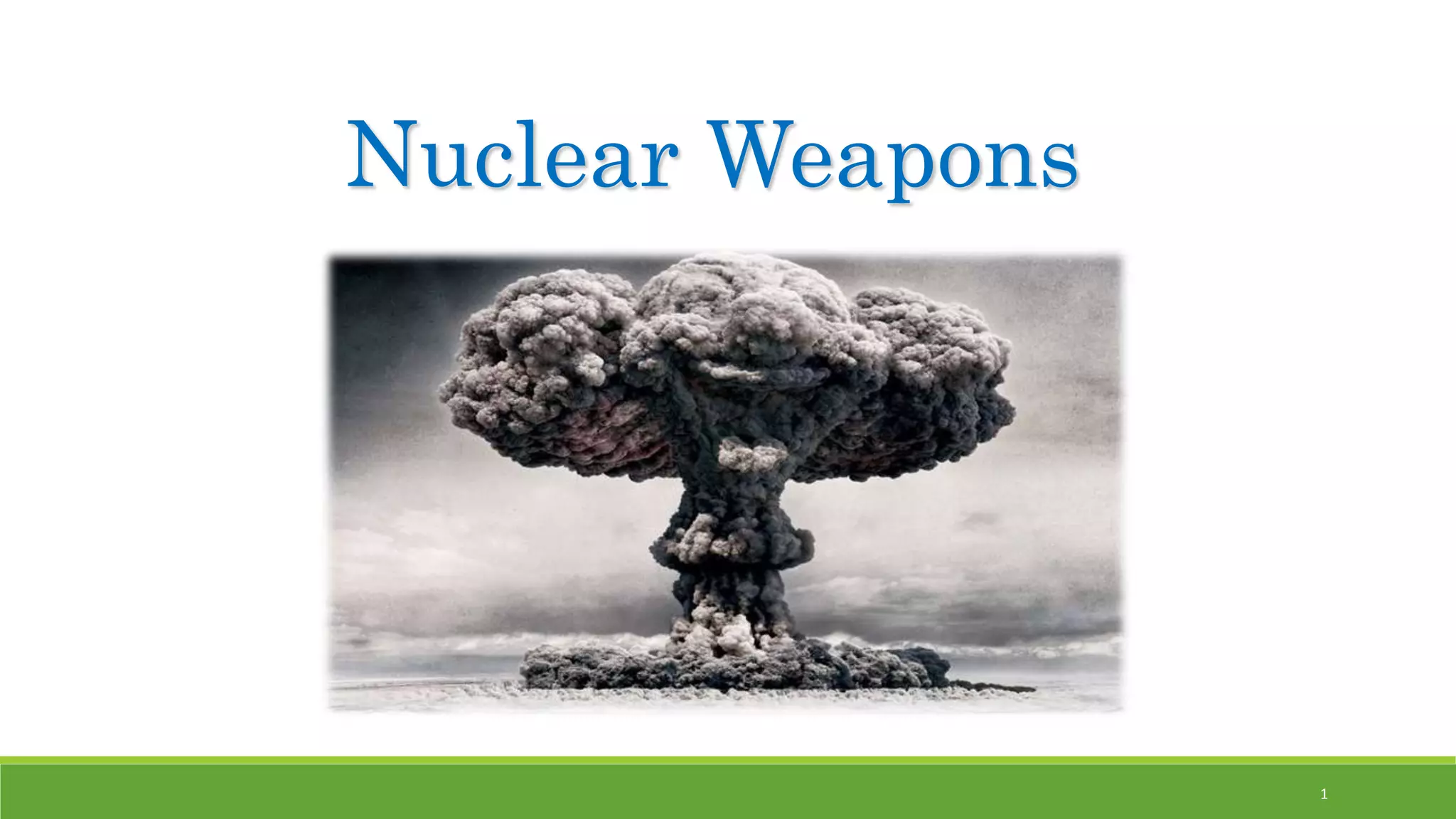
Nuclear Weapons
1
2
Presented
By:
IHSAN ALI WASSAN
(14CH18)
CHEMICAL ENGINEERING DEPARTMENT
In the respect of
Sir Hafiz Anees Rehman
QUAID-E-AWAM UNIVERSITY OF ENGINEERING, SCIENCE & TECHNOLOGY
NAWABSHAH, SINDH, PAKISTAN
 What is a nuclear weapon?
 Why people want to develop nuclear weapons?
 Why Nuclear weapons are so important?
 The history of nuclear weapons from 1940 to 2017
 Countries with the biggest Nuclear Arsenals
 Conclusion
Presentation Outlines
3
What is a Nuclear Weapon?
A nuclear weapon is an explosive device that derives its destructive force from nuclear
reactions, either fission (fission bomb) or from a combination of fission and fusion reactions
(thermonuclear bomb). Both bomb types release large quantities of energy from relatively small
amounts of matter.
4
Why people want to develop Nuclear Weapons?
 They were made for National Defense
 They are powerful
 For intimidating other countries
 It is a statement of development and power
5
Why Nuclear Weapons are so Important?
 Nuclear weapons are tools of mass destruction. They are also a possible danger to our would
and you have to understand the consequences of using them.
 It also very dangerous, The uranium can get into the skin and damage your blood, cells and
organs.
 The nuclear energy can damage whole city and wipe out entire country in just few seconds.
6
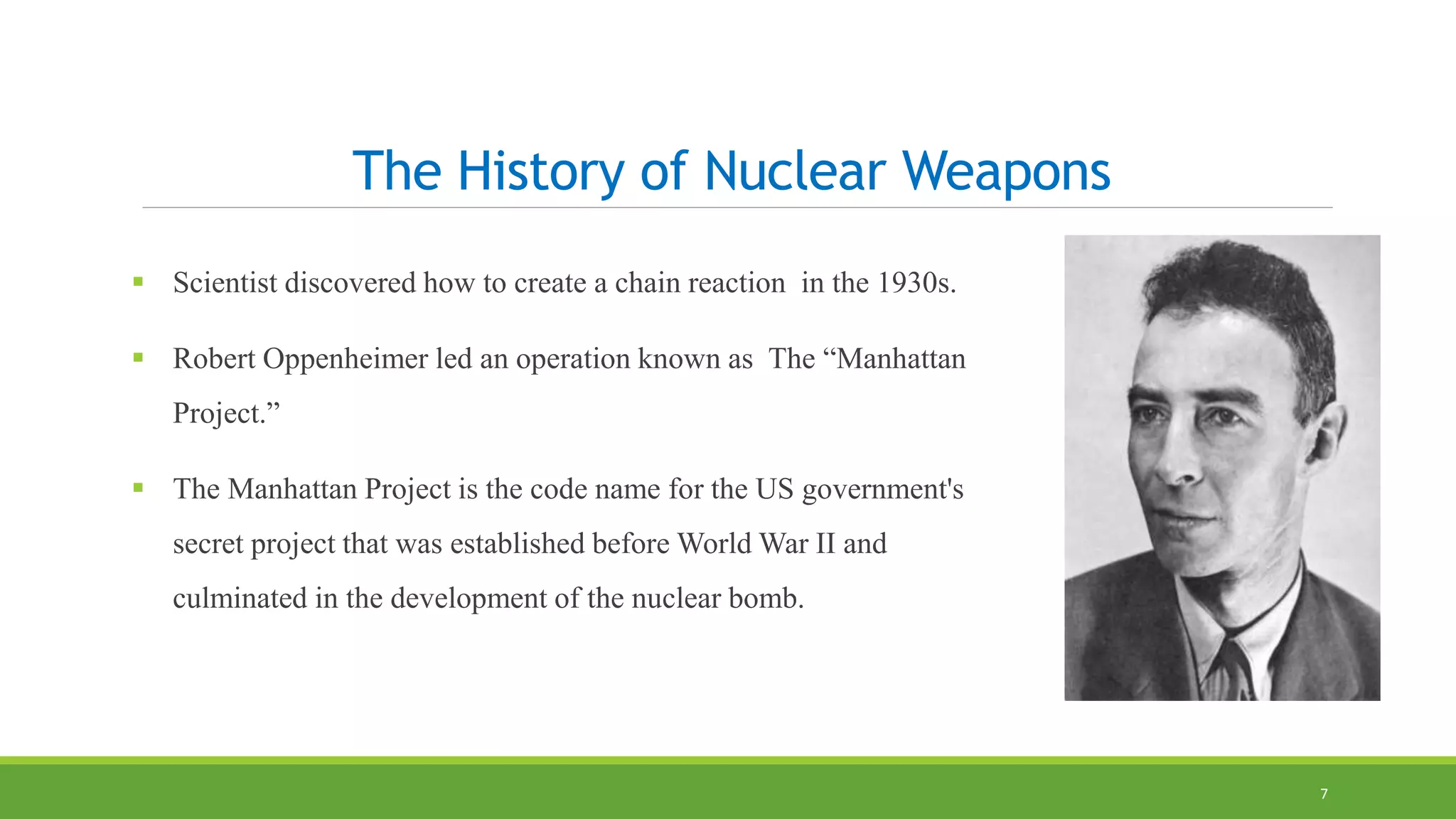
 Scientist discovered how to create a chain reaction in the 1930s.
 Robert Oppenheimer led an operation known as The “Manhattan
Project.”
 The Manhattan Project is the code name for the US government's
secret project that was established before World War II and
culminated in the development of the nuclear bomb.
7
The History of Nuclear Weapons
Today, nine states have nuclear weapons and many more can easily acquire those, although only
five states are officially recognized as possessing nuclear weapons by the 1968 nuclear Non
Proliferation Treaty (NPT). Those are
• the United States (1945),
• Russia (1949),
• the United Kingdom (1952),
• France (1960) and
• China (1964)
8
The History of Nuclear Weapons
Four states never joined the NPT but are known to possess nuclear weapons:
• Israel (1986)
• India (1974)
• Pakistan (1998) and
• North Korea (2006)
The History of Nuclear Weapons
9
August 1942
 The US sets up the Manhattan Project to develop the first nuclear weapon.
 It eventually employs more than 130,000 people and costs US$2 billion.
16 July 1945
 The US government tests its first nuclear weapon, code-named “Trinity”, in New Mexico.
24 January 1946
 UN calls for elimination of atomic weapons.
10
United States (1945)
Potsdam Declaration
 The Potsdam Declaration or the Proclamation Defining Terms for Japanese Surrender is a
statement that called for the surrender of all Japanese armed forces during World War II.
 On July 26, 1945, United States President Harry S. Truman, United Kingdom Prime
Minister Clement Attlee, and Chairman of the Nationalist Government of China Chiang Kai-
shek issued the document, which outlined the terms of surrender for the Empire of Japan as
agreed upon at the Potsdam Conference.
 This ultimatum stated that, if Japan did not surrender, it would face "prompt and utter
destruction"
11
The destruction of Hiroshima
 On August 6, 1945, Paul W. Tibbets and his
crew dropped the Uranium-based Atomic
bomb on Hiroshima.
 The bomb was code named “Little Boy.”
 It killed or wounded nearly 130,000 people.
12
Aftermath
13
 Three days later, the United States bombed
“Fat Man” on Nagasaki.
 Of the 286,00 people living there at the time
of the blast, 74,000 were killed and another
75,000 sustained severe injuries.
The destruction of Nagasaki
14
Aftermath
15
 Japan surrendered to the Allied Powers on August 14, 1945.
 Emperor Hirohito accepted the Potsdam Declaration.
Peace
16
Hiroshima
17
Nagasaki
18
Russia (1949)
19
29 August 1949
 the Soviet Union conducted its first nuclear test, code-named 'RDS-1', at the Semipalatinsk test site
in modern-day Kazakhstan.
 The device had a yield of 22 kilotons.
 The Soviet device was therefore also a plutonium-based implosion device.
 The Soviet Union conducted 456 of its tests at the Semipalatinsk test site, with severe consequences
for the local population, including high cancer rates, genetic defects and deformations in babies.
United Kingdom (1952)
20
3 October 1952
 The United Kingdom tested its first nuclear weapon "Hurricane “ in 1952 at Montebello
Islands off the coast of Western Australia.
 The United Kingdom was the third country in the world, after the United States and Soviet
Union, to develop and test a nuclear weapon.
 It tested its first hydrogen bomb in 1957 (Operation Grapple).
1 November 1952
 The US raises the stakes in the nuclear arms race by detonating the first hydrogen bomb at
Enewetak Atoll in the Marshall Islands.
 It is 500 times more powerful than the Nagasaki bomb.
1 March 1954
 The US detonates a 17-megaton hydrogen bomb, “Bravo”, at Bikini Atoll in the Pacific Ocean,
contaminating a Japanese fishing boat, Lucky Dragon, and residents of Rongelap and Utirik.
21
During 1950s
France (1960)
13 February 1960
 France explodes its first atomic bomb in the Sahara desert.
 It has a yield of 60–70 kilotons.
 France tested its first hydrogen bomb in 1968 "Opération Canopus”.
 It later moves its nuclear tests to the South Pacific.
 These continue up until 1996.
22
30 October 1961
 The Soviet Union also explodes the most powerful bomb ever: a 58-megaton atmospheric
nuclear weapon, nicknamed the “Tsar Bomba”, over Novaya Zemlya off northern Russia.
23
During 1960s
China (1964)
October 1964
 China entered the "nuclear arms club" in October 1964 when it conducted its first test.
 China explodes its first atomic bomb at the Lop Nor testing site in Sinkiang Province.
 It tested its first hydrogen bomb "Test No. 6” in 1967.
 In total, China conducts 23 atmospheric tests and 22 underground tests at the site.
24
India (1974)
18 May 1974
 India conducts an underground nuclear test at Pokharan in the Rajasthen desert.
 Code named the “Smiling Buddha”.
 The government falsely claims it is a peaceful nuclear test.
 22 September 1979, a nuclear test explosion occurs over the South Indian Ocean.
25
Israel (1986)
30 September 1986
 Israel’s nuclear programme revealed
 The Sunday Times publishes information supplied by Israeli nuclear technician Mordechai
Vanunu, which leads experts to conclude that Israel may have up to 200 nuclear weapons.
26
Pakistan (1998)
27
May 28, 1998
 Pakistan became a nuclear power when it successfully carried out five nuclear tests at Chaghi,
in the province of Baluchistan.
 President Zulfiqar Ali Bhutto promised in 1971 that if India could build nuclear weapons then
Pakistan would too, according to him: "We will develop Nuclear stockpiles, even if we have to
eat grass."
North Korea (2006)
October 9, 2006
 North Korea tested a nuclear weapon with the approximated power of the Hiroshima bomb.
 North Korea announced to the world that it has become the world's eighth declared nuclear
weapons state.
 Its missiles have the range to hit targets in South Korea, Japan as well as U.S., Chinese, and
Russian territories.
28
Countries with the biggest Nuclear Arsenals
29
Countries with the biggest Nuclear Arsenals
30
Conclusion
In the 70 years since, nearly 2,000 nuclear tests have been performed and about 125,000 nuclear
bombs have been built.
31
32
Reference
 http://asiasociety.org/education/brief-history-nuclear-weapons-states
 http://www.nuclearfiles.org/menu/key-issues/nuclear
weapons/issues/proliferation/Proliferation_History.pdf.
 A Brief History of Nuclear Proliferation By Volha Charnysh, NAPF Intern
 https://www.youtube.com/watch?v=sEhY6lButrs
 https://www.statista.com/chart/3653/the-countries-with-the-biggest-nuclear-arsenals/
 https://www.youtube.com/watch?v=cvkxkZ-yWos
 https://en.wikipedia.org/wiki/List_of_states_with_nuclear_weapons
33
34

Nuclear weapons (a brief history)

  • 1.
  • 2.
    2 Presented By: IHSAN ALI WASSAN (14CH18) CHEMICALENGINEERING DEPARTMENT In the respect of Sir Hafiz Anees Rehman QUAID-E-AWAM UNIVERSITY OF ENGINEERING, SCIENCE & TECHNOLOGY NAWABSHAH, SINDH, PAKISTAN
  • 3.
     What isa nuclear weapon?  Why people want to develop nuclear weapons?  Why Nuclear weapons are so important?  The history of nuclear weapons from 1940 to 2017  Countries with the biggest Nuclear Arsenals  Conclusion Presentation Outlines 3
  • 4.
    What is aNuclear Weapon? A nuclear weapon is an explosive device that derives its destructive force from nuclear reactions, either fission (fission bomb) or from a combination of fission and fusion reactions (thermonuclear bomb). Both bomb types release large quantities of energy from relatively small amounts of matter. 4
  • 5.
    Why people wantto develop Nuclear Weapons?  They were made for National Defense  They are powerful  For intimidating other countries  It is a statement of development and power 5
  • 6.
    Why Nuclear Weaponsare so Important?  Nuclear weapons are tools of mass destruction. They are also a possible danger to our would and you have to understand the consequences of using them.  It also very dangerous, The uranium can get into the skin and damage your blood, cells and organs.  The nuclear energy can damage whole city and wipe out entire country in just few seconds. 6
  • 7.
     Scientist discoveredhow to create a chain reaction in the 1930s.  Robert Oppenheimer led an operation known as The “Manhattan Project.”  The Manhattan Project is the code name for the US government's secret project that was established before World War II and culminated in the development of the nuclear bomb. 7 The History of Nuclear Weapons
  • 8.
    Today, nine stateshave nuclear weapons and many more can easily acquire those, although only five states are officially recognized as possessing nuclear weapons by the 1968 nuclear Non Proliferation Treaty (NPT). Those are • the United States (1945), • Russia (1949), • the United Kingdom (1952), • France (1960) and • China (1964) 8 The History of Nuclear Weapons
  • 9.
    Four states neverjoined the NPT but are known to possess nuclear weapons: • Israel (1986) • India (1974) • Pakistan (1998) and • North Korea (2006) The History of Nuclear Weapons 9
  • 10.
    August 1942  TheUS sets up the Manhattan Project to develop the first nuclear weapon.  It eventually employs more than 130,000 people and costs US$2 billion. 16 July 1945  The US government tests its first nuclear weapon, code-named “Trinity”, in New Mexico. 24 January 1946  UN calls for elimination of atomic weapons. 10 United States (1945)
  • 11.
    Potsdam Declaration  ThePotsdam Declaration or the Proclamation Defining Terms for Japanese Surrender is a statement that called for the surrender of all Japanese armed forces during World War II.  On July 26, 1945, United States President Harry S. Truman, United Kingdom Prime Minister Clement Attlee, and Chairman of the Nationalist Government of China Chiang Kai- shek issued the document, which outlined the terms of surrender for the Empire of Japan as agreed upon at the Potsdam Conference.  This ultimatum stated that, if Japan did not surrender, it would face "prompt and utter destruction" 11
  • 12.
    The destruction ofHiroshima  On August 6, 1945, Paul W. Tibbets and his crew dropped the Uranium-based Atomic bomb on Hiroshima.  The bomb was code named “Little Boy.”  It killed or wounded nearly 130,000 people. 12
  • 13.
  • 14.
     Three dayslater, the United States bombed “Fat Man” on Nagasaki.  Of the 286,00 people living there at the time of the blast, 74,000 were killed and another 75,000 sustained severe injuries. The destruction of Nagasaki 14
  • 15.
  • 16.
     Japan surrenderedto the Allied Powers on August 14, 1945.  Emperor Hirohito accepted the Potsdam Declaration. Peace 16
  • 17.
  • 18.
  • 19.
    Russia (1949) 19 29 August1949  the Soviet Union conducted its first nuclear test, code-named 'RDS-1', at the Semipalatinsk test site in modern-day Kazakhstan.  The device had a yield of 22 kilotons.  The Soviet device was therefore also a plutonium-based implosion device.  The Soviet Union conducted 456 of its tests at the Semipalatinsk test site, with severe consequences for the local population, including high cancer rates, genetic defects and deformations in babies.
  • 20.
    United Kingdom (1952) 20 3October 1952  The United Kingdom tested its first nuclear weapon "Hurricane “ in 1952 at Montebello Islands off the coast of Western Australia.  The United Kingdom was the third country in the world, after the United States and Soviet Union, to develop and test a nuclear weapon.  It tested its first hydrogen bomb in 1957 (Operation Grapple).
  • 21.
    1 November 1952 The US raises the stakes in the nuclear arms race by detonating the first hydrogen bomb at Enewetak Atoll in the Marshall Islands.  It is 500 times more powerful than the Nagasaki bomb. 1 March 1954  The US detonates a 17-megaton hydrogen bomb, “Bravo”, at Bikini Atoll in the Pacific Ocean, contaminating a Japanese fishing boat, Lucky Dragon, and residents of Rongelap and Utirik. 21 During 1950s
  • 22.
    France (1960) 13 February1960  France explodes its first atomic bomb in the Sahara desert.  It has a yield of 60–70 kilotons.  France tested its first hydrogen bomb in 1968 "Opération Canopus”.  It later moves its nuclear tests to the South Pacific.  These continue up until 1996. 22
  • 23.
    30 October 1961 The Soviet Union also explodes the most powerful bomb ever: a 58-megaton atmospheric nuclear weapon, nicknamed the “Tsar Bomba”, over Novaya Zemlya off northern Russia. 23 During 1960s
  • 24.
    China (1964) October 1964 China entered the "nuclear arms club" in October 1964 when it conducted its first test.  China explodes its first atomic bomb at the Lop Nor testing site in Sinkiang Province.  It tested its first hydrogen bomb "Test No. 6” in 1967.  In total, China conducts 23 atmospheric tests and 22 underground tests at the site. 24
  • 25.
    India (1974) 18 May1974  India conducts an underground nuclear test at Pokharan in the Rajasthen desert.  Code named the “Smiling Buddha”.  The government falsely claims it is a peaceful nuclear test.  22 September 1979, a nuclear test explosion occurs over the South Indian Ocean. 25
  • 26.
    Israel (1986) 30 September1986  Israel’s nuclear programme revealed  The Sunday Times publishes information supplied by Israeli nuclear technician Mordechai Vanunu, which leads experts to conclude that Israel may have up to 200 nuclear weapons. 26
  • 27.
    Pakistan (1998) 27 May 28,1998  Pakistan became a nuclear power when it successfully carried out five nuclear tests at Chaghi, in the province of Baluchistan.  President Zulfiqar Ali Bhutto promised in 1971 that if India could build nuclear weapons then Pakistan would too, according to him: "We will develop Nuclear stockpiles, even if we have to eat grass."
  • 28.
    North Korea (2006) October9, 2006  North Korea tested a nuclear weapon with the approximated power of the Hiroshima bomb.  North Korea announced to the world that it has become the world's eighth declared nuclear weapons state.  Its missiles have the range to hit targets in South Korea, Japan as well as U.S., Chinese, and Russian territories. 28
  • 29.
    Countries with thebiggest Nuclear Arsenals 29
  • 30.
    Countries with thebiggest Nuclear Arsenals 30
  • 31.
    Conclusion In the 70years since, nearly 2,000 nuclear tests have been performed and about 125,000 nuclear bombs have been built. 31
  • 32.
  • 33.
    Reference  http://asiasociety.org/education/brief-history-nuclear-weapons-states  http://www.nuclearfiles.org/menu/key-issues/nuclear weapons/issues/proliferation/Proliferation_History.pdf. A Brief History of Nuclear Proliferation By Volha Charnysh, NAPF Intern  https://www.youtube.com/watch?v=sEhY6lButrs  https://www.statista.com/chart/3653/the-countries-with-the-biggest-nuclear-arsenals/  https://www.youtube.com/watch?v=cvkxkZ-yWos  https://en.wikipedia.org/wiki/List_of_states_with_nuclear_weapons 33
  • 34.