Types of Narratives
(and other information to help you choose a story topic)
Personal Narrative
A story about a moment in
your own life.
It is not an autobiography (a story
about your entire life)!
A personal narrative focuses on a
single event or moment in your life.
Fictional Narrative
A story about a moment in a
made-up character’s life.
You create the characters, setting,
and conflict, but it should still
focus on a single event or moment
(because this is a SHORT story!)
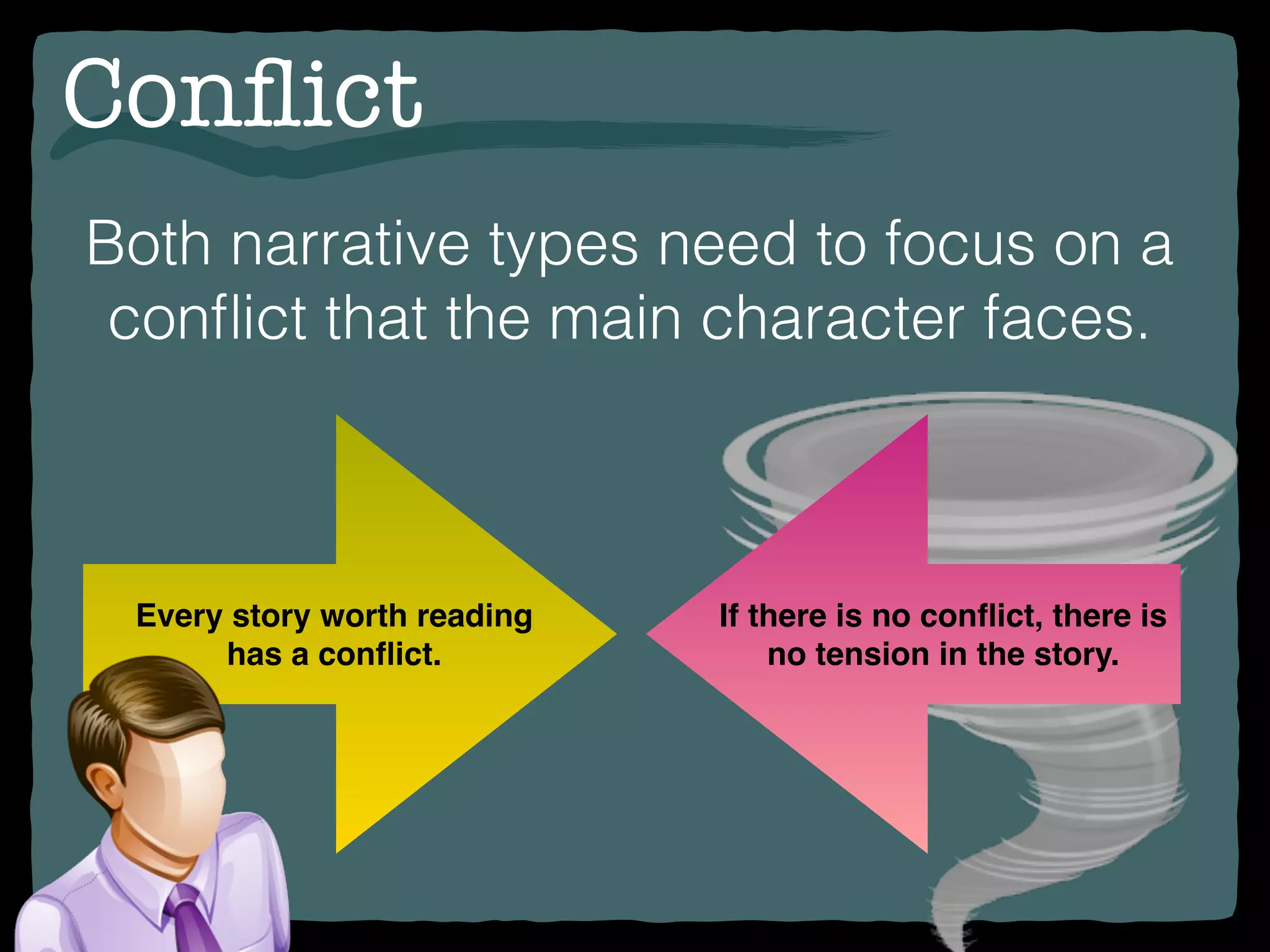
Conflict
Both narrative types need to focus on a
conflict that the main character faces.
Every story worth reading
has a conflict.
If there is no conflict, there is
no tension in the story.
Focus!
You can’t write a novel! When creating your
story, focus on a single moment or very
few moments.
Personal Narrative: I will tell the story of the
moment when I forgot my lines while
performing on stage.
Fictional Narrative: I will tell the story of the
moment when my character got lost in the
woods.
Point of View:
1st Person:
The narrator is the main
character of the story,
and uses the terms “I”
and “we”.
Personal narratives
must be written in 1st
person perspective.
3rd Person:
The narrator is not a
character in the story,
and uses the terms
“he,” “she,” and “they”
to refer to the
characters.
Point of View:
1st Person:
“I never thought that
owning a dog would be
so challenging. When I
brought Fluffy home for
the first time, she
destroyed my favorite
pair of shoes within five
minutes. After I found
the damage, I locked
Fluffy in her crate.”
3rd Person:
“Amber used to think that
owning a dog would be
easy, but when she
brought Fluffy home for
the first time, she
discovered she was
wrong. Fluffy had
destroyed her favorite pair
of shoes. When amber
saw them, she locked
Fluffy in her crate.”
Outline
Beginning
• Who is(are) the main character(s)?
• What is the setting?
• What is the problem?
Middle
• How does the character try to solve the
problem?
End
• Is the problem resolved? How?
• Reflect: why was this event important or
meaningful in the life of the character?

Types of Narratives

  • 1.
    Types of Narratives (andother information to help you choose a story topic)
  • 2.
    Personal Narrative A storyabout a moment in your own life. It is not an autobiography (a story about your entire life)! A personal narrative focuses on a single event or moment in your life.
  • 3.
    Fictional Narrative A storyabout a moment in a made-up character’s life. You create the characters, setting, and conflict, but it should still focus on a single event or moment (because this is a SHORT story!)
  • 4.
    Conflict Both narrative typesneed to focus on a conflict that the main character faces. Every story worth reading has a conflict. If there is no conflict, there is no tension in the story.
  • 5.
    Focus! You can’t writea novel! When creating your story, focus on a single moment or very few moments. Personal Narrative: I will tell the story of the moment when I forgot my lines while performing on stage. Fictional Narrative: I will tell the story of the moment when my character got lost in the woods.
  • 6.
    Point of View: 1stPerson: The narrator is the main character of the story, and uses the terms “I” and “we”. Personal narratives must be written in 1st person perspective. 3rd Person: The narrator is not a character in the story, and uses the terms “he,” “she,” and “they” to refer to the characters.
  • 7.
    Point of View: 1stPerson: “I never thought that owning a dog would be so challenging. When I brought Fluffy home for the first time, she destroyed my favorite pair of shoes within five minutes. After I found the damage, I locked Fluffy in her crate.” 3rd Person: “Amber used to think that owning a dog would be easy, but when she brought Fluffy home for the first time, she discovered she was wrong. Fluffy had destroyed her favorite pair of shoes. When amber saw them, she locked Fluffy in her crate.”
  • 8.
    Outline Beginning • Who is(are)the main character(s)? • What is the setting? • What is the problem? Middle • How does the character try to solve the problem? End • Is the problem resolved? How? • Reflect: why was this event important or meaningful in the life of the character?