Downloaded 81 times
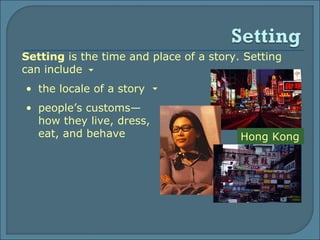
![Setting provides a background—a place where the characters live and act. [End of Section]](https://image.slidesharecdn.com/setting-110101012037-phpapp02/85/Setting-4-320.jpg)
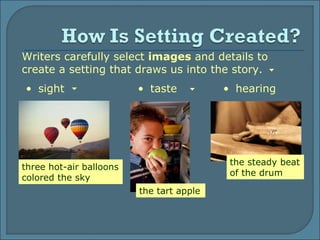
![smell gritty, wet sand between her toes strong, sweet scent of a rose touch [End of Section]](https://image.slidesharecdn.com/setting-110101012037-phpapp02/85/Setting-6-320.jpg)
![Sometimes writers place characters in settings that reflect the characters’ personalities. What do you think these characters are like? [End of Section]](https://image.slidesharecdn.com/setting-110101012037-phpapp02/85/Setting-7-320.jpg)
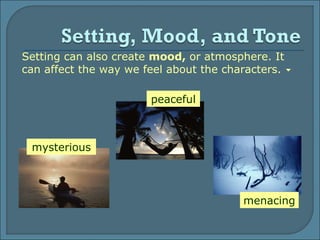
![Setting can also express a tone, or attitude toward a subject or object. Now, with supper finished, we retire to the room in a faraway part of the house where my friend sleeps in a scrap-quilt-covered iron bed painted rose pink, her favorite color. Silently, wallowing in the pleasures of conspiracy, we take the bead purse from its secret place and spill its contents on the scrap quilt. from “A Christmas Memory” by Truman Capote What is the tone of this passage? How do you think the writer feels about these characters? [End of Section]](https://image.slidesharecdn.com/setting-110101012037-phpapp02/85/Setting-9-320.jpg)
![Think of a story you’ve read in which the setting captured your imagination. Fill in a chart like this one to describe the setting and show its role in the story. [End of Section] Setting Title of story: Where story takes place: When story takes place: Details of setting that reveal character: Details of setting that reveal mood or tone:](https://image.slidesharecdn.com/setting-110101012037-phpapp02/85/Setting-10-320.jpg)


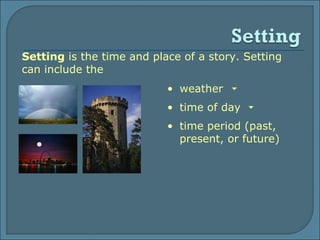
The document discusses how writers carefully craft setting to provide background context and affect the story. Setting includes specifics of location, time period, weather, and customs. Details of setting can reveal characteristics of characters and create mood or tone, influencing how readers feel about the story and characters. The passage example creates a mysterious and peaceful tone through descriptions of the setting.


![Elements of a plot diagram]](https://cdn.slidesharecdn.com/ss_thumbnails/elementsofaplotdiagram-100629124208-phpapp02-thumbnail.jpg?width=640&height=640&fit=bounds)


