Adverts in our life
By Konev Dmitriy
Advert
Advertising is a form of communication for marketing and used to encourage,
persuade, or manipulate an audience (viewers, readers or listeners;
sometimes a specific group) to continue or take some new action. Most
commonly, the desired result is to drive consumer behavior with respect to a
commercial offering, although political and ideological advertising is also
common.
History
.
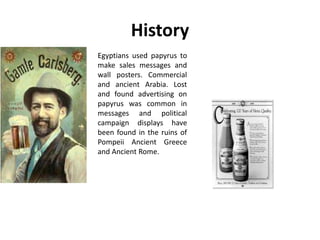
Egyptians used papyrus to
make sales messages and
wall posters. Commercial
and ancient Arabia. Lost
and found advertising on
papyrus was common in
messages and political
campaign displays have
been found in the ruins of
Pompeii Ancient Greece
and Ancient Rome.
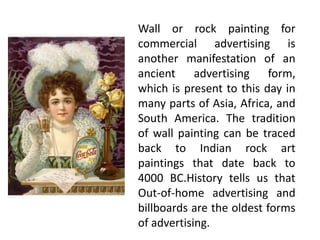
Wall or rock painting for
commercial advertising is
another manifestation of an
ancient advertising form,
which is present to this day in
many parts of Asia, Africa, and
South America. The tradition
of wall painting can be traced
back to Indian rock art
paintings that date back to
4000 BC.History tells us that
Out-of-home advertising and
billboards are the oldest forms
of advertising.
As education became an apparent
need and reading, as well as printing,
developed advertising expanded to
include handbills.In the 18th century
advertisements started to appear in
weekly newspapers in England. These
early print advertisements were used
mainly to promote books and
newspapers, which became
increasingly affordable with advances
in the printing press; and medicines,
which were increasingly sought after
as disease ravaged Europe. However,
false advertising and so-called "quack"
advertisements became a problem,
which ushered in the regulation of
advertising content.
In the early 1920s, the first radio stations were
established by radio equipment manufacturers and
retailers who offered programs in order to sell more
radios to consumers. As time passed, many non-profit
organizations followed suit in setting up their own radio
stations, and included: schools, clubs and civic groups.
When the practice of sponsoring programs was
popularized, each individual radio program was usually
sponsored by a single business in exchange for a brief
mention of the business' name at the beginning and end
of the sponsored shows. However, radio station owners
soon realized they could earn more money by selling
sponsorship rights in small time allocations to multiple
businesses throughout their radio station's broadcasts,
rather than selling the sponsorship rights to single
businesses per show .
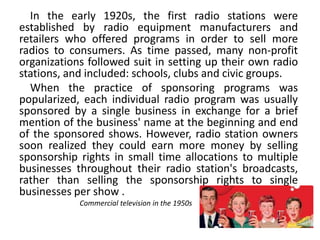
Commercial television in the 1950s
This practice was carried over to commercial television in the late
1940s and early 1950s. A fierce battle was fought between those
seeking to commercialise the radio and people who argued that the
radio spectrum should be considered a part of the commons – to be
used only non-commercially and for the public good.
The United Kingdom pursued a public funding model for the BBC,
originally a private company, the British Broadcasting Company, but
incorporated as a public body by Royal Charter in 1927. In Canada,
advocates like Graham Spry were likewise able to persuade the
federal government to adopt a public funding model, creating the
Canadian Broadcasting Corporation. However, in the United States,
the capitalist model prevailed with the passage of the
Communications Act of 1934 which created the Federal
Communications Commission (FCC).However, the U.S. Congress did
require commercial broadcasting companies to operate in the
"public interest, convenience, and necessity". Public broadcasting
now exists in the United States due to the 1967 Public Broadcasting
Act which led to the Public Broadcasting Service (PBS) and National
Public Radio (NPR).
In the early 1950s, the DuMont Television
Network began the modern practice of selling
advertisement time to multiple sponsors.
Previously, DuMont had trouble finding sponsors
for many of their programs and compensated by
selling smaller blocks of advertising time to several
businesses. This eventually became the standard
for the commercial television industry in the
United States. However, it was still a common
practice to have single sponsor shows, such as The
United States Steel Hour. In some instances the
sponsors exercised great control over the content
of the show—up to and including having one's
advertising agency actually writing the show. The
single sponsor model is much less prevalent now,
a notable exception being the Hallmark Hall of
Fame.
The advertising business model has also been
adapted in recent years. A new development is
Media for equity.

Advertising

  • 1.
    Adverts in ourlife By Konev Dmitriy
  • 2.
    Advert Advertising is aform of communication for marketing and used to encourage, persuade, or manipulate an audience (viewers, readers or listeners; sometimes a specific group) to continue or take some new action. Most commonly, the desired result is to drive consumer behavior with respect to a commercial offering, although political and ideological advertising is also common.
  • 3.
    History . Egyptians used papyrusto make sales messages and wall posters. Commercial and ancient Arabia. Lost and found advertising on papyrus was common in messages and political campaign displays have been found in the ruins of Pompeii Ancient Greece and Ancient Rome.
  • 4.
    Wall or rockpainting for commercial advertising is another manifestation of an ancient advertising form, which is present to this day in many parts of Asia, Africa, and South America. The tradition of wall painting can be traced back to Indian rock art paintings that date back to 4000 BC.History tells us that Out-of-home advertising and billboards are the oldest forms of advertising.
  • 5.
    As education becamean apparent need and reading, as well as printing, developed advertising expanded to include handbills.In the 18th century advertisements started to appear in weekly newspapers in England. These early print advertisements were used mainly to promote books and newspapers, which became increasingly affordable with advances in the printing press; and medicines, which were increasingly sought after as disease ravaged Europe. However, false advertising and so-called "quack" advertisements became a problem, which ushered in the regulation of advertising content.
  • 6.
    In the early1920s, the first radio stations were established by radio equipment manufacturers and retailers who offered programs in order to sell more radios to consumers. As time passed, many non-profit organizations followed suit in setting up their own radio stations, and included: schools, clubs and civic groups. When the practice of sponsoring programs was popularized, each individual radio program was usually sponsored by a single business in exchange for a brief mention of the business' name at the beginning and end of the sponsored shows. However, radio station owners soon realized they could earn more money by selling sponsorship rights in small time allocations to multiple businesses throughout their radio station's broadcasts, rather than selling the sponsorship rights to single businesses per show . Commercial television in the 1950s
  • 7.
    This practice wascarried over to commercial television in the late 1940s and early 1950s. A fierce battle was fought between those seeking to commercialise the radio and people who argued that the radio spectrum should be considered a part of the commons – to be used only non-commercially and for the public good. The United Kingdom pursued a public funding model for the BBC, originally a private company, the British Broadcasting Company, but incorporated as a public body by Royal Charter in 1927. In Canada, advocates like Graham Spry were likewise able to persuade the federal government to adopt a public funding model, creating the Canadian Broadcasting Corporation. However, in the United States, the capitalist model prevailed with the passage of the Communications Act of 1934 which created the Federal Communications Commission (FCC).However, the U.S. Congress did require commercial broadcasting companies to operate in the "public interest, convenience, and necessity". Public broadcasting now exists in the United States due to the 1967 Public Broadcasting Act which led to the Public Broadcasting Service (PBS) and National Public Radio (NPR).
  • 8.
    In the early1950s, the DuMont Television Network began the modern practice of selling advertisement time to multiple sponsors. Previously, DuMont had trouble finding sponsors for many of their programs and compensated by selling smaller blocks of advertising time to several businesses. This eventually became the standard for the commercial television industry in the United States. However, it was still a common practice to have single sponsor shows, such as The United States Steel Hour. In some instances the sponsors exercised great control over the content of the show—up to and including having one's advertising agency actually writing the show. The single sponsor model is much less prevalent now, a notable exception being the Hallmark Hall of Fame. The advertising business model has also been adapted in recent years. A new development is Media for equity.