
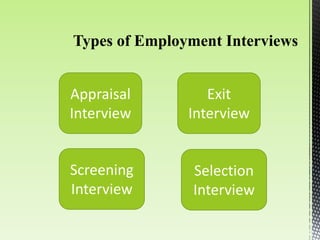

Screening
Interview
Appraisal
Interview
Exit
Interview
Selection
Interview
Appraisal Interview
-An interview where supervisor and employee
discuss the employee’s rating and possible remedial
actions.
Exit Interview
- An interview to elicit information about the job
or related matters to the employer some insight into
what’s right or wrong about the firm.
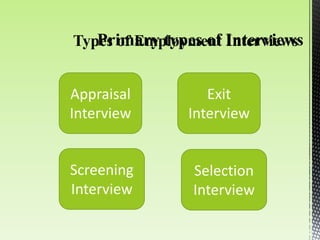
Screening
Interview
Appraisal
Interview
Exit
Interview
Selection
Interview
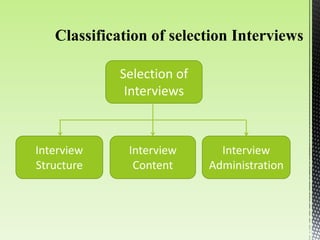
Selection of
Interviews
Interview
Structure
Interview
Content
Interview
Administration
Unstructured or Nondirective Interview
- interviewer pursues points of interest as they
come up in response to questions.
Structured or Directive Interview
- An interview following a set sequence of
questions.
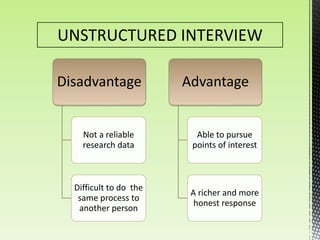
Disadvantage
Not a reliable
research data
Difficult to do the
same process to
another person
Advantage
Able to pursue
points of interest
A richer and more
honest response
UNSTRUCTURED INTERVIEW
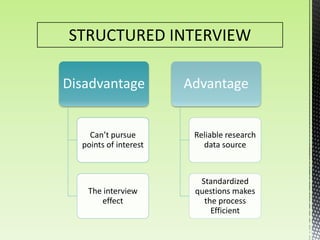
Disadvantage
Can’t pursue
points of interest
The interview
effect
Advantage
Reliable research
data source
Standardized
questions makes
the process
Efficient
STRUCTURED INTERVIEW
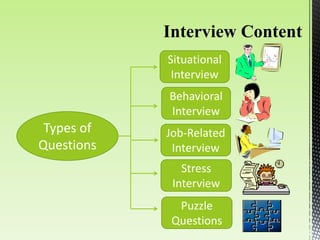
Types of
Questions
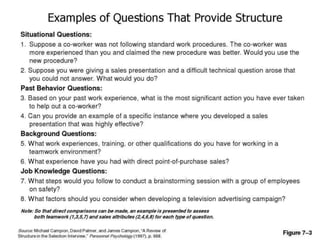
Situational
Interview
Behavioral
Interview
Job-Related
Interview
Stress
Interview
Puzzle
Questions
Situational Interview
- A series of job-related questions that focus on
how the candidate would behave in a given situation.
Behavioral Interview
- A series of job-related questions that focus on
how they reacted to actual situations in the past.
Job-related Interview
- A series of job-related questions that focus on
relevant past experiences.
Stress Interview
- An interview in which the interviewer seeks to
make the applicant uncomfortable with occasionally rude
questions that supposedly to spot sensitive applicants
and those with low or high stress tolerance.
Puzzle Questions
- Recruiters for technical, finance, and other types
of jobs use questions to pose problems requiring unique
(“out-of-the-box”) solutions to see how candidates think
under pressure.
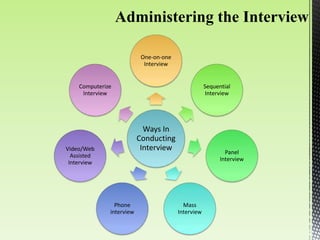
Ways In
Conducting
Interview
One-on-one
Interview
Sequential
Interview
Panel
Interview
Mass
Interview
Phone
interview
Video/Web
Assisted
Interview
Computerize
Interview
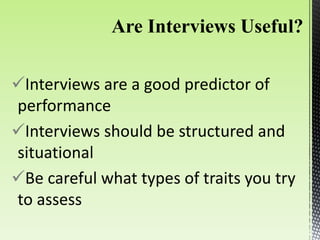
Interviews are a good predictor of
performance
Interviews should be structured and
situational
Be careful what types of traits you try
to assess
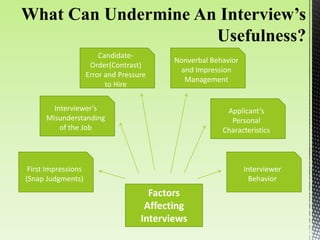
Factors
Affecting
Interviews
Interviewer’s
Misunderstanding
of the Job
First Impressions
(Snap Judgments)
Applicant’s
Personal
Characteristics
Interviewer
Behavior
Candidate-
Order(Contrast)
Error and Pressure
to Hire
Nonverbal Behavior
and Impression
Management
First Impressions
- The tendency for interviewers to jump to
conclusions-make snap judgments-about candidates
during the first few minutes of the interview.
- Negative bias: unfavorable information about an
applicant influences interviewers more than does
positive information.
Misunderstanding the Job
- Not knowing precisely what the job entails and
what sort of candidate is best suited causes
interviewers to make decisions based on incorrect
stereotypes of what a good applicant is.
Candidate-Order Error
- An error of judgment on the part of the
interviewer due to interviewing one or more very good
or very bad candidates just before the interview in
questions
Nonverbal Behavior and Impression Management
- Interviewers’ inferences of the interviewee’s
personality from the way he pr she acts in the
interview have a large impact on the interviewer’s
rating of the interviewee.
- Clever interviewees attempt to manage the
impression they present to persuade interviewers to
view them more favorably.
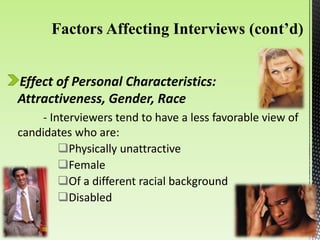
Effect of Personal Characteristics:
Attractiveness, Gender, Race
- Interviewers tend to have a less favorable view of
candidates who are:
Physically unattractive
Female
Of a different racial background
Disabled
Interviewer Behavior Affecting Interview
Outcomes
- Inadvertently telegraphing expected answers.
- Talking so much that applicants have no time to
answer questions.
- Letting the applicant dominate the interview.
- Acting more positively toward a favored (or similar to
the interviewer) applicant.
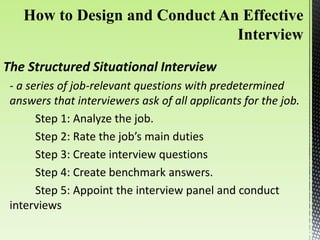
The Structured Situational Interview
- a series of job-relevant questions with predetermined
answers that interviewers ask of all applicants for the job.
Step 1: Analyze the job.
Step 2: Rate the job’s main duties
Step 3: Create interview questions
Step 4: Create benchmark answers.
Step 5: Appoint the interview panel and conduct
interviews
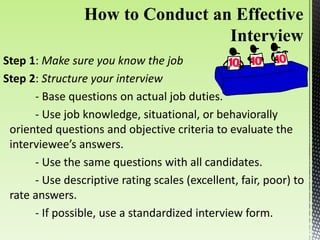
Step 1: Make sure you know the job
Step 2: Structure your interview
- Base questions on actual job duties.
- Use job knowledge, situational, or behaviorally
oriented questions and objective criteria to evaluate the
interviewee’s answers.
- Use the same questions with all candidates.
- Use descriptive rating scales (excellent, fair, poor) to
rate answers.
- If possible, use a standardized interview form.
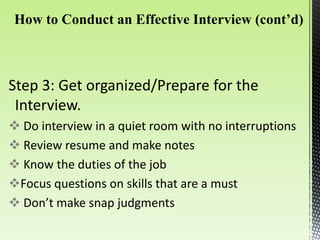
Step 3: Get organized/Prepare for the
Interview.
 Do interview in a quiet room with no interruptions
 Review resume and make notes
 Know the duties of the job
Focus questions on skills that are a must
 Don’t make snap judgments
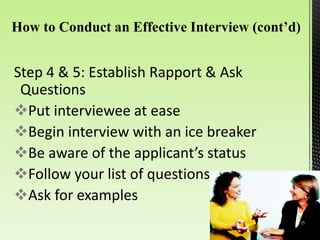
Step 4 & 5: Establish Rapport & Ask
Questions
Put interviewee at ease
Begin interview with an ice breaker
Be aware of the applicant’s status
Follow your list of questions
Ask for examples
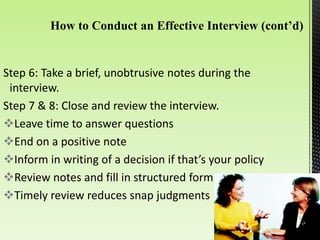
Step 6: Take a brief, unobtrusive notes during the
interview.
Step 7 & 8: Close and review the interview.
Leave time to answer questions
End on a positive note
Inform in writing of a decision if that’s your policy
Review notes and fill in structured form
Timely review reduces snap judgments
 Prepare for the interview and focus on
four basic required factors:
- Knowledge and experience
- Motivation
- Intellectual capacity
- Personality
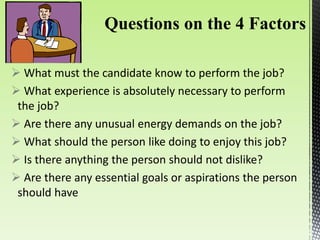
 What must the candidate know to perform the job?
 What experience is absolutely necessary to perform
the job?
 Are there any unusual energy demands on the job?
 What should the person like doing to enjoy this job?
 Is there anything the person should not dislike?
 Are there any essential goals or aspirations the person
should have
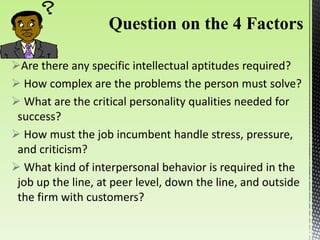
Are there any specific intellectual aptitudes required?
 How complex are the problems the person must solve?
 What are the critical personality qualities needed for
success?
 How must the job incumbent handle stress, pressure,
and criticism?
 What kind of interpersonal behavior is required in the
job up the line, at peer level, down the line, and outside
the firm with customers?
 Formulate questions to ask in the interview
• formulate a combination of situational and behavioral questions,
plus open-ended questions
 Conduct the interview
• have a plan: devise and use chronological plan to guide the
interview.
• follow your plan: start with an open-ended topic such as, “ Could
you tell me about what you did when you were in high school?”
 Match the candidate to the job
• draw conclusions about the person’s relevant intellectual
capacity, knowledge and experience, motivation, and personality.
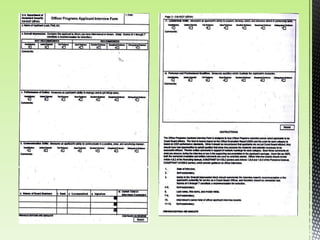
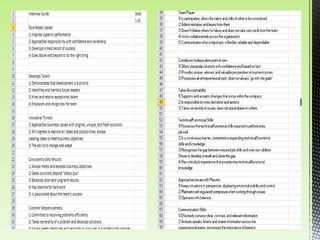
(Sample Interview Evaluation Form)
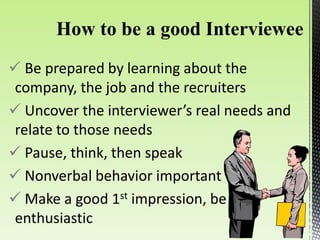
 Be prepared by learning about the
company, the job and the recruiters
 Uncover the interviewer’s real needs and
relate to those needs
 Pause, think, then speak
 Nonverbal behavior important
 Make a good 1st impression, be
enthusiastic
Interviewing candidates (2)

Interviewing candidates (2)

  • 2.
  • 3.
    Appraisal Interview -An interviewwhere supervisor and employee discuss the employee’s rating and possible remedial actions. Exit Interview - An interview to elicit information about the job or related matters to the employer some insight into what’s right or wrong about the firm.
  • 4.
  • 5.
  • 6.
    Unstructured or NondirectiveInterview - interviewer pursues points of interest as they come up in response to questions. Structured or Directive Interview - An interview following a set sequence of questions.
  • 9.
    Disadvantage Not a reliable researchdata Difficult to do the same process to another person Advantage Able to pursue points of interest A richer and more honest response UNSTRUCTURED INTERVIEW
  • 10.
    Disadvantage Can’t pursue points ofinterest The interview effect Advantage Reliable research data source Standardized questions makes the process Efficient STRUCTURED INTERVIEW
  • 11.
  • 12.
    Situational Interview - Aseries of job-related questions that focus on how the candidate would behave in a given situation. Behavioral Interview - A series of job-related questions that focus on how they reacted to actual situations in the past. Job-related Interview - A series of job-related questions that focus on relevant past experiences.
  • 13.
    Stress Interview - Aninterview in which the interviewer seeks to make the applicant uncomfortable with occasionally rude questions that supposedly to spot sensitive applicants and those with low or high stress tolerance. Puzzle Questions - Recruiters for technical, finance, and other types of jobs use questions to pose problems requiring unique (“out-of-the-box”) solutions to see how candidates think under pressure.
  • 14.
  • 15.
    Interviews are agood predictor of performance Interviews should be structured and situational Be careful what types of traits you try to assess
  • 16.
    Factors Affecting Interviews Interviewer’s Misunderstanding of the Job FirstImpressions (Snap Judgments) Applicant’s Personal Characteristics Interviewer Behavior Candidate- Order(Contrast) Error and Pressure to Hire Nonverbal Behavior and Impression Management
  • 17.
    First Impressions - Thetendency for interviewers to jump to conclusions-make snap judgments-about candidates during the first few minutes of the interview. - Negative bias: unfavorable information about an applicant influences interviewers more than does positive information.
  • 18.
    Misunderstanding the Job -Not knowing precisely what the job entails and what sort of candidate is best suited causes interviewers to make decisions based on incorrect stereotypes of what a good applicant is. Candidate-Order Error - An error of judgment on the part of the interviewer due to interviewing one or more very good or very bad candidates just before the interview in questions
  • 19.
    Nonverbal Behavior andImpression Management - Interviewers’ inferences of the interviewee’s personality from the way he pr she acts in the interview have a large impact on the interviewer’s rating of the interviewee. - Clever interviewees attempt to manage the impression they present to persuade interviewers to view them more favorably.
  • 20.
    Effect of PersonalCharacteristics: Attractiveness, Gender, Race - Interviewers tend to have a less favorable view of candidates who are: Physically unattractive Female Of a different racial background Disabled
  • 21.
    Interviewer Behavior AffectingInterview Outcomes - Inadvertently telegraphing expected answers. - Talking so much that applicants have no time to answer questions. - Letting the applicant dominate the interview. - Acting more positively toward a favored (or similar to the interviewer) applicant.
  • 22.
    The Structured SituationalInterview - a series of job-relevant questions with predetermined answers that interviewers ask of all applicants for the job. Step 1: Analyze the job. Step 2: Rate the job’s main duties Step 3: Create interview questions Step 4: Create benchmark answers. Step 5: Appoint the interview panel and conduct interviews
  • 23.
    Step 1: Makesure you know the job Step 2: Structure your interview - Base questions on actual job duties. - Use job knowledge, situational, or behaviorally oriented questions and objective criteria to evaluate the interviewee’s answers. - Use the same questions with all candidates. - Use descriptive rating scales (excellent, fair, poor) to rate answers. - If possible, use a standardized interview form.
  • 25.
    Step 3: Getorganized/Prepare for the Interview.  Do interview in a quiet room with no interruptions  Review resume and make notes  Know the duties of the job Focus questions on skills that are a must  Don’t make snap judgments
  • 26.
    Step 4 &5: Establish Rapport & Ask Questions Put interviewee at ease Begin interview with an ice breaker Be aware of the applicant’s status Follow your list of questions Ask for examples
  • 28.
    Step 6: Takea brief, unobtrusive notes during the interview. Step 7 & 8: Close and review the interview. Leave time to answer questions End on a positive note Inform in writing of a decision if that’s your policy Review notes and fill in structured form Timely review reduces snap judgments
  • 29.
     Prepare forthe interview and focus on four basic required factors: - Knowledge and experience - Motivation - Intellectual capacity - Personality
  • 30.
     What mustthe candidate know to perform the job?  What experience is absolutely necessary to perform the job?  Are there any unusual energy demands on the job?  What should the person like doing to enjoy this job?  Is there anything the person should not dislike?  Are there any essential goals or aspirations the person should have
  • 31.
    Are there anyspecific intellectual aptitudes required?  How complex are the problems the person must solve?  What are the critical personality qualities needed for success?  How must the job incumbent handle stress, pressure, and criticism?  What kind of interpersonal behavior is required in the job up the line, at peer level, down the line, and outside the firm with customers?
  • 32.
     Formulate questionsto ask in the interview • formulate a combination of situational and behavioral questions, plus open-ended questions  Conduct the interview • have a plan: devise and use chronological plan to guide the interview. • follow your plan: start with an open-ended topic such as, “ Could you tell me about what you did when you were in high school?”  Match the candidate to the job • draw conclusions about the person’s relevant intellectual capacity, knowledge and experience, motivation, and personality. (Sample Interview Evaluation Form)
  • 33.
     Be preparedby learning about the company, the job and the recruiters  Uncover the interviewer’s real needs and relate to those needs  Pause, think, then speak  Nonverbal behavior important  Make a good 1st impression, be enthusiastic

Editor's Notes

  • #15 Unstructured Sequential Interview - An interview in which each interviewer forms an independent opinion after asking different questions Structured Sequential Interview - An interview in which the applicant is interviewed sequentially by several persons; each rates the applicant on a standard form. Panel Interview - An interview in which a group of interviewers questions the applicant. Mass Interview - A panel interviews several candidates simultaneously. Phone Interviews - Neither party need worry about things like appearance or handshakes; each can focus on substantive answers. Video/Web-Assisted Interviews - Firms have long used the Web to do selection interviews(particularly the initial/prescreening interviews), and with the widespread use of Skype™-type products. Computerized Interviews - An interview in which a job candidate’s oral and/or computerized replies are obtained in response to computerized oral, visual, or written questions and/or situations.