
• Submitted By :-
• Kamlesh – 181
• Aakash – 199
• Nikhilender - ?
• Shivam - ?
• Shivam - ?
INTERVIEW
• An interview is a conversation between two or more
people where questions are asked by the interviewer
to elicit facts or statements from the interviewee.
Interviews are a standard part of qualitative research.
They are also used in journalism and media reporting
(see Interview (journalism) and in various
employment-related contexts.
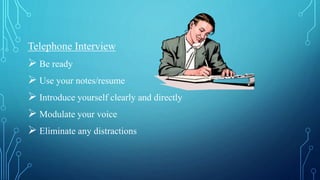
Telephone Interview
 Be ready
 Use your notes/resume
 Introduce yourself clearly and directly
 Modulate your voice
 Eliminate any distractions
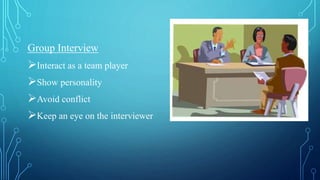
Group Interview
Interact as a team player
Show personality
Avoid conflict
Keep an eye on the interviewer
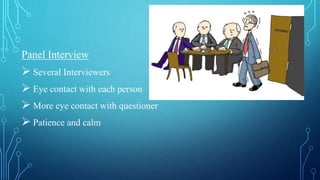
Panel Interview
 Several Interviewers
 Eye contact with each person
 More eye contact with questioner
 Patience and calm
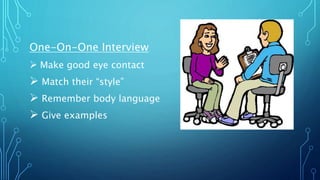
One-On-One Interview
 Make good eye contact
 Match their “style”
 Remember body language
 Give examples
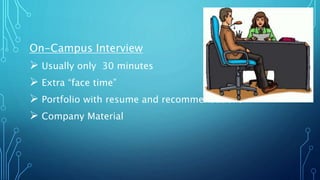
On-Campus Interview
 Usually only 30 minutes
 Extra “face time”
 Portfolio with resume and recommendations
 Company Material
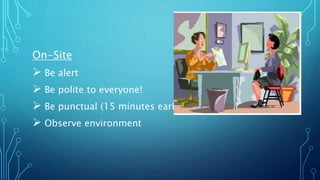
On-Site
 Be alert
 Be polite to everyone!
 Be punctual (15 minutes early)
 Observe environment
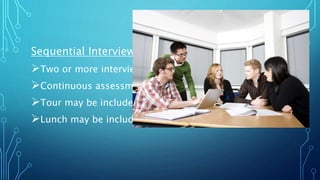
Sequential Interview
Two or more interviews
Continuous assessment
Tour may be included
Lunch may be included
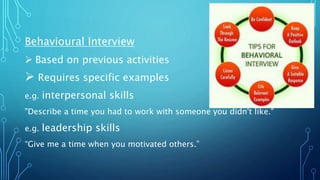
Behavioural Interview
 Based on previous activities
 Requires specific examples
e.g. interpersonal skills
"Describe a time you had to work with someone you didn't like."
e.g. leadership skills
“Give me a time when you motivated others.”
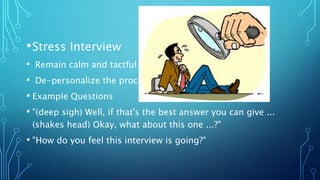
•Stress Interview
• Remain calm and tactful
• De-personalize the process
• Example Questions
• "(deep sigh) Well, if that's the best answer you can give ...
(shakes head) Okay, what about this one ...?"
• "How do you feel this interview is going?"
Case Interview
Two way discussion
Problem solving
No perfect answer
Structured approach
Ask questions
Technical Interview
 Problem solving and creativity
 Specific knowledge
 Not only technical but interpersonal
 Brain teasers
Meal-time Interview
Follow interviewer’s lead
Show social know-how
Be discrete!
Avoid messy food
Types of Interview

Types of Interview

  • 1.
    • Submitted By:- • Kamlesh – 181 • Aakash – 199 • Nikhilender - ? • Shivam - ? • Shivam - ?
  • 2.
    INTERVIEW • An interviewis a conversation between two or more people where questions are asked by the interviewer to elicit facts or statements from the interviewee. Interviews are a standard part of qualitative research. They are also used in journalism and media reporting (see Interview (journalism) and in various employment-related contexts.
  • 3.
    Telephone Interview  Beready  Use your notes/resume  Introduce yourself clearly and directly  Modulate your voice  Eliminate any distractions
  • 4.
    Group Interview Interact asa team player Show personality Avoid conflict Keep an eye on the interviewer
  • 5.
    Panel Interview  SeveralInterviewers  Eye contact with each person  More eye contact with questioner  Patience and calm
  • 6.
    One-On-One Interview  Makegood eye contact  Match their “style”  Remember body language  Give examples
  • 7.
    On-Campus Interview  Usuallyonly 30 minutes  Extra “face time”  Portfolio with resume and recommendations  Company Material
  • 8.
    On-Site  Be alert Be polite to everyone!  Be punctual (15 minutes early)  Observe environment
  • 9.
    Sequential Interview Two ormore interviews Continuous assessment Tour may be included Lunch may be included
  • 10.
    Behavioural Interview  Basedon previous activities  Requires specific examples e.g. interpersonal skills "Describe a time you had to work with someone you didn't like." e.g. leadership skills “Give me a time when you motivated others.”
  • 11.
    •Stress Interview • Remaincalm and tactful • De-personalize the process • Example Questions • "(deep sigh) Well, if that's the best answer you can give ... (shakes head) Okay, what about this one ...?" • "How do you feel this interview is going?"
  • 12.
    Case Interview Two waydiscussion Problem solving No perfect answer Structured approach Ask questions
  • 13.
    Technical Interview  Problemsolving and creativity  Specific knowledge  Not only technical but interpersonal  Brain teasers
  • 14.
    Meal-time Interview Follow interviewer’slead Show social know-how Be discrete! Avoid messy food