


Famous Events in
     Journalism

       By Anna Shorina
     Chuvash State University
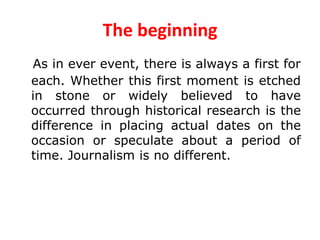
The beginning
As in ever event, there is always a first for
each. Whether this first moment is etched
in stone or widely believed to have
occurred through historical research is the
difference in placing actual dates on the
occasion or speculate about a period of
time. Journalism is no different.
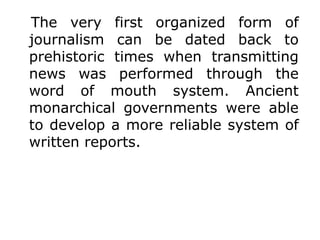
The very first organized form of
journalism can be dated back to
prehistoric times when transmitting
news was performed through the
word of mouth system. Ancient
monarchical governments were able
to develop a more reliable system of
written reports.
The Roman
Empire from Julius
Caesar and beyond
recorded and distributed a
daily report of political
news and acts of the
Roman colonies. Ancient
Egypt was another empire
that practiced this type of
journalism.
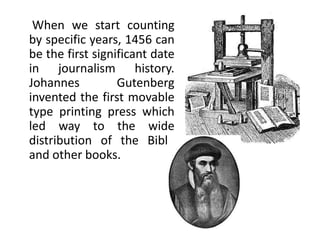
When we start counting
by specific years, 1456 can
be the first significant date
in journalism history.
Johannes          Gutenberg
invented the first movable
type printing press which
led way to the wide
distribution of the Bible
and other books.
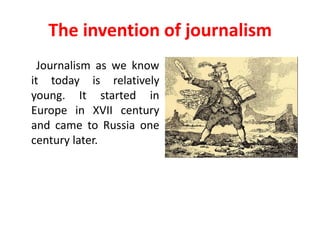
The invention of journalism
  Journalism as we know
it today is relatively
young. It started in
Europe in XVII century
and came to Russia one
century later.
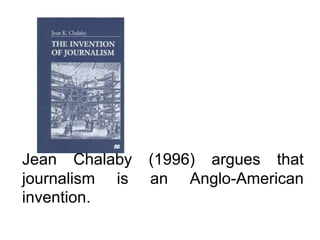
Jean Chalaby    (1996) argues that
journalism is   an Anglo-American
invention.
In ‘Journalism as an Anglo-American
invention: A comparison of the development
of French and Anglo-American journalism
1830s-1920s’, he develops this argument
through a comparison of French and Anglo-
American journalism.
People
 Chalaby’s work is aligned to that
of journalism scholars such as
Schudson (2001), who interrogated
the core journalistic concept of
objectivity.

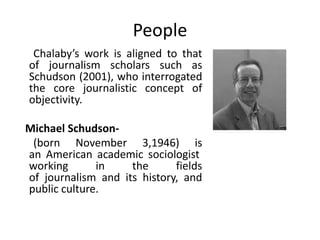
Michael Schudson-
 (born November 3,1946) is
an American academic sociologist
working       in    the      fields
of journalism and its history, and
public culture.
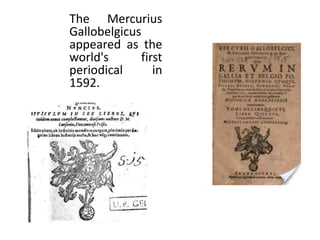
The Mercurius
Gallobelgicus
appeared as the
world's      first
periodical      in
1592.
It was issued in Latin semi-annually
and generally distributed at book
fairs. While the periodical provide
information to the reader, the
publishing dates gave more an
impression of reviewing recent
history than reading the latest news.
First regular newspaper
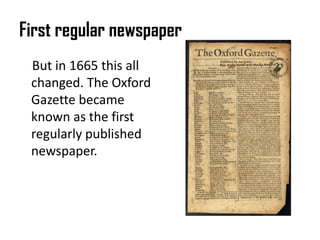
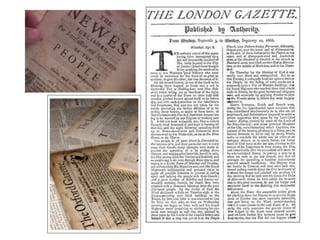
 But in 1665 this all
 changed. The Oxford
 Gazette became
 known as the first
 regularly published
 newspaper.
Incidentally, some contribute the invention of
the newspaper to the English court's way of
communicating to London what was
occurring. London, at the time, was suffering
the affects of the plague and the English court
transferred to Oxford to avoid falling victim.
When the plague went away and the English
court returned to Oxford, the Gazette survived
the move and set up publishing in London.
An earlier newsbook, The Continuation of
Our Weekly News, had previously been
published in London on a regular basis since
1623.
The first printer in the U.S.
 In the U.S., the printing was regulated by the
Press Restriction Act. This act made it
mandatory for the printer's name and place of
publication to be included on each printed
document. In 1638, Stephen Day became the
first printer in Cambridge, Massachusetts.
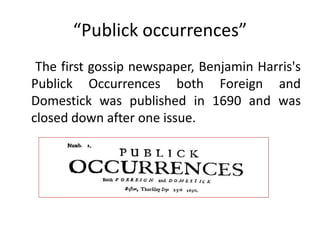
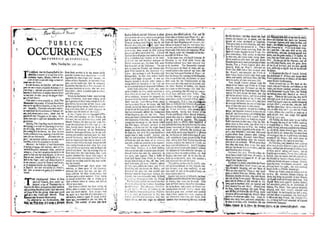
“Publick occurrences”
 The first gossip newspaper, Benjamin Harris's
Publick Occurrences both Foreign and
Domestick was published in 1690 and was
closed down after one issue.
Unwanted story
   Apart from not being licensed, the
newspaper published an unfavourable story of
the French King having an affair with his son's
wife. Censorship had arrived to the U.S.
shores.
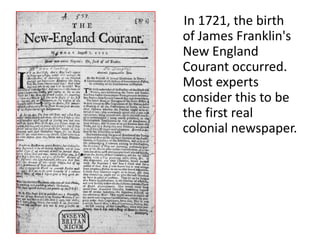
In 1721, the birth
of James Franklin's
New England
Courant occurred.
Most experts
consider this to be
the first real
colonial newspaper.
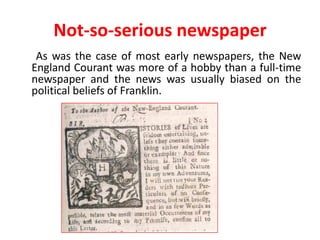
Not-so-serious newspaper
 As was the case of most early newspapers, the New
England Courant was more of a hobby than a full-time
newspaper and the news was usually biased on the
political beliefs of Franklin.
Unfortunately for
Franklin, his political
beliefs were on the
opposite side of the
ones in power.
  While       Franklin
eventually had to
give up publishing
his newspaper.
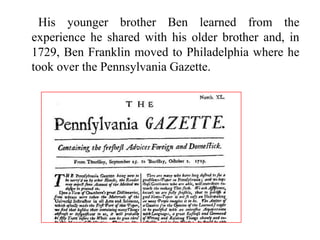
His younger brother Ben learned from the
experience he shared with his older brother and, in
1729, Ben Franklin moved to Philadelphia where he
took over the Pennsylvania Gazette.
By 1750, weekly newspapers had grown to 14
in the six largest colonies. Some were even
turning over a profit for their owners.
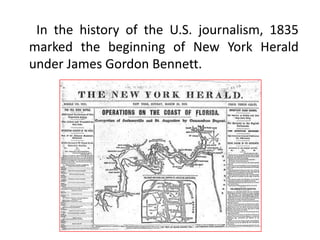
In the history of the U.S. journalism, 1835
marked the beginning of New York Herald
under James Gordon Bennett.
Getting steady
   This newspaper introduced the world to the
modern concept of the newspaper. The New
York Herald was a capitalist institution free of
government or political party control. Within
fifteen months, the circulation grew to 40,000.
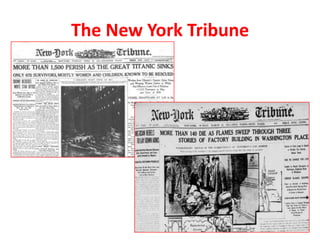
The New York Tribune
 The New York Tribune began print in 1841
and was known as the first newspaper to carry
national influence with it. By the eve of the
Civil War, the Tribune was getting demands for
thousands of copies from any parts of the U.S.
The New York Times was founded in 1851 and
represented the principle of balanced
reportage with high-level writing.
The New York Tribune
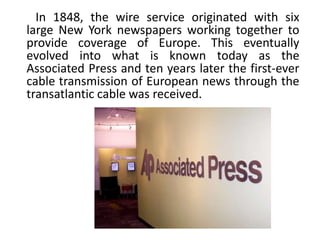
In 1848, the wire service originated with six
large New York newspapers working together to
provide coverage of Europe. This eventually
evolved into what is known today as the
Associated Press and ten years later the first-ever
cable transmission of European news through the
transatlantic cable was received.
First radio broadcast
   While the nineteenth century witness
newspapers growing across the U.S., the next
significant events didn't occur until 1901 when
Gugliemo Marconi and his colleagues were
successful in sending the first wireless signal
across the ocean. Broadcast news was on the
brink of existence. In 1912, it arrived with the
first radio broadcast in Los Angeles.
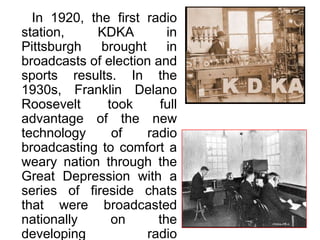
In 1920, the first radio
station,    KDKA          in
Pittsburgh   brought in
broadcasts of election and
sports results. In the
1930s, Franklin Delano
Roosevelt     took      full
advantage of the new
technology     of     radio
broadcasting to comfort a
weary nation through the
Great Depression with a
series of fireside chats
that were broadcasted
nationally     on       the
developing            radio
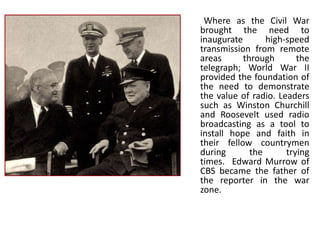
Where as the Civil War
brought the need to
inaugurate       high-speed
transmission from remote
areas      through       the
telegraph; World War II
provided the foundation of
the need to demonstrate
the value of radio. Leaders
such as Winston Churchill
and Roosevelt used radio
broadcasting as a tool to
install hope and faith in
their fellow countrymen
during       the      trying
times. Edward Murrow of
CBS became the father of
the reporter in the war
zone.
Recovering newsprint
  The growth of the radio, followed by the
introduction of mainstream journalism into
television saw the decline of the newspaper. It
wasn't until Al Neauharth founded the USA
Today in the 1980s as a national "hometown"
newspaper did journalism in print recover
some of its prestige and following.
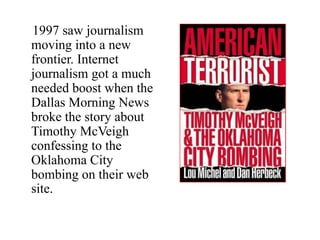
1997 saw journalism
moving into a new
frontier. Internet
journalism got a much
needed boost when the
Dallas Morning News
broke the story about
Timothy McVeigh
confessing to the
Oklahoma City
bombing on their web
site.
Journalism has grown through many different
forms and measures. It has fought against
censorship as well as it has been used as a
tool of manipulation by government leaders.
Still, there are many boundaries to explore
and the journalists of tomorrow will be the
ones leading the path. The history of
journalism is ongoing and forever changing. As
long as there are journalists willing to keep the
desire to inform alive, journalism will continue
to adapt to the technologies of tomorrow.
The End

Important events in journalism

  • 1.
    Famous Events in Journalism By Anna Shorina Chuvash State University
  • 2.
    The beginning As inever event, there is always a first for each. Whether this first moment is etched in stone or widely believed to have occurred through historical research is the difference in placing actual dates on the occasion or speculate about a period of time. Journalism is no different.
  • 3.
    The very firstorganized form of journalism can be dated back to prehistoric times when transmitting news was performed through the word of mouth system. Ancient monarchical governments were able to develop a more reliable system of written reports.
  • 4.
    The Roman Empire fromJulius Caesar and beyond recorded and distributed a daily report of political news and acts of the Roman colonies. Ancient Egypt was another empire that practiced this type of journalism.
  • 5.
    When we startcounting by specific years, 1456 can be the first significant date in journalism history. Johannes Gutenberg invented the first movable type printing press which led way to the wide distribution of the Bible and other books.
  • 6.
    The invention ofjournalism Journalism as we know it today is relatively young. It started in Europe in XVII century and came to Russia one century later.
  • 7.
    Jean Chalaby (1996) argues that journalism is an Anglo-American invention.
  • 8.
    In ‘Journalism asan Anglo-American invention: A comparison of the development of French and Anglo-American journalism 1830s-1920s’, he develops this argument through a comparison of French and Anglo- American journalism.
  • 9.
    People Chalaby’s workis aligned to that of journalism scholars such as Schudson (2001), who interrogated the core journalistic concept of objectivity. Michael Schudson- (born November 3,1946) is an American academic sociologist working in the fields of journalism and its history, and public culture.
  • 10.
    The Mercurius Gallobelgicus appeared asthe world's first periodical in 1592.
  • 11.
    It was issuedin Latin semi-annually and generally distributed at book fairs. While the periodical provide information to the reader, the publishing dates gave more an impression of reviewing recent history than reading the latest news.
  • 12.
    First regular newspaper But in 1665 this all changed. The Oxford Gazette became known as the first regularly published newspaper.
  • 14.
    Incidentally, some contributethe invention of the newspaper to the English court's way of communicating to London what was occurring. London, at the time, was suffering the affects of the plague and the English court transferred to Oxford to avoid falling victim. When the plague went away and the English court returned to Oxford, the Gazette survived the move and set up publishing in London.
  • 15.
    An earlier newsbook,The Continuation of Our Weekly News, had previously been published in London on a regular basis since 1623.
  • 16.
    The first printerin the U.S. In the U.S., the printing was regulated by the Press Restriction Act. This act made it mandatory for the printer's name and place of publication to be included on each printed document. In 1638, Stephen Day became the first printer in Cambridge, Massachusetts.
  • 17.
    “Publick occurrences” Thefirst gossip newspaper, Benjamin Harris's Publick Occurrences both Foreign and Domestick was published in 1690 and was closed down after one issue.
  • 19.
    Unwanted story Apart from not being licensed, the newspaper published an unfavourable story of the French King having an affair with his son's wife. Censorship had arrived to the U.S. shores.
  • 20.
    In 1721, thebirth of James Franklin's New England Courant occurred. Most experts consider this to be the first real colonial newspaper.
  • 21.
    Not-so-serious newspaper Aswas the case of most early newspapers, the New England Courant was more of a hobby than a full-time newspaper and the news was usually biased on the political beliefs of Franklin.
  • 22.
    Unfortunately for Franklin, hispolitical beliefs were on the opposite side of the ones in power. While Franklin eventually had to give up publishing his newspaper.
  • 23.
    His younger brotherBen learned from the experience he shared with his older brother and, in 1729, Ben Franklin moved to Philadelphia where he took over the Pennsylvania Gazette.
  • 24.
    By 1750, weeklynewspapers had grown to 14 in the six largest colonies. Some were even turning over a profit for their owners.
  • 25.
    In the historyof the U.S. journalism, 1835 marked the beginning of New York Herald under James Gordon Bennett.
  • 26.
    Getting steady This newspaper introduced the world to the modern concept of the newspaper. The New York Herald was a capitalist institution free of government or political party control. Within fifteen months, the circulation grew to 40,000.
  • 27.
    The New YorkTribune The New York Tribune began print in 1841 and was known as the first newspaper to carry national influence with it. By the eve of the Civil War, the Tribune was getting demands for thousands of copies from any parts of the U.S. The New York Times was founded in 1851 and represented the principle of balanced reportage with high-level writing.
  • 28.
    The New YorkTribune
  • 29.
    In 1848, thewire service originated with six large New York newspapers working together to provide coverage of Europe. This eventually evolved into what is known today as the Associated Press and ten years later the first-ever cable transmission of European news through the transatlantic cable was received.
  • 30.
    First radio broadcast While the nineteenth century witness newspapers growing across the U.S., the next significant events didn't occur until 1901 when Gugliemo Marconi and his colleagues were successful in sending the first wireless signal across the ocean. Broadcast news was on the brink of existence. In 1912, it arrived with the first radio broadcast in Los Angeles.
  • 31.
    In 1920, thefirst radio station, KDKA in Pittsburgh brought in broadcasts of election and sports results. In the 1930s, Franklin Delano Roosevelt took full advantage of the new technology of radio broadcasting to comfort a weary nation through the Great Depression with a series of fireside chats that were broadcasted nationally on the developing radio
  • 32.
    Where as theCivil War brought the need to inaugurate high-speed transmission from remote areas through the telegraph; World War II provided the foundation of the need to demonstrate the value of radio. Leaders such as Winston Churchill and Roosevelt used radio broadcasting as a tool to install hope and faith in their fellow countrymen during the trying times. Edward Murrow of CBS became the father of the reporter in the war zone.
  • 33.
    Recovering newsprint The growth of the radio, followed by the introduction of mainstream journalism into television saw the decline of the newspaper. It wasn't until Al Neauharth founded the USA Today in the 1980s as a national "hometown" newspaper did journalism in print recover some of its prestige and following.
  • 34.
    1997 saw journalism movinginto a new frontier. Internet journalism got a much needed boost when the Dallas Morning News broke the story about Timothy McVeigh confessing to the Oklahoma City bombing on their web site.
  • 35.
    Journalism has grownthrough many different forms and measures. It has fought against censorship as well as it has been used as a tool of manipulation by government leaders. Still, there are many boundaries to explore and the journalists of tomorrow will be the ones leading the path. The history of journalism is ongoing and forever changing. As long as there are journalists willing to keep the desire to inform alive, journalism will continue to adapt to the technologies of tomorrow.
  • 36.