HOW TO CONDUCT AN
INTERVIEW
Submitted to: Dr. Zahid
Yousaf
Submitted by: Neha Imtiaz
Roll no. 12031516-061
CMCS BS-V
WHAT IS AN INTERVIEW?
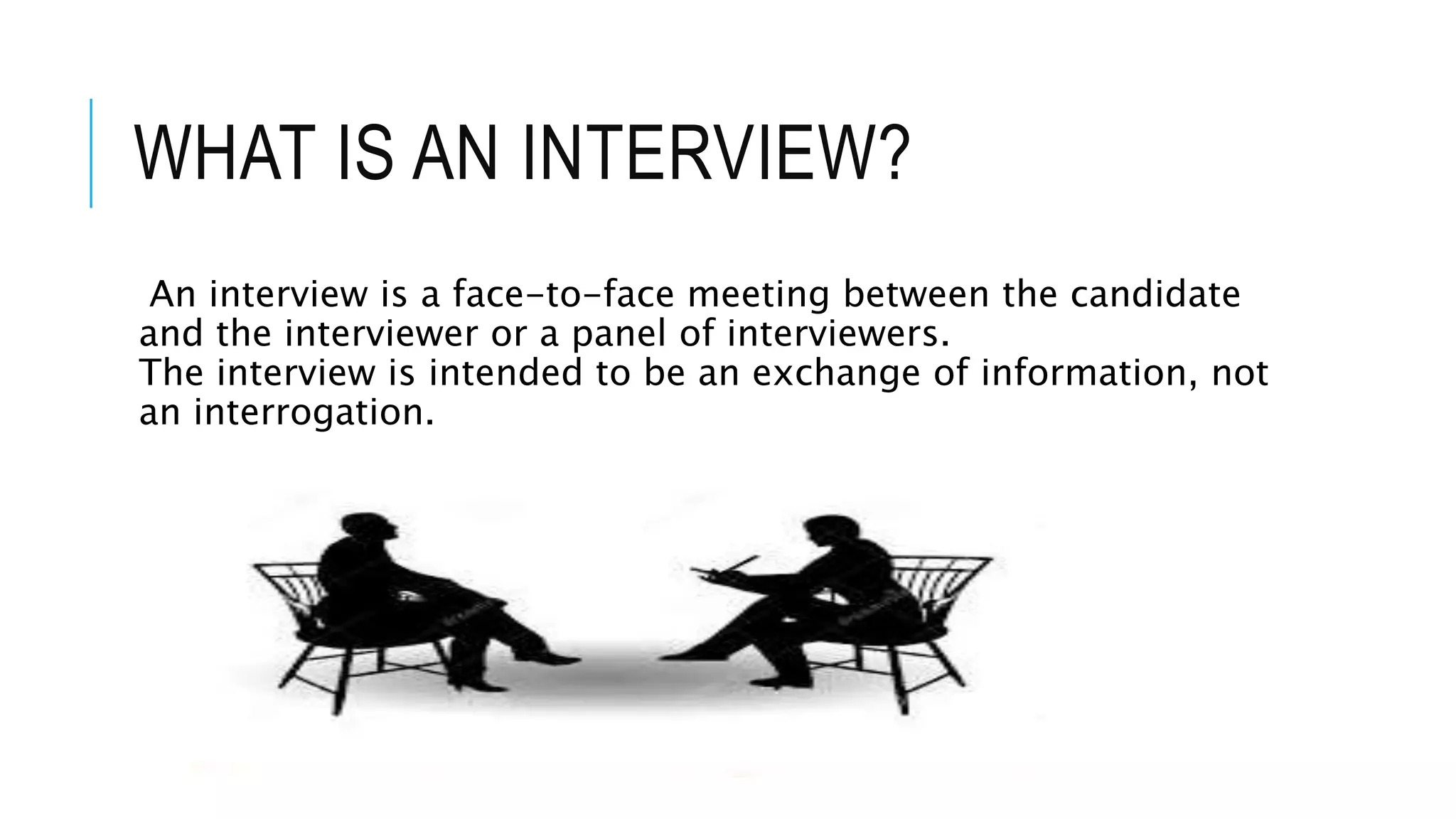
An interview is a face-to-face meeting between the candidate
and the interviewer or a panel of interviewers.
The interview is intended to be an exchange of information, not
an interrogation.
TYPES OF INTERVIEW
Interviews to be broadcast/published as a whole:
Informative Interview - facts & figures about certain topics.
Opinion Interview - what the interviewee thinks of a specific
issue, event or development.
Personality Interview - personality of the interviewee.
TYPES OF INTERVIEW
Interviews as tools:
Research Interview – research or double-check information. Get
additional information for writing reports/commentaries.
Statement Interview - get an individual statement which
becomes part of another journalistic piece.
PREPARING THE INTERVIEW
Research the topic
Focus on one topic
Define the goal
PREPARING THE INTERVIEW
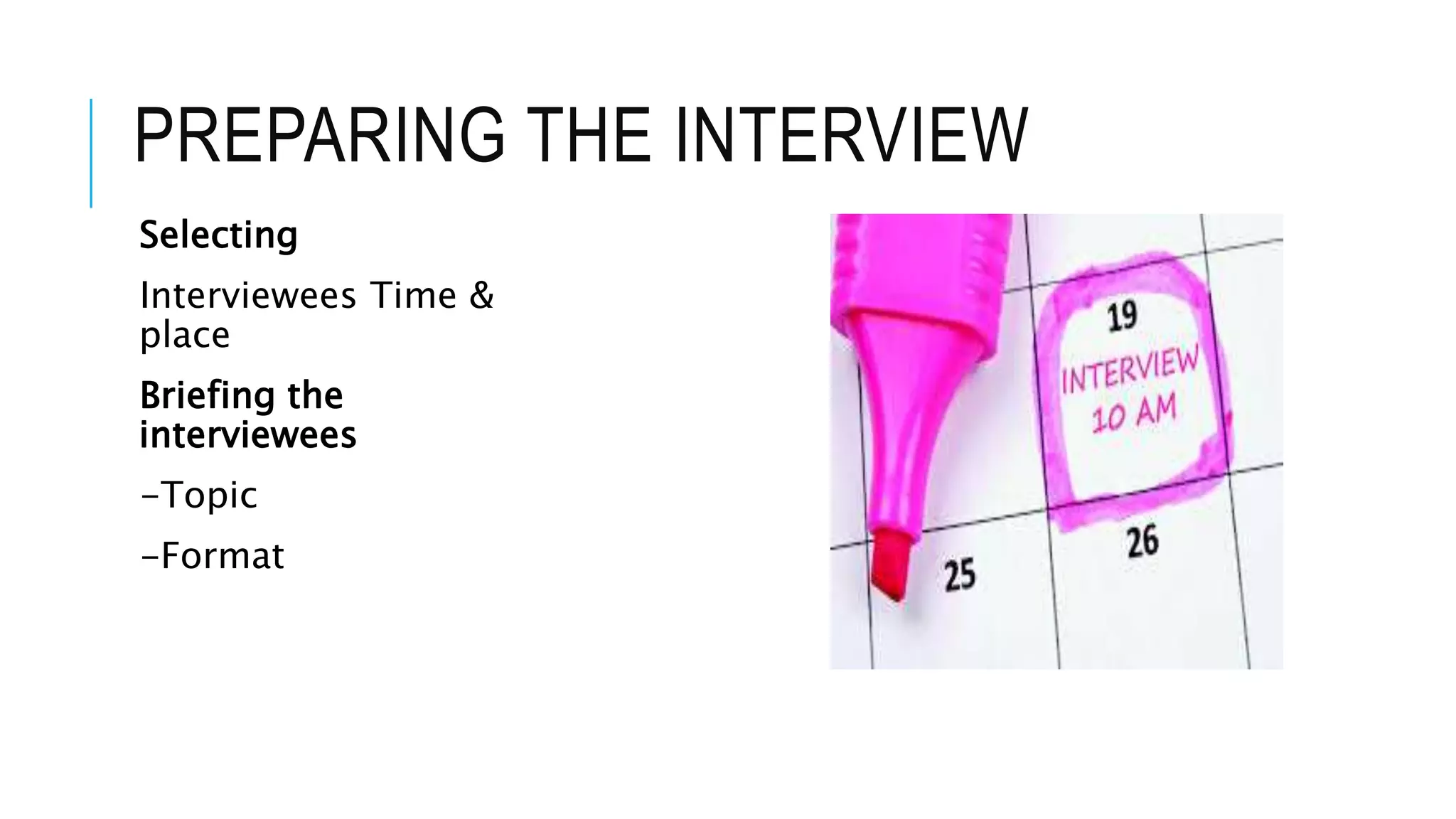
Selecting
Interviewees Time &
place
Briefing the
interviewees
-Topic
-Format
STRUCTURE OF INTERVIEW
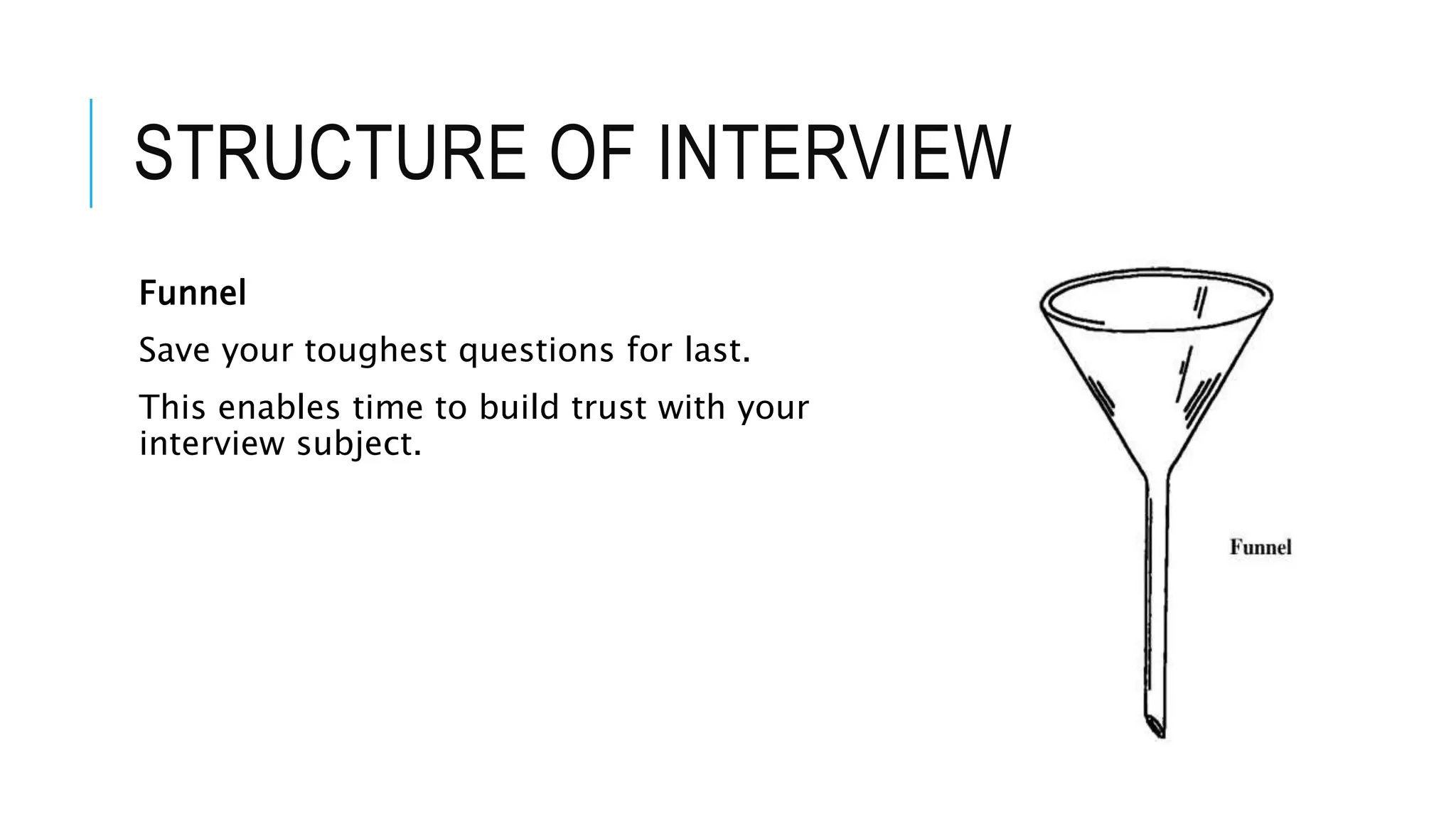
Funnel
Save your toughest questions for last.
This enables time to build trust with your
interview subject.
STRUCTURE OF INTERVIEW
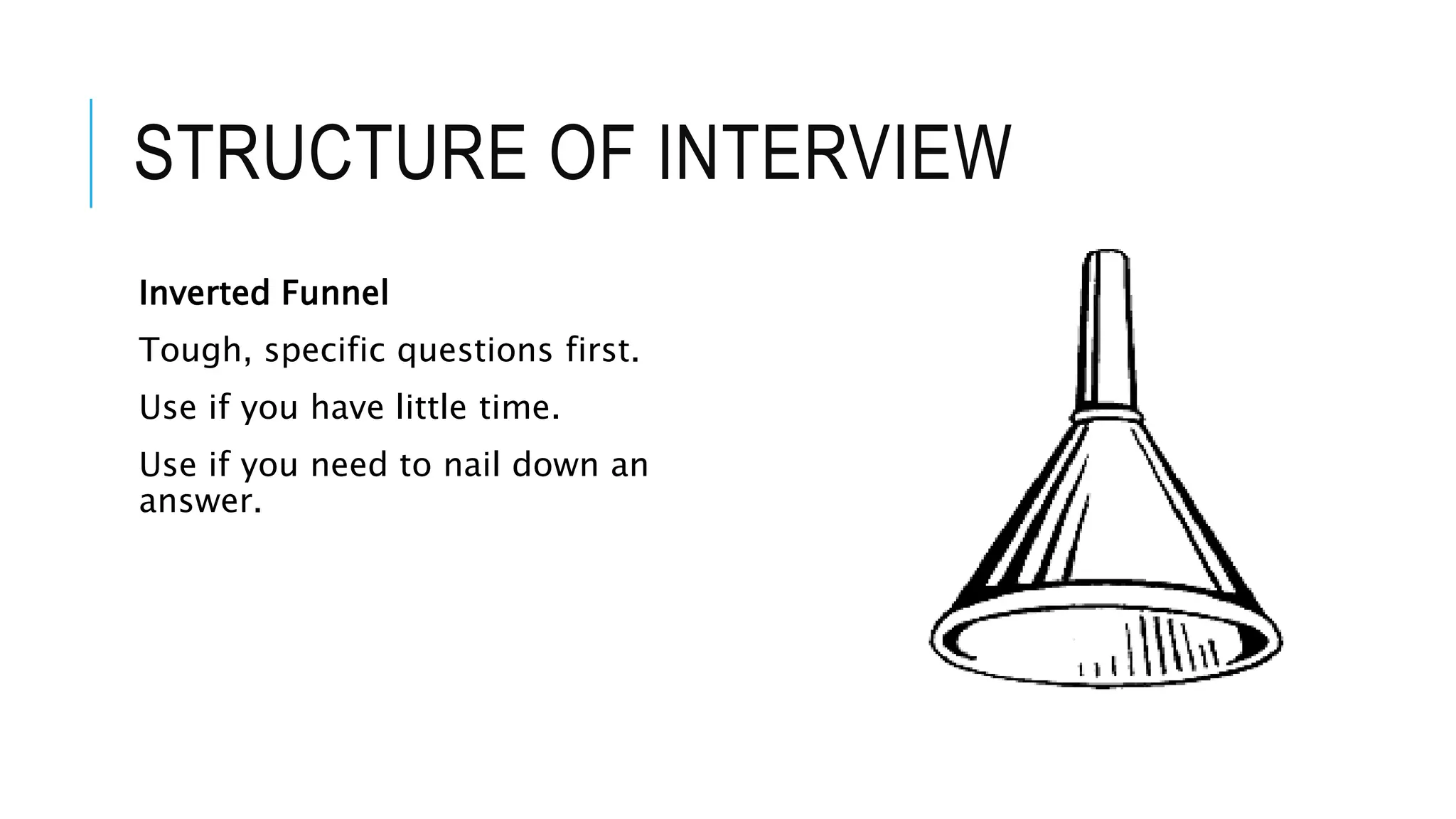
Inverted Funnel
Tough, specific questions first.
Use if you have little time.
Use if you need to nail down an
answer.
DURING THE INTERVIEW
•Gain trust of the subject
•Honesty and empathy almost always work.
•Address the subject by name in practically every sentence.
•Eye contact.
•GOAL : Make the interviewee relax and really TALK instead of
just answering questions.
DURING THE INTERVIEW
•Be alert for intentional drifters - interviewees who deliberately
change the focus of a question (I'm still wondering about the
original question, ….You didn't answer the question.“)
•Know when and how to interrupt to keep the subject from
rambling.
•Make sure that your key questions are answered.
•Anticipate answers as part of your plan.
•Ask follow-up questions.
GUIDELINES
•First question should be friendly and easy.
•Ask critical questions after you’ve established a rapport.
•If you don’t get a direct answer, ask later in different words.
•Politeness allows you to ask hard-nosed questions without
being rude.
•A good question is short one.
•One question at a time.
•Avoid obvious questions.
•Avoid leading questions.
DO’S AND DON'TS
DO’S
Specify the amount of time you
will need.
Create a good first impression –
it‘s critical.
When meeting someone for the
first time, it’s better to be a little
formal at the outset. Never be
familiar.
The good interviewer listens
carefully, but not passively.
Have a conversation.
DO’S AND DON’TS
DON’TS
Don't be fixated on your
notebook
Don’t gaze at your watch
showing that you’re in a rush (if
you are not)
Don’t interrupt when the subject
is talking
Don't try to shout down someone
or get defensive
Stupidity is a reporter’s greatest
asset. So, don’t be afraid to say:
THE RIGHT ENDING
“ One final question…”
“ Is there anything you think important which I
haven’t asked?”
“ Who else should I speak to about this topic?”
“ Thanks for giving me your time and some
great quotes”.
Make sure you can contact the interviewee
later.
AFTER THE INTERVIEW
Double-check the information.
Statistics are often manipulated - be prepared to confirm all
statistics with
an independent source
Keep in touch – like whine, a good source improves with age
and occasional care.

How to conduct an interview

  • 1.
    HOW TO CONDUCTAN INTERVIEW Submitted to: Dr. Zahid Yousaf Submitted by: Neha Imtiaz Roll no. 12031516-061 CMCS BS-V
  • 2.
    WHAT IS ANINTERVIEW? An interview is a face-to-face meeting between the candidate and the interviewer or a panel of interviewers. The interview is intended to be an exchange of information, not an interrogation.
  • 3.
    TYPES OF INTERVIEW Interviewsto be broadcast/published as a whole: Informative Interview - facts & figures about certain topics. Opinion Interview - what the interviewee thinks of a specific issue, event or development. Personality Interview - personality of the interviewee.
  • 4.
    TYPES OF INTERVIEW Interviewsas tools: Research Interview – research or double-check information. Get additional information for writing reports/commentaries. Statement Interview - get an individual statement which becomes part of another journalistic piece.
  • 5.
    PREPARING THE INTERVIEW Researchthe topic Focus on one topic Define the goal
  • 6.
    PREPARING THE INTERVIEW Selecting IntervieweesTime & place Briefing the interviewees -Topic -Format
  • 7.
    STRUCTURE OF INTERVIEW Funnel Saveyour toughest questions for last. This enables time to build trust with your interview subject.
  • 8.
    STRUCTURE OF INTERVIEW InvertedFunnel Tough, specific questions first. Use if you have little time. Use if you need to nail down an answer.
  • 9.
    DURING THE INTERVIEW •Gaintrust of the subject •Honesty and empathy almost always work. •Address the subject by name in practically every sentence. •Eye contact. •GOAL : Make the interviewee relax and really TALK instead of just answering questions.
  • 10.
    DURING THE INTERVIEW •Bealert for intentional drifters - interviewees who deliberately change the focus of a question (I'm still wondering about the original question, ….You didn't answer the question.“) •Know when and how to interrupt to keep the subject from rambling. •Make sure that your key questions are answered. •Anticipate answers as part of your plan. •Ask follow-up questions.
  • 11.
    GUIDELINES •First question shouldbe friendly and easy. •Ask critical questions after you’ve established a rapport. •If you don’t get a direct answer, ask later in different words. •Politeness allows you to ask hard-nosed questions without being rude. •A good question is short one. •One question at a time. •Avoid obvious questions. •Avoid leading questions.
  • 12.
    DO’S AND DON'TS DO’S Specifythe amount of time you will need. Create a good first impression – it‘s critical. When meeting someone for the first time, it’s better to be a little formal at the outset. Never be familiar. The good interviewer listens carefully, but not passively. Have a conversation.
  • 13.
    DO’S AND DON’TS DON’TS Don'tbe fixated on your notebook Don’t gaze at your watch showing that you’re in a rush (if you are not) Don’t interrupt when the subject is talking Don't try to shout down someone or get defensive Stupidity is a reporter’s greatest asset. So, don’t be afraid to say:
  • 14.
    THE RIGHT ENDING “One final question…” “ Is there anything you think important which I haven’t asked?” “ Who else should I speak to about this topic?” “ Thanks for giving me your time and some great quotes”. Make sure you can contact the interviewee later.
  • 15.
    AFTER THE INTERVIEW Double-checkthe information. Statistics are often manipulated - be prepared to confirm all statistics with an independent source Keep in touch – like whine, a good source improves with age and occasional care.