Presented by,
Chief Manager & Faculty Member
BOI Staff Training College, Bhopal
Creation of charge by the
borrowers on various kinds of
securities/assets means creation
of a right in favour of the bank.
By creation of charge, the
ownership is not transferred in
favour of the creditor. (except in
few transaction such as English
Mortgage).
Marketability;
Ascertain ability;
Stability of value;
Storability;
Transferability;
Durability.
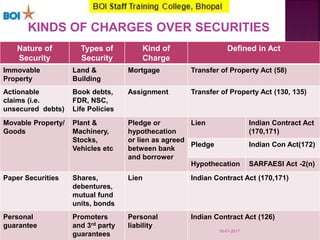
KINDS OF CHARGES OVER SECURITIES
4
Nature of
Security
Types of
Security
Kind of
Charge
Defined in Act
Immovable
Property
Land &
Building
Mortgage Transfer of Property Act (58)
Actionable
claims (i.e.
unsecured debts)
Book debts,
FDR, NSC,
Life Policies
Assignment Transfer of Property Act (130, 135)
Movable Property/
Goods
Plant &
Machinery,
Stocks,
Vehicles etc
Pledge or
hypothecation
or lien as agreed
between bank
and borrower
Lien Indian Contract Act
(170,171)
Pledge Indian Con Act(172)
Hypothecation SARFAESI Act -2(n)
Paper Securities Shares,
debentures,
mutual fund
units, bonds
Lien Indian Contract Act (170,171)
Personal
guarantee
Promoters
and 3rd party
guarantees
Personal
liability
Indian Contract Act (126)
16-01-2017
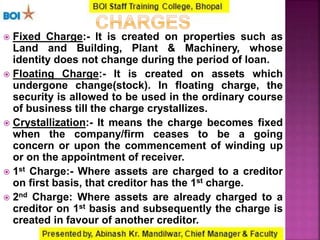
 Fixed Charge:- It is created on properties such as
Land and Building, Plant & Machinery, whose
identity does not change during the period of loan.
 Floating Charge:- It is created on assets which
undergone change(stock). In floating charge, the
security is allowed to be used in the ordinary course
of business till the charge crystallizes.
 Crystallization:- It means the charge becomes fixed
when the company/firm ceases to be a going
concern or upon the commencement of winding up
or on the appointment of receiver.
 1st Charge:- Where assets are charged to a creditor
on first basis, that creditor has the 1st charge.
 2nd Charge: Where assets are already charged to a
creditor on 1st basis and subsequently the charge is
created in favour of another creditor.
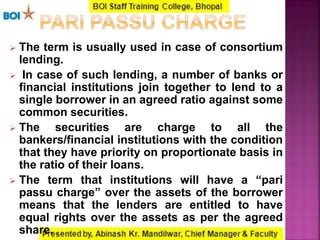
 The term is usually used in case of consortium
lending.
 In case of such lending, a number of banks or
financial institutions join together to lend to a
single borrower in an agreed ratio against some
common securities.
 The securities are charge to all the
bankers/financial institutions with the condition
that they have priority on proportionate basis in
the ratio of their loans.
 The term that institutions will have a “pari
passu charge” over the assets of the borrower
means that the lenders are entitled to have
equal rights over the assets as per the agreed
share.
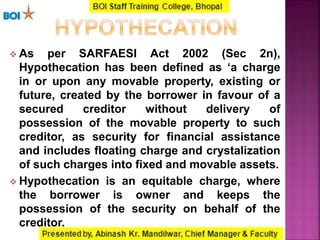
 As per SARFAESI Act 2002 (Sec 2n),
Hypothecation has been defined as ‘a charge
in or upon any movable property, existing or
future, created by the borrower in favour of a
secured creditor without delivery of
possession of the movable property to such
creditor, as security for financial assistance
and includes floating charge and crystalization
of such charges into fixed and movable assets.
 Hypothecation is an equitable charge, where
the borrower is owner and keeps the
possession of the security on behalf of the
creditor.
 U/s 172 of Indian contract act, pledge is
bailment (delivery) of goods as security for
payment of a loan. Only goods (Sec. 2 (7) of
Sales of Goods Act) can be pledged.
 In pledge, the legal rights are different from
hypothecation as the possession of the
securities remains with the bank while the
ownership remains with the borrower.
 Delivery of the goods pledged by the pledger
to the pledgee is essential for creating a
pledge, which may be actual or constructive.
As per Section 130 & 135 of Transfer of
Property Act, assignment is transfer of
an actionable claim, which may be
existing or future, as a security for
loan.
The transfer of such claim is called the
Assignor and the transferee is called
Assignee.
Example: FDR, LIC policy, Future
income, Book debt, NSC etc.
 Lien is the right of one person to retain goods and
securities in his possession belonging to another
until certain legal debts due to the person retaining
the goods are satisfied.
 In other words, it is the right of the creditor to
retain the goods and securities in his possession,
belonging to a debtor, until the debt due is paid.
Lien does not give power of sale but only to retain
the property.
 Particular lien: Particular lien is that lien which confers
the right to retain that particular commodity in respect
of which the particular debt arose.
 General lien: A general lien confers a right to retain
goods and securities not only in respect of a particular
debt incurred in connection with them but in respect of
the general balance due by the owner of the goods and
securities, to the person in possession of them.
Banker’s lien: As a general rule, the right of lien does
not give the person exercising the right, any power or
right to sell or dispose of the securities retained. But in
case of a bank, it is otherwise. A Banker’s lien is more
than a general lien.
It is an implied pledge and the banker has a right to
sell the property after reasonable notice, provide the
property comes into his hands in the ordinary course
of his business.
Section 171 of the contract act lays down that a
bankers lien can be applied if:
 The property is in the hands of the banker in
the capacity of his customer’s bankers;
 the instruments of the money or goods with
the banker are not for a specific purpose
inconsistent with lien;
 the possession of the instruments has been
obtained lawfully as a banker;
 there exists no implied or expressed
agreement contrary to the lien.
 At the time the advance is made, the banker
sometimes asks a borrower to execute a letter
declaring that his assets are free from any sort of
charge or encumbrance.
 The borrower also undertakes that the assets
stated in the said declaration shall not be
encumbered or disposed of without a bank’s
permission in writing so long as the advance
continues.
 This undertaking is known as a Negative lien.
Usually the arrangement is drafted in the form of an
agreement.
 The banker cannot directly realize his debts from
such assets. However, on account of the above
restrictions, the interests of the banker are to a
certain extent protected.
 As per section 58 of Transfer of Property Act
1882, mortgage is transfer of interest in
specific immovable property for the purpose of
securing the payment of money advanced or to
be advanced by way of loan, an existing or
future debt or the performance of an
engagement which may give rise to pecuniary
liability.
 The mortgagor only pats with the interest in
the property and not the ownership. As regards
the possession, except for usufructuary
mortgage, the possession remains with the
mortgager.
As per Sec. 3 of General Clauses
Act, Immovable Property includes
land, benefit arising out of land
and things attached, permanently
fastened to earth.
The transferor of interest in
property, is called a mortgagor
and the transferee is called a
mortgagee.
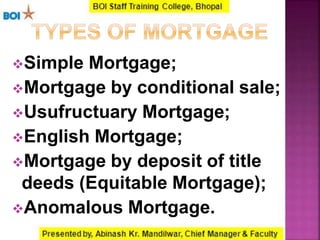
Simple Mortgage;
Mortgage by conditional sale;
Usufructuary Mortgage;
English Mortgage;
Mortgage by deposit of title
deeds (Equitable Mortgage);
Anomalous Mortgage.
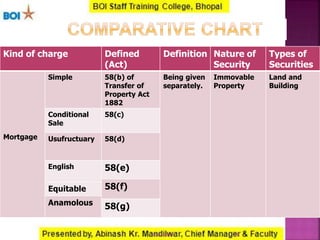
Kind of charge Defined
(Act)
Definition Nature of
Security
Types of
Securities
Mortgage
Simple 58(b) of
Transfer of
Property Act
1882
Being given
separately.
Immovable
Property
Land and
Building
Conditional
Sale
58(c)
Usufructuary 58(d)
English 58(e)
58(f)Equitable
Anamolous 58(g)
1816-01-2017
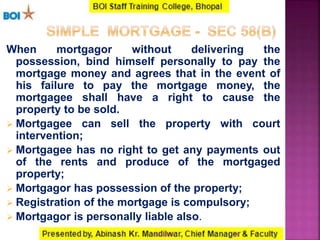
When mortgagor without delivering the
possession, bind himself personally to pay the
mortgage money and agrees that in the event of
his failure to pay the mortgage money, the
mortgagee shall have a right to cause the
property to be sold.
 Mortgagee can sell the property with court
intervention;
 Mortgagee has no right to get any payments out
of the rents and produce of the mortgaged
property;
 Mortgagor has possession of the property;
 Registration of the mortgage is compulsory;
 Mortgagor is personally liable also.
1916-01-2017
 In case of Registered Mortgage, charge is created
on the property with the Sub-Registrar through a
formal, written process as a proof of transfer of
interest to the lender as security for the loan.
 In case of borrower’s failure to repay the loan,
lender/ bank will have the right to take possession
of the property. When the borrower repays the loan
to lender/ bank, the title of the property is given
back to the borrower.
Registered mortgage is required to be created:
 when original title deed is not available (if it is lost
or in case of ancestral property, where title deed is
not available).
 Equitable mortgage can be created in notified
towns only, if mortgage is required to be created in
a town which is not notified, registered mortgage is
required to be created.
In this, the mortgagor ostensibly sells the
mortgaged property on conditions that on
default of payment of the mortgage money,
the sale shall become absolute or on such
payment being made, the sale shall
become void or the buyer shall transfer the
property to the seller.
Sale is ostensible and not real.
If money remains unpaid as per agreement,
the sale becomes absolute.
No personal liability for loan repayment.
2116-01-2017
 Where the mortgagor delivers the possession of the
mortgaged property to the mortgagee, and
authorises him to retain such possession until
payment of the mortgage money and to receive the
rents and profits accruing from property or any part
of such property to appropriate the same in lieu of
interest or the mortgage money.
 Mortgage is actual legal possession of the property,
till dues is repaid.
 No personal liability.
 Sale is not allowed.
 No time limit specified
2216-01-2017
Where the mortgagor binds himself to
repay the mortgage money on a certain
date and transfers the mortgaged property
absolutely to the mortgagee, but subject to
the condition that mortgagee will re-
transfer the property to the mortgagor
upon payment of the mortgage money, as
agreed.
Personal liability to pay on a specified date.
Absolute transfer of the property to the
mortgagee, subject to re-conveying (re-
transfer) the property if the debt is repaid.
2316-01-2017
Most common form of mortgage accepted by banks
in India is Equitable Mortgage or Mortgage by
deposit of title deeds.
Where a person delivers to a creditor (say bank) or
his agent documents of title to immovable property,
with the intent to create a security thereon, the
transaction is called a mortgage by deposit of title
deed or equitable mortgage.
Deposit at notified centers, ( Kolkatta, Chennai,
Mumbai and any other town which the State
Government concerned may by notification in the
Official Gazatte, under the provisions of Sec 58 f of
Transfer of Property Act).
Territorial restriction does not affect the location of
the property. i.e. property can be located any where.
The transaction is not to be reduced to writing;
2416-01-2017
Anomalous Mortgage : Sec 58(G)
 A mortgage which is not of any of the above
5 kinds, is an anomalous mortgage.
Registration of mortgage: Sec 59
 Where the principal money secured is one
hundred rupees or upwards, a mortgage
other than a mortgage by deposit of title
deeds can be effected only by a registered
instrument signed by the mortgagor and
attested by at least two witnesses.
 Central Registry of Securitisation Asset
Reconstruction and Security Interest (CERSAI) is a
central online security interest registry of India.
 It was primarily created to check frauds in lending
against equitable mortgages, in which people would
take multiple loans on the same asset from different
banks.
 A Government company licensed under section 25 of
the Companies Act, 1956 having its Registered Office
at New Delhi.
 According to the government's directives, financial
institutions must register details of security interests
created by them with CERSAI within 30 days of its
creation.
A Reverse Mortgage (called a life-time
mortgage), is the loan allowed to the
sole owner of the house which he
doesn’t need to pay for the time that the
borrower or the co-owner stay there.
Instead, the loan is repaid when the
borrower/s die, or sells the house, or no
longer live there as their primary
residence.
It essentially converts the home equity
into cash, which can be put into varied
usages without any requirement to make
monthly repayments.
2716-01-2017
 The borrower/s are not evaluated on the basis of
an income criteria to qualify for the loan;
 The credit history of the borrower/s being not
very relevant, is not verified;
 The amount of loan is determined on the basis of
borrower’s age, value of the property, rate of
interest and lender’s norms;
 No repayment of the loan is required till
borrower or any of the co-owner occupies the
property;
 Borrower remains the owner of the property and
is liable to pay all property taxes/insurance etc.
during the currency of the loan.
2816-01-2017
Types of charges

Types of charges

  • 1.
    Presented by, Chief Manager& Faculty Member BOI Staff Training College, Bhopal
  • 2.
    Creation of chargeby the borrowers on various kinds of securities/assets means creation of a right in favour of the bank. By creation of charge, the ownership is not transferred in favour of the creditor. (except in few transaction such as English Mortgage).
  • 3.
    Marketability; Ascertain ability; Stability ofvalue; Storability; Transferability; Durability.
  • 4.
    KINDS OF CHARGESOVER SECURITIES 4 Nature of Security Types of Security Kind of Charge Defined in Act Immovable Property Land & Building Mortgage Transfer of Property Act (58) Actionable claims (i.e. unsecured debts) Book debts, FDR, NSC, Life Policies Assignment Transfer of Property Act (130, 135) Movable Property/ Goods Plant & Machinery, Stocks, Vehicles etc Pledge or hypothecation or lien as agreed between bank and borrower Lien Indian Contract Act (170,171) Pledge Indian Con Act(172) Hypothecation SARFAESI Act -2(n) Paper Securities Shares, debentures, mutual fund units, bonds Lien Indian Contract Act (170,171) Personal guarantee Promoters and 3rd party guarantees Personal liability Indian Contract Act (126) 16-01-2017
  • 5.
     Fixed Charge:-It is created on properties such as Land and Building, Plant & Machinery, whose identity does not change during the period of loan.  Floating Charge:- It is created on assets which undergone change(stock). In floating charge, the security is allowed to be used in the ordinary course of business till the charge crystallizes.  Crystallization:- It means the charge becomes fixed when the company/firm ceases to be a going concern or upon the commencement of winding up or on the appointment of receiver.  1st Charge:- Where assets are charged to a creditor on first basis, that creditor has the 1st charge.  2nd Charge: Where assets are already charged to a creditor on 1st basis and subsequently the charge is created in favour of another creditor.
  • 6.
     The termis usually used in case of consortium lending.  In case of such lending, a number of banks or financial institutions join together to lend to a single borrower in an agreed ratio against some common securities.  The securities are charge to all the bankers/financial institutions with the condition that they have priority on proportionate basis in the ratio of their loans.  The term that institutions will have a “pari passu charge” over the assets of the borrower means that the lenders are entitled to have equal rights over the assets as per the agreed share.
  • 7.
     As perSARFAESI Act 2002 (Sec 2n), Hypothecation has been defined as ‘a charge in or upon any movable property, existing or future, created by the borrower in favour of a secured creditor without delivery of possession of the movable property to such creditor, as security for financial assistance and includes floating charge and crystalization of such charges into fixed and movable assets.  Hypothecation is an equitable charge, where the borrower is owner and keeps the possession of the security on behalf of the creditor.
  • 8.
     U/s 172of Indian contract act, pledge is bailment (delivery) of goods as security for payment of a loan. Only goods (Sec. 2 (7) of Sales of Goods Act) can be pledged.  In pledge, the legal rights are different from hypothecation as the possession of the securities remains with the bank while the ownership remains with the borrower.  Delivery of the goods pledged by the pledger to the pledgee is essential for creating a pledge, which may be actual or constructive.
  • 9.
    As per Section130 & 135 of Transfer of Property Act, assignment is transfer of an actionable claim, which may be existing or future, as a security for loan. The transfer of such claim is called the Assignor and the transferee is called Assignee. Example: FDR, LIC policy, Future income, Book debt, NSC etc.
  • 10.
     Lien isthe right of one person to retain goods and securities in his possession belonging to another until certain legal debts due to the person retaining the goods are satisfied.  In other words, it is the right of the creditor to retain the goods and securities in his possession, belonging to a debtor, until the debt due is paid. Lien does not give power of sale but only to retain the property.
  • 11.
     Particular lien:Particular lien is that lien which confers the right to retain that particular commodity in respect of which the particular debt arose.  General lien: A general lien confers a right to retain goods and securities not only in respect of a particular debt incurred in connection with them but in respect of the general balance due by the owner of the goods and securities, to the person in possession of them.
  • 12.
    Banker’s lien: Asa general rule, the right of lien does not give the person exercising the right, any power or right to sell or dispose of the securities retained. But in case of a bank, it is otherwise. A Banker’s lien is more than a general lien. It is an implied pledge and the banker has a right to sell the property after reasonable notice, provide the property comes into his hands in the ordinary course of his business.
  • 13.
    Section 171 ofthe contract act lays down that a bankers lien can be applied if:  The property is in the hands of the banker in the capacity of his customer’s bankers;  the instruments of the money or goods with the banker are not for a specific purpose inconsistent with lien;  the possession of the instruments has been obtained lawfully as a banker;  there exists no implied or expressed agreement contrary to the lien.
  • 14.
     At thetime the advance is made, the banker sometimes asks a borrower to execute a letter declaring that his assets are free from any sort of charge or encumbrance.  The borrower also undertakes that the assets stated in the said declaration shall not be encumbered or disposed of without a bank’s permission in writing so long as the advance continues.  This undertaking is known as a Negative lien. Usually the arrangement is drafted in the form of an agreement.  The banker cannot directly realize his debts from such assets. However, on account of the above restrictions, the interests of the banker are to a certain extent protected.
  • 15.
     As persection 58 of Transfer of Property Act 1882, mortgage is transfer of interest in specific immovable property for the purpose of securing the payment of money advanced or to be advanced by way of loan, an existing or future debt or the performance of an engagement which may give rise to pecuniary liability.  The mortgagor only pats with the interest in the property and not the ownership. As regards the possession, except for usufructuary mortgage, the possession remains with the mortgager.
  • 16.
    As per Sec.3 of General Clauses Act, Immovable Property includes land, benefit arising out of land and things attached, permanently fastened to earth. The transferor of interest in property, is called a mortgagor and the transferee is called a mortgagee.
  • 17.
    Simple Mortgage; Mortgage byconditional sale; Usufructuary Mortgage; English Mortgage; Mortgage by deposit of title deeds (Equitable Mortgage); Anomalous Mortgage.
  • 18.
    Kind of chargeDefined (Act) Definition Nature of Security Types of Securities Mortgage Simple 58(b) of Transfer of Property Act 1882 Being given separately. Immovable Property Land and Building Conditional Sale 58(c) Usufructuary 58(d) English 58(e) 58(f)Equitable Anamolous 58(g) 1816-01-2017
  • 19.
    When mortgagor withoutdelivering the possession, bind himself personally to pay the mortgage money and agrees that in the event of his failure to pay the mortgage money, the mortgagee shall have a right to cause the property to be sold.  Mortgagee can sell the property with court intervention;  Mortgagee has no right to get any payments out of the rents and produce of the mortgaged property;  Mortgagor has possession of the property;  Registration of the mortgage is compulsory;  Mortgagor is personally liable also. 1916-01-2017
  • 20.
     In caseof Registered Mortgage, charge is created on the property with the Sub-Registrar through a formal, written process as a proof of transfer of interest to the lender as security for the loan.  In case of borrower’s failure to repay the loan, lender/ bank will have the right to take possession of the property. When the borrower repays the loan to lender/ bank, the title of the property is given back to the borrower. Registered mortgage is required to be created:  when original title deed is not available (if it is lost or in case of ancestral property, where title deed is not available).  Equitable mortgage can be created in notified towns only, if mortgage is required to be created in a town which is not notified, registered mortgage is required to be created.
  • 21.
    In this, themortgagor ostensibly sells the mortgaged property on conditions that on default of payment of the mortgage money, the sale shall become absolute or on such payment being made, the sale shall become void or the buyer shall transfer the property to the seller. Sale is ostensible and not real. If money remains unpaid as per agreement, the sale becomes absolute. No personal liability for loan repayment. 2116-01-2017
  • 22.
     Where themortgagor delivers the possession of the mortgaged property to the mortgagee, and authorises him to retain such possession until payment of the mortgage money and to receive the rents and profits accruing from property or any part of such property to appropriate the same in lieu of interest or the mortgage money.  Mortgage is actual legal possession of the property, till dues is repaid.  No personal liability.  Sale is not allowed.  No time limit specified 2216-01-2017
  • 23.
    Where the mortgagorbinds himself to repay the mortgage money on a certain date and transfers the mortgaged property absolutely to the mortgagee, but subject to the condition that mortgagee will re- transfer the property to the mortgagor upon payment of the mortgage money, as agreed. Personal liability to pay on a specified date. Absolute transfer of the property to the mortgagee, subject to re-conveying (re- transfer) the property if the debt is repaid. 2316-01-2017
  • 24.
    Most common formof mortgage accepted by banks in India is Equitable Mortgage or Mortgage by deposit of title deeds. Where a person delivers to a creditor (say bank) or his agent documents of title to immovable property, with the intent to create a security thereon, the transaction is called a mortgage by deposit of title deed or equitable mortgage. Deposit at notified centers, ( Kolkatta, Chennai, Mumbai and any other town which the State Government concerned may by notification in the Official Gazatte, under the provisions of Sec 58 f of Transfer of Property Act). Territorial restriction does not affect the location of the property. i.e. property can be located any where. The transaction is not to be reduced to writing; 2416-01-2017
  • 25.
    Anomalous Mortgage :Sec 58(G)  A mortgage which is not of any of the above 5 kinds, is an anomalous mortgage. Registration of mortgage: Sec 59  Where the principal money secured is one hundred rupees or upwards, a mortgage other than a mortgage by deposit of title deeds can be effected only by a registered instrument signed by the mortgagor and attested by at least two witnesses.
  • 26.
     Central Registryof Securitisation Asset Reconstruction and Security Interest (CERSAI) is a central online security interest registry of India.  It was primarily created to check frauds in lending against equitable mortgages, in which people would take multiple loans on the same asset from different banks.  A Government company licensed under section 25 of the Companies Act, 1956 having its Registered Office at New Delhi.  According to the government's directives, financial institutions must register details of security interests created by them with CERSAI within 30 days of its creation.
  • 27.
    A Reverse Mortgage(called a life-time mortgage), is the loan allowed to the sole owner of the house which he doesn’t need to pay for the time that the borrower or the co-owner stay there. Instead, the loan is repaid when the borrower/s die, or sells the house, or no longer live there as their primary residence. It essentially converts the home equity into cash, which can be put into varied usages without any requirement to make monthly repayments. 2716-01-2017
  • 28.
     The borrower/sare not evaluated on the basis of an income criteria to qualify for the loan;  The credit history of the borrower/s being not very relevant, is not verified;  The amount of loan is determined on the basis of borrower’s age, value of the property, rate of interest and lender’s norms;  No repayment of the loan is required till borrower or any of the co-owner occupies the property;  Borrower remains the owner of the property and is liable to pay all property taxes/insurance etc. during the currency of the loan. 2816-01-2017