Security: Part 2
MORTGAGE
(General)
• = mortgagee (creditor) obtains a limited real right over
immovable property belonging to the mortgagor
(debtor) or a 3rd party to secure payment of a debt
Agreement to mortgage & registration of bond
• mortgagor and mortgagee conclude a mortgage contract
(which creates mortgage right)
• security is constituted by registration of bond in the
Deeds Registry
• NB – must be in writing (formality)
MORTGAGE
(General)
Section 88 of the Insolvency Act, 1936 NB
• self-study
– Nagel par 28.28
MORTGAGE
(Ancillary clauses)
Ancillary clauses / agreement
• Pactum commissorium
– invalid (as in the case of pledge)
• Parate executie
– in principle: invalid (contra pledge)
– will be valid only where mortgagor’s specific consent
to such execution is given again to mortgagee after
default in performance
MORTGAGE
(Rights and Duties)
Rights of mortgagee
• bond on property includes other accruals (eg building on land)
• mortgagor usually remains in possession and retains right of
use and enjoyment of property (contra pledge)
• possible to have more than 1 bond over same property
• conferral of further bonds? need written consent of mortgagee
• sale of mortgaged property? bond must be cancelled in
Deeds Registry first
Duties of mortgagee
• if in possession of property? (unlikely) – same duties as pledgee
MORTGAGES
(Types)
Special bond over specified immovable property
• agreement registered in Deeds Registry
• registered mineral rights & registered leases
Kustingsbrief
• a bond to secure payment of balance of purchase price
iro immovable property
• registered simultaneously with transfer of ownership
MORTGAGES
(Types)
Kinderbewys
• bond passed by surviving spouse over specific
immovable property bequeathed to minor child born of
the marriage
• to secure minor child’s inheritance
Covering bond
• provides security for debts incurred in the future
• usually iro bank overdrafts
Bond over movable and immovable incorporeal rights
• Self-study: Nagel par 28.39
MORTGAGES
(Types)
Notarial bond
• “special” or “general” (description of objects of security)
• brings about a mortgage over movable property
• same principles as mortgage bonds
• NB – only special notarial bond provides real security
– general notarial bond = mortgagor has no real right iro property
– BUT: does give mortgagor statutory preference in insolvency
• bond embodied in a deed which must be notarially-
executed
• bond must be lodged for registration within 3 months of
its notarial execution
CESSION IN SECURITY
• debtor (cedent) cedes personal rights to creditor
(cessionary) as security for performance of debtor’s oblig
• debtor and creditor conclude a cession agreement
– cession in securitatem debiti
HYPOTHECS
• operate ex lege (vs by agreement)
• provide real security BUT dr’s consent is not necessary
• Types:
– 1) landlord’s tacit hypothec (contract of lease)
– 2) credit grantor’s tacit hypothec ito s 84(1) of
Insolvency Act, 1936
• CG has hypothec over an object sold on credit by way of an
instalment agreement (NCA)
• offers protection to CG in event of insolvency of credit
receiver/debtor
• secures payment of balance of purchase price still owing
– 3) By order of court
• Self-study: Nagel pars 29.18 – 29.21
LIENS
(General)
• = a right of retention NB
– where a person in possession of a thing belonging to
another has incurred expenses irt that thing (money /
labour), he has the right to keep the thing in his
possession until he has been reimbursed by the owner
• serves as a method for securing reimbursement
• Possession = an absolute prerequisite (contra hypothecs)
• Types: NB
– (a) Debtor / creditor liens (based on contract)
– (b) Enrichment liens (based on unjustified enrichment)
• Salvage / storage liens
• Improvement liens
LIENS
(Types)
Debtor / creditor liens
• constituted by debtor / creditor relationship
• creditor incurs costs based on an agreement with debtor
• contractual consent to expenses (express / tacit)
• creditor entitled to remain in possession until paid
• example - ?
LIENS
(Types)
Enrichment liens
• in possession of property & incurred costs w/o consent
• lien constituted if owner benefitted / is enriched
• property salvaged / stored - ? (= salvage / storage lien)
– usually: all costs are recoverable (enrichment)
• increase in market value of property due to expenditure?
– = improvement lien
– amount by which owner is enriched = recoverable
– additional costs (labour) - ?
• claim of lien-holder limited to:
– smaller of: amount of enrichment of def’s estate or
amount of impoverishment of pl’s estate
– = “double cap” rule of unjustified enrichment
LIENS
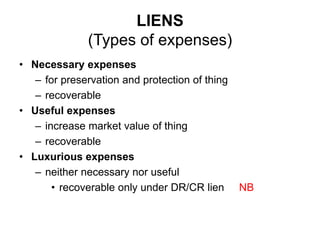
(Types of expenses)
• Necessary expenses
– for preservation and protection of thing
– recoverable
• Useful expenses
– increase market value of thing
– recoverable
• Luxurious expenses
– neither necessary nor useful
• recoverable only under DR/CR lien NB
LIENS
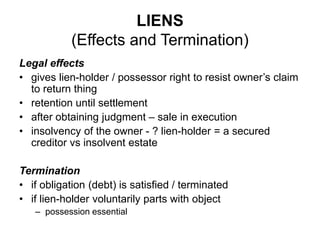
(Effects and Termination)
Legal effects
• gives lien-holder / possessor right to resist owner’s claim
to return thing
• retention until settlement
• after obtaining judgment – sale in execution
• insolvency of the owner - ? lien-holder = a secured
creditor vs insolvent estate
Termination
• if obligation (debt) is satisfied / terminated
• if lien-holder voluntarily parts with object
– possession essential

Lecture 9 sem 2 security contracts_part 2_12 oct 2016

  • 1.
    Security: Part 2 MORTGAGE (General) •= mortgagee (creditor) obtains a limited real right over immovable property belonging to the mortgagor (debtor) or a 3rd party to secure payment of a debt Agreement to mortgage & registration of bond • mortgagor and mortgagee conclude a mortgage contract (which creates mortgage right) • security is constituted by registration of bond in the Deeds Registry • NB – must be in writing (formality)
  • 2.
    MORTGAGE (General) Section 88 ofthe Insolvency Act, 1936 NB • self-study – Nagel par 28.28
  • 3.
    MORTGAGE (Ancillary clauses) Ancillary clauses/ agreement • Pactum commissorium – invalid (as in the case of pledge) • Parate executie – in principle: invalid (contra pledge) – will be valid only where mortgagor’s specific consent to such execution is given again to mortgagee after default in performance
  • 4.
    MORTGAGE (Rights and Duties) Rightsof mortgagee • bond on property includes other accruals (eg building on land) • mortgagor usually remains in possession and retains right of use and enjoyment of property (contra pledge) • possible to have more than 1 bond over same property • conferral of further bonds? need written consent of mortgagee • sale of mortgaged property? bond must be cancelled in Deeds Registry first Duties of mortgagee • if in possession of property? (unlikely) – same duties as pledgee
  • 5.
    MORTGAGES (Types) Special bond overspecified immovable property • agreement registered in Deeds Registry • registered mineral rights & registered leases Kustingsbrief • a bond to secure payment of balance of purchase price iro immovable property • registered simultaneously with transfer of ownership
  • 6.
    MORTGAGES (Types) Kinderbewys • bond passedby surviving spouse over specific immovable property bequeathed to minor child born of the marriage • to secure minor child’s inheritance Covering bond • provides security for debts incurred in the future • usually iro bank overdrafts Bond over movable and immovable incorporeal rights • Self-study: Nagel par 28.39
  • 7.
    MORTGAGES (Types) Notarial bond • “special”or “general” (description of objects of security) • brings about a mortgage over movable property • same principles as mortgage bonds • NB – only special notarial bond provides real security – general notarial bond = mortgagor has no real right iro property – BUT: does give mortgagor statutory preference in insolvency • bond embodied in a deed which must be notarially- executed • bond must be lodged for registration within 3 months of its notarial execution
  • 8.
    CESSION IN SECURITY •debtor (cedent) cedes personal rights to creditor (cessionary) as security for performance of debtor’s oblig • debtor and creditor conclude a cession agreement – cession in securitatem debiti
  • 9.
    HYPOTHECS • operate exlege (vs by agreement) • provide real security BUT dr’s consent is not necessary • Types: – 1) landlord’s tacit hypothec (contract of lease) – 2) credit grantor’s tacit hypothec ito s 84(1) of Insolvency Act, 1936 • CG has hypothec over an object sold on credit by way of an instalment agreement (NCA) • offers protection to CG in event of insolvency of credit receiver/debtor • secures payment of balance of purchase price still owing – 3) By order of court • Self-study: Nagel pars 29.18 – 29.21
  • 10.
    LIENS (General) • = aright of retention NB – where a person in possession of a thing belonging to another has incurred expenses irt that thing (money / labour), he has the right to keep the thing in his possession until he has been reimbursed by the owner • serves as a method for securing reimbursement • Possession = an absolute prerequisite (contra hypothecs) • Types: NB – (a) Debtor / creditor liens (based on contract) – (b) Enrichment liens (based on unjustified enrichment) • Salvage / storage liens • Improvement liens
  • 11.
    LIENS (Types) Debtor / creditorliens • constituted by debtor / creditor relationship • creditor incurs costs based on an agreement with debtor • contractual consent to expenses (express / tacit) • creditor entitled to remain in possession until paid • example - ?
  • 12.
    LIENS (Types) Enrichment liens • inpossession of property & incurred costs w/o consent • lien constituted if owner benefitted / is enriched • property salvaged / stored - ? (= salvage / storage lien) – usually: all costs are recoverable (enrichment) • increase in market value of property due to expenditure? – = improvement lien – amount by which owner is enriched = recoverable – additional costs (labour) - ? • claim of lien-holder limited to: – smaller of: amount of enrichment of def’s estate or amount of impoverishment of pl’s estate – = “double cap” rule of unjustified enrichment
  • 13.
    LIENS (Types of expenses) •Necessary expenses – for preservation and protection of thing – recoverable • Useful expenses – increase market value of thing – recoverable • Luxurious expenses – neither necessary nor useful • recoverable only under DR/CR lien NB
  • 14.
    LIENS (Effects and Termination) Legaleffects • gives lien-holder / possessor right to resist owner’s claim to return thing • retention until settlement • after obtaining judgment – sale in execution • insolvency of the owner - ? lien-holder = a secured creditor vs insolvent estate Termination • if obligation (debt) is satisfied / terminated • if lien-holder voluntarily parts with object – possession essential