GARNISHEE ORDER &
ATTACHMENT ORDER
A Garnishee Order is an order issued by court under
provisions of Order 21, Rule 46 of the Code of Civil Procedure,
1908.
The concept of ‘Garnishment’ has been introduced in civil
procedure code by the amendment Act, 1976 and is a
remarkable piece of legislation.
This term has been derived from the French word ‘garnir‘
which means to warn or to prepare.
In simple words the garnishee is the person who is
liable to pay a debt to a debt to judgment debtor or
to deliver any movable property to him.
Besides Judgment Debtor and decree Holder,
Garnishee is a third person in whose hands debt of
the judgment debtor is kept.
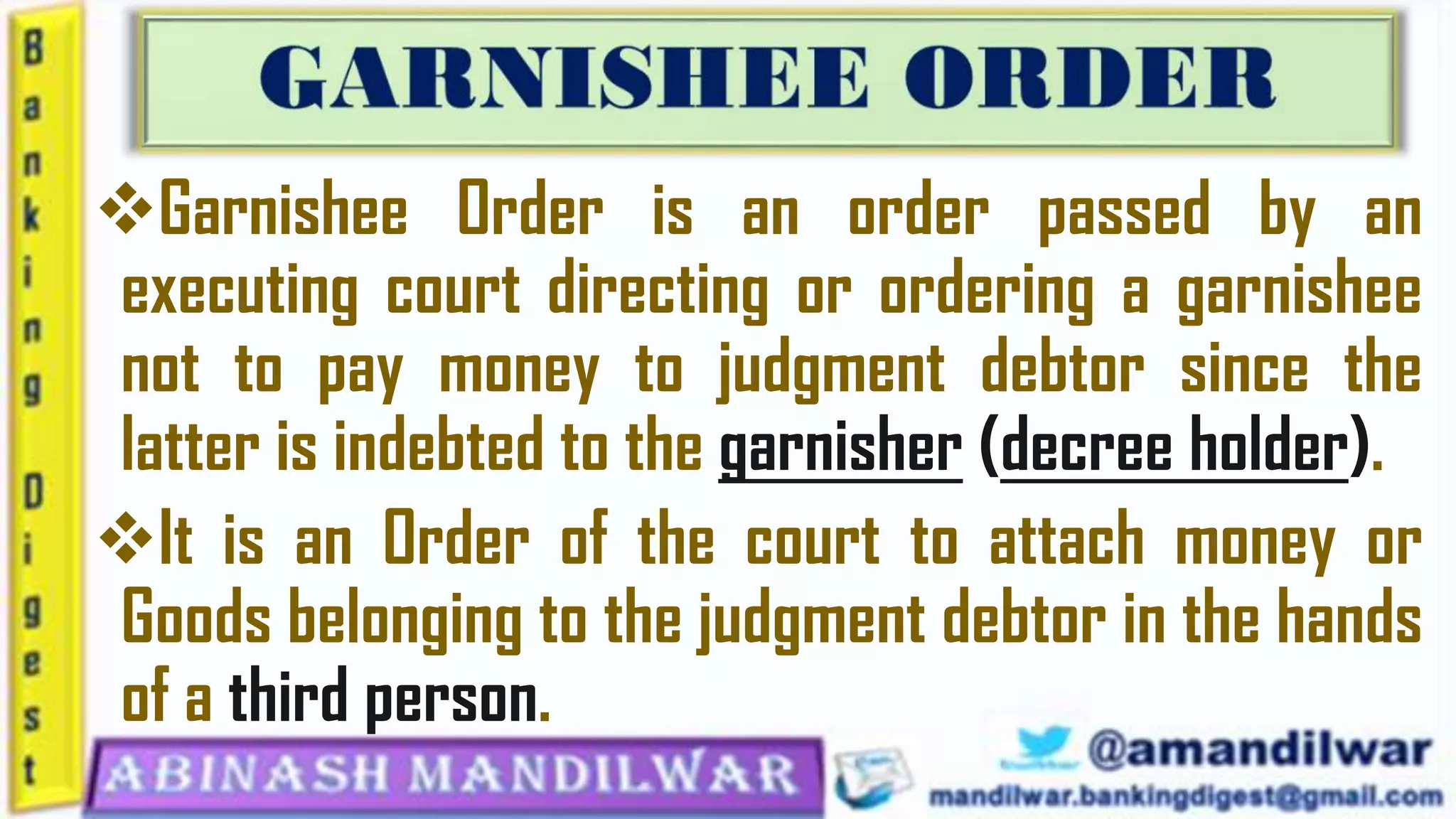
Garnishee Order is an order passed by an
executing court directing or ordering a garnishee
not to pay money to judgment debtor since the
latter is indebted to the garnisher (decree holder).
It is an Order of the court to attach money or
Goods belonging to the judgment debtor in the hands
of a third person.
A default judgement is usually obtained by a creditor either
when a debt has gone unpaid, you haven’t been able to come
to any agreement with the creditor about repaying the debt,
or other alternative debt collection avenues have been
exhausted.
If a garnishee order is made against you, then your bank,
financial institution, or employer will likely be notified rather
than you.
The payment made by the garnishee into the court
pursuant to the notice shall be treated as a valid
discharge to him as against the judgment debtor.
The court may direct that such amount may be paid
to the decree holder towards the satisfaction of the
decree and costs of the execution.
The bank upon whom the order is served is called Garnishee.
The depositor who owes money to another person is called
judgement debtor. Features of the Garnishee Order are as
under;
Garnishee Order applies to existing debts as also debts
accruing due i.e. SB/CD, RD/FD Accounts.
Garnishee Order applies only to those accounts of Judgement
Debtor which have credit balance.
The relationship between bank and judgement debtor is of debtor and
creditor.
Bank is the debtor of Judgement Debtor who is a creditor of the bank.
Garnishee Order does not apply to money deposited subsequent to receipt of
Garnishee Order.
It also does not apply to cheques sent for collection but yet to be realized.
But if credit was allowed in the account before realization with power to
withdraw to customer, Garnishee order will be applicable on this amount.
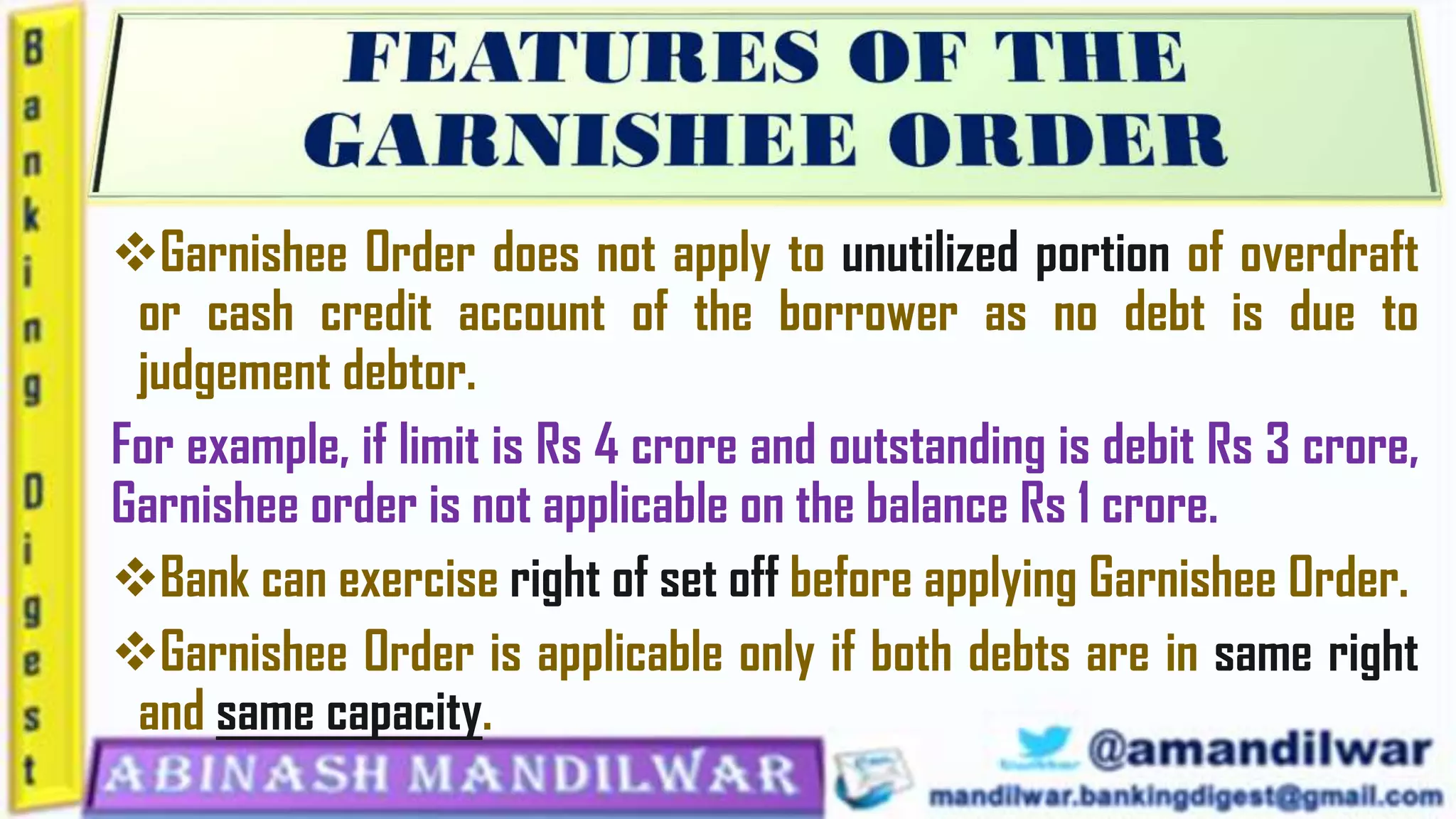
Garnishee Order does not apply to unutilized portion of overdraft
or cash credit account of the borrower as no debt is due to
judgement debtor.
For example, if limit is Rs 4 crore and outstanding is debit Rs 3 crore,
Garnishee order is not applicable on the balance Rs 1 crore.
Bank can exercise right of set off before applying Garnishee Order.
Garnishee Order is applicable only if both debts are in same right
and same capacity.
Garnishee Order issued in a single name does not apply to
accounts in the joint names of judgement debtor with another
person(s).
But if Garnishee Order is issued in joint names, it will apply to
individual accounts also of the same debtors.
When Garnishee Order is in the name of a partner it will not apply
to partnership account but when Garnishee Order is in the name of
firm, accounts of individual partners are covered.
If amount is not specified in the order, then it will be applicable
on the entire balance in the account. However, if it is for specific
amount, the cheques can be paid from the balance available after
setting aside the amount as mentioned in the Garnishee Order.
Not applicable on fixed deposits taken as security for some loan.
If loan given against fixed deposits, applicable on the amount
after adjusting the loan.
Where neither the garnishee makes the payment into the court, as
ordered, nor appears and shows any cause in answer to the notice,
the court may order the garnishee to comply with such notice as if
such order were a decree against him.
The costs of the garnishee proceedings are at the discretion of the
court.
Orders passed in garnishee proceedings are appealable as Decrees.
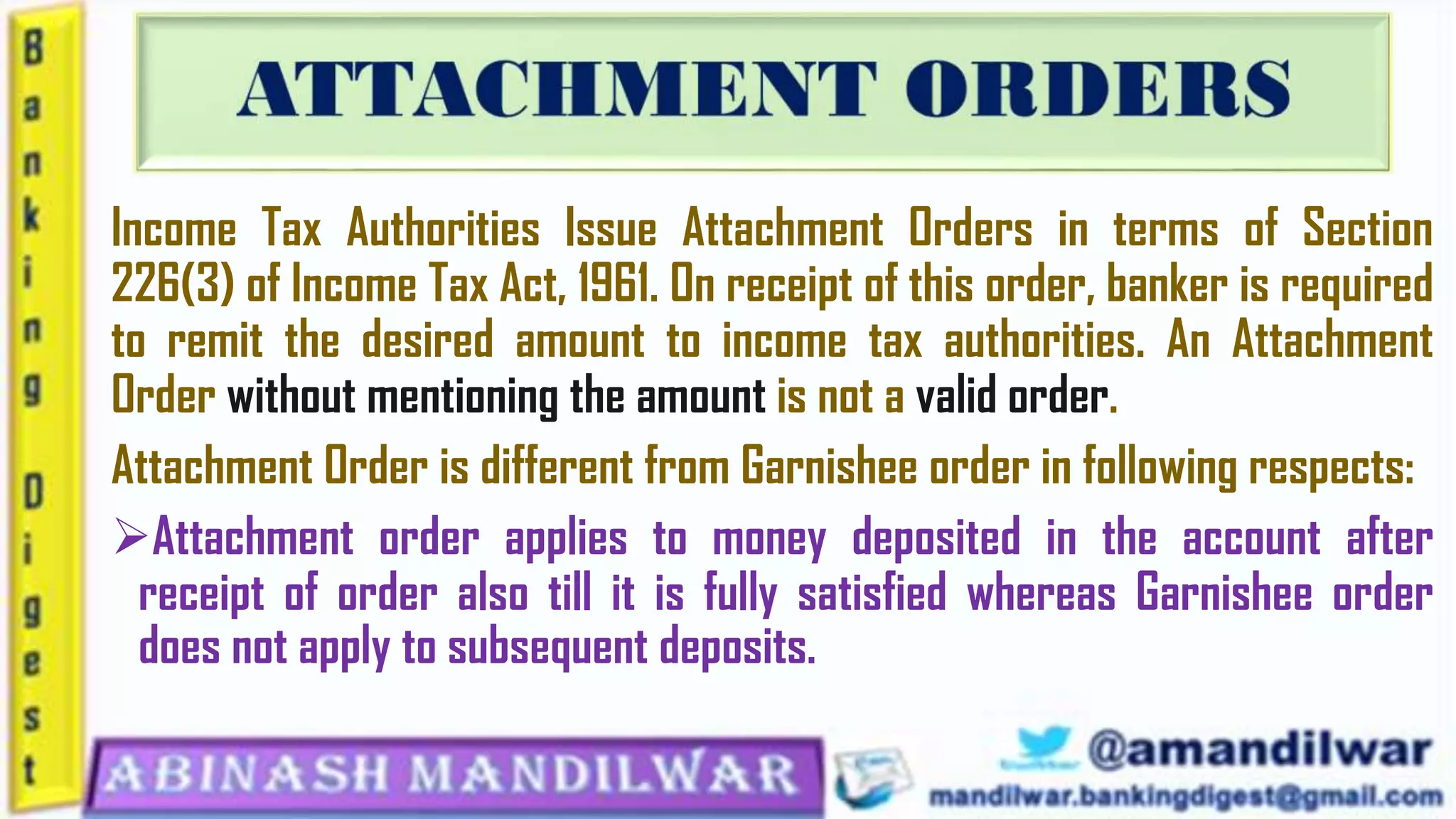
Income Tax Authorities Issue Attachment Orders in terms of Section
226(3) of Income Tax Act, 1961. On receipt of this order, banker is required
to remit the desired amount to income tax authorities. An Attachment
Order without mentioning the amount is not a valid order.
Attachment Order is different from Garnishee order in following respects:
Attachment order applies to money deposited in the account after
receipt of order also till it is fully satisfied whereas Garnishee order
does not apply to subsequent deposits.
Attachment Order in single name applies to joint accounts also
proportionately unless the contrary is proved whereas Garnishee
order in single name does not apply to joint accounts. However, right
of set off is available to bank before applying the order.
In case banker fails to comply with Attachment Order, it will be liable
for the amount of order and deemed as an assesses in default.
When both Garnishee Order and Attachment Order are received
simultaneously, priority should be given to Attachment Order.
COMPARISON OF GARNISHEE ORDER & ATTACHMENT ORDER
Particulars Garnishee Order Attachment Order
Issuing Authority Competent Court of Law Income Tax Department
Under which Act
Order 21, Rule 46 of the Code of
Civil Procedure, 1908.
Section 226(3) of Income Tax
Act, 1961
Depositor called Judgement debtor Assessee
Bank called Judgement debtor’s debtor Assessee debtor
Issued to recover Recover of Private Due Recover of Statutory due
Amount May be mentioned specifically. Mentioned clearly in the Order.
Applicable to
(Amount)
On clear balance available with the
garnishes at time of receipt of
order.
Amount in the account at the
time of receiving order and
future credit also attachable.
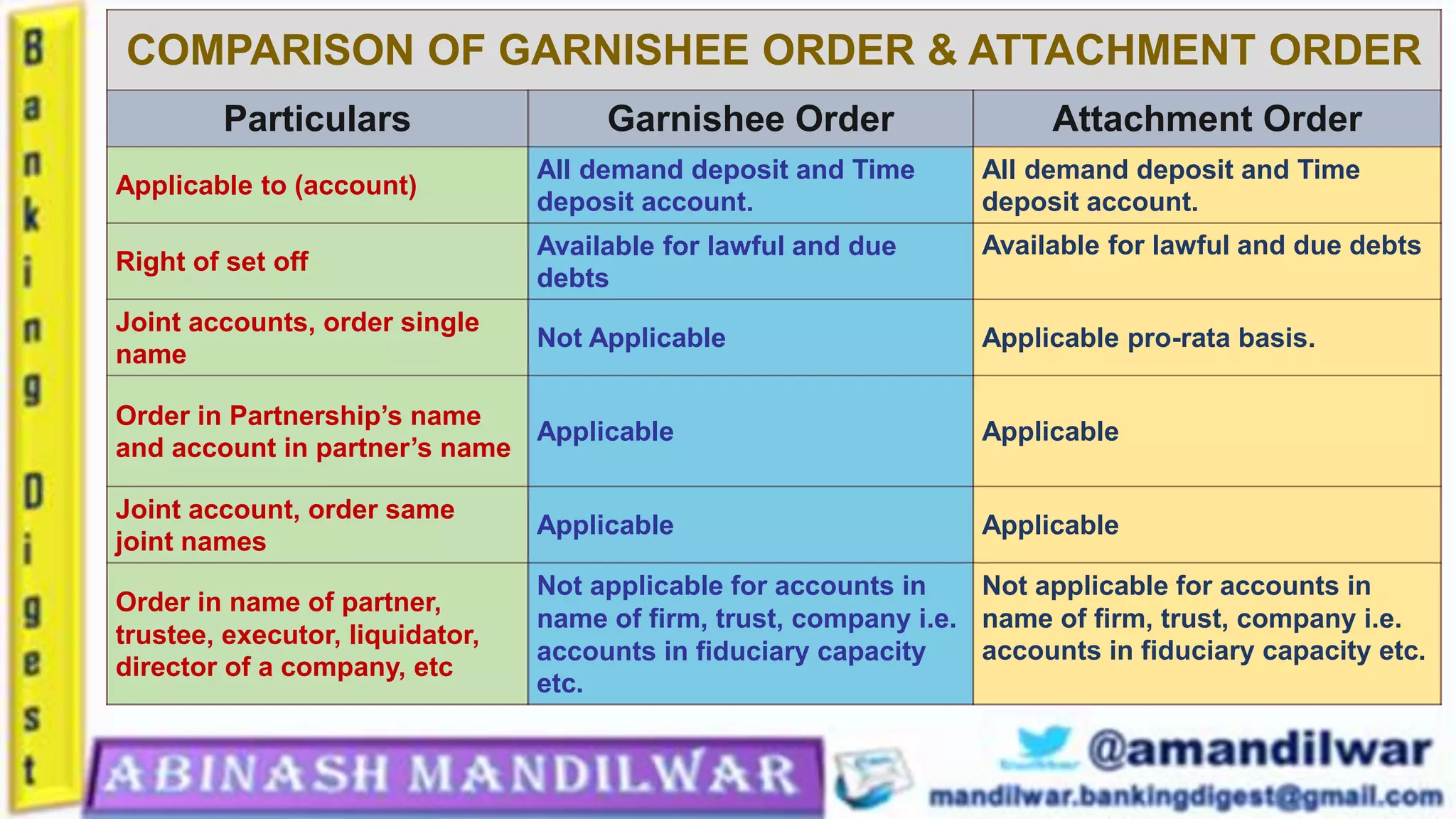
COMPARISON OF GARNISHEE ORDER & ATTACHMENT ORDER
Particulars Garnishee Order Attachment Order
Applicable to (account)
All demand deposit and Time
deposit account.
All demand deposit and Time
deposit account.
Right of set off
Available for lawful and due
debts
Available for lawful and due debts
Joint accounts, order single
name
Not Applicable Applicable pro-rata basis.
Order in Partnership’s name
and account in partner’s name
Applicable Applicable
Joint account, order same
joint names
Applicable Applicable
Order in name of partner,
trustee, executor, liquidator,
director of a company, etc
Not applicable for accounts in
name of firm, trust, company i.e.
accounts in fiduciary capacity
etc.
Not applicable for accounts in
name of firm, trust, company i.e.
accounts in fiduciary capacity etc.
COMPARISON OF GARNISHEE ORDER & ATTACHMENT ORDER
Particulars Garnishee Order Attachment Order
Order in name of
partnership/ company.
Individual Account of partner/
director is attachable.
Individual Account of partner/
director is attachable.
Deceased Applicable. Applicable
Insolvent Not applicable Not applicable
Undrawn CC or OD limit Not applicable Not applicable
FDR as collateral security Not applicable Not applicable
Failure to comply the order Contempt of court Assessee in default
Preference of Order, if
received simultaneously or
is pending for payment
Attachment order will have the
preference over Garnishee Order.
However, bankers right of set-off is
superior.
Attachment order will have the
preference over Garnishee
Order. However, bankers right of
set-off is superior.
GARNISHEE ORDER & ATTACHMENT ORDER.pdf

GARNISHEE ORDER & ATTACHMENT ORDER.pdf

  • 1.
  • 2.
    A Garnishee Orderis an order issued by court under provisions of Order 21, Rule 46 of the Code of Civil Procedure, 1908. The concept of ‘Garnishment’ has been introduced in civil procedure code by the amendment Act, 1976 and is a remarkable piece of legislation. This term has been derived from the French word ‘garnir‘ which means to warn or to prepare.
  • 3.
    In simple wordsthe garnishee is the person who is liable to pay a debt to a debt to judgment debtor or to deliver any movable property to him. Besides Judgment Debtor and decree Holder, Garnishee is a third person in whose hands debt of the judgment debtor is kept.
  • 4.
    Garnishee Order isan order passed by an executing court directing or ordering a garnishee not to pay money to judgment debtor since the latter is indebted to the garnisher (decree holder). It is an Order of the court to attach money or Goods belonging to the judgment debtor in the hands of a third person.
  • 5.
    A default judgementis usually obtained by a creditor either when a debt has gone unpaid, you haven’t been able to come to any agreement with the creditor about repaying the debt, or other alternative debt collection avenues have been exhausted. If a garnishee order is made against you, then your bank, financial institution, or employer will likely be notified rather than you.
  • 6.
    The payment madeby the garnishee into the court pursuant to the notice shall be treated as a valid discharge to him as against the judgment debtor. The court may direct that such amount may be paid to the decree holder towards the satisfaction of the decree and costs of the execution.
  • 7.
    The bank uponwhom the order is served is called Garnishee. The depositor who owes money to another person is called judgement debtor. Features of the Garnishee Order are as under; Garnishee Order applies to existing debts as also debts accruing due i.e. SB/CD, RD/FD Accounts. Garnishee Order applies only to those accounts of Judgement Debtor which have credit balance.
  • 8.
    The relationship betweenbank and judgement debtor is of debtor and creditor. Bank is the debtor of Judgement Debtor who is a creditor of the bank. Garnishee Order does not apply to money deposited subsequent to receipt of Garnishee Order. It also does not apply to cheques sent for collection but yet to be realized. But if credit was allowed in the account before realization with power to withdraw to customer, Garnishee order will be applicable on this amount.
  • 9.
    Garnishee Order doesnot apply to unutilized portion of overdraft or cash credit account of the borrower as no debt is due to judgement debtor. For example, if limit is Rs 4 crore and outstanding is debit Rs 3 crore, Garnishee order is not applicable on the balance Rs 1 crore. Bank can exercise right of set off before applying Garnishee Order. Garnishee Order is applicable only if both debts are in same right and same capacity.
  • 10.
    Garnishee Order issuedin a single name does not apply to accounts in the joint names of judgement debtor with another person(s). But if Garnishee Order is issued in joint names, it will apply to individual accounts also of the same debtors. When Garnishee Order is in the name of a partner it will not apply to partnership account but when Garnishee Order is in the name of firm, accounts of individual partners are covered.
  • 11.
    If amount isnot specified in the order, then it will be applicable on the entire balance in the account. However, if it is for specific amount, the cheques can be paid from the balance available after setting aside the amount as mentioned in the Garnishee Order. Not applicable on fixed deposits taken as security for some loan. If loan given against fixed deposits, applicable on the amount after adjusting the loan.
  • 12.
    Where neither thegarnishee makes the payment into the court, as ordered, nor appears and shows any cause in answer to the notice, the court may order the garnishee to comply with such notice as if such order were a decree against him. The costs of the garnishee proceedings are at the discretion of the court. Orders passed in garnishee proceedings are appealable as Decrees.
  • 13.
    Income Tax AuthoritiesIssue Attachment Orders in terms of Section 226(3) of Income Tax Act, 1961. On receipt of this order, banker is required to remit the desired amount to income tax authorities. An Attachment Order without mentioning the amount is not a valid order. Attachment Order is different from Garnishee order in following respects: Attachment order applies to money deposited in the account after receipt of order also till it is fully satisfied whereas Garnishee order does not apply to subsequent deposits.
  • 14.
    Attachment Order insingle name applies to joint accounts also proportionately unless the contrary is proved whereas Garnishee order in single name does not apply to joint accounts. However, right of set off is available to bank before applying the order. In case banker fails to comply with Attachment Order, it will be liable for the amount of order and deemed as an assesses in default. When both Garnishee Order and Attachment Order are received simultaneously, priority should be given to Attachment Order.
  • 15.
    COMPARISON OF GARNISHEEORDER & ATTACHMENT ORDER Particulars Garnishee Order Attachment Order Issuing Authority Competent Court of Law Income Tax Department Under which Act Order 21, Rule 46 of the Code of Civil Procedure, 1908. Section 226(3) of Income Tax Act, 1961 Depositor called Judgement debtor Assessee Bank called Judgement debtor’s debtor Assessee debtor Issued to recover Recover of Private Due Recover of Statutory due Amount May be mentioned specifically. Mentioned clearly in the Order. Applicable to (Amount) On clear balance available with the garnishes at time of receipt of order. Amount in the account at the time of receiving order and future credit also attachable.
  • 16.
    COMPARISON OF GARNISHEEORDER & ATTACHMENT ORDER Particulars Garnishee Order Attachment Order Applicable to (account) All demand deposit and Time deposit account. All demand deposit and Time deposit account. Right of set off Available for lawful and due debts Available for lawful and due debts Joint accounts, order single name Not Applicable Applicable pro-rata basis. Order in Partnership’s name and account in partner’s name Applicable Applicable Joint account, order same joint names Applicable Applicable Order in name of partner, trustee, executor, liquidator, director of a company, etc Not applicable for accounts in name of firm, trust, company i.e. accounts in fiduciary capacity etc. Not applicable for accounts in name of firm, trust, company i.e. accounts in fiduciary capacity etc.
  • 17.
    COMPARISON OF GARNISHEEORDER & ATTACHMENT ORDER Particulars Garnishee Order Attachment Order Order in name of partnership/ company. Individual Account of partner/ director is attachable. Individual Account of partner/ director is attachable. Deceased Applicable. Applicable Insolvent Not applicable Not applicable Undrawn CC or OD limit Not applicable Not applicable FDR as collateral security Not applicable Not applicable Failure to comply the order Contempt of court Assessee in default Preference of Order, if received simultaneously or is pending for payment Attachment order will have the preference over Garnishee Order. However, bankers right of set-off is superior. Attachment order will have the preference over Garnishee Order. However, bankers right of set-off is superior.