MONITORING DRILLING BIT
           PARAMETERS
             ALLOWS
OPTIMIZATION OF DRILLING RATES

  V.C. KELESSIDIS - P. DALAMARINIS
           vaskel1@hotmail.com
             sk l1@h tm il m
       Technical University of Crete
      Mineral Resources Engineering
               SGEM 2009
         Albena, June 14-19, 2009
Research aim
Optimization of drilling rates
Less expensive and safer drilling practices
Hydrocarbon, geothermal, mining, water well
H d      b      th    l i i        t     ll
drilling
Multitude of parameters affecting drilling
performance
Availability of data and proper modeling
software
Optimum combination      better drilling rates
                                              2
The problem
Drilling allows for access to subsurface
target areas
Pythagoras saying ‘whoever digs, finds, he who
never digs, will never find’
       digs            find
Drilling is expensive
Optimum drilling practice     arrive to target
in the most economical way, but with safety
                            y               y
Main monitoring parameter – Penetration Rate
(m/ )
(m/h)
Depends on two main groups
  Formation
  Drilling parameters                        3
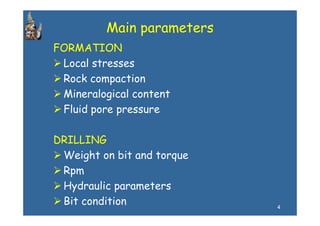
Main parameters
FORMATION
 Local stresses
 Rock compaction
 Mineralogical content
 Flu d
 Fluid pore pressure

DRILLING
 Weight on bit and torque
 Rpm
 Hydraulic parameters
   y        p  m
 Bit condition              4
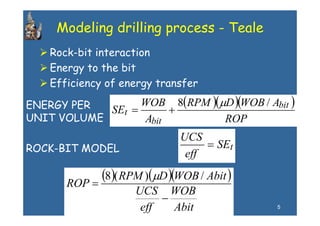
Modeling drilling process - Teale
    Rock-bit interaction
    Energy to the bit
    Efficiency of energy transfer
     ff      y f      gy      f

ENERGY PER        WOB 8(RPM )(μD )(WOB / Abit )
            SEt =      +
UNIT VOLUME       Abit         ROP
                              UCS
ROCK-BIT MODEL                     = SEt
                               eff

       ROP =
             (8)( RPM )(μD )(WOB / Abit )
                     UCS WOB
                          −
                      eff   Abit            5
Payzone simulator
      Developed by G. Cooper, UCB
      Similar to Teale’s model predictions
      Adjustable p
        j         parameters
                      m
      Use of historical data for tuning
                                    SPE 30213 36660
                                         30213,

ROP = ( flow _ factor )(C )(aggressivity )( RPM )(tooth _ length)(G )

            ⎡ ⎛ WOB ⎞ curv ⎛       12              ⎞⎤
G = 1 − exp ⎢− ⎜     ⎟ ⎜ 2 .5                      ⎟⎥
            ⎢ ⎝
            ⎣    UCS ⎠ ⎜ D (0.4 * tooth _ length ) ⎟⎥
                           ⎝                 g ⎠⎦
                                                                6
Comparison of models with lab data


                                     7
Use of historical data


                         8
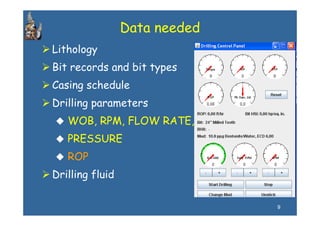
Data needed
Lithology
Bit records and bit types
Casing schedule
Drilling parameters
   WOB, RPM, FLOW RATE,
   PRESSURE
   ROP
Drilling fluid

                               9
Adequate simulation


                      10
Case study analysis
Drilling in Norwegian Continental Shelf
Reconstruct drill time log
1917 – 2414 m
Four main lithologies, 18 formation intervals


                                                11
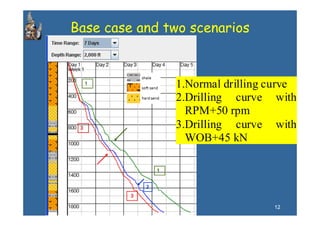
Base case and two scenarios


               1.Normal drilling curve
               2.Drilling curve with
                 RPM+50 rpm
               3.Drilling curve with
                 WOB+45 kN


                                 12
Full scenarios


        1.Base drilling time plot
        1B      d illi ti     l t
        2.Simulated drilling time
          plot b having extra 4.5
           l t by h i       t 45
          tons, extra 50 RPM and
          extra 200 lpm
            t         l


                               13
Increase in UCS by 50%


Increase may range between 58
            y     g
and 96%, giving an overall
increase in total drilling time for
                         g
the sections chosen for the
                                      14
simulation of 82%
Conclusions
Penetration rate – the most sought after
parameter f d i of well d illi
         t for design f      ll drilling
Attempts to simulate the process – none very
successful
Recent advances, flexible simulators that
                 ,f
could be used on site
Payzone,
Payzone is one of them (G Cooper)
                         (G.
Drilling advance model, few adjustable
parameters
Can be tuned via use of prior historical data
from the region and the field
f      th     i    d th fi ld
                                            15
Conclusions
Data: WOB, RPM, Flow, well geometry, drill
bit record, ROP, Lithology
                        gy
Normally monitored – need to monitor in non-
critical wells also
Can be used to effectively model and describe
the drilling process
Re-engineering and re-drilling possible, no
great difficulties
 reat
Increase in WOB, RPM, Flow -> beneficial
effect, need to worry about bi wear
  ff         d          b    bit
Increase (error) of UCS by 50%
                           y        decrease
in ROP by 82%
                                           16

Drill Bit Parameters

  • 1.
    MONITORING DRILLING BIT PARAMETERS ALLOWS OPTIMIZATION OF DRILLING RATES V.C. KELESSIDIS - P. DALAMARINIS vaskel1@hotmail.com sk l1@h tm il m Technical University of Crete Mineral Resources Engineering SGEM 2009 Albena, June 14-19, 2009
  • 2.
    Research aim Optimization ofdrilling rates Less expensive and safer drilling practices Hydrocarbon, geothermal, mining, water well H d b th l i i t ll drilling Multitude of parameters affecting drilling performance Availability of data and proper modeling software Optimum combination better drilling rates 2
  • 3.
    The problem Drilling allowsfor access to subsurface target areas Pythagoras saying ‘whoever digs, finds, he who never digs, will never find’ digs find Drilling is expensive Optimum drilling practice arrive to target in the most economical way, but with safety y y Main monitoring parameter – Penetration Rate (m/ ) (m/h) Depends on two main groups Formation Drilling parameters 3
  • 4.
    Main parameters FORMATION Localstresses Rock compaction Mineralogical content Flu d Fluid pore pressure DRILLING Weight on bit and torque Rpm Hydraulic parameters y p m Bit condition 4
  • 5.
    Modeling drilling process- Teale Rock-bit interaction Energy to the bit Efficiency of energy transfer ff y f gy f ENERGY PER WOB 8(RPM )(μD )(WOB / Abit ) SEt = + UNIT VOLUME Abit ROP UCS ROCK-BIT MODEL = SEt eff ROP = (8)( RPM )(μD )(WOB / Abit ) UCS WOB − eff Abit 5
  • 6.
    Payzone simulator Developed by G. Cooper, UCB Similar to Teale’s model predictions Adjustable p j parameters m Use of historical data for tuning SPE 30213 36660 30213, ROP = ( flow _ factor )(C )(aggressivity )( RPM )(tooth _ length)(G ) ⎡ ⎛ WOB ⎞ curv ⎛ 12 ⎞⎤ G = 1 − exp ⎢− ⎜ ⎟ ⎜ 2 .5 ⎟⎥ ⎢ ⎝ ⎣ UCS ⎠ ⎜ D (0.4 * tooth _ length ) ⎟⎥ ⎝ g ⎠⎦ 6
  • 7.
    Comparison of modelswith lab data 7
  • 8.
  • 9.
    Data needed Lithology Bit recordsand bit types Casing schedule Drilling parameters WOB, RPM, FLOW RATE, PRESSURE ROP Drilling fluid 9
  • 10.
  • 11.
    Case study analysis Drillingin Norwegian Continental Shelf Reconstruct drill time log 1917 – 2414 m Four main lithologies, 18 formation intervals 11
  • 12.
    Base case andtwo scenarios 1.Normal drilling curve 2.Drilling curve with RPM+50 rpm 3.Drilling curve with WOB+45 kN 12
  • 13.
    Full scenarios 1.Base drilling time plot 1B d illi ti l t 2.Simulated drilling time plot b having extra 4.5 l t by h i t 45 tons, extra 50 RPM and extra 200 lpm t l 13
  • 14.
    Increase in UCSby 50% Increase may range between 58 y g and 96%, giving an overall increase in total drilling time for g the sections chosen for the 14 simulation of 82%
  • 15.
    Conclusions Penetration rate –the most sought after parameter f d i of well d illi t for design f ll drilling Attempts to simulate the process – none very successful Recent advances, flexible simulators that ,f could be used on site Payzone, Payzone is one of them (G Cooper) (G. Drilling advance model, few adjustable parameters Can be tuned via use of prior historical data from the region and the field f th i d th fi ld 15
  • 16.
    Conclusions Data: WOB, RPM,Flow, well geometry, drill bit record, ROP, Lithology gy Normally monitored – need to monitor in non- critical wells also Can be used to effectively model and describe the drilling process Re-engineering and re-drilling possible, no great difficulties reat Increase in WOB, RPM, Flow -> beneficial effect, need to worry about bi wear ff d b bit Increase (error) of UCS by 50% y decrease in ROP by 82% 16