Two
Positio
n
Control
TOPIC
2
Two-Position Control Systems
Used in small, relatively simple systems
Controlled device is on or off it is a switch, not a valve
Good for devices that change slowly
A two-position (on-off) controller that actuates when
the manipulated variable reaches the high or low value of its
range (differential gap).
ON-OFF control
ON-OFF control is discontinuous controller.
Known as a two position control
Can be used for simple control loops
Can measured variable including temperature, relative humidity, pressure, current and
liquid levels.
Operate on very simple, switching final controlling elements.
❖Air cond
❖Heater
❖Oven
❖Avr
❖refer
Illustration and explaination the
process
of two position control in heating room
syste
m
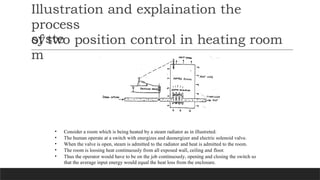
• Consider a room which is being heated by a steam radiator as in illustreted.
• The human operate at a switch with energizes and deenergizer and electric solenoid valve.
• When the valve is open, steam is admitted to the radiator and heat is admitted to the room.
• The room is loosing heat continuously from all exposed wall, ceiling and floor.
• Thus the operator would have to be on the job continuously, opening and closing the switch so
that the average input energy would equal the heat loss from the enclosure.
Simple diagram showing the process two
position
control work.
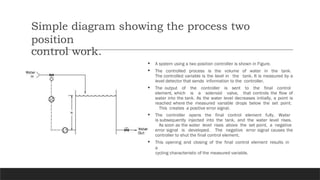
• A system using a two position controller is shown in Figure.
• The controlled process is the volume of water in the tank.
The controlled variable is the level in the tank. It is measured by a
level detector that sends information to the controller.
• The output of the controller is sent to the final control
element, which is a solenoid valve, that controls the flow of
water into the tank. As the water level decreases initially, a point is
reached where the measured variable drops below the set point.
This creates a positive error signal.
• The controller opens the final control element fully. Water
is subsequently injected into the tank, and the water level rises.
As soon as the water level rises above the set point, a negative
error signal is developed. The negative error signal causes the
controller to shut the final control element.
• This opening and closing of the final control element results in
a
cycling characteristic of the measured variable.
TWO (2) types of ON/OFF control
1.Basic Two Position Control
2.Timed Two Position
Control
Basic two position control
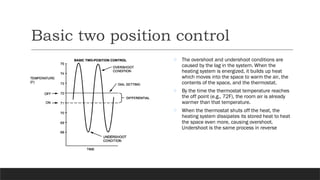
❖ The overshoot and undershoot conditions are
caused by the lag in the system. When the
heating system is energized, it builds up heat
which moves into the space to warm the air, the
contents of the space, and the thermostat.
❖ By the time the thermostat temperature reaches
the off point (e.g., 72F), the room air is already
warmer than that temperature.
❖ When the thermostat shuts off the heat, the
heating system dissipates its stored heat to heat
the space even more, causing overshoot.
Undershoot is the same process in reverse
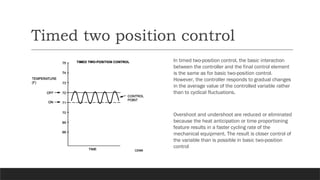
Timed two position control
In timed two-position control, the basic interaction
between the controller and the final control element
is the same as for basic two-position control.
However, the controller responds to gradual changes
in the average value of the controlled variable rather
than to cyclical fluctuations.
Overshoot and undershoot are reduced or eliminated
because the heat anticipation or time proportioning
feature results in a faster cycling rate of the
mechanical equipment. The result is closer control of
the variable than is possible in basic two-position
control
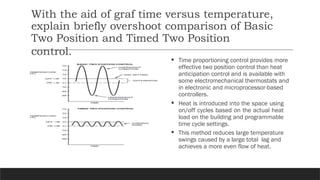
With the aid of graf time versus temperature,
explain briefly overshoot comparison of Basic
Two Position and Timed Two Position
control.
• Time proportioning control provides more
effective two position control than heat
anticipation control and is available with
some electromechanical thermostats and
in electronic and microprocessor-based
controllers.
• Heat is introduced into the space using
on/off cycles based on the actual heat
load on the building and programmable
time cycle settings.
• This method reduces large temperature
swings caused by a large total lag and
achieves a more even flow of heat.
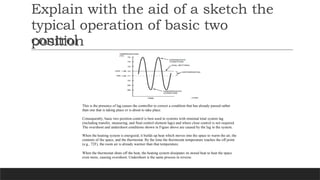
Explain with the aid of a sketch the
typical operation of basic two
position
control
This is the presence of lag causes the controller to correct a condition that has already passed rather
than one that is taking place or is about to take place.
Consequently, basic two position control is best used in systems with minimal total system lag
(including transfer, measuring, and final control element lags) and where close control is not required.
The overshoot and undershoot conditions shown in Figure above are caused by the lag in the system.
When the heating system is energized, it builds up heat which moves into the space to warm the air, the
contents of the space, and the thermostat. By the time the thermostat temperature reaches the off point
(e.g., 72F), the room air is already warmer than that temperature.
When the thermostat shuts off the heat, the heating system dissipates its stored heat to heat the space
even more, causing overshoot. Undershoot is the same process in reverse.
Define the following term
GAIN
Gain, also called sensitivity, compares the
ratio of amount of change in the final control
element to amount of change in the
controlled variable. Mathematically, gain
and sensitivity are reciprocal to
proportional band
OFFSET
Offset, also called droop, is deviation that
remains after a process has stabilized.
Offset is an inherent characteristic of the
proportional mode of control. In other words,
the proportional mode of control will not
necessarily return a controlled variable to its
setpoint
Explain with the aid of a sketch,
the
term definition differential gap
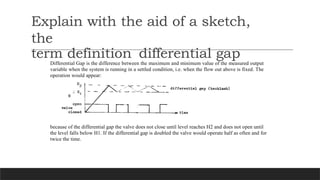
Differential Gap is the difference between the maximum and minimum value of the measured output
variable when the system is running in a settled condition, i.e. when the flow out above is fixed. The
operation would appear:
because of the differential gap the valve does not close until level reaches H2 and does not open until
the level falls below H1. If the differential gap is doubled the valve would operate half as often and for
twice the time.
7
.II!'
Diffe rentia
I
l 70
Space
T mpe atu
Fi re .3: T v Positiem Contro l
Response
eating =
Setpoint ay
d d as 7
w ith
a :2°F d -
er
ntial
Differential Gap in Two-Position
control system
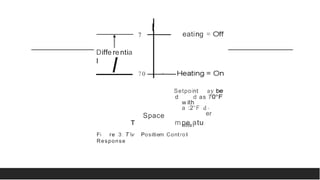
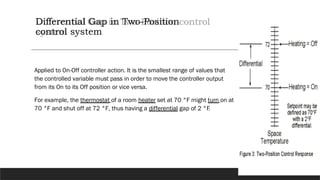
Applied to On-Off controller action. It is the smallest range of values that
the controlled variable must pass in order to move the controller output
from its On to its Off position or vice versa.
For example, the thermostat of a room heater set at 70 °F might turn on at
70 °F and shut off at 72 °F, thus having a differential gap of 2 °F.
Effect of adjusting the differential
adjustment screw
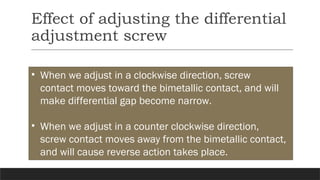
• When we adjust in a clockwise direction, screw
contact moves toward the bimetallic contact, and will
make differential gap become narrow.
• When we adjust in a counter clockwise direction,
screw contact moves away from the bimetallic contact,
and will cause reverse action takes place.
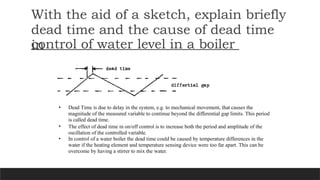
With the aid of a sketch, explain briefly
dead time and the cause of dead time
in
control of water level in a boiler
• Dead Time is due to delay in the system, e.g. to mechanical movement, that causes the
magnitude of the measured variable to continue beyond the differential gap limits. This period
is called dead time.
• The effect of dead time in on/off control is to increase both the period and amplitude of the
oscillation of the controlled variable.
• In control of a water boiler the dead time could be caused by temperature differences in the
water if the heating element and temperature sensing device were too far apart. This can be
overcome by having a stirrer to mix the water.
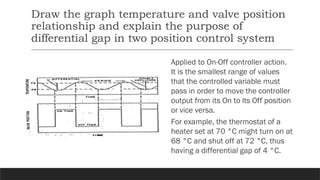
Draw the graph temperature and valve position
relationship and explain the purpose of
differential gap in two position control system
Applied to On-Off controller action.
It is the smallest range of values
that the controlled variable must
pass in order to move the controller
output from its On to its Off position
or vice versa.
For example, the thermostat of a
heater set at 70 °C might turn on at
68 °C and shut off at 72 °C, thus
having a differential gap of 4 °C.

TWO POSITION CONTROL FOR CONTROL ENGINEERING

  • 1.
  • 2.
    Two-Position Control Systems Usedin small, relatively simple systems Controlled device is on or off it is a switch, not a valve Good for devices that change slowly A two-position (on-off) controller that actuates when the manipulated variable reaches the high or low value of its range (differential gap).
  • 3.
    ON-OFF control ON-OFF controlis discontinuous controller. Known as a two position control Can be used for simple control loops Can measured variable including temperature, relative humidity, pressure, current and liquid levels. Operate on very simple, switching final controlling elements.
  • 4.
  • 5.
    Illustration and explainationthe process of two position control in heating room syste m • Consider a room which is being heated by a steam radiator as in illustreted. • The human operate at a switch with energizes and deenergizer and electric solenoid valve. • When the valve is open, steam is admitted to the radiator and heat is admitted to the room. • The room is loosing heat continuously from all exposed wall, ceiling and floor. • Thus the operator would have to be on the job continuously, opening and closing the switch so that the average input energy would equal the heat loss from the enclosure.
  • 6.
    Simple diagram showingthe process two position control work. • A system using a two position controller is shown in Figure. • The controlled process is the volume of water in the tank. The controlled variable is the level in the tank. It is measured by a level detector that sends information to the controller. • The output of the controller is sent to the final control element, which is a solenoid valve, that controls the flow of water into the tank. As the water level decreases initially, a point is reached where the measured variable drops below the set point. This creates a positive error signal. • The controller opens the final control element fully. Water is subsequently injected into the tank, and the water level rises. As soon as the water level rises above the set point, a negative error signal is developed. The negative error signal causes the controller to shut the final control element. • This opening and closing of the final control element results in a cycling characteristic of the measured variable.
  • 7.
    TWO (2) typesof ON/OFF control 1.Basic Two Position Control 2.Timed Two Position Control
  • 8.
    Basic two positioncontrol ❖ The overshoot and undershoot conditions are caused by the lag in the system. When the heating system is energized, it builds up heat which moves into the space to warm the air, the contents of the space, and the thermostat. ❖ By the time the thermostat temperature reaches the off point (e.g., 72F), the room air is already warmer than that temperature. ❖ When the thermostat shuts off the heat, the heating system dissipates its stored heat to heat the space even more, causing overshoot. Undershoot is the same process in reverse
  • 9.
    Timed two positioncontrol In timed two-position control, the basic interaction between the controller and the final control element is the same as for basic two-position control. However, the controller responds to gradual changes in the average value of the controlled variable rather than to cyclical fluctuations. Overshoot and undershoot are reduced or eliminated because the heat anticipation or time proportioning feature results in a faster cycling rate of the mechanical equipment. The result is closer control of the variable than is possible in basic two-position control
  • 10.
    With the aidof graf time versus temperature, explain briefly overshoot comparison of Basic Two Position and Timed Two Position control. • Time proportioning control provides more effective two position control than heat anticipation control and is available with some electromechanical thermostats and in electronic and microprocessor-based controllers. • Heat is introduced into the space using on/off cycles based on the actual heat load on the building and programmable time cycle settings. • This method reduces large temperature swings caused by a large total lag and achieves a more even flow of heat.
  • 11.
    Explain with theaid of a sketch the typical operation of basic two position control This is the presence of lag causes the controller to correct a condition that has already passed rather than one that is taking place or is about to take place. Consequently, basic two position control is best used in systems with minimal total system lag (including transfer, measuring, and final control element lags) and where close control is not required. The overshoot and undershoot conditions shown in Figure above are caused by the lag in the system. When the heating system is energized, it builds up heat which moves into the space to warm the air, the contents of the space, and the thermostat. By the time the thermostat temperature reaches the off point (e.g., 72F), the room air is already warmer than that temperature. When the thermostat shuts off the heat, the heating system dissipates its stored heat to heat the space even more, causing overshoot. Undershoot is the same process in reverse.
  • 12.
    Define the followingterm GAIN Gain, also called sensitivity, compares the ratio of amount of change in the final control element to amount of change in the controlled variable. Mathematically, gain and sensitivity are reciprocal to proportional band OFFSET Offset, also called droop, is deviation that remains after a process has stabilized. Offset is an inherent characteristic of the proportional mode of control. In other words, the proportional mode of control will not necessarily return a controlled variable to its setpoint
  • 13.
    Explain with theaid of a sketch, the term definition differential gap Differential Gap is the difference between the maximum and minimum value of the measured output variable when the system is running in a settled condition, i.e. when the flow out above is fixed. The operation would appear: because of the differential gap the valve does not close until level reaches H2 and does not open until the level falls below H1. If the differential gap is doubled the valve would operate half as often and for twice the time.
  • 14.
    7 .II!' Diffe rentia I l 70 Space Tmpe atu Fi re .3: T v Positiem Contro l Response eating = Setpoint ay d d as 7 w ith a :2°F d - er ntial
  • 15.
    Differential Gap inTwo-Position control system Applied to On-Off controller action. It is the smallest range of values that the controlled variable must pass in order to move the controller output from its On to its Off position or vice versa. For example, the thermostat of a room heater set at 70 °F might turn on at 70 °F and shut off at 72 °F, thus having a differential gap of 2 °F.
  • 16.
    Effect of adjustingthe differential adjustment screw • When we adjust in a clockwise direction, screw contact moves toward the bimetallic contact, and will make differential gap become narrow. • When we adjust in a counter clockwise direction, screw contact moves away from the bimetallic contact, and will cause reverse action takes place.
  • 17.
    With the aidof a sketch, explain briefly dead time and the cause of dead time in control of water level in a boiler • Dead Time is due to delay in the system, e.g. to mechanical movement, that causes the magnitude of the measured variable to continue beyond the differential gap limits. This period is called dead time. • The effect of dead time in on/off control is to increase both the period and amplitude of the oscillation of the controlled variable. • In control of a water boiler the dead time could be caused by temperature differences in the water if the heating element and temperature sensing device were too far apart. This can be overcome by having a stirrer to mix the water.
  • 18.
    Draw the graphtemperature and valve position relationship and explain the purpose of differential gap in two position control system Applied to On-Off controller action. It is the smallest range of values that the controlled variable must pass in order to move the controller output from its On to its Off position or vice versa. For example, the thermostat of a heater set at 70 °C might turn on at 68 °C and shut off at 72 °C, thus having a differential gap of 4 °C.