
Welcome!!
Siraj Munir – CS@DSU
Introduction To Turing Machine
Siraj Munir – CS@DSU
Tip of The Day
discourager.ignore();
(Courtesy: Syed Hammad Ahmed – CS@DSU)
Background
Siraj Munir – CS@DSU
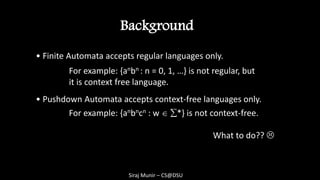
Background
• Finite Automata accepts regular languages only.
For example: {anbn : n = 0, 1, …} is not regular, but
it is context free language.
• Pushdown Automata accepts context-free languages only.
For example: {anbncn : w  *} is not context-free.
What to do?? 
Siraj Munir – CS@DSU
Turing Machines
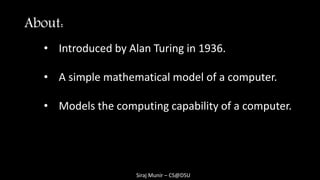
About:
• Introduced by Alan Turing in 1936.
• A simple mathematical model of a computer.
• Models the computing capability of a computer.
Siraj Munir – CS@DSU
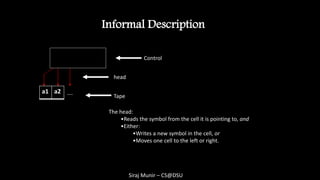
a1 a2 ….
Control
head
Tape
Informal Description
The head:
•Reads the symbol from the cell it is pointing to,
•Either:
•Writes a new symbol in the cell, or
•Moves one cell to the left or right.
Siraj Munir – CS@DSU
Informal Description (II)
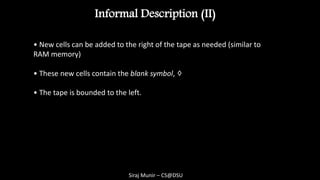
• New cells can be added to the right of the tape as needed (similar to
RAM memory)
• These new cells contain the blank symbol, ♢
1q 2q
Rba ,
............    ca
Time 1
1q
current state

Siraj Munir – CS@DSU
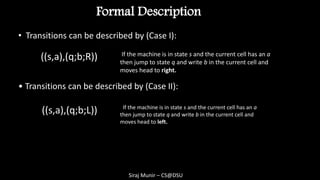
• Transitions can be described by (Case I):
((s,a),(q;b;R)) If the machine is in state s and the current cell has an a
then jump to state q and write b in the current cell and
moves head to right.
Formal Description
• Transitions can be described by (Case II):
((s,a),(q;b;L)) If the machine is in state s and the current cell has an a
then jump to state q and write b in the current cell and
moves head to left.
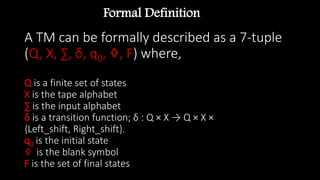
A TM can be formally described as a 7-tuple
(Q, X, ∑, δ, q0, ♢, F) where,
Q is a finite set of states
X is the tape alphabet
∑ is the input alphabet
δ is a transition function; δ : Q × X → Q × X ×
{Left_shift, Right_shift}.
q0 is the initial state
♢ is the blank symbol
F is the set of final states
Formal Definition
Siraj Munir – CS@DSU
Comparison with Previous Models
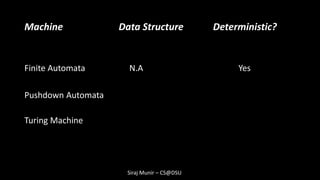
Machine Data Structure Deterministic?
Finite Automata N.A Yes
Pushdown Automata
Turing Machine
Siraj Munir – CS@DSU
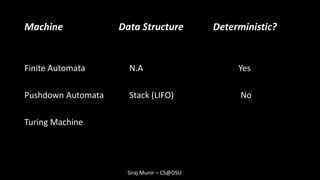
Machine Data Structure Deterministic?
Finite Automata N.A Yes
Pushdown Automata Stack (LIFO) No
Turing Machine
Siraj Munir – CS@DSU
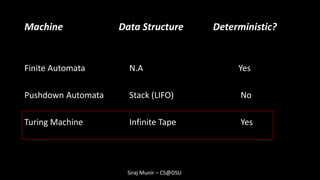
Machine Data Structure Deterministic?
Finite Automata N.A Yes
Pushdown Automata Stack (LIFO) No
Turing Machine Infinite Tape Yes
Siraj Munir – CS@DSU
Comparison with Previous Models
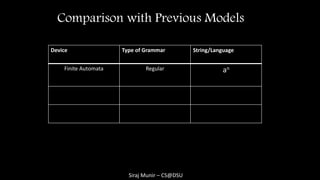
Device Type of Grammar String/Language
Finite Automata Regular an
Siraj Munir – CS@DSU
Comparison with Previous Models
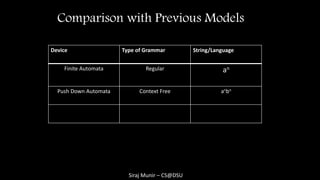
Device Type of Grammar String/Language
Finite Automata Regular an
Push Down Automata Context Free anbn
Siraj Munir – CS@DSU
Comparison with Previous Models
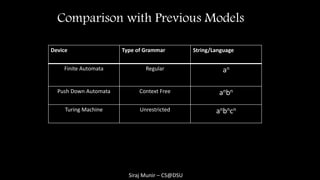
Device Type of Grammar String/Language
Finite Automata Regular an
Push Down Automata Context Free anbn
Turing Machine Unrestricted anbncn
Siraj Munir – CS@DSU
Questions??
Siraj Munir – CS@DSU
Reference:
http://www.slideshare.net/abhishiv77/push-down-automata-
vs-turing-machine
http://www.slideshare.net/AyAnKhAn5/turing-machine-
34338253
http://www.slideshare.net/dkalita3/turing-machine-bydeep
http://www.slideshare.net/lavishka_anuj/turing-machines-
12176328
https://en.wikipedia.org/wiki/Turing_machine
Siraj Munir – CS@DSU
Thankyou!

Introduction to Turing Machine

  • 1.
  • 2.
    Introduction To TuringMachine Siraj Munir – CS@DSU
  • 3.
    Tip of TheDay discourager.ignore(); (Courtesy: Syed Hammad Ahmed – CS@DSU)
  • 4.
  • 5.
    Background • Finite Automataaccepts regular languages only. For example: {anbn : n = 0, 1, …} is not regular, but it is context free language. • Pushdown Automata accepts context-free languages only. For example: {anbncn : w  *} is not context-free. What to do??  Siraj Munir – CS@DSU
  • 6.
  • 7.
    About: • Introduced byAlan Turing in 1936. • A simple mathematical model of a computer. • Models the computing capability of a computer. Siraj Munir – CS@DSU
  • 8.
    Siraj Munir –CS@DSU a1 a2 …. Control head Tape Informal Description The head: •Reads the symbol from the cell it is pointing to, •Either: •Writes a new symbol in the cell, or •Moves one cell to the left or right.
  • 9.
    Siraj Munir –CS@DSU Informal Description (II) • New cells can be added to the right of the tape as needed (similar to RAM memory) • These new cells contain the blank symbol, ♢ 1q 2q Rba , ............    ca Time 1 1q current state 
  • 10.
    Siraj Munir –CS@DSU • Transitions can be described by (Case I): ((s,a),(q;b;R)) If the machine is in state s and the current cell has an a then jump to state q and write b in the current cell and moves head to right. Formal Description • Transitions can be described by (Case II): ((s,a),(q;b;L)) If the machine is in state s and the current cell has an a then jump to state q and write b in the current cell and moves head to left.
  • 11.
    A TM canbe formally described as a 7-tuple (Q, X, ∑, δ, q0, ♢, F) where, Q is a finite set of states X is the tape alphabet ∑ is the input alphabet δ is a transition function; δ : Q × X → Q × X × {Left_shift, Right_shift}. q0 is the initial state ♢ is the blank symbol F is the set of final states Formal Definition
  • 12.
    Siraj Munir –CS@DSU Comparison with Previous Models
  • 13.
    Machine Data StructureDeterministic? Finite Automata N.A Yes Pushdown Automata Turing Machine Siraj Munir – CS@DSU
  • 14.
    Machine Data StructureDeterministic? Finite Automata N.A Yes Pushdown Automata Stack (LIFO) No Turing Machine Siraj Munir – CS@DSU
  • 15.
    Machine Data StructureDeterministic? Finite Automata N.A Yes Pushdown Automata Stack (LIFO) No Turing Machine Infinite Tape Yes Siraj Munir – CS@DSU
  • 16.
    Siraj Munir –CS@DSU Comparison with Previous Models Device Type of Grammar String/Language Finite Automata Regular an
  • 17.
    Siraj Munir –CS@DSU Comparison with Previous Models Device Type of Grammar String/Language Finite Automata Regular an Push Down Automata Context Free anbn
  • 18.
    Siraj Munir –CS@DSU Comparison with Previous Models Device Type of Grammar String/Language Finite Automata Regular an Push Down Automata Context Free anbn Turing Machine Unrestricted anbncn
  • 19.
    Siraj Munir –CS@DSU Questions??
  • 20.
    Siraj Munir –CS@DSU Reference: http://www.slideshare.net/abhishiv77/push-down-automata- vs-turing-machine http://www.slideshare.net/AyAnKhAn5/turing-machine- 34338253 http://www.slideshare.net/dkalita3/turing-machine-bydeep http://www.slideshare.net/lavishka_anuj/turing-machines- 12176328 https://en.wikipedia.org/wiki/Turing_machine
  • 21.
    Siraj Munir –CS@DSU Thankyou!