Turbine Blades
Terry Andersen
Nathan Stastny
ME 372
Brigham Young University
Fall 2001
Overview
• Applications
• Design Considerations
• Material Considerations
• Manufacturing Processes
• Review
• Questions
Applications
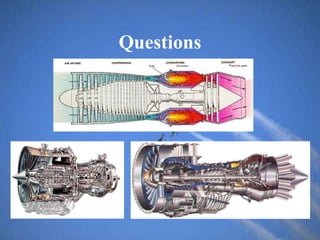
• Gas Turbine Generators
• Jet Engines
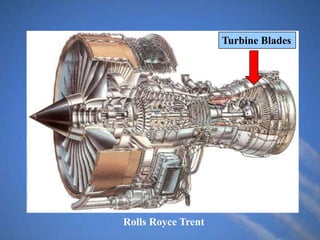
Rolls Royce
Rolls Royce Trent
Turbine Blades
Design Considerations
• Geometry
• Cooling Vanes
• Attachment Interface
• Safety Factors
Geometry
• Strength / Fatigue Life
• Each row will be different
• Air Flow (CFD Package)
• Machineability
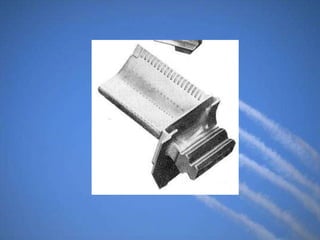
General Turbine Blade Shape
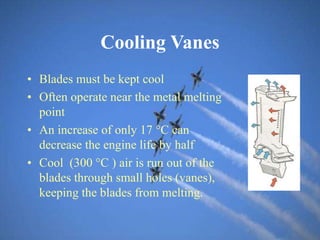
Cooling Vanes
• Blades must be kept cool
• Often operate near the metal melting
point
• An increase of only 17 C can
decrease the engine life by half
• Cool (300 C ) air is run out of the
blades through small holes (vanes),
keeping the blades from melting.
Pic
Attachment
• Keep Stress Concentrations Low
• “Fir Tree” Attachment
– Reduced stress
concentrations
– Easy replacement
– Also known as the
“Christmas Tree”
Safety Factors
• Higher S.F. is usually the best.
• But what if the engine runs out of control at
speeds higher than intended?
• The energy of the rotating blades goes up with ω2
• What happens if the blades brake at 10%
overload? 20%, 30%, 40%, 50% ?
• Too much energy and the blades might break
through the engine shroud and into the fuselage.
Quick Video
Boeing 777
Engine Test
Material Considerations
• Environment
• Creep
• Current Materials Used
• Materials In Research
Environment
• Air Temperature: Between 850 and 1600 °C
• Melting Temperature:
– Steel:1400C
– Nickel Alloy: 1200C
– Titanium:1650C
• Turbine RPM: Appx. 20,000 rpm
Creep
• Turbine blades elongate during their life
• Tip clearance
• Result of environment and grain structure
• Soft “abradable” lining
• Directional solidification (cooling)
• Single crystal structure
Current Materials Used
• Initially Steel
• Nickel Alloys
• Most common material is Titanium
• Laser peening
• Ceramic Coatings
Material In Research
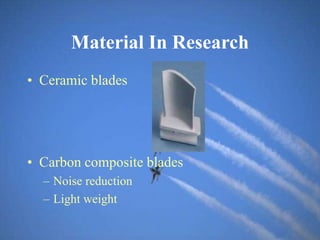
• Ceramic blades
• Carbon composite blades
– Noise reduction
– Light weight
Manufacturing Processes
• Machining (not too common)
• Investment Casting
– Secondary machining
• Electro-Chemical Machining
– Single operation
Design Sites
1. www.pccsmp.com (manufacturing)
2. www.turboblades.com (manufacturing)
3. www.giverin.demon.co.uk/NewFiles/HT
WTurbines.html (information)
4. www.gas-turbines.com/begin (information)
5. www.pratt-whitney.com (engine manufacturer)
Review
• Applications:
– Jet Engines
– Gas Turbine Generators
• Design Factors:
– Geometry
– S.F.
• Materials:
– Very high temperatures
– Titanium
• Manufacturing:
Questions
Terry
Nathan
Dr. Chase
Squadron Commander
Special thanks to all
those who didn’t
believe in us, but whom
we’ve proved wrong.

Turbine_Blades.ppt