Turbo Chargers

   Class 2 Motor
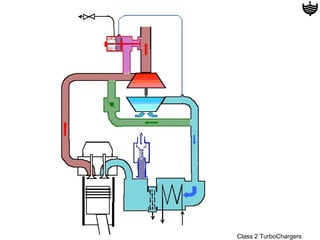
Advantages Of Increased Scavenge Pressure:

• Increased power for similar sized engines

• Reduced SFOC : ‑ Mechanical, scavenge and thermal
  efficiencies are improved due to less cylinders, greater air
  supply and use of exhaust gases respectively.

• Cheaper engine: ‑ Smaller for required output power.

• Thermal load reduced: ‑ due to less exacting cylinder
  conditions


                                                    Class 2 TurboChargers
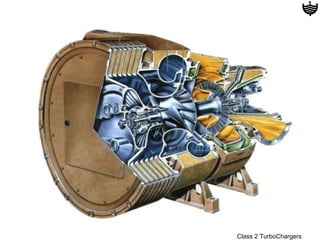
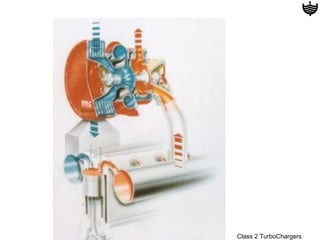
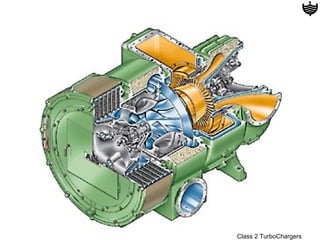
Advantages Of Turbo-charger

•   Smaller and lighter than mechanical blower
•   Less moving parts
•   No drive required from engine
•   Can easily deliver the large quantities of air required
•   Increases thermal efficiency.


                                               Class 2 TurboChargers
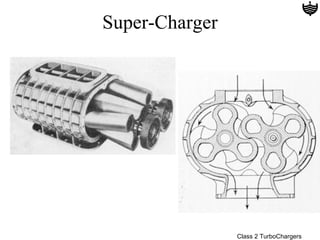
Super-Charger


                Class 2 TurboChargers
Class 2 TurboChargers
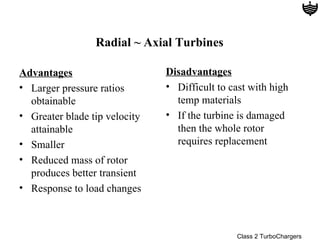
Radial ~ Axial Turbines

Advantages                     Disadvantages
• Larger pressure ratios       • Difficult to cast with high
  obtainable                     temp materials
• Greater blade tip velocity   • If the turbine is damaged
  attainable                     then the whole rotor
• Smaller                        requires replacement
• Reduced mass of rotor
  produces better transient
• Response to load changes


                                               Class 2 TurboChargers
Class 2 TurboChargers
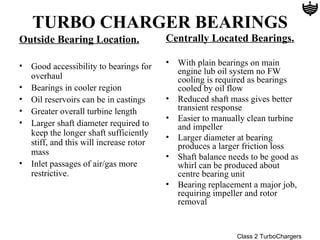
TURBO CHARGER BEARINGS
Outside Bearing Location.               Centrally Located Bearings.

• Good accessibility to bearings for    •   With plain bearings on main
                                            engine lub oil system no FW
  overhaul                                  cooling is required as bearings
• Bearings in cooler region                 cooled by oil flow
• Oil reservoirs can be in castings     •   Reduced shaft mass gives better
• Greater overall turbine length            transient response
                                        •   Easier to manually clean turbine
• Larger shaft diameter required to         and impeller
  keep the longer shaft sufficiently    •   Larger diameter at bearing
  stiff, and this will increase rotor       produces a larger friction loss
  mass                                  •   Shaft balance needs to be good as
• Inlet passages of air/gas more            whirl can be produced about
  restrictive.                              centre bearing unit
                                        •   Bearing replacement a major job,
                                            requiring impeller and rotor
                                            removal


                                                            Class 2 TurboChargers
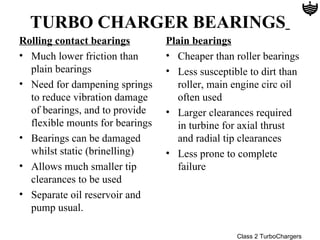
TURBO CHARGER BEARINGS
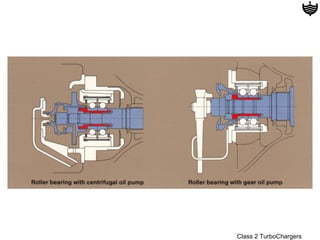
Rolling contact bearings         Plain bearings
• Much lower friction than       • Cheaper than roller bearings
  plain bearings                 • Less susceptible to dirt than
• Need for dampening springs       roller, main engine circ oil
  to reduce vibration damage       often used
  of bearings, and to provide    • Larger clearances required
  flexible mounts for bearings     in turbine for axial thrust
• Bearings can be damaged          and radial tip clearances
  whilst static (brinelling)     • Less prone to complete
• Allows much smaller tip          failure
  clearances to be used
• Separate oil reservoir and
  pump usual.

                                                 Class 2 TurboChargers
TURBO CHARGER VIBRATION
Gradual increase in vibration   Sudden increase in vibration
  could be due to:                could be due to:
• Worn damping springs in       • Washing removing only part
  roller bearings                 of the rotor dirt
• Ineffective mounting bolts    • Blade damage from
• Uneven fouling                  mechanical item striking
• Failure of damping wire         rotor blades
                                • Bearing failure
Vibration after overhaul        • Water striking rotor from
  could be due to:                casing leak
• Incomplete cleaning
• Misalignment of rotating
  parts


                                              Class 2 TurboChargers
RUNNING WITH DAMAGE
•   Damaged Rotor                             Damaged Casing
•   lock rotor – pulse system lock both       • Blank off cooling flow to affected
    ends as full gas flow must still pass       casing
    through turbine                           • Remove covers and direct
•   Insert blanks – air side only for pulse     scavenge air or air from vent fan
    system, both sides for constant             into open casing to assist in
    pressure system. Blanks must have           cooling
    orifice to allow air flow to              • Monitor oil temperature and
    compressor for cooling and sealing,         adjust load / rpm to ensure that
    to allow gas flow to prevent cold end       temperature does not go above
    corrosion                                   90°C
•   Run at reduced load/revs using
    exhaust temps as load limiter (never
    above 500°C). The following is used
    as a guide by MAN B & W
    (constant pressure T/C)
CUT OUT       % POWER         % M/E REVS
1 of 1 T/C        15                 53
1 of 2 T/C        50                 70
1 of 3 T/C        66                 87

                                                                 Class 2 TurboChargers
TURBOCHARGER REDUCED AIR
  DELIVERY
• Drop in ambient pressure
• Reduction in engine load
• Change in fuel quality
• Change in engine timing
• Fouling of air intake filter
• Fouling of inducer/diffuser
• Fouling of air side of charger air
  cooler
• Fouling of exhaust ports and
  pipework
• Fouling of protection grid
• Fouling of nozzle ring, turbine
  blades
• Fouling of exhaust gas boiler
• Fouling of silencer
• Mechanical damage to rotor
• Casing or piping leaks


                                       Class 2 TurboChargers
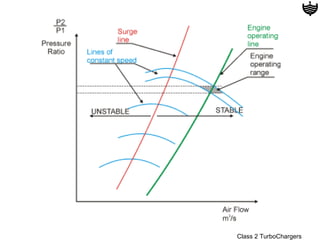
Reasons For Turbo Charger Surging
•   Rapid Change In Load
     – Fluctuations due to rough weather, will cause variations in air mass flow rate due to
         change in engine speed.
•   Insufficient Supply Of Fuel
     – This can cause the engine speed to vary due to fuel starvation. Produces similar result as
         above.
•   Fault In Fuel System
     – Due to incorrect settings, timing of fuel pumps, or sticking fuel pump barrels, etc, result
         in different combustion conditions for individual cylinders. This can lead to variation in
         turbocharger speeds and air mass flow rates (pulse system).
•   Restriction Of Scavenge Passages
     – Blockage of air filters, will cause pressure ratio across compressor to increase and reduce
         airflow rates. Operating line of turbocharger moves closer to the surge line.
•   Narrowed Exhaust Gas Passages (After Turbo)
     – An extreme increase in resistance of the exhaust gas discharge passage will result in the
         reduction of airflow through the compressor.
•   Engine Operation At Overload
     – If the engine speed is maintained constant after fouling of the hull or damage to the
         propeller turbocharger speed will increase without an increase in air mass flow.
         Reduction in surge margin.
•   Failure Of Turbine Blade, Nozzle Or Diffuser
     – Fouling or damage to the above will result in increased resistance to gas flow and reduce
         airflow into the engine.


                                                                             Class 2 TurboChargers
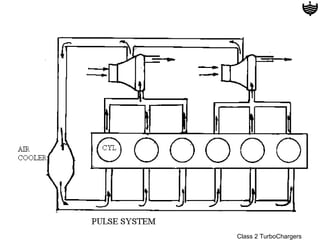
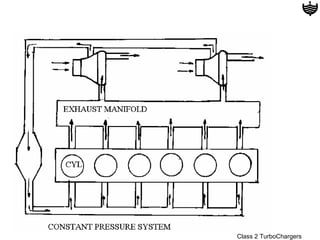
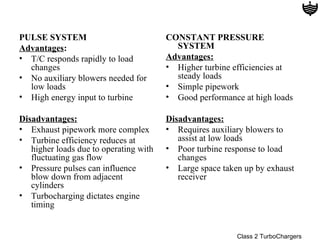
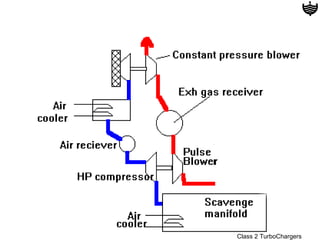
PULSE SYSTEM                            CONSTANT PRESSURE
Advantages:                               SYSTEM
• T/C responds rapidly to load          Advantages:
  changes                               • Higher turbine efficiencies at
• No auxiliary blowers needed for         steady loads
  low loads                             • Simple pipework
• High energy input to turbine          • Good performance at high loads

Disadvantages:                          Disadvantages:
• Exhaust pipework more complex         • Requires auxiliary blowers to
• Turbine efficiency reduces at            assist at low loads
   higher loads due to operating with   • Poor turbine response to load
   fluctuating gas flow                    changes
• Pressure pulses can influence         • Large space taken up by exhaust
   blow down from adjacent                 receiver
   cylinders
• Turbocharging dictates engine
   timing


                                                          Class 2 TurboChargers
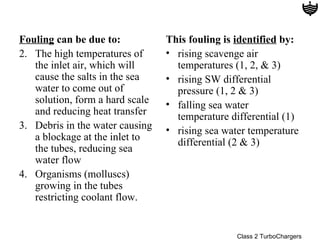
Fouling can be due to:           This fouling is identified by:
2. The high temperatures of      • rising scavenge air
   the inlet air, which will       temperatures (1, 2, & 3)
   cause the salts in the sea    • rising SW differential
   water to come out of            pressure (1, 2 & 3)
   solution, form a hard scale   • falling sea water
   and reducing heat transfer      temperature differential (1)
3. Debris in the water causing   • rising sea water temperature
   a blockage at the inlet to      differential (2 & 3)
   the tubes, reducing sea
   water flow
4. Organisms (molluscs)
   growing in the tubes
   restricting coolant flow.


                                                 Class 2 TurboChargers
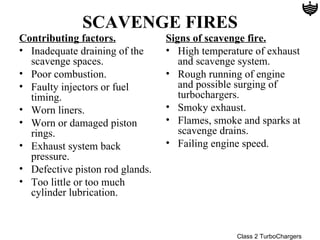
SCAVENGE FIRES
Contributing factors.            Signs of scavenge fire.
• Inadequate draining of the     • High temperature of exhaust
  scavenge spaces.                  and scavenge system.
• Poor combustion.               • Rough running of engine
• Faulty injectors or fuel          and possible surging of
  timing.                           turbochargers.
• Worn liners.                   • Smoky exhaust.
• Worn or damaged piston         • Flames, smoke and sparks at
  rings.                            scavenge drains.
• Exhaust system back            • Failing engine speed.
  pressure.
• Defective piston rod glands.
• Too little or too much
  cylinder lubrication.


                                                Class 2 TurboChargers
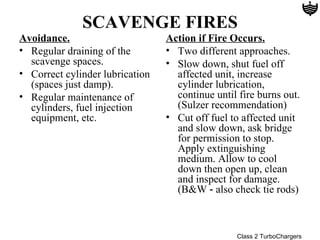
SCAVENGE FIRES
Avoidance.                       Action if Fire Occurs.
• Regular draining of the        • Two different approaches.
  scavenge spaces.               • Slow down, shut fuel off
• Correct cylinder lubrication     affected unit, increase
  (spaces just damp).              cylinder lubrication,
• Regular maintenance of           continue until fire burns out.
  cylinders, fuel injection        (Sulzer recommendation)
  equipment, etc.                • Cut off fuel to affected unit
                                   and slow down, ask bridge
                                   for permission to stop.
                                   Apply extinguishing
                                   medium. Allow to cool
                                   down then open up, clean
                                   and inspect for damage.
                                   (B&W ‑ also check tie rods)


                                                  Class 2 TurboChargers
Class 2 TurboChargers
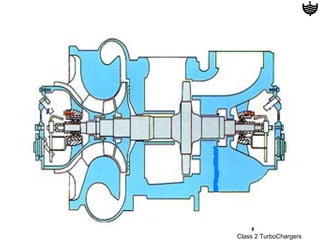
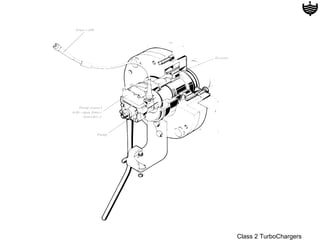
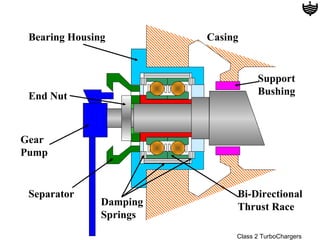
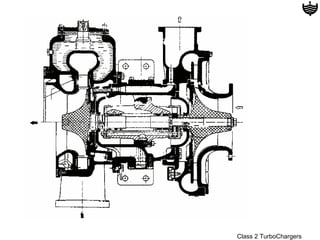
Bearing Housing         Casing


                                    Support
 End Nut                            Bushing


Gear
Pump


 Separator                    Bi-Directional
               Damping        Thrust Race
               Springs
                              Class 2 TurboChargers

Turbo chargers

  • 1.
    Turbo Chargers Class 2 Motor
  • 2.
    Advantages Of IncreasedScavenge Pressure: • Increased power for similar sized engines • Reduced SFOC : ‑ Mechanical, scavenge and thermal efficiencies are improved due to less cylinders, greater air supply and use of exhaust gases respectively. • Cheaper engine: ‑ Smaller for required output power. • Thermal load reduced: ‑ due to less exacting cylinder conditions Class 2 TurboChargers
  • 3.
    Advantages Of Turbo-charger • Smaller and lighter than mechanical blower • Less moving parts • No drive required from engine • Can easily deliver the large quantities of air required • Increases thermal efficiency. Class 2 TurboChargers
  • 4.
    Super-Charger Class 2 TurboChargers
  • 5.
  • 6.
  • 7.
  • 8.
  • 9.
  • 10.
  • 11.
    Radial ~ AxialTurbines Advantages Disadvantages • Larger pressure ratios • Difficult to cast with high obtainable temp materials • Greater blade tip velocity • If the turbine is damaged attainable then the whole rotor • Smaller requires replacement • Reduced mass of rotor produces better transient • Response to load changes Class 2 TurboChargers
  • 12.
  • 13.
  • 14.
  • 15.
  • 16.
  • 17.
  • 18.
  • 19.
  • 20.
  • 21.
  • 22.
  • 23.
  • 24.
  • 25.
  • 26.
    TURBO CHARGER BEARINGS OutsideBearing Location. Centrally Located Bearings. • Good accessibility to bearings for • With plain bearings on main engine lub oil system no FW overhaul cooling is required as bearings • Bearings in cooler region cooled by oil flow • Oil reservoirs can be in castings • Reduced shaft mass gives better • Greater overall turbine length transient response • Easier to manually clean turbine • Larger shaft diameter required to and impeller keep the longer shaft sufficiently • Larger diameter at bearing stiff, and this will increase rotor produces a larger friction loss mass • Shaft balance needs to be good as • Inlet passages of air/gas more whirl can be produced about restrictive. centre bearing unit • Bearing replacement a major job, requiring impeller and rotor removal Class 2 TurboChargers
  • 27.
    TURBO CHARGER BEARINGS Rollingcontact bearings Plain bearings • Much lower friction than • Cheaper than roller bearings plain bearings • Less susceptible to dirt than • Need for dampening springs roller, main engine circ oil to reduce vibration damage often used of bearings, and to provide • Larger clearances required flexible mounts for bearings in turbine for axial thrust • Bearings can be damaged and radial tip clearances whilst static (brinelling) • Less prone to complete • Allows much smaller tip failure clearances to be used • Separate oil reservoir and pump usual. Class 2 TurboChargers
  • 28.
    TURBO CHARGER VIBRATION Gradualincrease in vibration Sudden increase in vibration could be due to: could be due to: • Worn damping springs in • Washing removing only part roller bearings of the rotor dirt • Ineffective mounting bolts • Blade damage from • Uneven fouling mechanical item striking • Failure of damping wire rotor blades • Bearing failure Vibration after overhaul • Water striking rotor from could be due to: casing leak • Incomplete cleaning • Misalignment of rotating parts Class 2 TurboChargers
  • 29.
    RUNNING WITH DAMAGE • Damaged Rotor Damaged Casing • lock rotor – pulse system lock both • Blank off cooling flow to affected ends as full gas flow must still pass casing through turbine • Remove covers and direct • Insert blanks – air side only for pulse scavenge air or air from vent fan system, both sides for constant into open casing to assist in pressure system. Blanks must have cooling orifice to allow air flow to • Monitor oil temperature and compressor for cooling and sealing, adjust load / rpm to ensure that to allow gas flow to prevent cold end temperature does not go above corrosion 90°C • Run at reduced load/revs using exhaust temps as load limiter (never above 500°C). The following is used as a guide by MAN B & W (constant pressure T/C) CUT OUT % POWER % M/E REVS 1 of 1 T/C 15 53 1 of 2 T/C 50 70 1 of 3 T/C 66 87 Class 2 TurboChargers
  • 30.
    TURBOCHARGER REDUCED AIR DELIVERY • Drop in ambient pressure • Reduction in engine load • Change in fuel quality • Change in engine timing • Fouling of air intake filter • Fouling of inducer/diffuser • Fouling of air side of charger air cooler • Fouling of exhaust ports and pipework • Fouling of protection grid • Fouling of nozzle ring, turbine blades • Fouling of exhaust gas boiler • Fouling of silencer • Mechanical damage to rotor • Casing or piping leaks Class 2 TurboChargers
  • 31.
    Reasons For TurboCharger Surging • Rapid Change In Load – Fluctuations due to rough weather, will cause variations in air mass flow rate due to change in engine speed. • Insufficient Supply Of Fuel – This can cause the engine speed to vary due to fuel starvation. Produces similar result as above. • Fault In Fuel System – Due to incorrect settings, timing of fuel pumps, or sticking fuel pump barrels, etc, result in different combustion conditions for individual cylinders. This can lead to variation in turbocharger speeds and air mass flow rates (pulse system). • Restriction Of Scavenge Passages – Blockage of air filters, will cause pressure ratio across compressor to increase and reduce airflow rates. Operating line of turbocharger moves closer to the surge line. • Narrowed Exhaust Gas Passages (After Turbo) – An extreme increase in resistance of the exhaust gas discharge passage will result in the reduction of airflow through the compressor. • Engine Operation At Overload – If the engine speed is maintained constant after fouling of the hull or damage to the propeller turbocharger speed will increase without an increase in air mass flow. Reduction in surge margin. • Failure Of Turbine Blade, Nozzle Or Diffuser – Fouling or damage to the above will result in increased resistance to gas flow and reduce airflow into the engine. Class 2 TurboChargers
  • 32.
    PULSE SYSTEM CONSTANT PRESSURE Advantages: SYSTEM • T/C responds rapidly to load Advantages: changes • Higher turbine efficiencies at • No auxiliary blowers needed for steady loads low loads • Simple pipework • High energy input to turbine • Good performance at high loads Disadvantages: Disadvantages: • Exhaust pipework more complex • Requires auxiliary blowers to • Turbine efficiency reduces at assist at low loads higher loads due to operating with • Poor turbine response to load fluctuating gas flow changes • Pressure pulses can influence • Large space taken up by exhaust blow down from adjacent receiver cylinders • Turbocharging dictates engine timing Class 2 TurboChargers
  • 33.
    Fouling can bedue to: This fouling is identified by: 2. The high temperatures of • rising scavenge air the inlet air, which will temperatures (1, 2, & 3) cause the salts in the sea • rising SW differential water to come out of pressure (1, 2 & 3) solution, form a hard scale • falling sea water and reducing heat transfer temperature differential (1) 3. Debris in the water causing • rising sea water temperature a blockage at the inlet to differential (2 & 3) the tubes, reducing sea water flow 4. Organisms (molluscs) growing in the tubes restricting coolant flow. Class 2 TurboChargers
  • 34.
    SCAVENGE FIRES Contributing factors. Signs of scavenge fire. • Inadequate draining of the • High temperature of exhaust scavenge spaces. and scavenge system. • Poor combustion. • Rough running of engine • Faulty injectors or fuel and possible surging of timing. turbochargers. • Worn liners. • Smoky exhaust. • Worn or damaged piston • Flames, smoke and sparks at rings. scavenge drains. • Exhaust system back • Failing engine speed. pressure. • Defective piston rod glands. • Too little or too much cylinder lubrication. Class 2 TurboChargers
  • 35.
    SCAVENGE FIRES Avoidance. Action if Fire Occurs. • Regular draining of the • Two different approaches. scavenge spaces. • Slow down, shut fuel off • Correct cylinder lubrication affected unit, increase (spaces just damp). cylinder lubrication, • Regular maintenance of continue until fire burns out. cylinders, fuel injection (Sulzer recommendation) equipment, etc. • Cut off fuel to affected unit and slow down, ask bridge for permission to stop. Apply extinguishing medium. Allow to cool down then open up, clean and inspect for damage. (B&W ‑ also check tie rods) Class 2 TurboChargers
  • 36.
  • 37.
  • 38.
  • 39.
  • 40.
  • 41.
  • 42.
  • 43.
  • 44.
  • 45.
  • 46.
  • 47.
  • 48.
  • 49.
  • 50.
  • 51.
  • 52.
    Bearing Housing Casing Support End Nut Bushing Gear Pump Separator Bi-Directional Damping Thrust Race Springs Class 2 TurboChargers