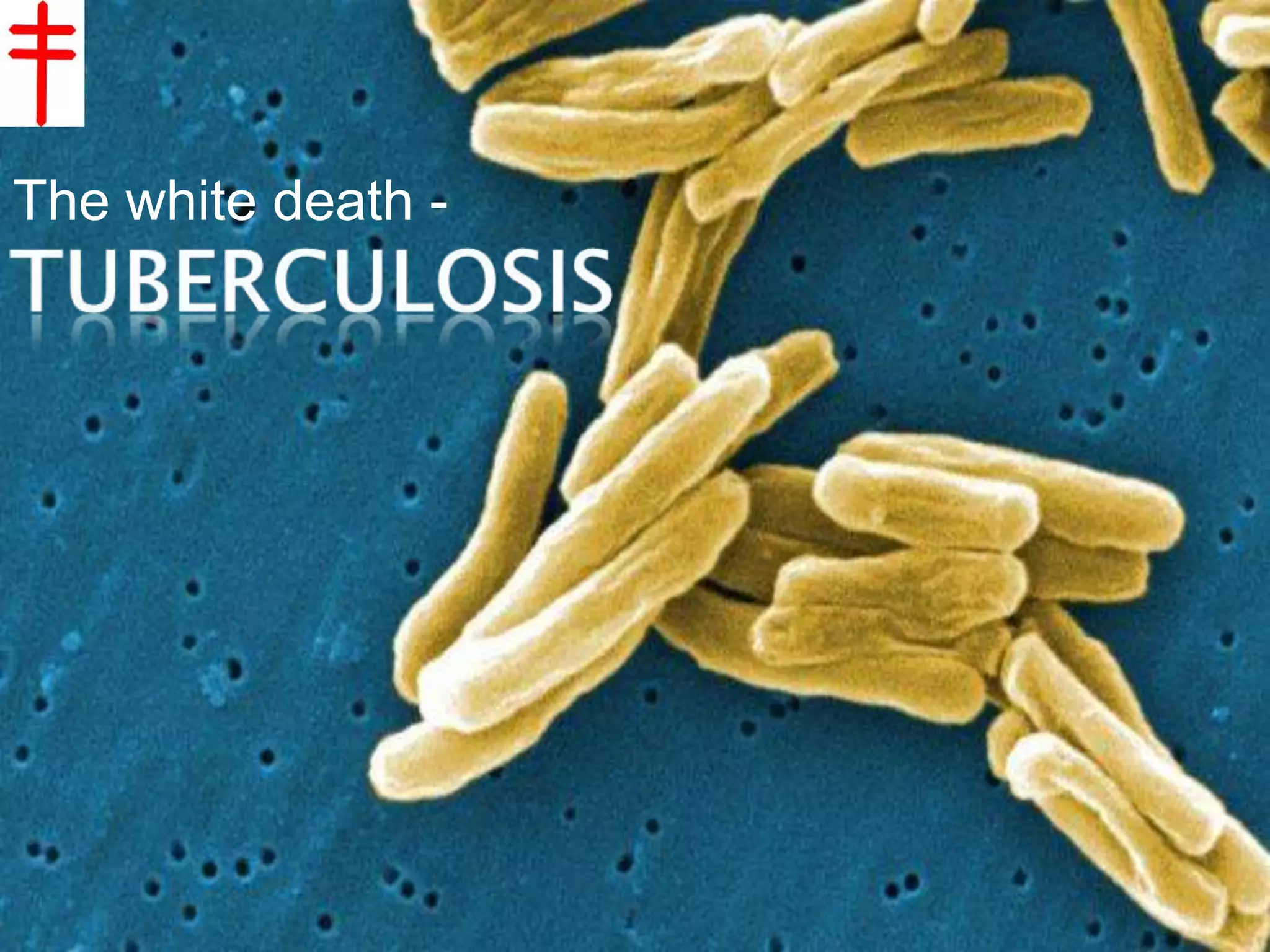
The white death -
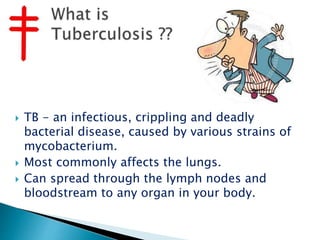
 TB - an infectious, crippling and deadly
bacterial disease, caused by various strains of
mycobacterium.
 Most commonly affects the lungs.
 Can spread through the lymph nodes and
bloodstream to any organ in your body.
 Tuberculosis may be Pulmonary or Extra pulmonary:
1.Pulmonary TB- If a tuberculosis infection does
become active, it most commonly involves the lungs
(in about 90% of cases).
-Tuberculosis may become a chronic illness and
cause extensive scarring in the upper lobes of the
lungs.
2.Extra pulmonary TB- In 15–20% of active cases,
the infection spreads outside the lungs, causing
other kinds of TB.
-Extrapulmonary TB occurs more commonly in
immunosuppressed persons and young children.
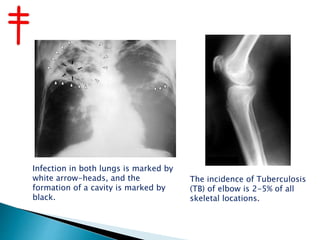
Infection in both lungs is marked by
white arrow-heads, and the
formation of a cavity is marked by
black.
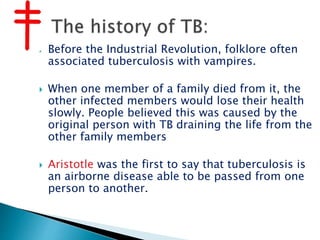
The incidence of Tuberculosis
(TB) of elbow is 2-5% of all
skeletal locations.
 Before the Industrial Revolution, folklore often
associated tuberculosis with vampires.
 When one member of a family died from it, the
other infected members would lose their health
slowly. People believed this was caused by the
original person with TB draining the life from the
other family members
 Aristotle was the first to say that tuberculosis is
an airborne disease able to be passed from one
person to another.
 1882, Dr. Robert Koch announced the discovery
of Mycobacterium tuberculosis, the bacteria that
cause TB.
 Tuberculosis caused the most widespread public
concern in the 19th and early 20th centuries as
an endemic disease of the urban poor.
 By 1918, one in six deaths in France was still
caused by TB. In Europe, rates of tuberculosis
began to rise in the early 1600s to a peak level in
the 1800s, when it caused nearly 25% of all
deaths
 In 1946, the development of the antibiotic
streptomycin made effective treatment and cure
of TB a reality.
 Mycobacterium tuberculosis belongs to Mycobacteriaceae
and is the causative agent of most cases of tuberculosis.
 M. tuberculosis has an unusual, waxy coating on its cell
surface (primarily due to the presence of mycolic acid)-
high lipid content
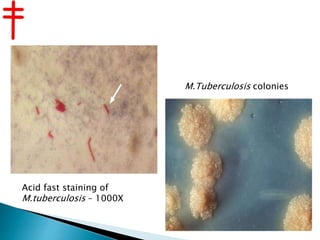
 It does not retain any bacteriological stain due to high
lipid content in its wall, hence Ziehl-Neelsen staining, or
acid-fast staining, is used.
 They are classified as acid-fast Gram-positive bacteria
due to their lack of an outer cell membrane.
Acid fast staining of
M.tuberculosis – 1000X
M.Tuberculosis colonies
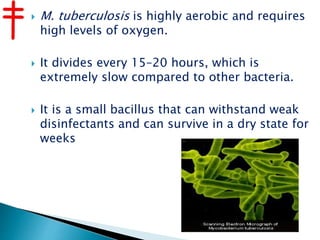
 M. tuberculosis is highly aerobic and requires
high levels of oxygen.
 It divides every 15–20 hours, which is
extremely slow compared to other bacteria.
 It is a small bacillus that can withstand weak
disinfectants and can survive in a dry state for
weeks
 In the lungs, M. tuberculosis is taken up by alveolar
macrophages, but they are unable to digest and
eradicate the bacterium.
 Its cell wall prevents the fusion of the phagosome with
the lysosome, which contains a host of
anti-mycobacterial factors.
 Consequently, the bacteria multiply unchecked within
the macrophage.

 The bacteria also carry the UreC gene, which prevents
acidification of the phagosome.
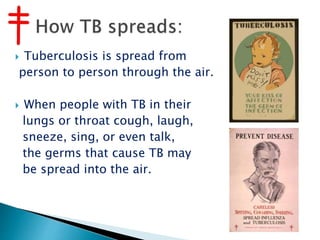
 Tuberculosis is spread from
person to person through the air.
 When people with TB in their
lungs or throat cough, laugh,
sneeze, sing, or even talk,
the germs that cause TB may
be spread into the air.
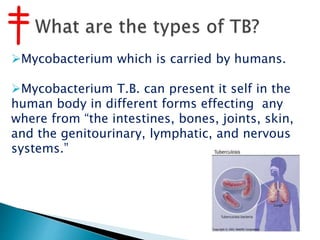
Mycobacterium which is carried by humans.
Mycobacterium T.B. can present it self in the
human body in different forms effecting any
where from “the intestines, bones, joints, skin,
and the genitourinary, lymphatic, and nervous
systems.”
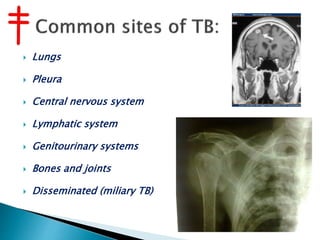
 Lungs
 Pleura
 Central nervous system
 Lymphatic system
 Genitourinary systems
 Bones and joints
 Disseminated (miliary TB)
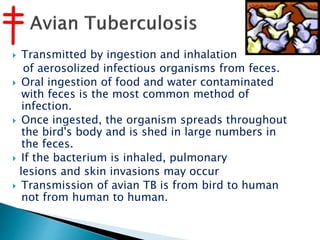
 Transmitted by ingestion and inhalation
of aerosolized infectious organisms from feces.
 Oral ingestion of food and water contaminated
with feces is the most common method of
infection.
 Once ingested, the organism spreads throughout
the bird's body and is shed in large numbers in
the feces.
 If the bacterium is inhaled, pulmonary
lesions and skin invasions may occur
 Transmission of avian TB is from bird to human
not from human to human.
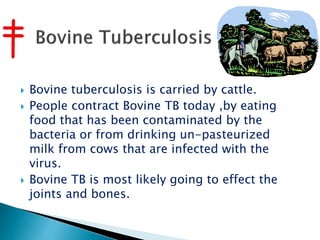
 Bovine tuberculosis is carried by cattle.
 People contract Bovine TB today ,by eating
food that has been contaminated by the
bacteria or from drinking un-pasteurized
milk from cows that are infected with the
virus.
 Bovine TB is most likely going to effect the
joints and bones.
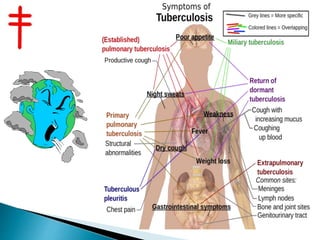
 The primary stage of the disease may be
symptom-free, or the individual may
experience a flu-like illness. This is called the
“inactive stage.”
 Within the active stage of the disease, there
might be a slight fever, night sweats, weight
loss, fatigue.
 The symptoms my vary depending on what
type of tuberculosis you contract.
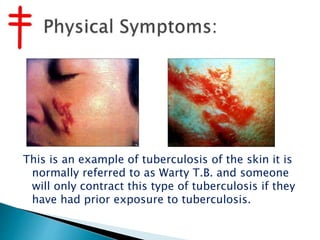
This is an example of tuberculosis of the skin it is
normally referred to as Warty T.B. and someone
will only contract this type of tuberculosis if they
have had prior exposure to tuberculosis.
 When someone comes into contact with
tuberculosis or feels as if they become
infected by tuberculosis, they should call a
doctor and order a skin test.
 The doctor will inject a small amount of
tuberculin under the skin.
 If a person has been exposed to tuberculosis
a swelling will develop around the spot where
the skin test is given.
 If your T.B skin test comes back positive your
doctor will take one of several treatments to treat
you.
 Your doctor may prescribe a medicine called
isoniazid to prevent the tuberculosis infection
from developing into the active disease and
making you feel sick.
 If you contract TB of the abdominal or of the
extra- pulmonary you may have the choice of a
mainstay therapy that takes a course of 9-12
months in order to complete.
 Surgery is generally reserved for patients with
obstruction of vital organs.
 No treatment at all since most people
develop an immune response and warts
go away by themselves.
 If your warts don't disappear, or if uncomfortable,
first-choice remedy should be over-the-counter
medication in liquid, gel, pad or ointment form.
 If over-the-counter treatment fails, your doctor can
remove a wart by: “freezing it with liquid nitrogen,
burning it off with electricity or a laser, excising it
(a minor surgical procedure), dissolving it by
wrapping it in a plaster patch impregnated with
salicylic acid.”
 MDR-TB - Mycobacterium TB that is resistant to at least Isoniazid and
Rifampin.
 XDR TB is defined as resistance to the four first-line drugs, an injectable,
and one of the quinolones
 Individuals with XDR TB are more likely to die during treatment or have
treatment failure
 XDR TB has emerged worldwide as a threat to public health and TB control
raising concerns for a future epidemic of virtually untreatable TB
 Second-line anti-TB medications are used in the treatment of MDR and
XDR-TB. These are costly, difficult to administer, and cause serious side
effects
Tuberculosis- The white death

Tuberculosis- The white death

  • 1.
  • 2.
     TB -an infectious, crippling and deadly bacterial disease, caused by various strains of mycobacterium.  Most commonly affects the lungs.  Can spread through the lymph nodes and bloodstream to any organ in your body.
  • 3.
     Tuberculosis maybe Pulmonary or Extra pulmonary: 1.Pulmonary TB- If a tuberculosis infection does become active, it most commonly involves the lungs (in about 90% of cases). -Tuberculosis may become a chronic illness and cause extensive scarring in the upper lobes of the lungs. 2.Extra pulmonary TB- In 15–20% of active cases, the infection spreads outside the lungs, causing other kinds of TB. -Extrapulmonary TB occurs more commonly in immunosuppressed persons and young children.
  • 4.
    Infection in bothlungs is marked by white arrow-heads, and the formation of a cavity is marked by black. The incidence of Tuberculosis (TB) of elbow is 2-5% of all skeletal locations.
  • 5.
     Before theIndustrial Revolution, folklore often associated tuberculosis with vampires.  When one member of a family died from it, the other infected members would lose their health slowly. People believed this was caused by the original person with TB draining the life from the other family members  Aristotle was the first to say that tuberculosis is an airborne disease able to be passed from one person to another.
  • 6.
     1882, Dr.Robert Koch announced the discovery of Mycobacterium tuberculosis, the bacteria that cause TB.  Tuberculosis caused the most widespread public concern in the 19th and early 20th centuries as an endemic disease of the urban poor.  By 1918, one in six deaths in France was still caused by TB. In Europe, rates of tuberculosis began to rise in the early 1600s to a peak level in the 1800s, when it caused nearly 25% of all deaths  In 1946, the development of the antibiotic streptomycin made effective treatment and cure of TB a reality.
  • 8.
     Mycobacterium tuberculosisbelongs to Mycobacteriaceae and is the causative agent of most cases of tuberculosis.  M. tuberculosis has an unusual, waxy coating on its cell surface (primarily due to the presence of mycolic acid)- high lipid content  It does not retain any bacteriological stain due to high lipid content in its wall, hence Ziehl-Neelsen staining, or acid-fast staining, is used.  They are classified as acid-fast Gram-positive bacteria due to their lack of an outer cell membrane.
  • 9.
    Acid fast stainingof M.tuberculosis – 1000X M.Tuberculosis colonies
  • 10.
     M. tuberculosisis highly aerobic and requires high levels of oxygen.  It divides every 15–20 hours, which is extremely slow compared to other bacteria.  It is a small bacillus that can withstand weak disinfectants and can survive in a dry state for weeks
  • 11.
     In thelungs, M. tuberculosis is taken up by alveolar macrophages, but they are unable to digest and eradicate the bacterium.  Its cell wall prevents the fusion of the phagosome with the lysosome, which contains a host of anti-mycobacterial factors.  Consequently, the bacteria multiply unchecked within the macrophage.   The bacteria also carry the UreC gene, which prevents acidification of the phagosome.
  • 12.
     Tuberculosis isspread from person to person through the air.  When people with TB in their lungs or throat cough, laugh, sneeze, sing, or even talk, the germs that cause TB may be spread into the air.
  • 13.
    Mycobacterium which iscarried by humans. Mycobacterium T.B. can present it self in the human body in different forms effecting any where from “the intestines, bones, joints, skin, and the genitourinary, lymphatic, and nervous systems.”
  • 14.
     Lungs  Pleura Central nervous system  Lymphatic system  Genitourinary systems  Bones and joints  Disseminated (miliary TB)
  • 15.
     Transmitted byingestion and inhalation of aerosolized infectious organisms from feces.  Oral ingestion of food and water contaminated with feces is the most common method of infection.  Once ingested, the organism spreads throughout the bird's body and is shed in large numbers in the feces.  If the bacterium is inhaled, pulmonary lesions and skin invasions may occur  Transmission of avian TB is from bird to human not from human to human.
  • 16.
     Bovine tuberculosisis carried by cattle.  People contract Bovine TB today ,by eating food that has been contaminated by the bacteria or from drinking un-pasteurized milk from cows that are infected with the virus.  Bovine TB is most likely going to effect the joints and bones.
  • 17.
     The primarystage of the disease may be symptom-free, or the individual may experience a flu-like illness. This is called the “inactive stage.”  Within the active stage of the disease, there might be a slight fever, night sweats, weight loss, fatigue.  The symptoms my vary depending on what type of tuberculosis you contract.
  • 19.
    This is anexample of tuberculosis of the skin it is normally referred to as Warty T.B. and someone will only contract this type of tuberculosis if they have had prior exposure to tuberculosis.
  • 20.
     When someonecomes into contact with tuberculosis or feels as if they become infected by tuberculosis, they should call a doctor and order a skin test.  The doctor will inject a small amount of tuberculin under the skin.  If a person has been exposed to tuberculosis a swelling will develop around the spot where the skin test is given.
  • 21.
     If yourT.B skin test comes back positive your doctor will take one of several treatments to treat you.  Your doctor may prescribe a medicine called isoniazid to prevent the tuberculosis infection from developing into the active disease and making you feel sick.  If you contract TB of the abdominal or of the extra- pulmonary you may have the choice of a mainstay therapy that takes a course of 9-12 months in order to complete.  Surgery is generally reserved for patients with obstruction of vital organs.
  • 22.
     No treatmentat all since most people develop an immune response and warts go away by themselves.  If your warts don't disappear, or if uncomfortable, first-choice remedy should be over-the-counter medication in liquid, gel, pad or ointment form.  If over-the-counter treatment fails, your doctor can remove a wart by: “freezing it with liquid nitrogen, burning it off with electricity or a laser, excising it (a minor surgical procedure), dissolving it by wrapping it in a plaster patch impregnated with salicylic acid.”
  • 23.
     MDR-TB -Mycobacterium TB that is resistant to at least Isoniazid and Rifampin.  XDR TB is defined as resistance to the four first-line drugs, an injectable, and one of the quinolones  Individuals with XDR TB are more likely to die during treatment or have treatment failure  XDR TB has emerged worldwide as a threat to public health and TB control raising concerns for a future epidemic of virtually untreatable TB  Second-line anti-TB medications are used in the treatment of MDR and XDR-TB. These are costly, difficult to administer, and cause serious side effects