DR. TAHIRA GUL
HOUSE OFFICER
MEDICINE UNIT II
INTRODUCTION
• Tuberculosis (TB) is one of the most prevalent infections
of human beings and contributes considerably to illness
and death around the world. It is spread by inhaling tiny
droplets of saliva from the coughs or sneezes of an
infected person. It is a slowly spreading, chronic,
granulomatous bacterial infection, characterized by
gradual weight loss.
DEFINITION
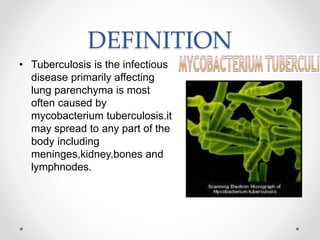
• Tuberculosis is the infectious
disease primarily affecting
lung parenchyma is most
often caused by
mycobacterium tuberculosis.it
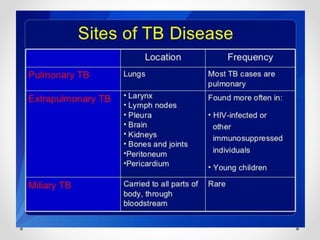
may spread to any part of the
body including
meninges,kidney,bones and
lymphnodes.
INCIDENCE
• With the increased incidence of AIDS, TB has become
more a problem in the U.S., and the world.
• It is currently estimated that 1/2 of the world's population
(3.1 billion) is infected with Mycobacterium tuberculosis
• Global Emergency Tuberculosis kills 5,000 people a day
• 2.3 million die each year
TYPES
• PULMONARY TUBERCULOSIS
• AVIAN TUBERCULOSIS(MICROBACTERIUM AVIUM :
OF BIRDS)
• BOVINE TUBERCULOSIS(MYCOBACTERIUM BOVIS :
OF CATTLE)
• MILIARY TUBERCULOSIS / DISSEMINATED
TUBERCULOSIS
• Risk factors of tuberculosis are
:
o Elderly
o Infants
o Low socioeconomic status
o Crowded living conditions
o Disease that weakens immune
system like HIV immune
system
o Alcoholism
o Recent Tubercular infection
(within last 2 years)
PATHOGENESIS
CLINICAL
MANIFESTATIONS
o CONSTITUTIONAL SYMPTOMS
o Anorexia
o Low grade fever
o Night sweats
o Fatique
o Weight loss
• PULMONARY SYMPTOMS
o Dyspnea
o Non resolving bronchopneumonia
o Chest tightness
o Non productive cough
o Mucopurulent sputum with hemoptpysis
o Chest pain
• EXTRA PULMONARY SYMPTOMS
o Pain
o Inflammation
ASSESSMENT AND
DIAGNOSTIC FINDINGS
• HISTORY COLLECTION
• PHYSICAL EXAMINATION
• Clubbing of the fingers or toes (in people with advanced
disease)
• Swollen or tender lymph nodes in the neck or other
areas
• Fluid around a lung (pleural effusion)
• Unusual breath sounds (crackles)
IF MILIARY TB :
• A physical exam may show:
• Swollen liver
• Swollen lymph nodes
• Swollen spleen
Tests may include
• Biopsy of the affected tissue (rare)
• Bronchoscopy
• Chest CT scan
• Chest x-ray
• Interferon-gamma release blood test such as the QFT-Gold test to
test for TB infection
• Sputum examination and cultures
• Thoracentesis
• Tuberculin skin test (also called a PPD test)
RADIOLOGICAL
EXAIMINATION
MEDICAL
MANAGEMENT
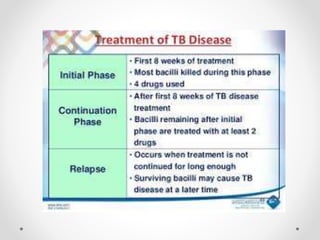
• PULMONARY TB is treated primarily with anti-
tuberculosis agents for 6 to 12 months.
• Pharmacological management
• First line anti-tubercular medications Streptomycin
15mg/kg
• Isoniazid or INH (Nydrazid) 5 mg/kg(300 mg max per
day)
• Rifampin 10 mg/kg
• Pyrazinamide 15 – 30 mg/kg
• Ethambutol (Myambutol) 15 -25 mg/kg daily for 8 weeks
and continuing for up to 4 to 7 months
Second line medications
• Capreomycin 12 -15 mg/kg
• Ethionamide 15mg/kg
• Paraaminosalycilate sodium 200 300 mg/kg
• Cycloserine 15 mg/kg
• Vitamin b(pyridoxine) usually adminstered with INH
Tuberculosis
Tuberculosis

Tuberculosis

  • 1.
    DR. TAHIRA GUL HOUSEOFFICER MEDICINE UNIT II
  • 2.
    INTRODUCTION • Tuberculosis (TB)is one of the most prevalent infections of human beings and contributes considerably to illness and death around the world. It is spread by inhaling tiny droplets of saliva from the coughs or sneezes of an infected person. It is a slowly spreading, chronic, granulomatous bacterial infection, characterized by gradual weight loss.
  • 3.
    DEFINITION • Tuberculosis isthe infectious disease primarily affecting lung parenchyma is most often caused by mycobacterium tuberculosis.it may spread to any part of the body including meninges,kidney,bones and lymphnodes.
  • 4.
    INCIDENCE • With theincreased incidence of AIDS, TB has become more a problem in the U.S., and the world. • It is currently estimated that 1/2 of the world's population (3.1 billion) is infected with Mycobacterium tuberculosis • Global Emergency Tuberculosis kills 5,000 people a day • 2.3 million die each year
  • 5.
    TYPES • PULMONARY TUBERCULOSIS •AVIAN TUBERCULOSIS(MICROBACTERIUM AVIUM : OF BIRDS) • BOVINE TUBERCULOSIS(MYCOBACTERIUM BOVIS : OF CATTLE) • MILIARY TUBERCULOSIS / DISSEMINATED TUBERCULOSIS
  • 6.
    • Risk factorsof tuberculosis are : o Elderly o Infants o Low socioeconomic status o Crowded living conditions o Disease that weakens immune system like HIV immune system o Alcoholism o Recent Tubercular infection (within last 2 years)
  • 7.
  • 8.
    CLINICAL MANIFESTATIONS o CONSTITUTIONAL SYMPTOMS oAnorexia o Low grade fever o Night sweats o Fatique o Weight loss
  • 9.
    • PULMONARY SYMPTOMS oDyspnea o Non resolving bronchopneumonia o Chest tightness o Non productive cough o Mucopurulent sputum with hemoptpysis o Chest pain • EXTRA PULMONARY SYMPTOMS o Pain o Inflammation
  • 10.
    ASSESSMENT AND DIAGNOSTIC FINDINGS •HISTORY COLLECTION • PHYSICAL EXAMINATION • Clubbing of the fingers or toes (in people with advanced disease) • Swollen or tender lymph nodes in the neck or other areas • Fluid around a lung (pleural effusion) • Unusual breath sounds (crackles)
  • 11.
    IF MILIARY TB: • A physical exam may show: • Swollen liver • Swollen lymph nodes • Swollen spleen
  • 12.
    Tests may include •Biopsy of the affected tissue (rare) • Bronchoscopy • Chest CT scan • Chest x-ray • Interferon-gamma release blood test such as the QFT-Gold test to test for TB infection • Sputum examination and cultures • Thoracentesis • Tuberculin skin test (also called a PPD test)
  • 13.
  • 16.
    MEDICAL MANAGEMENT • PULMONARY TBis treated primarily with anti- tuberculosis agents for 6 to 12 months. • Pharmacological management • First line anti-tubercular medications Streptomycin 15mg/kg • Isoniazid or INH (Nydrazid) 5 mg/kg(300 mg max per day) • Rifampin 10 mg/kg • Pyrazinamide 15 – 30 mg/kg • Ethambutol (Myambutol) 15 -25 mg/kg daily for 8 weeks and continuing for up to 4 to 7 months
  • 17.
    Second line medications •Capreomycin 12 -15 mg/kg • Ethionamide 15mg/kg • Paraaminosalycilate sodium 200 300 mg/kg • Cycloserine 15 mg/kg • Vitamin b(pyridoxine) usually adminstered with INH