TUBERCULOSIS
• KHETAN
EXPLANATION
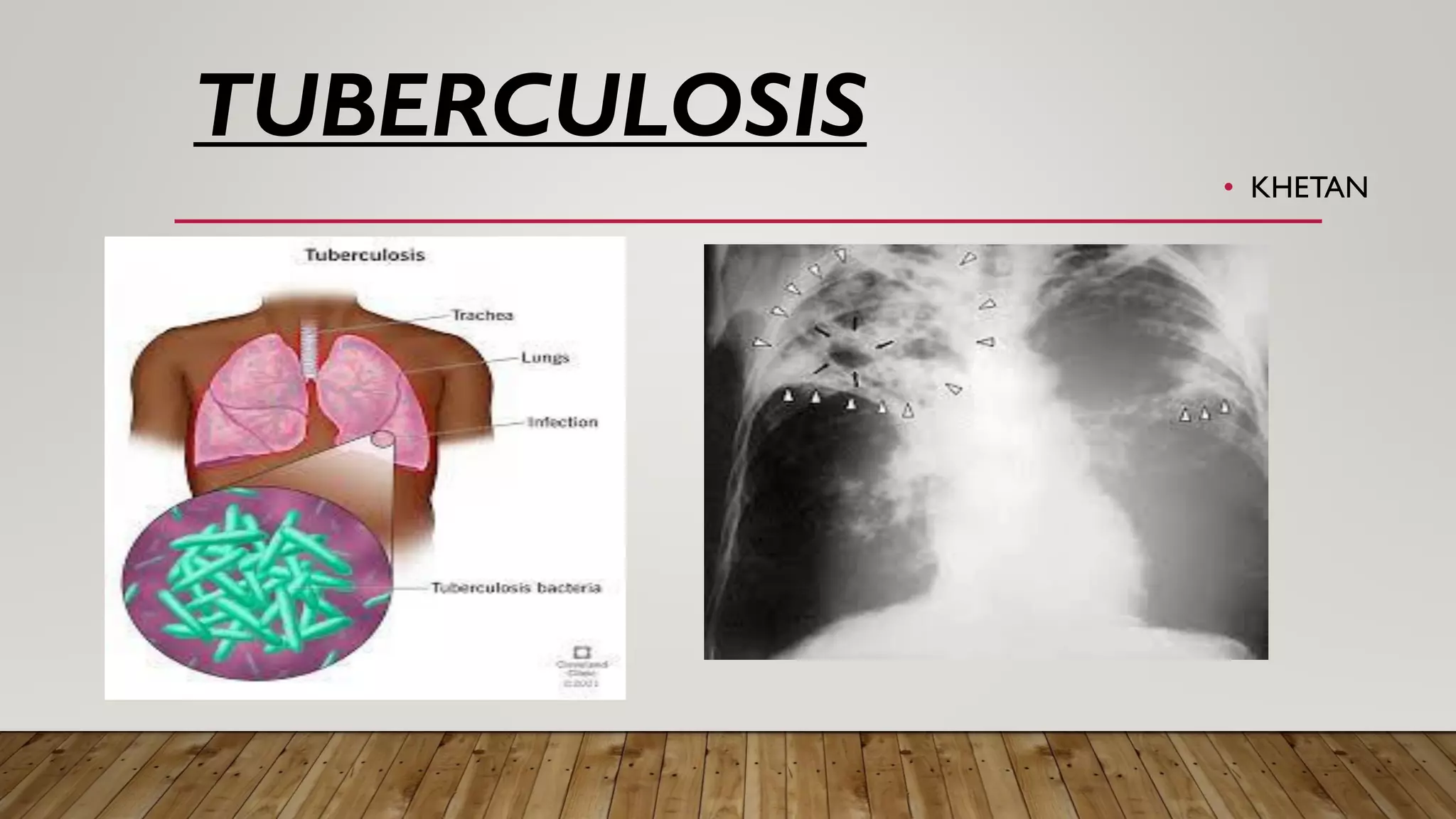
• Tuberculosis (TB) is a potentially serious infectious disease that mainly affects the lungs.
The bacteria that cause tuberculosis are spread from person to person through tiny
droplets released into the air via coughs and sneezes
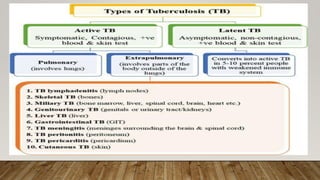
Tuberculosis can also affect other parts of your body,including the kidneys,spine or brain.
WhenTB occurs outside lungs,signs and symptoms vary according to the organs involved.
For example,tuberculosis of the spine might cause back pain,and tuberculosis in kidneys
might cause blood in your urine.
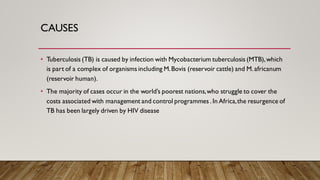
SYMPTOMS
• Coughing for three or more weeks
• Coughing up blood or mucus
• Chest pain,or pain with breathing or coughing
• Unintentional weight loss
• Fatigue
• Fever
• Night sweats
• Chills
• Loss of appetite
CAUSES
• Tuberculosis (TB) is caused by infection with Mycobacterium tuberculosis (MTB),which
is part of a complex of organisms including M.Bovis (reservoir cattle) and M.africanum
(reservoir human).
• The majority of cases occur in the world’s poorest nations,who struggle to cover the
costs associated with management and control programmes . In Africa,the resurgence of
TB has been largely driven by HIV disease
PATHOPHYSIOLOGY
• M. Bovis infection arises from drinking non-sterilised milk from infected cows. M.
Tuberculosis is spread by the inhalation of aerosolised droplet nuclei from other infected
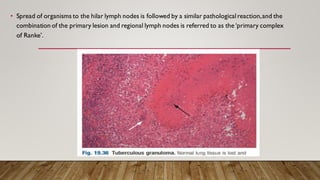
patients.Once inhaled,the organisms lodge in the alveoli and initiate the recruitment of
macrophages and lymphocytes.Macrophages undergo transforma-tion into epithelioid
and Langhans cells,which aggregate with the lymphocytes to form the classical
tuberculous granuloma
• The only clue that infection has occurred may be the appearance of a cell-mediated,
delayed-type hypersensitivity reaction to tuberculin,demonstrated by tuberculin skin
testing.
• Spread of organisms to the hilar lymph nodes is followed by a similar pathological reaction,and the
combination of the primary lesion and regional lymph nodes is referred to as the‘primary complex
of Ranke’.
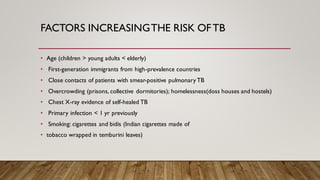
FACTORS INCREASINGTHE RISK OFTB
• Age (children > young adults < elderly)
• First-generation immigrants from high-prevalence countries
• Close contacts of patients with smear-positive pulmonary TB
• Overcrowding (prisons, collective dormitories); homelessness(doss houses and hostels)
• Chest X-ray evidence of self-healed TB
• Primary infection < 1 yr previously
• Smoking: cigarettes and bidis (Indian cigarettes made of
• tobacco wrapped in temburini leaves)
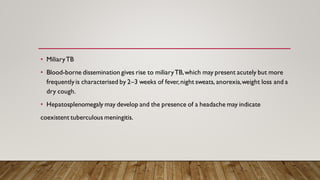
• MiliaryTB
• Blood-borne dissemination gives rise to miliaryTB,which may present acutely but more
frequently is characterised by 2–3 weeks of fever,night sweats, anorexia,weight loss and a
dry cough.
• Hepatosplenomegaly may develop and the presence of a headache may indicate
coexistent tuberculous meningitis.
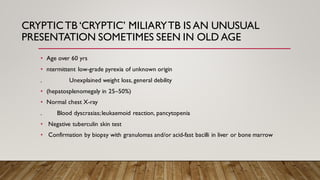
CRYPTICTB ‘CRYPTIC’ MILIARYTB IS AN UNUSUAL
PRESENTATION SOMETIMES SEEN IN OLD AGE
• Age over 60 yrs
• ntermittent low-grade pyrexia of unknown origin
. Unexplained weight loss, general debility
• (hepatosplenomegaly in 25–50%)
• Normal chest X-ray
. Blood dyscrasias;leukaemoid reaction, pancytopenia
• Negative tuberculin skin test
• Confirmation by biopsy with granulomas and/or acid-fast bacilli in liver or bone marrow
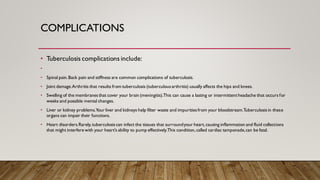
COMPLICATIONS
• Tuberculosis complications include:
•
• Spinal pain.Back pain and stiffness are common complications of tuberculosis.
• Joint damage.Arthritis that results from tuberculosis (tuberculousarthritis) usually affects the hips and knees.
• Swelling of the membranesthat cover your brain (meningitis).This can cause a lasting or intermittentheadache that occurs for
weeks and possible mental changes.
• Liver or kidney problems.Your liver and kidneys help filter waste and impuritiesfrom your bloodstream.Tuberculosisin these
organs can impair their functions.
• Heart disorders.Rarely,tuberculosiscan infect the tissues that surroundyour heart,causing inflammation and fluid collections
that might interfere with your heart’s ability to pump effectively.This condition,called cardiac tamponade,can be fatal.
DIAGNOSIS
• During the physical exam,check lymph nodes for swelling and use a stethoscope to
listen to the sounds lungs make when breathe.
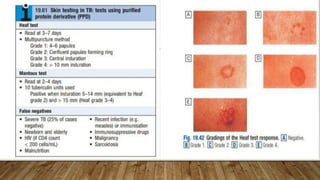
• The most commonly used diagnostic tool for tuberculosis is a skin test, though blood
tests are becoming more commonplace.A small amount of a substance called tuberculin
is injected just below the skin on the inside of forearm. should feel only a slight needle
prick.
• Within 48 to 72 hours,a health care professional will check your arm for swelling at the
injection site.A hard,raised red bump means you’re likely to haveTB infection.The size of
the bump determines whether the test results are significant.
• Blood tests can confirm or rule out latent or active tuberculosis.These tests measure your
immune system’s reaction to TB bacteria.
• had a positive skin test, likely to order a chest X-ray or a CT scan.
• Might show white spots in lungs where your immune system has walled off TB bacteria, or it
might reveal changes in lungs caused by active tuberculosis.
• If your chest X-ray shows signs of tuberculosis, might take samples of your sputum — the
mucus that comes up when you cough.The samples are tested for TB bacteria.
• Sputum samples can also be used to test for drug-resistant strains ofTB.
MANAGEMENT
• take only one or two types ofTB drugs.Active tuberculosis,particularly if it’s a drug-resistant strain,will
require several drugs at once.The most common medications usedto treat tuberculosis include:
• Isoniazid,Rifampin (Rifadin,Rimactane),Ethambutol (Myambutol),Pyrazinamide
• If you have drug-resistantTB,a combination of antibiotics called fluoroquinolones and injectable
medications,such as amikacin or capreomycin (Capastat),are generally used for 20 to 30
months. Some types ofTB are developing resistance to these medications as well.
• Some drugs might be added to therapy to counter drug resistance,including:
• Bedaquiline (Sirturo)
• Linezolid (Zyvox)
• The Bacille Calmette-Guérin (BCG) vaccine has existed for 80 years and is one of the
most widely used of all current vaccines,reading >80%of neonates and infants in
countries.
• Tuberculosis (TB) can develop resistance to the antimicrobial drugs used to cure the
disease.Multidrug-resistantTB (MDR-TB) isTB that does not respond to at least
isoniazid and rifampicin,the 2 most powerful anti-TB drugs
FAST RECOVERY FOLLOWTHE RULES
• Stay home. Don’t go to work or school or sleep in a room with other people during the first few
weeks of treatment.
• Ventilate the room. Tuberculosis germs spread more easily in small closed spaces where air
doesn’t move.If it’s not too cold outdoors,open the windows and use a fan to blow indoor air outside.
• Cover your mouth. Use a tissue to cover your mouth anytime you laugh,sneeze or cough.Put the
dirty tissue in a bag,seal it and throw it away.
• Wear a face mask. Wearing a face mask when you’re around other people during the
first three weeks of treatment may help lessen the risk of transmission.

tuberculosis (2).pdf

  • 1.
  • 2.
    EXPLANATION • Tuberculosis (TB)is a potentially serious infectious disease that mainly affects the lungs. The bacteria that cause tuberculosis are spread from person to person through tiny droplets released into the air via coughs and sneezes Tuberculosis can also affect other parts of your body,including the kidneys,spine or brain. WhenTB occurs outside lungs,signs and symptoms vary according to the organs involved. For example,tuberculosis of the spine might cause back pain,and tuberculosis in kidneys might cause blood in your urine.
  • 4.
    SYMPTOMS • Coughing forthree or more weeks • Coughing up blood or mucus • Chest pain,or pain with breathing or coughing • Unintentional weight loss • Fatigue • Fever • Night sweats • Chills • Loss of appetite
  • 5.
    CAUSES • Tuberculosis (TB)is caused by infection with Mycobacterium tuberculosis (MTB),which is part of a complex of organisms including M.Bovis (reservoir cattle) and M.africanum (reservoir human). • The majority of cases occur in the world’s poorest nations,who struggle to cover the costs associated with management and control programmes . In Africa,the resurgence of TB has been largely driven by HIV disease
  • 6.
    PATHOPHYSIOLOGY • M. Bovisinfection arises from drinking non-sterilised milk from infected cows. M. Tuberculosis is spread by the inhalation of aerosolised droplet nuclei from other infected patients.Once inhaled,the organisms lodge in the alveoli and initiate the recruitment of macrophages and lymphocytes.Macrophages undergo transforma-tion into epithelioid and Langhans cells,which aggregate with the lymphocytes to form the classical tuberculous granuloma • The only clue that infection has occurred may be the appearance of a cell-mediated, delayed-type hypersensitivity reaction to tuberculin,demonstrated by tuberculin skin testing.
  • 7.
    • Spread oforganisms to the hilar lymph nodes is followed by a similar pathological reaction,and the combination of the primary lesion and regional lymph nodes is referred to as the‘primary complex of Ranke’.
  • 8.
    FACTORS INCREASINGTHE RISKOFTB • Age (children > young adults < elderly) • First-generation immigrants from high-prevalence countries • Close contacts of patients with smear-positive pulmonary TB • Overcrowding (prisons, collective dormitories); homelessness(doss houses and hostels) • Chest X-ray evidence of self-healed TB • Primary infection < 1 yr previously • Smoking: cigarettes and bidis (Indian cigarettes made of • tobacco wrapped in temburini leaves)
  • 9.
    • MiliaryTB • Blood-bornedissemination gives rise to miliaryTB,which may present acutely but more frequently is characterised by 2–3 weeks of fever,night sweats, anorexia,weight loss and a dry cough. • Hepatosplenomegaly may develop and the presence of a headache may indicate coexistent tuberculous meningitis.
  • 10.
    CRYPTICTB ‘CRYPTIC’ MILIARYTBIS AN UNUSUAL PRESENTATION SOMETIMES SEEN IN OLD AGE • Age over 60 yrs • ntermittent low-grade pyrexia of unknown origin . Unexplained weight loss, general debility • (hepatosplenomegaly in 25–50%) • Normal chest X-ray . Blood dyscrasias;leukaemoid reaction, pancytopenia • Negative tuberculin skin test • Confirmation by biopsy with granulomas and/or acid-fast bacilli in liver or bone marrow
  • 11.
    COMPLICATIONS • Tuberculosis complicationsinclude: • • Spinal pain.Back pain and stiffness are common complications of tuberculosis. • Joint damage.Arthritis that results from tuberculosis (tuberculousarthritis) usually affects the hips and knees. • Swelling of the membranesthat cover your brain (meningitis).This can cause a lasting or intermittentheadache that occurs for weeks and possible mental changes. • Liver or kidney problems.Your liver and kidneys help filter waste and impuritiesfrom your bloodstream.Tuberculosisin these organs can impair their functions. • Heart disorders.Rarely,tuberculosiscan infect the tissues that surroundyour heart,causing inflammation and fluid collections that might interfere with your heart’s ability to pump effectively.This condition,called cardiac tamponade,can be fatal.
  • 12.
    DIAGNOSIS • During thephysical exam,check lymph nodes for swelling and use a stethoscope to listen to the sounds lungs make when breathe. • The most commonly used diagnostic tool for tuberculosis is a skin test, though blood tests are becoming more commonplace.A small amount of a substance called tuberculin is injected just below the skin on the inside of forearm. should feel only a slight needle prick. • Within 48 to 72 hours,a health care professional will check your arm for swelling at the injection site.A hard,raised red bump means you’re likely to haveTB infection.The size of the bump determines whether the test results are significant.
  • 14.
    • Blood testscan confirm or rule out latent or active tuberculosis.These tests measure your immune system’s reaction to TB bacteria. • had a positive skin test, likely to order a chest X-ray or a CT scan. • Might show white spots in lungs where your immune system has walled off TB bacteria, or it might reveal changes in lungs caused by active tuberculosis. • If your chest X-ray shows signs of tuberculosis, might take samples of your sputum — the mucus that comes up when you cough.The samples are tested for TB bacteria. • Sputum samples can also be used to test for drug-resistant strains ofTB.
  • 15.
    MANAGEMENT • take onlyone or two types ofTB drugs.Active tuberculosis,particularly if it’s a drug-resistant strain,will require several drugs at once.The most common medications usedto treat tuberculosis include: • Isoniazid,Rifampin (Rifadin,Rimactane),Ethambutol (Myambutol),Pyrazinamide • If you have drug-resistantTB,a combination of antibiotics called fluoroquinolones and injectable medications,such as amikacin or capreomycin (Capastat),are generally used for 20 to 30 months. Some types ofTB are developing resistance to these medications as well. • Some drugs might be added to therapy to counter drug resistance,including: • Bedaquiline (Sirturo) • Linezolid (Zyvox)
  • 16.
    • The BacilleCalmette-Guérin (BCG) vaccine has existed for 80 years and is one of the most widely used of all current vaccines,reading >80%of neonates and infants in countries. • Tuberculosis (TB) can develop resistance to the antimicrobial drugs used to cure the disease.Multidrug-resistantTB (MDR-TB) isTB that does not respond to at least isoniazid and rifampicin,the 2 most powerful anti-TB drugs
  • 17.
    FAST RECOVERY FOLLOWTHERULES • Stay home. Don’t go to work or school or sleep in a room with other people during the first few weeks of treatment. • Ventilate the room. Tuberculosis germs spread more easily in small closed spaces where air doesn’t move.If it’s not too cold outdoors,open the windows and use a fan to blow indoor air outside. • Cover your mouth. Use a tissue to cover your mouth anytime you laugh,sneeze or cough.Put the dirty tissue in a bag,seal it and throw it away. • Wear a face mask. Wearing a face mask when you’re around other people during the first three weeks of treatment may help lessen the risk of transmission.