GAS GANGRENE
The Battle Wound Injury  How would YOU
battle this wound injury?
- Shweta Achuthan Kutty
• Introduction
• Microbiology
• Etiology
• Pathogenesis
• Clinical features
• Investigation
• Management
• Prevention
INTRODUCTION
• War time injury : WW1, WW2, Vietnam
War ….
• Now-a-days: Road traffic accidents,
Terrorist attacks, Earthquakes
• Synonyms: Anaerobic myonecrosis, Clostridial
myonecrosis, Oedematous myonecrosis
• Seen in severe wounds with contamination (Class3+4),
involves skeletal muscles mostly
• Causative organism: Clostridium species
• Rapidly progressive myonecrosis sepsis myocardial
depression, MOF death
• Should be vigilant about – Diabetics,
immunocompromised, pts with malignancies
MICROBIOLOGY
• Causative organism : Clostridium spp
C. perfringens (welchii) – 60%
C. oedematiens, C.septicum, C.histolyticum
+/- other anaerobes
• Gram positive, spore bearing, capsulated, non-
motile
• Obligate-aerotolerant anaerobes
• Source : soil, dust, faeces
• Incubation period : 1-2 days
ETIOLOGY
• Soil/faeces contaminated wounds
• Crush injuries: RTA, Earthquakes,Wars
• High velocity wounds: Gunshot, Shrapnel, RTA
• Post amputation
• Ischaemic limb
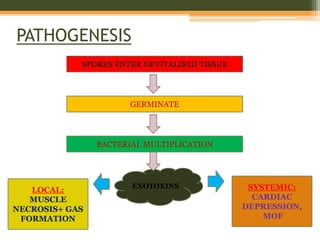
PATHOGENESIS
SPORES ENTER DEVITALISED TISSUE
GERMINATE
BACTERIAL MULTIPLICATION
EXOTOXINS
LOCAL:
MUSCLE
NECROSIS+ GAS
FORMATION
SYSTEMIC:
CARDIAC
DEPRESSION,
MOF
EXOTOXINS
• Lecinthinase: hemolytic, membranolytic,
necrotic
• Hemolysin: hemolytic
• Hyaluronidase
• Proteinase
CLINICAL FEATURES
• Common sites:
• limbs>other
• Adductor area of legs, buttocks, subscapular
region
• abdominal wall, viscera- liver (foamy liver),
appendix, intestines
• SEVERE local pain
• WOUND-
 oedematous,tense, tender
 spreading gangrene
 Serosanguinous discharge – “decaying apple
odour”
 purple-black-brown-green “KHAKHI” colour
 haemorrhagic blebs
 crepitus+
• Toxic features, fever, tachycardia, altered mental
status*
• Jaundice
• Features of shock- rapid thready pulse, cold
extremities, oliguria
• DIC
• Multiorgan failure
•DEATH
INVESTIGATIONS
• CBC
• Total count
• ABG
• Xray- limb, chest
• CT- chest/abdomen
• RFTs
• LFTs
• Gram stain: Gram positive bacteria (sensitive)
• Blood culture: <1% grew C.spp
• Upcoming: ELISA for exotoxins, PCR
TREATMENT
Immediate:
• Stabilize patient: IV line, fluids, blood
transfusion, pressors, ventilate if needed
• Polyvalent anti-gas gangrene serum
• Antibiotics- inj
• Monitor vitals, urine output, electrolytes
Once stable/ In stable patient:
• Cont. antibiotics
• Debride and excise all devitalised tissue till bleed
seen, H2O2+NS rinses
• Guillotine amputation
• Hyperbaric O2 therapy
PREVENTION
• Proper debridement of devitalised crush wounds
• Devitalised tissue should not be sutured
• Adequate cleaning with H2O2 + NS
• Penicillin/Antibiotic prophylaxis

Gas gangrene

  • 1.
    GAS GANGRENE The BattleWound Injury  How would YOU battle this wound injury? - Shweta Achuthan Kutty
  • 2.
    • Introduction • Microbiology •Etiology • Pathogenesis • Clinical features • Investigation • Management • Prevention
  • 3.
    INTRODUCTION • War timeinjury : WW1, WW2, Vietnam War …. • Now-a-days: Road traffic accidents, Terrorist attacks, Earthquakes
  • 4.
    • Synonyms: Anaerobicmyonecrosis, Clostridial myonecrosis, Oedematous myonecrosis • Seen in severe wounds with contamination (Class3+4), involves skeletal muscles mostly • Causative organism: Clostridium species • Rapidly progressive myonecrosis sepsis myocardial depression, MOF death • Should be vigilant about – Diabetics, immunocompromised, pts with malignancies
  • 5.
    MICROBIOLOGY • Causative organism: Clostridium spp C. perfringens (welchii) – 60% C. oedematiens, C.septicum, C.histolyticum +/- other anaerobes • Gram positive, spore bearing, capsulated, non- motile • Obligate-aerotolerant anaerobes
  • 6.
    • Source :soil, dust, faeces • Incubation period : 1-2 days
  • 7.
    ETIOLOGY • Soil/faeces contaminatedwounds • Crush injuries: RTA, Earthquakes,Wars • High velocity wounds: Gunshot, Shrapnel, RTA • Post amputation • Ischaemic limb
  • 8.
    PATHOGENESIS SPORES ENTER DEVITALISEDTISSUE GERMINATE BACTERIAL MULTIPLICATION EXOTOXINS LOCAL: MUSCLE NECROSIS+ GAS FORMATION SYSTEMIC: CARDIAC DEPRESSION, MOF
  • 9.
    EXOTOXINS • Lecinthinase: hemolytic,membranolytic, necrotic • Hemolysin: hemolytic • Hyaluronidase • Proteinase
  • 10.
    CLINICAL FEATURES • Commonsites: • limbs>other • Adductor area of legs, buttocks, subscapular region • abdominal wall, viscera- liver (foamy liver), appendix, intestines
  • 11.
    • SEVERE localpain • WOUND-  oedematous,tense, tender  spreading gangrene  Serosanguinous discharge – “decaying apple odour”  purple-black-brown-green “KHAKHI” colour  haemorrhagic blebs  crepitus+
  • 12.
    • Toxic features,fever, tachycardia, altered mental status* • Jaundice • Features of shock- rapid thready pulse, cold extremities, oliguria • DIC • Multiorgan failure •DEATH
  • 13.
    INVESTIGATIONS • CBC • Totalcount • ABG • Xray- limb, chest • CT- chest/abdomen • RFTs • LFTs • Gram stain: Gram positive bacteria (sensitive) • Blood culture: <1% grew C.spp • Upcoming: ELISA for exotoxins, PCR
  • 14.
    TREATMENT Immediate: • Stabilize patient:IV line, fluids, blood transfusion, pressors, ventilate if needed • Polyvalent anti-gas gangrene serum • Antibiotics- inj • Monitor vitals, urine output, electrolytes
  • 15.
    Once stable/ Instable patient: • Cont. antibiotics • Debride and excise all devitalised tissue till bleed seen, H2O2+NS rinses • Guillotine amputation • Hyperbaric O2 therapy
  • 16.
    PREVENTION • Proper debridementof devitalised crush wounds • Devitalised tissue should not be sutured • Adequate cleaning with H2O2 + NS • Penicillin/Antibiotic prophylaxis