Fasahat Ahmed Butt
Roll # 36
Group: C
 What is Tuberculosis?
 Transmission
 Diagnosis
 TB in Pakistan
 Relationship of TB with dentistry
 Decision tree for dental management of TB
patients
 Safety measures by dentists
Infectious disease caused by Mycobacterium
Tuberculosis, which primarily affects the
lungs but is also capable of involving almost
any site in the body including the oral cavity.
 Aerosolized droplets 5µm in diameter.
 Estimated 5-200 orgs required for infection
 Spreads through the air when a person:
• Sneezes
• Coughs
• Speaks
• Talks
 Chest x-rays Air appears black in
lungs (radiograph)
 Tuberculin skin test (TST or PPD)
 TB has been prevalent in Pakistan and
unfortunately it has been one of the neglected
health areas in the past.
 Pakistan ranks 6th amongst the countries with a
highest burden of TB in the world.
 Pakistan contributes about 44% of tuberculosis
burden in the Eastern Mediterranean Region.
 According to WHO, the incidence of sputum
positive TB cases in Pakistan is 80/100,000 per
year and for all types it is 177/100,000.
 TB is responsible for 5.1 percent of the total
national disease burden in Pakistan.
 The impact of TB on socio economic status is
substantial.
 In dentistry, the incidence of exposure
to an active TB patient is quite low.
 Oral lesions of TB are uncommon, with
most cases appearing as a chronic
painless ulcer.
 This does not mean that the dental
health care worker should not concern
themselves with good diagnostic and
preventive measures and realization
that patients and other HCWs may be
infected with TB.
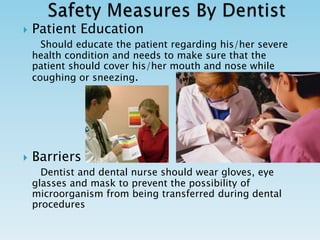
 Patient Education
Should educate the patient regarding his/her severe
health condition and needs to make sure that the
patient should cover his/her mouth and nose while
coughing or sneezing.
 Barriers
Dentist and dental nurse should wear gloves, eye
glasses and mask to prevent the possibility of
microorganism from being transferred during dental
procedures
 Sterilization
Proper sterilization of all the instruments should
be done before and after the treatment of that
patient. The dentist should also disinfect his/her
hand after treatment.
Tuberculosis and dentistry

Tuberculosis and dentistry

  • 1.
  • 2.
     What isTuberculosis?  Transmission  Diagnosis  TB in Pakistan  Relationship of TB with dentistry  Decision tree for dental management of TB patients  Safety measures by dentists
  • 3.
    Infectious disease causedby Mycobacterium Tuberculosis, which primarily affects the lungs but is also capable of involving almost any site in the body including the oral cavity.
  • 4.
     Aerosolized droplets5µm in diameter.  Estimated 5-200 orgs required for infection  Spreads through the air when a person: • Sneezes • Coughs • Speaks • Talks
  • 5.
     Chest x-raysAir appears black in lungs (radiograph)  Tuberculin skin test (TST or PPD)
  • 6.
     TB hasbeen prevalent in Pakistan and unfortunately it has been one of the neglected health areas in the past.  Pakistan ranks 6th amongst the countries with a highest burden of TB in the world.  Pakistan contributes about 44% of tuberculosis burden in the Eastern Mediterranean Region.  According to WHO, the incidence of sputum positive TB cases in Pakistan is 80/100,000 per year and for all types it is 177/100,000.  TB is responsible for 5.1 percent of the total national disease burden in Pakistan.  The impact of TB on socio economic status is substantial.
  • 7.
     In dentistry,the incidence of exposure to an active TB patient is quite low.  Oral lesions of TB are uncommon, with most cases appearing as a chronic painless ulcer.  This does not mean that the dental health care worker should not concern themselves with good diagnostic and preventive measures and realization that patients and other HCWs may be infected with TB.
  • 9.
     Patient Education Shouldeducate the patient regarding his/her severe health condition and needs to make sure that the patient should cover his/her mouth and nose while coughing or sneezing.  Barriers Dentist and dental nurse should wear gloves, eye glasses and mask to prevent the possibility of microorganism from being transferred during dental procedures
  • 10.
     Sterilization Proper sterilizationof all the instruments should be done before and after the treatment of that patient. The dentist should also disinfect his/her hand after treatment.