PRESENTED BY:
FASAHAT AHMED BUTT
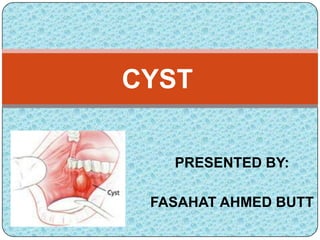
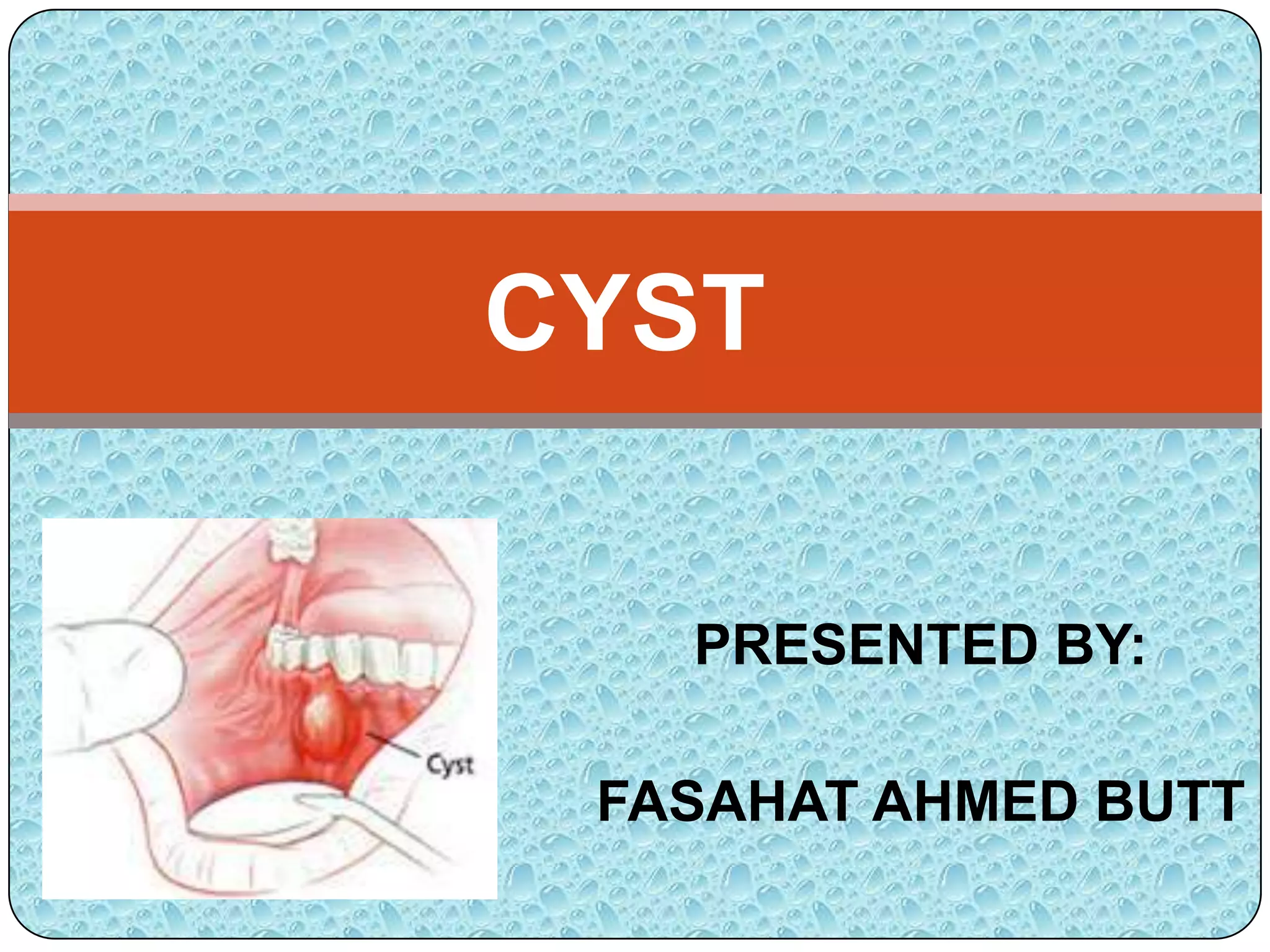
CYST
OBJECTIVES
What is cyst?
Types of cysts
a. Clinical features
b. Radiographic
findings
c. Histology
 Diagnosis
 Treatment
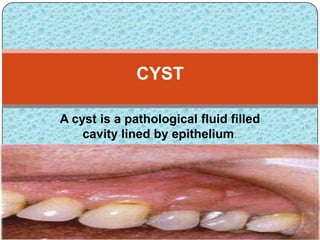
A cyst is a pathological fluid filled
cavity lined by epithelium.
CYST
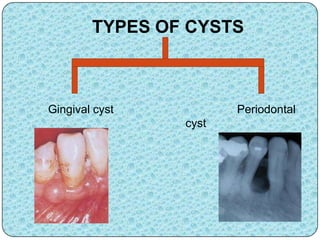
TYPES OF CYSTS
Gingival cyst Periodontal
cyst
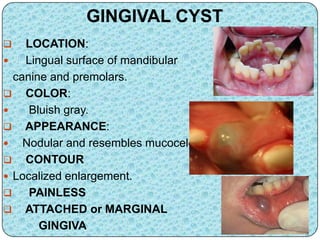
GINGIVAL CYST
 LOCATION:
 Lingual surface of mandibular
canine and premolars.
 COLOR:
 Bluish gray.
 APPEARANCE:
 Nodular and resembles mucocele
 CONTOUR
 Localized enlargement.
 PAINLESS
 ATTACHED or MARGINAL
GINGIVA
 ORIGIN
 Develop from odontogenic epithelium or
from surface or sulcular epithelium
RADIOGRAPHIC FINDINGS
 No radiographic findings because the usually
involve the soft tissues
HISTOLOGY
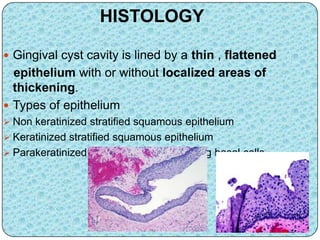
 Gingival cyst cavity is lined by a thin , flattened
epithelium with or without localized areas of
thickening.
 Types of epithelium
 Non keratinized stratified squamous epithelium
 Keratinized stratified squamous epithelium
 Parakeratinized epithelium with palisading basal cells
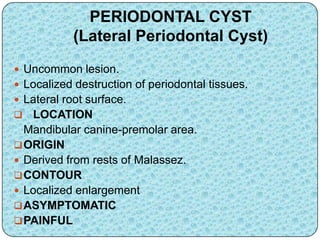
PERIODONTAL CYST
(Lateral Periodontal Cyst)
 Uncommon lesion.
 Localized destruction of periodontal tissues.
 Lateral root surface.
 LOCATION
Mandibular canine-premolar area.
ORIGIN
 Derived from rests of Malassez.
CONTOUR
 Localized enlargement
ASYMPTOMATIC
PAINFUL
RADIOGRAPHIC FINDINGS
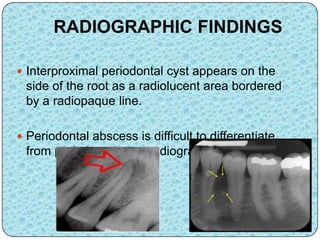
 Interproximal periodontal cyst appears on the
side of the root as a radiolucent area bordered
by a radiopaque line.
 Periodontal abscess is difficult to differentiate
from periodontal cyst, radiographically
`
Cyst Abscess
 Filled with fluid
 <1.5cm
 Gingiva appears
bluish gray
 Filled with puss
 2-10cm
 Gingiva appears red
HISTOLOGY
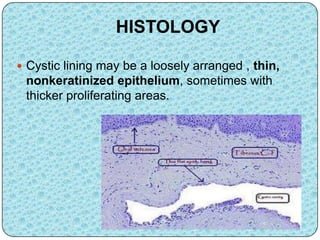
 Cystic lining may be a loosely arranged , thin,
nonkeratinized epithelium, sometimes with
thicker proliferating areas.
DIAGNOSIS
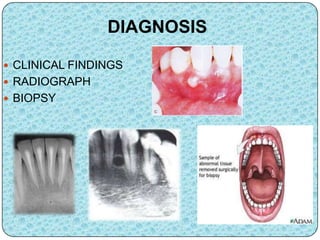
 CLINICAL FINDINGS
 RADIOGRAPH
 BIOPSY
TREATMENT
 Treatment is surgical excision and histopathologic
examination for a conclusive diagnosis.
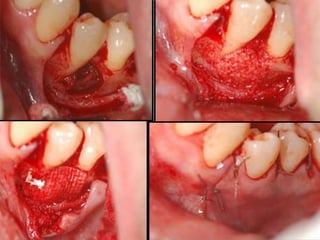
 ENUCLEATION
 MARSUPIALIZATION
 COMBINATION
 ENUCLEATION WITH CURETTAGE
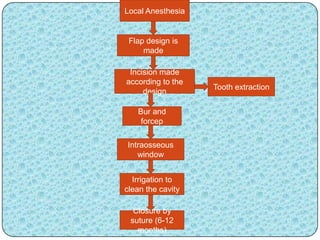
ENUCLEATION
 Enucleation means shelling out the entire cystic lesion
without rupture.
INDICATION:
 Small cyst, which can be done when the vital structures are
not involved.
Local Anesthesia
Flap design is
made
Incision made
according to the
design
Tooth extraction
Bur and
forcep
Intraosseous
window
Irrigation to
clean the cavity
Closure by
suture (6-12
months)
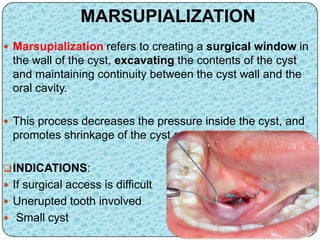
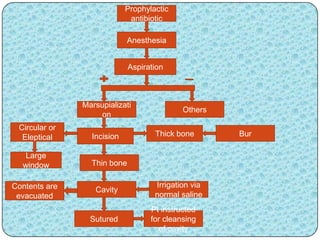
MARSUPIALIZATION
 Marsupialization refers to creating a surgical window in
the wall of the cyst, excavating the contents of the cyst
and maintaining continuity between the cyst wall and the
oral cavity.
 This process decreases the pressure inside the cyst, and
promotes shrinkage of the cyst as well as bone fill.
INDICATIONS:
 If surgical access is difficult
 Unerupted tooth involved
 Small cyst
Prophylactic
antibiotic
Anesthesia
Marsupializati
on
Others
Aspiration
Thin bone
Cavity
Incision
Circular or
Eleptical
Large
window
Thick bone Bur
Sutured
Pt instructed
for cleansing
of cavity
Contents are
evacuated
Irrigation via
normal saline
COMBINATION
 Combined approach morbidity and complete
healing of the defect.
 In this technique marsupialization is done first
and the enucleation is done at a later date.
 The advantage is that as marsupialization is
done first, it spares the vital structures. The size
of the cystic cavity also becomes small and after
healing the cystic lining becomes thick, making
enucleation easier at this stage.
ENUCLEATION WITH
CURETTAGE
 After enucleation is done, a curette or bur is used to
remove 1 to 2 millimeter of bone around the entire
periphery of cystic cavity.
INDICATIONS
 For cysts reported to have high recurrence rate, for
example odontogenic keratocyst
Advantages
 If enucleation leaves any remnants, curettage may remove
them thereby decreasing the likelihood of recurrence.
Disadvantage
 Curettage is more destructive to adjacent bone, blood
REFERRENCES
 CARRANZA
 EOP
 GOOGLE
Periodontology Cyst

Periodontology Cyst

  • 1.
  • 2.
    OBJECTIVES What is cyst? Typesof cysts a. Clinical features b. Radiographic findings c. Histology  Diagnosis  Treatment
  • 3.
    A cyst isa pathological fluid filled cavity lined by epithelium. CYST
  • 4.
    TYPES OF CYSTS Gingivalcyst Periodontal cyst
  • 5.
    GINGIVAL CYST  LOCATION: Lingual surface of mandibular canine and premolars.  COLOR:  Bluish gray.  APPEARANCE:  Nodular and resembles mucocele  CONTOUR  Localized enlargement.  PAINLESS  ATTACHED or MARGINAL GINGIVA
  • 6.
     ORIGIN  Developfrom odontogenic epithelium or from surface or sulcular epithelium
  • 7.
    RADIOGRAPHIC FINDINGS  Noradiographic findings because the usually involve the soft tissues
  • 8.
    HISTOLOGY  Gingival cystcavity is lined by a thin , flattened epithelium with or without localized areas of thickening.  Types of epithelium  Non keratinized stratified squamous epithelium  Keratinized stratified squamous epithelium  Parakeratinized epithelium with palisading basal cells
  • 9.
    PERIODONTAL CYST (Lateral PeriodontalCyst)  Uncommon lesion.  Localized destruction of periodontal tissues.  Lateral root surface.  LOCATION Mandibular canine-premolar area. ORIGIN  Derived from rests of Malassez. CONTOUR  Localized enlargement ASYMPTOMATIC PAINFUL
  • 10.
    RADIOGRAPHIC FINDINGS  Interproximalperiodontal cyst appears on the side of the root as a radiolucent area bordered by a radiopaque line.  Periodontal abscess is difficult to differentiate from periodontal cyst, radiographically
  • 11.
    ` Cyst Abscess  Filledwith fluid  <1.5cm  Gingiva appears bluish gray  Filled with puss  2-10cm  Gingiva appears red
  • 12.
    HISTOLOGY  Cystic liningmay be a loosely arranged , thin, nonkeratinized epithelium, sometimes with thicker proliferating areas.
  • 13.
  • 14.
    TREATMENT  Treatment issurgical excision and histopathologic examination for a conclusive diagnosis.  ENUCLEATION  MARSUPIALIZATION  COMBINATION  ENUCLEATION WITH CURETTAGE
  • 15.
    ENUCLEATION  Enucleation meansshelling out the entire cystic lesion without rupture. INDICATION:  Small cyst, which can be done when the vital structures are not involved.
  • 16.
    Local Anesthesia Flap designis made Incision made according to the design Tooth extraction Bur and forcep Intraosseous window Irrigation to clean the cavity Closure by suture (6-12 months)
  • 18.
    MARSUPIALIZATION  Marsupialization refersto creating a surgical window in the wall of the cyst, excavating the contents of the cyst and maintaining continuity between the cyst wall and the oral cavity.  This process decreases the pressure inside the cyst, and promotes shrinkage of the cyst as well as bone fill. INDICATIONS:  If surgical access is difficult  Unerupted tooth involved  Small cyst
  • 19.
    Prophylactic antibiotic Anesthesia Marsupializati on Others Aspiration Thin bone Cavity Incision Circular or Eleptical Large window Thickbone Bur Sutured Pt instructed for cleansing of cavity Contents are evacuated Irrigation via normal saline
  • 20.
    COMBINATION  Combined approachmorbidity and complete healing of the defect.  In this technique marsupialization is done first and the enucleation is done at a later date.  The advantage is that as marsupialization is done first, it spares the vital structures. The size of the cystic cavity also becomes small and after healing the cystic lining becomes thick, making enucleation easier at this stage.
  • 21.
    ENUCLEATION WITH CURETTAGE  Afterenucleation is done, a curette or bur is used to remove 1 to 2 millimeter of bone around the entire periphery of cystic cavity. INDICATIONS  For cysts reported to have high recurrence rate, for example odontogenic keratocyst Advantages  If enucleation leaves any remnants, curettage may remove them thereby decreasing the likelihood of recurrence. Disadvantage  Curettage is more destructive to adjacent bone, blood
  • 23.

Editor's Notes

  • #9 a)Histologic slide showing stratified squamous epithelium with areas of focal thickening b) Higher magnification showing corrugated parakeratin surface and palisaded basal cell layer.
  • #18 a)  Intrabony osseous defect before cyst enucleation. b) Following debridement, decortication and allograft placement. C) Collagen membrane adaptation. D)  Primary flap closure using 5.0 Dacron suture.
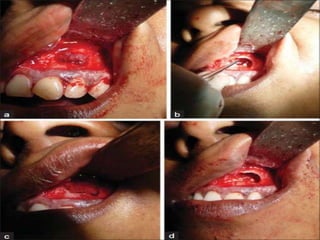
  • #23 (a) Exposure of the cyst, (b) Enucleation and curettage, (c) Soaking of the saline pack placed in the cystic cavity within seconds, (d) Achieving optimal hemostasis for retrograde filling