TSUNAMI
EFFECT
What does the word Tsunami mean?
• The term tsunami comes from the Japanese meaning harbour
and wave. Tsunamis are common throughout Japanese history;
approximately 195 events in Japan have been recorded over the
centuries.
• It was called this because Tsunamis can suck all the water
out of a harbour before the waves come back into
shore. These waves may grow more than 100 feet tall and
flatten whole villages. Hence its meaning.
What is a Tsunami?
• A tsunami is a series of great sea waves caused by an
underwater earthquake, landslide, or volcanic eruption. It is very
rare but sometimes a tsunami can be generated by a giant
meteor impact with the ocean
• Try and imagine when you have tossed a pebble into a pond,
then watched ripples spread out over the surface? Well a
Tsunami works in much the same way.
• These underwater earthquakes, landslides, or volcanic
eruptions can generate a tsunami by creating a sufficient force
and violent movement of the earth. This movement then
causes a substantial and sudden displacement of a massive
amount of water.
How it forms?
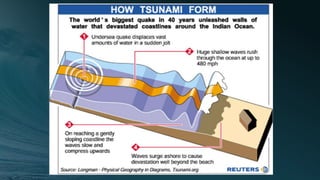
• When the ocean is deep tsunamis can travel unnoticed on the
surface at speeds up to 800 kms per hour, crossing the entire
ocean in a day or less! A tsunami may be less than 30cm in
height on the surface of the open ocean, which is why they are
not noticed by sailors.
• The powerful shock wave of energy travels rapidly through the
ocean as fast as a commercial jet. Once a tsunami reaches
shallow water near the coast it is slowed down. The top of the
wave moves faster than the bottom, causing the sea to rise
dramatically and wave to get allot bigger!
• Tsunamis have been known to get as high as 30 meters,
however most tsunamis cause the sea to rise no more than 9
meters.
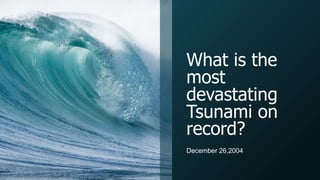
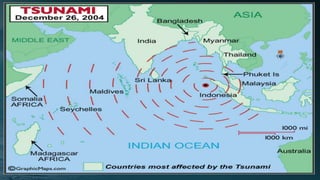
What is the
most
devastating
Tsunami on
record?
December 26,2004
Made
by
lalith
sai
• Nalanda vidya nikethan , vijayawada

Tsunami

  • 1.
  • 2.
    What does theword Tsunami mean? • The term tsunami comes from the Japanese meaning harbour and wave. Tsunamis are common throughout Japanese history; approximately 195 events in Japan have been recorded over the centuries. • It was called this because Tsunamis can suck all the water out of a harbour before the waves come back into shore. These waves may grow more than 100 feet tall and flatten whole villages. Hence its meaning.
  • 3.
    What is aTsunami? • A tsunami is a series of great sea waves caused by an underwater earthquake, landslide, or volcanic eruption. It is very rare but sometimes a tsunami can be generated by a giant meteor impact with the ocean • Try and imagine when you have tossed a pebble into a pond, then watched ripples spread out over the surface? Well a Tsunami works in much the same way. • These underwater earthquakes, landslides, or volcanic eruptions can generate a tsunami by creating a sufficient force and violent movement of the earth. This movement then causes a substantial and sudden displacement of a massive amount of water.
  • 5.
    How it forms? •When the ocean is deep tsunamis can travel unnoticed on the surface at speeds up to 800 kms per hour, crossing the entire ocean in a day or less! A tsunami may be less than 30cm in height on the surface of the open ocean, which is why they are not noticed by sailors. • The powerful shock wave of energy travels rapidly through the ocean as fast as a commercial jet. Once a tsunami reaches shallow water near the coast it is slowed down. The top of the wave moves faster than the bottom, causing the sea to rise dramatically and wave to get allot bigger! • Tsunamis have been known to get as high as 30 meters, however most tsunamis cause the sea to rise no more than 9 meters.
  • 6.
    What is the most devastating Tsunamion record? December 26,2004
  • 12.