Research
Objectives
• To rekindle passion and commitment in
writing research
• To enhance prior skills in research
• Relate research findings in the delivery of
technical assistance
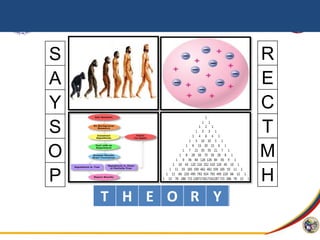
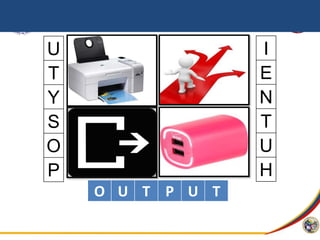
4 PICS
1
E
S
A
Y
S
O
P
R
E
C
T
M
H
T H E O R Y
T P
U
T
Y
S
O
P
I
E
N
T
U
H
O U T P U T
U
T
C
D
O
P
I
E
N
T
U
A
D A
E D U C A T I O N
7
What is research?
• research. 1.a. the systematic investigation
into and study of materials, sources, etc, in
order to establish facts and reach new
conclusions. b. an endeavour to discover
new or collate old facts etc by the scientific
study of a subject or by a course of critical
investigation. [Oxford Concise Dictionary]
8
What is research?
• Research is what we do when we have a question or
a problem we want to resolve
• We may already think we know the answer to our
question already
• We may think the answer is obvious, common sense
even
• But until we have subjected our problem to rigorous
scientific scrutiny, our 'knowledge' remains little
more than guesswork or at best, intuition.
9
What is research?
• First priority is to formulate your question
• Then figure out how you are going to answer
it
– How have others answered it?
– How does your proposal fit in with what others
have done?
– How will you know when you have answered it?
• Then you can present your answer
Why Educational Research is
Important?
• Accountability -- Education is a public trust, therefore it has a
responsibility to be wise in it’s decision making.
• There are three main reasons Research is important…..
– Money – Time – Outcomes (status)
• Education spends a lot of money.
– Programs, personnel, eq, books, software, facilities
– What is the cost of a bad decision?
• Even if it was not money what would it be?
– Time – Time spent in activities that are not productive.
– Loss or gains in student learning -- After all that is why we exist
How important is
research in our
daily life?
Presentation Flow
DEPARTMENT OF EDUCATION-BUREAU OF CURRICULUM DEVELOPMENT
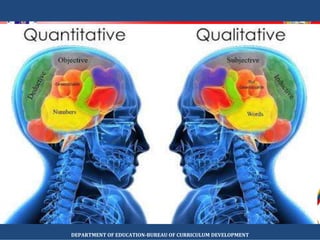
It’s a Practical World!
DEPARTMENT OF EDUCATION-BUREAU OF CURRICULUM DEVELOPMENT
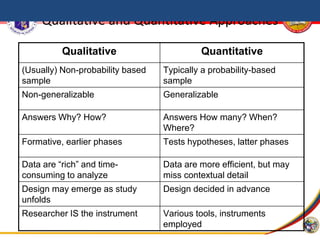
Qualitative and Quantitative Approaches
Qualitative Quantitative
(Usually) Non-probability based
sample
Typically a probability-based
sample
Non-generalizable Generalizable
Answers Why? How? Answers How many? When?
Where?
Formative, earlier phases Tests hypotheses, latter phases
Data are “rich” and time-
consuming to analyze
Data are more efficient, but may
miss contextual detail
Design may emerge as study
unfolds
Design decided in advance
Researcher IS the instrument Various tools, instruments
employed
DEPARTMENT OF EDUCATION-BUREAU OF CURRICULUM DEVELOPMENT
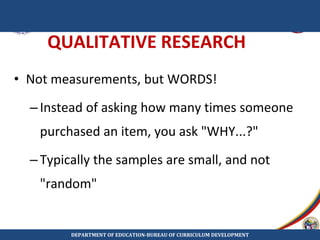
QUALITATIVE RESEARCH
• Not measurements, but WORDS!
–Instead of asking how many times someone
purchased an item, you ask "WHY...?"
–Typically the samples are small, and not
"random"
DEPARTMENT OF EDUCATION-BUREAU OF CURRICULUM DEVELOPMENT
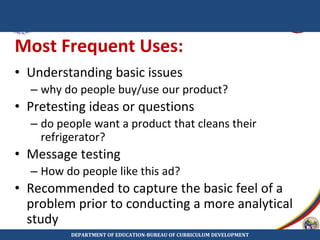
Most Frequent Uses:
• Understanding basic issues
– why do people buy/use our product?
• Pretesting ideas or questions
– do people want a product that cleans their
refrigerator?
• Message testing
– How do people like this ad?
• Recommended to capture the basic feel of a
problem prior to conducting a more analytical
study
DEPARTMENT OF EDUCATION-BUREAU OF CURRICULUM DEVELOPMENT
Strengths
• Can’t extrapolate to the whole population
• Volume of data
• Complexity of analysis
• Time-consuming nature of the clerical efforts require
•Good for examining feelings and motivations
•Allows for complexity and depth of issues
•Provides insights
Weaknesses
DEPARTMENT OF EDUCATION-BUREAU OF CURRICULUM DEVELOPMENT
Philosophy and Qualitative Research
❑Frameworks are not used the same as in quantitative
❑The goal is not theory testing
❑Each study should be guided by a particular
philosophical stance
Philosophical Stance assists to:
(a) directs the question(s) that are asked
(b) the observations which are made
(c) the interpretation of data
DEPARTMENT OF EDUCATION-BUREAU OF CURRICULUM DEVELOPMENT
Qualitative Designs
PHASES of a Qualitative Study:
❑Orientation an overview
❑Focused exploration
❑Focused confirmation and
closure
DEPARTMENT OF EDUCATION-BUREAU OF CURRICULUM DEVELOPMENT
Qualitative Design Features
❑Control over the independent
variable
❑Type of group comparisons
❑Number of data collection points
❑Occurrence of the independent &
dependent variables
DEPARTMENT OF EDUCATION-BUREAU OF CURRICULUM DEVELOPMENT
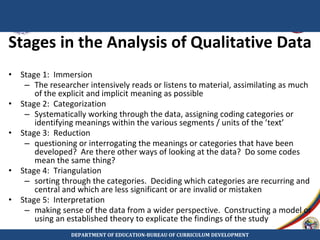
Stages in the Analysis of Qualitative Data
• Stage 1: Immersion
– The researcher intensively reads or listens to material, assimilating as much
of the explicit and implicit meaning as possible
• Stage 2: Categorization
– Systematically working through the data, assigning coding categories or
identifying meanings within the various segments / units of the ’text’
• Stage 3: Reduction
– questioning or interrogating the meanings or categories that have been
developed? Are there other ways of looking at the data? Do some codes
mean the same thing?
• Stage 4: Triangulation
– sorting through the categories. Deciding which categories are recurring and
central and which are less significant or are invalid or mistaken
• Stage 5: Interpretation
– making sense of the data from a wider perspective. Constructing a model or
using an established theory to explicate the findings of the study
DEPARTMENT OF EDUCATION-BUREAU OF CURRICULUM DEVELOPMENT
Research Findings must be
utilized . . .
Thank you!!!
To God be the glory!

Research.pptx

  • 1.
  • 2.
    Objectives • To rekindlepassion and commitment in writing research • To enhance prior skills in research • Relate research findings in the delivery of technical assistance
  • 3.
  • 4.
  • 5.
  • 6.
  • 7.
    7 What is research? •research. 1.a. the systematic investigation into and study of materials, sources, etc, in order to establish facts and reach new conclusions. b. an endeavour to discover new or collate old facts etc by the scientific study of a subject or by a course of critical investigation. [Oxford Concise Dictionary]
  • 8.
    8 What is research? •Research is what we do when we have a question or a problem we want to resolve • We may already think we know the answer to our question already • We may think the answer is obvious, common sense even • But until we have subjected our problem to rigorous scientific scrutiny, our 'knowledge' remains little more than guesswork or at best, intuition.
  • 9.
    9 What is research? •First priority is to formulate your question • Then figure out how you are going to answer it – How have others answered it? – How does your proposal fit in with what others have done? – How will you know when you have answered it? • Then you can present your answer
  • 10.
    Why Educational Researchis Important? • Accountability -- Education is a public trust, therefore it has a responsibility to be wise in it’s decision making. • There are three main reasons Research is important….. – Money – Time – Outcomes (status) • Education spends a lot of money. – Programs, personnel, eq, books, software, facilities – What is the cost of a bad decision? • Even if it was not money what would it be? – Time – Time spent in activities that are not productive. – Loss or gains in student learning -- After all that is why we exist
  • 11.
    How important is researchin our daily life? Presentation Flow DEPARTMENT OF EDUCATION-BUREAU OF CURRICULUM DEVELOPMENT
  • 12.
    It’s a PracticalWorld! DEPARTMENT OF EDUCATION-BUREAU OF CURRICULUM DEVELOPMENT
  • 13.
    Qualitative and QuantitativeApproaches Qualitative Quantitative (Usually) Non-probability based sample Typically a probability-based sample Non-generalizable Generalizable Answers Why? How? Answers How many? When? Where? Formative, earlier phases Tests hypotheses, latter phases Data are “rich” and time- consuming to analyze Data are more efficient, but may miss contextual detail Design may emerge as study unfolds Design decided in advance Researcher IS the instrument Various tools, instruments employed
  • 14.
    DEPARTMENT OF EDUCATION-BUREAUOF CURRICULUM DEVELOPMENT
  • 15.
    QUALITATIVE RESEARCH • Notmeasurements, but WORDS! –Instead of asking how many times someone purchased an item, you ask "WHY...?" –Typically the samples are small, and not "random" DEPARTMENT OF EDUCATION-BUREAU OF CURRICULUM DEVELOPMENT
  • 16.
    Most Frequent Uses: •Understanding basic issues – why do people buy/use our product? • Pretesting ideas or questions – do people want a product that cleans their refrigerator? • Message testing – How do people like this ad? • Recommended to capture the basic feel of a problem prior to conducting a more analytical study DEPARTMENT OF EDUCATION-BUREAU OF CURRICULUM DEVELOPMENT
  • 17.
    Strengths • Can’t extrapolateto the whole population • Volume of data • Complexity of analysis • Time-consuming nature of the clerical efforts require •Good for examining feelings and motivations •Allows for complexity and depth of issues •Provides insights Weaknesses DEPARTMENT OF EDUCATION-BUREAU OF CURRICULUM DEVELOPMENT
  • 18.
    DEPARTMENT OF EDUCATION-BUREAUOF CURRICULUM DEVELOPMENT
  • 19.
    Philosophy and QualitativeResearch ❑Frameworks are not used the same as in quantitative ❑The goal is not theory testing ❑Each study should be guided by a particular philosophical stance Philosophical Stance assists to: (a) directs the question(s) that are asked (b) the observations which are made (c) the interpretation of data DEPARTMENT OF EDUCATION-BUREAU OF CURRICULUM DEVELOPMENT
  • 20.
    Qualitative Designs PHASES ofa Qualitative Study: ❑Orientation an overview ❑Focused exploration ❑Focused confirmation and closure DEPARTMENT OF EDUCATION-BUREAU OF CURRICULUM DEVELOPMENT
  • 21.
    Qualitative Design Features ❑Controlover the independent variable ❑Type of group comparisons ❑Number of data collection points ❑Occurrence of the independent & dependent variables DEPARTMENT OF EDUCATION-BUREAU OF CURRICULUM DEVELOPMENT
  • 23.
    Stages in theAnalysis of Qualitative Data • Stage 1: Immersion – The researcher intensively reads or listens to material, assimilating as much of the explicit and implicit meaning as possible • Stage 2: Categorization – Systematically working through the data, assigning coding categories or identifying meanings within the various segments / units of the ’text’ • Stage 3: Reduction – questioning or interrogating the meanings or categories that have been developed? Are there other ways of looking at the data? Do some codes mean the same thing? • Stage 4: Triangulation – sorting through the categories. Deciding which categories are recurring and central and which are less significant or are invalid or mistaken • Stage 5: Interpretation – making sense of the data from a wider perspective. Constructing a model or using an established theory to explicate the findings of the study DEPARTMENT OF EDUCATION-BUREAU OF CURRICULUM DEVELOPMENT
  • 24.
    Research Findings mustbe utilized . . .
  • 25.
    Thank you!!! To Godbe the glory!