An Introduction to the
Research Process
Dr Vicente Chua Reyes, Jr.
© 2009, Vicente Chua Reyes, Jr. PHD. All rights reserved.
Copyright © 2008 by Pearson Education, Inc.
Upper Saddle River, New Jersey 07458
All rights reserved.
By the end of this module, you
should be able to:
 Define educational research
 Identify the importance of educational
research
 Name problems with research today
 Describe the research process
 Identify ethical considerations in conducting
research
 Reflect on the skills you bring to the research
process
Adapted from : John W. Creswell Educational Research:
Planning, Conducting, and Evaluating Quantitative and
Qualitative Research, third edition
© 2009, Vicente Chua Reyes, Jr. PHD. All rights reserved.
Copyright © 2008 by Pearson Education, Inc.
Upper Saddle River, New Jersey 07458
All rights reserved.
What Is Research?
 The researcher asks a question.
 The researcher collects data.
 The researcher indicates how the data
answered the question.
Adapted from : John W. Creswell Educational Research:
Planning, Conducting, and Evaluating Quantitative and
Qualitative Research, third edition
© 2009, Vicente Chua Reyes, Jr. PHD. All rights reserved.
Copyright © 2008 by Pearson Education, Inc.
Upper Saddle River, New Jersey 07458
All rights reserved.
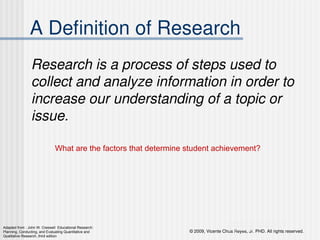
A Definition of Research
Research is a process of steps used to
collect and analyze information in order to
increase our understanding of a topic or
issue.
Adapted from : John W. Creswell Educational Research:
Planning, Conducting, and Evaluating Quantitative and
Qualitative Research, third edition
What are the factors that determine student achievement?
© 2009, Vicente Chua Reyes, Jr. PHD. All rights reserved.
Copyright © 2008 by Pearson Education, Inc.
Upper Saddle River, New Jersey 07458
All rights reserved.
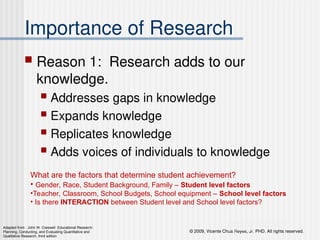
Importance of Research
 Reason 1: Research adds to our
knowledge.
 Addresses gaps in knowledge
 Expands knowledge
 Replicates knowledge
 Adds voices of individuals to knowledge
Adapted from : John W. Creswell Educational Research:
Planning, Conducting, and Evaluating Quantitative and
Qualitative Research, third edition
What are the factors that determine student achievement?
• Gender, Race, Student Background, Family – Student level factors
•Teacher, Classroom, School Budgets, School equipment – School level factors
• Is there INTERACTION between Student level and School level factors?
© 2009, Vicente Chua Reyes, Jr. PHD. All rights reserved.
Copyright © 2008 by Pearson Education, Inc.
Upper Saddle River, New Jersey 07458
All rights reserved.
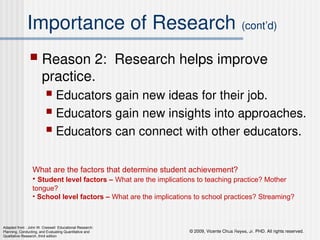
Importance of Research (cont’d)
 Reason 2: Research helps improve
practice.
 Educators gain new ideas for their job.
 Educators gain new insights into approaches.
 Educators can connect with other educators.
Adapted from : John W. Creswell Educational Research:
Planning, Conducting, and Evaluating Quantitative and
Qualitative Research, third edition
What are the factors that determine student achievement?
• Student level factors – What are the implications to teaching practice? Mother
tongue?
• School level factors – What are the implications to school practices? Streaming?
© 2009, Vicente Chua Reyes, Jr. PHD. All rights reserved.
Copyright © 2008 by Pearson Education, Inc.
Upper Saddle River, New Jersey 07458
All rights reserved.
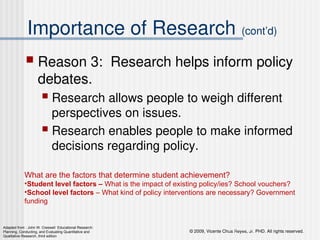
Importance of Research (cont’d)
 Reason 3: Research helps inform policy
debates.
 Research allows people to weigh different
perspectives on issues.
 Research enables people to make informed
decisions regarding policy.
Adapted from : John W. Creswell Educational Research:
Planning, Conducting, and Evaluating Quantitative and
Qualitative Research, third edition
What are the factors that determine student achievement?
•Student level factors – What is the impact of existing policy/ies? School vouchers?
•School level factors – What kind of policy interventions are necessary? Government
funding
© 2009, Vicente Chua Reyes, Jr. PHD. All rights reserved.
Copyright © 2008 by Pearson Education, Inc.
Upper Saddle River, New Jersey 07458
All rights reserved.
Problems with Research Today
 Contradictory or vague findings
 Questionable data
 Unclear statements about the intent
of the study
 Lack of full disclosure of the data
collection procedure
 Inarticulate rendering of the
research problem
Adapted from : John W. Creswell Educational Research:
Planning, Conducting, and Evaluating Quantitative and
Qualitative Research, third edition
© 2009, Vicente Chua Reyes, Jr. PHD. All rights reserved.
Copyright © 2008 by Pearson Education, Inc.
Upper Saddle River, New Jersey 07458
All rights reserved.
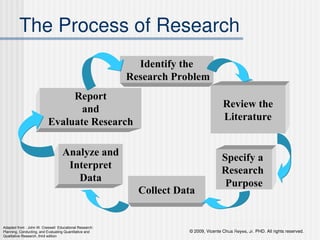
The Process of Research
Adapted from : John W. Creswell Educational Research:
Planning, Conducting, and Evaluating Quantitative and
Qualitative Research, third edition
Identify the
Research Problem
Review the
Literature
Report
and
Evaluate Research
Specify a
Research
Purpose
Collect Data
Analyze and
Interpret
Data
© 2009, Vicente Chua Reyes, Jr. PHD. All rights reserved.
Copyright © 2008 by Pearson Education, Inc.
Upper Saddle River, New Jersey 07458
All rights reserved.
The Process of Research:
Identify the Research Problem
 Specify a problem
 Justify a problem
 Suggest a need to study the problem for
audiences
Adapted from : John W. Creswell Educational Research:
Planning, Conducting, and Evaluating Quantitative and
Qualitative Research, third edition
© 2009, Vicente Chua Reyes, Jr. PHD. All rights reserved.
Copyright © 2008 by Pearson Education, Inc.
Upper Saddle River, New Jersey 07458
All rights reserved.
The Process of Research:
Review the Literature
 Locate resources
 Books
 Journals
 Electronic resources
 Select resources
 Determine the relevant resources for the topic
 Organize the resources by developing a
“Literature Map”
 Summarize the resources in a literature
review
Adapted from : John W. Creswell Educational Research:
Planning, Conducting, and Evaluating Quantitative and
Qualitative Research, third edition
© 2009, Vicente Chua Reyes, Jr. PHD. All rights reserved.
Copyright © 2008 by Pearson Education, Inc.
Upper Saddle River, New Jersey 07458
All rights reserved.
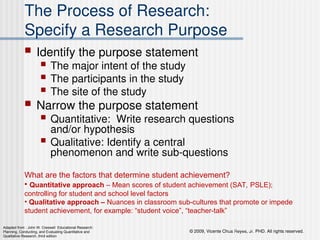
The Process of Research:
Specify a Research Purpose
 Identify the purpose statement
 The major intent of the study
 The participants in the study
 The site of the study
 Narrow the purpose statement
 Quantitative: Write research questions
and/or hypothesis
 Qualitative: Identify a central
phenomenon and write sub-questions
Adapted from : John W. Creswell Educational Research:
Planning, Conducting, and Evaluating Quantitative and
Qualitative Research, third edition
What are the factors that determine student achievement?
• Quantitative approach – Mean scores of student achievement (SAT, PSLE);
controlling for student and school level factors
• Qualitative approach – Nuances in classroom sub-cultures that promote or impede
student achievement, for example: “student voice”, “teacher-talk”
© 2009, Vicente Chua Reyes, Jr. PHD. All rights reserved.
Copyright © 2008 by Pearson Education, Inc.
Upper Saddle River, New Jersey 07458
All rights reserved.
The Research Process:
Collect Data
 Determine the data collection method
 Select the individuals to study
 Design data collection instruments
and outline data collection procedures
 Obtain permissions
 Gather data
Adapted from : John W. Creswell Educational Research:
Planning, Conducting, and Evaluating Quantitative and
Qualitative Research, third edition
© 2009, Vicente Chua Reyes, Jr. PHD. All rights reserved.
Copyright © 2008 by Pearson Education, Inc.
Upper Saddle River, New Jersey 07458
All rights reserved.
The Research Process:
Analyze and Interpret Data
 Take the data apart to look at individual
responses
 Represent the data in tables, figures,
and pictures
 Explain conclusions from the data that
address the research questions
Adapted from : John W. Creswell Educational Research:
Planning, Conducting, and Evaluating Quantitative and
Qualitative Research, third edition
© 2009, Vicente Chua Reyes, Jr. PHD. All rights reserved.
Copyright © 2008 by Pearson Education, Inc.
Upper Saddle River, New Jersey 07458
All rights reserved.
The Research Process:
Report and Evaluate Research
 Report research
 Determine the audience for the report
 Structure the report
 Write the report sensitively and accurately
 Evaluate research
 Assess the quality of research using
recognized standards in a discipline
 Standards can come from the academic
community, school districts, or federal or
state agencies
Adapted from : John W. Creswell Educational Research:
Planning, Conducting, and Evaluating Quantitative and
Qualitative Research, third edition
© 2009, Vicente Chua Reyes, Jr. PHD. All rights reserved.
Copyright © 2008 by Pearson Education, Inc.
Upper Saddle River, New Jersey 07458
All rights reserved.
Ethical Considerations in Research
 Respect the rights of the participants
 Honor the requests and restrictions of the
research site
 Report the research fully and honestly
Adapted from : John W. Creswell Educational Research:
Planning, Conducting, and Evaluating Quantitative and
Qualitative Research, third edition
© 2009, Vicente Chua Reyes, Jr. PHD. All rights reserved.
Copyright © 2008 by Pearson Education, Inc.
Upper Saddle River, New Jersey 07458
All rights reserved.
Skills Needed for Research
 Curiosity to solve puzzles
 Long attention span
 Library and computer resource skills
 Writing and editing skills
Adapted from : John W. Creswell Educational Research:
Planning, Conducting, and Evaluating Quantitative and
Qualitative Research, third edition

Introduction-to-the-research-process.ppt

  • 1.
    An Introduction tothe Research Process Dr Vicente Chua Reyes, Jr.
  • 2.
    © 2009, VicenteChua Reyes, Jr. PHD. All rights reserved. Copyright © 2008 by Pearson Education, Inc. Upper Saddle River, New Jersey 07458 All rights reserved. By the end of this module, you should be able to:  Define educational research  Identify the importance of educational research  Name problems with research today  Describe the research process  Identify ethical considerations in conducting research  Reflect on the skills you bring to the research process Adapted from : John W. Creswell Educational Research: Planning, Conducting, and Evaluating Quantitative and Qualitative Research, third edition
  • 3.
    © 2009, VicenteChua Reyes, Jr. PHD. All rights reserved. Copyright © 2008 by Pearson Education, Inc. Upper Saddle River, New Jersey 07458 All rights reserved. What Is Research?  The researcher asks a question.  The researcher collects data.  The researcher indicates how the data answered the question. Adapted from : John W. Creswell Educational Research: Planning, Conducting, and Evaluating Quantitative and Qualitative Research, third edition
  • 4.
    © 2009, VicenteChua Reyes, Jr. PHD. All rights reserved. Copyright © 2008 by Pearson Education, Inc. Upper Saddle River, New Jersey 07458 All rights reserved. A Definition of Research Research is a process of steps used to collect and analyze information in order to increase our understanding of a topic or issue. Adapted from : John W. Creswell Educational Research: Planning, Conducting, and Evaluating Quantitative and Qualitative Research, third edition What are the factors that determine student achievement?
  • 5.
    © 2009, VicenteChua Reyes, Jr. PHD. All rights reserved. Copyright © 2008 by Pearson Education, Inc. Upper Saddle River, New Jersey 07458 All rights reserved. Importance of Research  Reason 1: Research adds to our knowledge.  Addresses gaps in knowledge  Expands knowledge  Replicates knowledge  Adds voices of individuals to knowledge Adapted from : John W. Creswell Educational Research: Planning, Conducting, and Evaluating Quantitative and Qualitative Research, third edition What are the factors that determine student achievement? • Gender, Race, Student Background, Family – Student level factors •Teacher, Classroom, School Budgets, School equipment – School level factors • Is there INTERACTION between Student level and School level factors?
  • 6.
    © 2009, VicenteChua Reyes, Jr. PHD. All rights reserved. Copyright © 2008 by Pearson Education, Inc. Upper Saddle River, New Jersey 07458 All rights reserved. Importance of Research (cont’d)  Reason 2: Research helps improve practice.  Educators gain new ideas for their job.  Educators gain new insights into approaches.  Educators can connect with other educators. Adapted from : John W. Creswell Educational Research: Planning, Conducting, and Evaluating Quantitative and Qualitative Research, third edition What are the factors that determine student achievement? • Student level factors – What are the implications to teaching practice? Mother tongue? • School level factors – What are the implications to school practices? Streaming?
  • 7.
    © 2009, VicenteChua Reyes, Jr. PHD. All rights reserved. Copyright © 2008 by Pearson Education, Inc. Upper Saddle River, New Jersey 07458 All rights reserved. Importance of Research (cont’d)  Reason 3: Research helps inform policy debates.  Research allows people to weigh different perspectives on issues.  Research enables people to make informed decisions regarding policy. Adapted from : John W. Creswell Educational Research: Planning, Conducting, and Evaluating Quantitative and Qualitative Research, third edition What are the factors that determine student achievement? •Student level factors – What is the impact of existing policy/ies? School vouchers? •School level factors – What kind of policy interventions are necessary? Government funding
  • 8.
    © 2009, VicenteChua Reyes, Jr. PHD. All rights reserved. Copyright © 2008 by Pearson Education, Inc. Upper Saddle River, New Jersey 07458 All rights reserved. Problems with Research Today  Contradictory or vague findings  Questionable data  Unclear statements about the intent of the study  Lack of full disclosure of the data collection procedure  Inarticulate rendering of the research problem Adapted from : John W. Creswell Educational Research: Planning, Conducting, and Evaluating Quantitative and Qualitative Research, third edition
  • 9.
    © 2009, VicenteChua Reyes, Jr. PHD. All rights reserved. Copyright © 2008 by Pearson Education, Inc. Upper Saddle River, New Jersey 07458 All rights reserved. The Process of Research Adapted from : John W. Creswell Educational Research: Planning, Conducting, and Evaluating Quantitative and Qualitative Research, third edition Identify the Research Problem Review the Literature Report and Evaluate Research Specify a Research Purpose Collect Data Analyze and Interpret Data
  • 10.
    © 2009, VicenteChua Reyes, Jr. PHD. All rights reserved. Copyright © 2008 by Pearson Education, Inc. Upper Saddle River, New Jersey 07458 All rights reserved. The Process of Research: Identify the Research Problem  Specify a problem  Justify a problem  Suggest a need to study the problem for audiences Adapted from : John W. Creswell Educational Research: Planning, Conducting, and Evaluating Quantitative and Qualitative Research, third edition
  • 11.
    © 2009, VicenteChua Reyes, Jr. PHD. All rights reserved. Copyright © 2008 by Pearson Education, Inc. Upper Saddle River, New Jersey 07458 All rights reserved. The Process of Research: Review the Literature  Locate resources  Books  Journals  Electronic resources  Select resources  Determine the relevant resources for the topic  Organize the resources by developing a “Literature Map”  Summarize the resources in a literature review Adapted from : John W. Creswell Educational Research: Planning, Conducting, and Evaluating Quantitative and Qualitative Research, third edition
  • 12.
    © 2009, VicenteChua Reyes, Jr. PHD. All rights reserved. Copyright © 2008 by Pearson Education, Inc. Upper Saddle River, New Jersey 07458 All rights reserved. The Process of Research: Specify a Research Purpose  Identify the purpose statement  The major intent of the study  The participants in the study  The site of the study  Narrow the purpose statement  Quantitative: Write research questions and/or hypothesis  Qualitative: Identify a central phenomenon and write sub-questions Adapted from : John W. Creswell Educational Research: Planning, Conducting, and Evaluating Quantitative and Qualitative Research, third edition What are the factors that determine student achievement? • Quantitative approach – Mean scores of student achievement (SAT, PSLE); controlling for student and school level factors • Qualitative approach – Nuances in classroom sub-cultures that promote or impede student achievement, for example: “student voice”, “teacher-talk”
  • 13.
    © 2009, VicenteChua Reyes, Jr. PHD. All rights reserved. Copyright © 2008 by Pearson Education, Inc. Upper Saddle River, New Jersey 07458 All rights reserved. The Research Process: Collect Data  Determine the data collection method  Select the individuals to study  Design data collection instruments and outline data collection procedures  Obtain permissions  Gather data Adapted from : John W. Creswell Educational Research: Planning, Conducting, and Evaluating Quantitative and Qualitative Research, third edition
  • 14.
    © 2009, VicenteChua Reyes, Jr. PHD. All rights reserved. Copyright © 2008 by Pearson Education, Inc. Upper Saddle River, New Jersey 07458 All rights reserved. The Research Process: Analyze and Interpret Data  Take the data apart to look at individual responses  Represent the data in tables, figures, and pictures  Explain conclusions from the data that address the research questions Adapted from : John W. Creswell Educational Research: Planning, Conducting, and Evaluating Quantitative and Qualitative Research, third edition
  • 15.
    © 2009, VicenteChua Reyes, Jr. PHD. All rights reserved. Copyright © 2008 by Pearson Education, Inc. Upper Saddle River, New Jersey 07458 All rights reserved. The Research Process: Report and Evaluate Research  Report research  Determine the audience for the report  Structure the report  Write the report sensitively and accurately  Evaluate research  Assess the quality of research using recognized standards in a discipline  Standards can come from the academic community, school districts, or federal or state agencies Adapted from : John W. Creswell Educational Research: Planning, Conducting, and Evaluating Quantitative and Qualitative Research, third edition
  • 16.
    © 2009, VicenteChua Reyes, Jr. PHD. All rights reserved. Copyright © 2008 by Pearson Education, Inc. Upper Saddle River, New Jersey 07458 All rights reserved. Ethical Considerations in Research  Respect the rights of the participants  Honor the requests and restrictions of the research site  Report the research fully and honestly Adapted from : John W. Creswell Educational Research: Planning, Conducting, and Evaluating Quantitative and Qualitative Research, third edition
  • 17.
    © 2009, VicenteChua Reyes, Jr. PHD. All rights reserved. Copyright © 2008 by Pearson Education, Inc. Upper Saddle River, New Jersey 07458 All rights reserved. Skills Needed for Research  Curiosity to solve puzzles  Long attention span  Library and computer resource skills  Writing and editing skills Adapted from : John W. Creswell Educational Research: Planning, Conducting, and Evaluating Quantitative and Qualitative Research, third edition