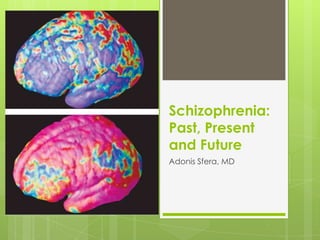
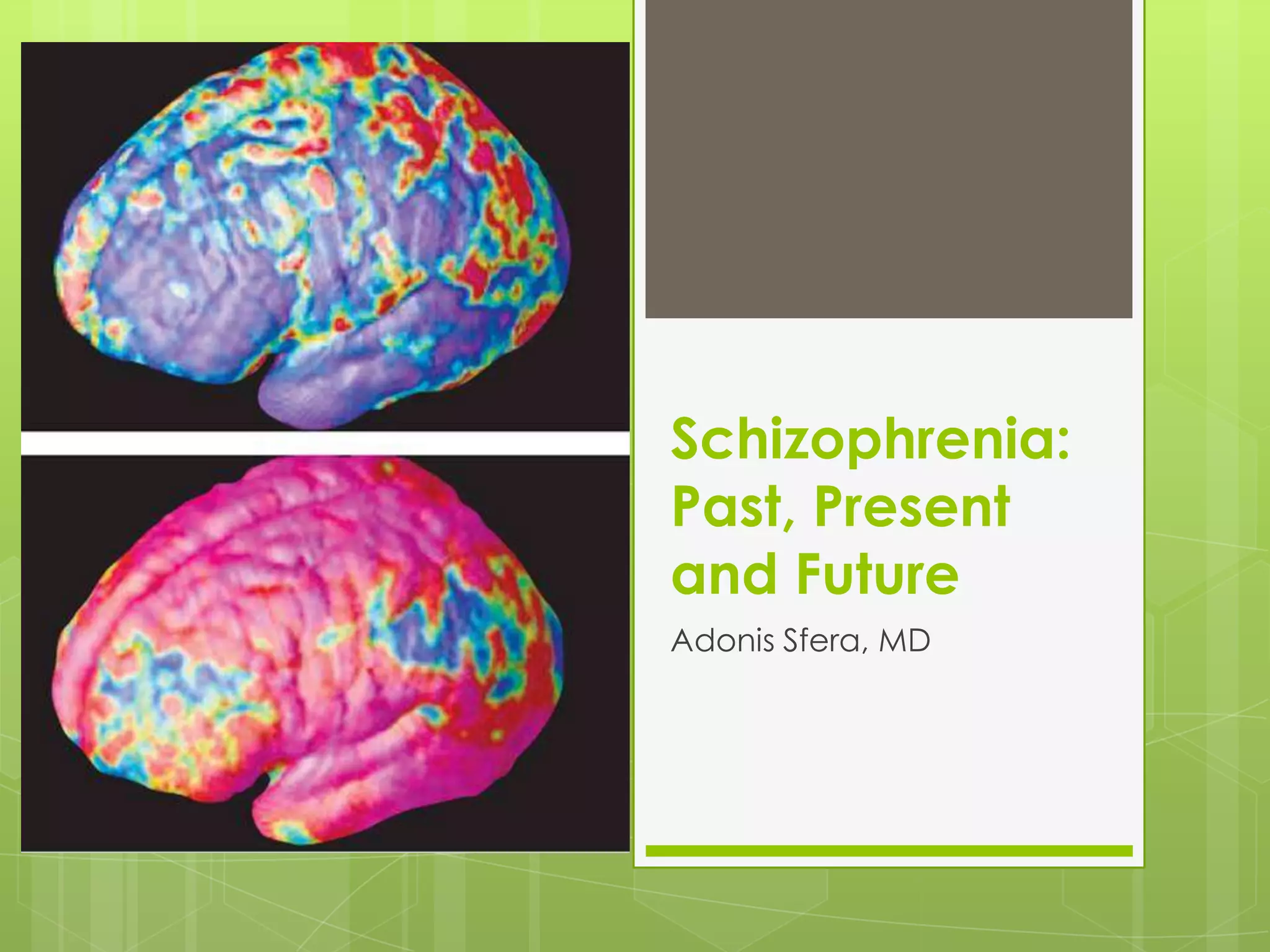
Schizophrenia:
Past, Present
and Future
Adonis Sfera, MD
This year alone

 100,000
        young people will have a first
 episode of schizophrenia.

 5%of people with schizophrenia will die
 by suicide.
One Hundred Years of Schizophrenia
A  century ago we had large public institutions for
  severe mental illness, tuberculosis and leprosy.

 Of these three, today only mental illness, especially
  schizophrenia, remains unchanged in prevalence
  and disability .

 Sustained  recovery is less than 14% within the first 5
  years following a psychotic episode.

Thomas Insel; Rethinking Schizophrenia; Nature vol 468, November 201; doi:10.1038/nature09552
Schizophrenia: The Past


   Francisco Goya – The Madhouse 1812
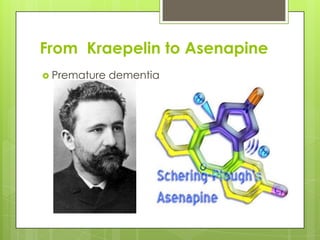
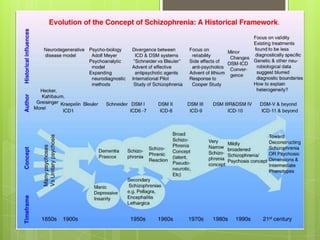
From Kraepelin to Asenapine
 Premature   dementia
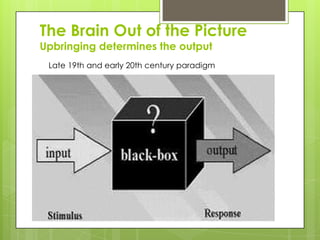
The Brain Out of the Picture
Upbringing determines the output
 Late 19th and early 20th century paradigm
Biochemical Paradigm
From blaming the mother to blaming
neurotransmitters

 Second  half of the 20th century
 Schizophrenia a “dopamine disorder”
 1954 discovery of Chlorpromazine
 Psychopharmacology


 The  biochemical trinity:
     -dopamine
     -serotonin
    - norepinephrine
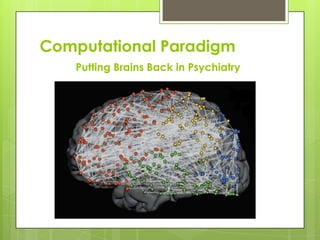
Computational Paradigm
    Putting Brains Back in Psychiatry
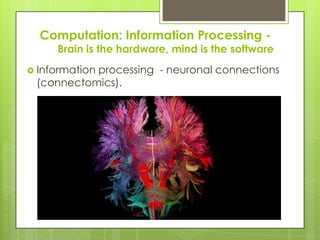
Computation: Information Processing -
     Brain is the hardware, mind is the software
 Information
           processing - neuronal connections
 (connectomics).
21st Century Concept of
Schizophrenia
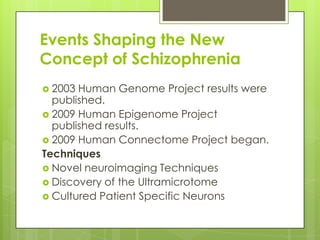
Events Shaping the New
Concept of Schizophrenia
 2003 Human Genome Project results were
  published.
 2009 Human Epigenome Project
  published results.
 2009 Human Connectome Project began.
Techniques
 Novel neuroimaging Techniques
 Discovery of the Ultramicrotome
 Cultured Patient Specific Neurons
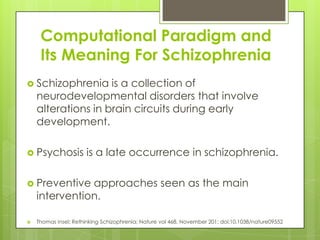
Computational Paradigm and
     Its Meaning For Schizophrenia
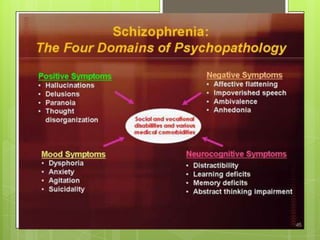
 Schizophrenia     is a collection of
    neurodevelopmental disorders that involve
    alterations in brain circuits during early
    development.

 Psychosis           is a late occurrence in schizophrenia.

 Preventive   approaches seen as the main
    intervention.

   Thomas Insel; Rethinking Schizophrenia; Nature vol 468, November 201; doi:10.1038/nature09552
Schizophrenia: A Case for
Prevention and Early Detection


 Birth   cohort studies demonstrate that
    individuals who develop schizophrenia
    differ from the general population on a
    range of developmental indices some of
    which occur as early as the first year of
    life.


Joy Welham,2 Matti Isohanni,3 Peter Jones,4 and John McGrath; The Antecedents of Schizophrenia: A
Review of Birth Cohort Studies; Schizophr Bull. 2009 May; 35(3): 603–623, . doi: 10.1093/schbul/sbn084
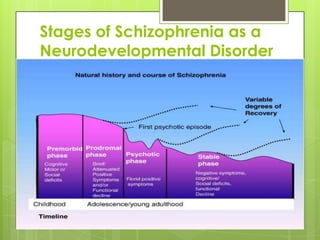
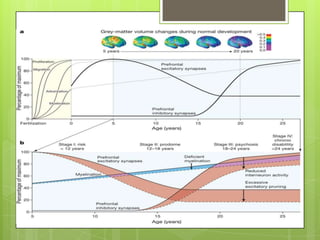
Stages of Schizophrenia as a
Neurodevelopmental Disorder
Learning from Neurodegenerative
  Disorders
 Inneurodegenerative disorders such as
  Parkinson’s disease, Alzheimer’s disease and
  Huntington’s disease changes in the brain
  precede changes in behavior , sometimes by

  more than a decade.

 InParkinson’s disease symptoms only emerge
  after 80% of dopamine cells have been lost.

 Thomas Insel; Rethinking Schizophrenia; Nature vol 468, November 201; doi:10.1038/nature09552
Learning From Medicine
Prevention, Prevention, Prevention

 Over the past few decades preventive
 efforts led to:

 60%reduction in mortality due to
 coronary artery disease (1.1 million death
 averted each year).

 AIDS   was declared a chronic disease.
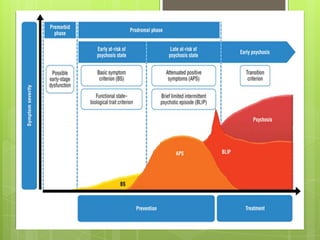
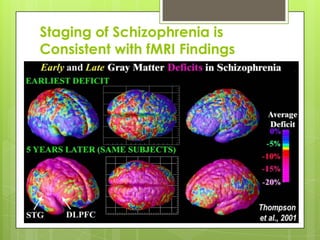
Staging of Schizophrenia is
Consistent with fMRI Findings
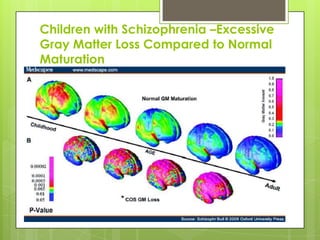
Children with Schizophrenia –Excessive
Gray Matter Loss Compared to Normal
Maturation
Emerging Biological Markers
 fMRIand Brain mapping markers
 Genetic markers
 Metabolic markers
 Neuropsychological testing
 Assessment of Tx efficacy
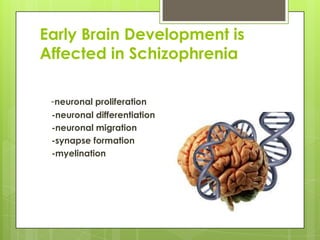
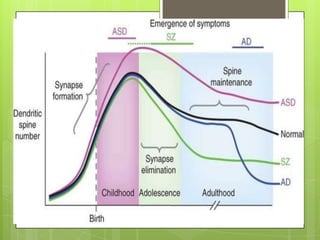
Early Brain Development is
Affected in Schizophrenia

 -neuronal proliferation
 -neuronal differentiation
 -neuronal migration
 -synapse formation
 -myelination
More Realistic Perspective on
  Genes in Schizophrenia


 There
      is no gene for schizophrenia, bipolar disorder,
 depression or anxiety and there will never be one.

 Genesdo not code for psychiatric illnesses or for
 behaviors or for symptoms of psychiatric illnesses.

 Genesoperate at a very basic cellular level. They
 code for proteins that may lead to subtle
 molecular abnormalities in cells.
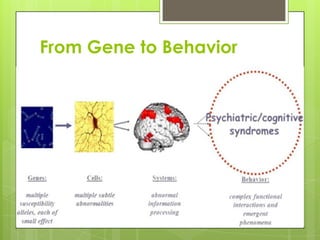
From Gene to Behavior
Genes are Risk Factors for
   Mental Illness

 Genes  do not respect the boundaries of psychiatric
 disorders or even the boundaries of medical
 disciplines.

 Forinstance most risk genes for schizophrenia are
 present also in bipolar disorder, schizoaffective
 disorder, ASD, Alzheimer’s disease and anxiety.
Several Hundred Loci (genes) Can
  Contribute To the Development of
  Schizophrenia.


 There
      are vulnerability genes as well as resilience
 genes.

 The chance that two patients with schizophrenia
 will have exactly the same combination of
 mutations is small.
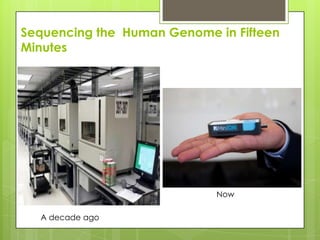
Sequencing the Human Genome in Fifteen
Minutes


                            Now

  A decade ago
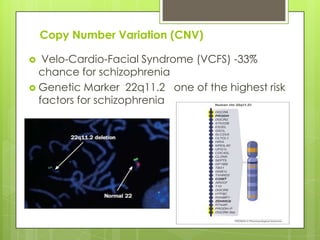
Copy Number Variation (CNV)

  Velo-Cardio-Facial Syndrome (VCFS) -33%
  chance for schizophrenia
 Genetic Marker 22q11.2 one of the highest risk
  factors for schizophrenia
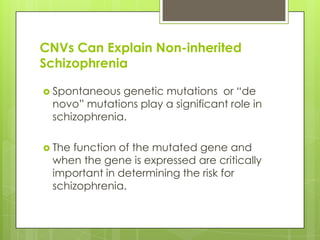
CNVs Can Explain Non-inherited
Schizophrenia

 Spontaneous genetic mutations or “de
 novo” mutations play a significant role in
 schizophrenia.

 Thefunction of the mutated gene and
 when the gene is expressed are critically
 important in determining the risk for
 schizophrenia.
Research Domain Criteria (RDoC)

 RDoC   is an experimental approach to the
 classification of mental disorders that incorporates
 multiple dimensions: behavior, thought patterns,
 neurobiological measures, and genetics.

 The
    aim of the project is to develop a more
 accurate diagnostic system.
Connectomics (brain
mapping) in Schizophrenia
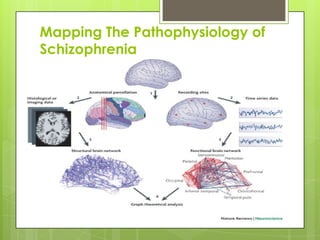
Mapping The Pathophysiology of
Schizophrenia
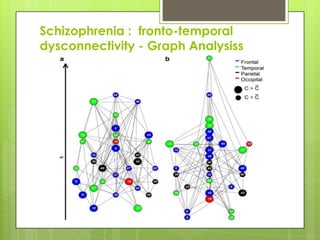
Schizophrenia : fronto-temporal
dysconnectivity - Graph Analysiss
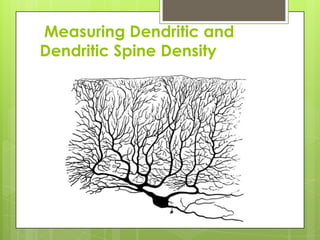
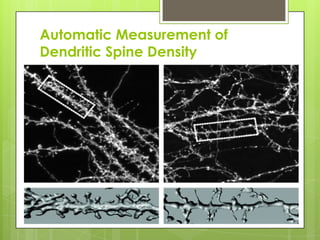
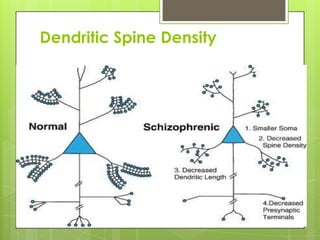
Measuring Dendritic and
Dendritic Spine Density
Automatic Measurement of
Dendritic Spine Density
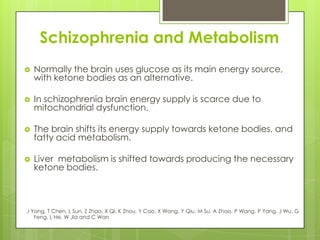
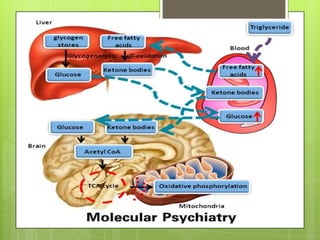
Schizophrenia and Metabolism
   Normally the brain uses glucose as its main energy source,
    with ketone bodies as an alternative.

   In schizophrenia brain energy supply is scarce due to
    mitochondrial dysfunction.

   The brain shifts its energy supply towards ketone bodies, and
    fatty acid metabolism.

   Liver metabolism is shifted towards producing the necessary
    ketone bodies.


J Yang, T Chen, L Sun, Z Zhao, X Qi, K Zhou, Y Cao, X Wang, Y Qiu, M Su, A Zhao, P Wang, P Yang, J Wu, G
   Feng, L He, W Jia and C Wan
Metabolic Biomarkers in
Schizophrenia
 The following set of metabolic biomarkers
  have identical sensitivity and specificity as
  the MSE:
 Glycerate
 Eicosenoic acid
 Beta-hydroxybutirate
 Pyruvate
 Cysteine
 Urine beta hydroxybutirate


Potential Metabolite Markers of Schizophrenia; J. Yang et al.; Molecular Psychiatry(213)
18, 67-78; doi:10.1038/mp.131
Neuropsychological Screening
for Prodromal Symptoms
Neuropsychological Screening Tests for
   the Prodromal Phase of Schizophrenia

 Severalneuropsychological deficits have been
  detected in the prodromal phase of schizophrenia.
 Neuropsychological instruments developed:


 -Structured Interview for Prodromal Symptoms (SIPS)
 -Neurocognitive Test Batteries for at Risk Mental
 states (ARMS)
 -Cognitive Perceptive Basic Symptoms (COPER)

Positive predictive power for conversion to psychosis
 75%
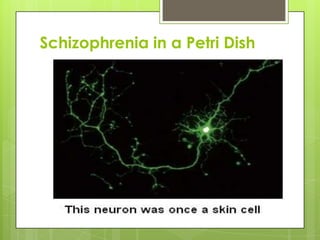
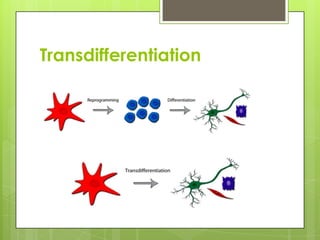
Schizophrenia in a Petri Dish
Transdifferentiation
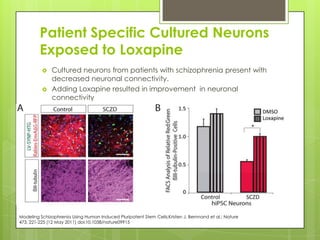
Patient Specific Cultured Neurons
         Exposed to Loxapine
             Cultured neurons from patients with schizophrenia present with
              decreased neuronal connectivity.
             Adding Loxapine resulted in improvement in neuronal
              connectivity


Modeling Schizophrenia Using Human Induced Pluripotent Stem Cells;Kristen J. Bernnand et al.; Nature
473, 221-225 (12 May 2011) doi:10.1038/nature09915
Integration of Care
 Currently the care is fragmented into medical
   care separated from psychiatric care.

 Both  are isolated from psychosocial interventions
   such as supportive employment, family education.

 Recovery   After Initial Episode of Schizophrenia
   (RAISE) project is developing a best-practice
   approach to bundled services.
Thomas Insel; Rethinking Schizophrenia; Nature vol 468, November 201; doi:10.1038/nature09552
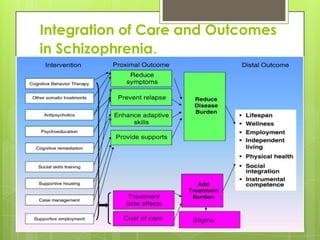
Integration of Care and Outcomes
in Schizophrenia.
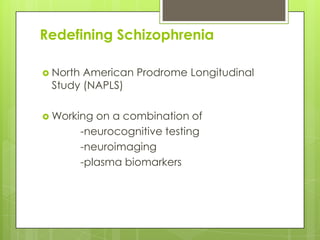
Redefining Schizophrenia

 NorthAmerican Prodrome Longitudinal
 Study (NAPLS)

 Working    on a combination of
          -neurocognitive testing
          -neuroimaging
          -plasma biomarkers
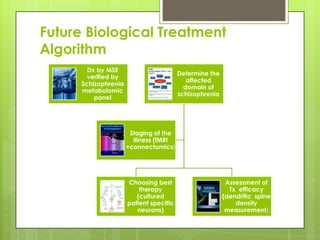
Future Biological Treatment
Algorithm
        Dx by MSE
                                         Determine the
        verified by
                                            affected
      Schizophrenia
                                           domain of
      metabolomic
                                         schizophrenia
          panel


                       Staging of the
                        illness (fMRI
                      +connectomics)


                      Choosing best                       Assessment of
                          therapy                          Tx efficacy
                         (cultured                       (dendritic spine
                      patient specific                       density
                         neurons)                         measurement)
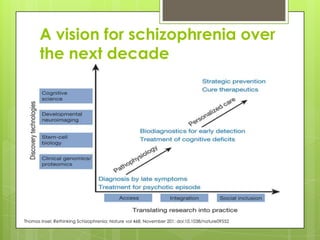
A vision for schizophrenia over
       the next decade


Thomas Insel; Rethinking Schizophrenia; Nature vol 468, November 201; doi:10.1038/nature09552

Schizophrenia Past, Present and Future

  • 1.
  • 2.
    This year alone 100,000 young people will have a first episode of schizophrenia.  5%of people with schizophrenia will die by suicide.
  • 3.
    One Hundred Yearsof Schizophrenia A century ago we had large public institutions for severe mental illness, tuberculosis and leprosy.  Of these three, today only mental illness, especially schizophrenia, remains unchanged in prevalence and disability .  Sustained recovery is less than 14% within the first 5 years following a psychotic episode. Thomas Insel; Rethinking Schizophrenia; Nature vol 468, November 201; doi:10.1038/nature09552
  • 4.
    Schizophrenia: The Past Francisco Goya – The Madhouse 1812
  • 5.
    From Kraepelin toAsenapine  Premature dementia
  • 6.
    The Brain Outof the Picture Upbringing determines the output Late 19th and early 20th century paradigm
  • 7.
    Biochemical Paradigm From blamingthe mother to blaming neurotransmitters  Second half of the 20th century  Schizophrenia a “dopamine disorder”  1954 discovery of Chlorpromazine  Psychopharmacology  The biochemical trinity: -dopamine -serotonin - norepinephrine
  • 8.
    Computational Paradigm Putting Brains Back in Psychiatry
  • 9.
    Computation: Information Processing- Brain is the hardware, mind is the software  Information processing - neuronal connections (connectomics).
  • 11.
    21st Century Conceptof Schizophrenia
  • 12.
    Events Shaping theNew Concept of Schizophrenia  2003 Human Genome Project results were published.  2009 Human Epigenome Project published results.  2009 Human Connectome Project began. Techniques  Novel neuroimaging Techniques  Discovery of the Ultramicrotome  Cultured Patient Specific Neurons
  • 13.
    Computational Paradigm and Its Meaning For Schizophrenia  Schizophrenia is a collection of neurodevelopmental disorders that involve alterations in brain circuits during early development.  Psychosis is a late occurrence in schizophrenia.  Preventive approaches seen as the main intervention.  Thomas Insel; Rethinking Schizophrenia; Nature vol 468, November 201; doi:10.1038/nature09552
  • 14.
    Schizophrenia: A Casefor Prevention and Early Detection  Birth cohort studies demonstrate that individuals who develop schizophrenia differ from the general population on a range of developmental indices some of which occur as early as the first year of life. Joy Welham,2 Matti Isohanni,3 Peter Jones,4 and John McGrath; The Antecedents of Schizophrenia: A Review of Birth Cohort Studies; Schizophr Bull. 2009 May; 35(3): 603–623, . doi: 10.1093/schbul/sbn084
  • 15.
    Stages of Schizophreniaas a Neurodevelopmental Disorder
  • 17.
    Learning from Neurodegenerative Disorders  Inneurodegenerative disorders such as Parkinson’s disease, Alzheimer’s disease and Huntington’s disease changes in the brain precede changes in behavior , sometimes by more than a decade.  InParkinson’s disease symptoms only emerge after 80% of dopamine cells have been lost. Thomas Insel; Rethinking Schizophrenia; Nature vol 468, November 201; doi:10.1038/nature09552
  • 18.
    Learning From Medicine Prevention,Prevention, Prevention  Over the past few decades preventive efforts led to:  60%reduction in mortality due to coronary artery disease (1.1 million death averted each year).  AIDS was declared a chronic disease.
  • 19.
    Staging of Schizophreniais Consistent with fMRI Findings
  • 20.
    Children with Schizophrenia–Excessive Gray Matter Loss Compared to Normal Maturation
  • 22.
    Emerging Biological Markers fMRIand Brain mapping markers  Genetic markers  Metabolic markers  Neuropsychological testing  Assessment of Tx efficacy
  • 23.
    Early Brain Developmentis Affected in Schizophrenia -neuronal proliferation -neuronal differentiation -neuronal migration -synapse formation -myelination
  • 25.
    More Realistic Perspectiveon Genes in Schizophrenia  There is no gene for schizophrenia, bipolar disorder, depression or anxiety and there will never be one.  Genesdo not code for psychiatric illnesses or for behaviors or for symptoms of psychiatric illnesses.  Genesoperate at a very basic cellular level. They code for proteins that may lead to subtle molecular abnormalities in cells.
  • 26.
    From Gene toBehavior
  • 27.
    Genes are RiskFactors for Mental Illness  Genes do not respect the boundaries of psychiatric disorders or even the boundaries of medical disciplines.  Forinstance most risk genes for schizophrenia are present also in bipolar disorder, schizoaffective disorder, ASD, Alzheimer’s disease and anxiety.
  • 28.
    Several Hundred Loci(genes) Can Contribute To the Development of Schizophrenia.  There are vulnerability genes as well as resilience genes.  The chance that two patients with schizophrenia will have exactly the same combination of mutations is small.
  • 29.
    Sequencing the HumanGenome in Fifteen Minutes Now A decade ago
  • 30.
    Copy Number Variation(CNV)  Velo-Cardio-Facial Syndrome (VCFS) -33% chance for schizophrenia  Genetic Marker 22q11.2 one of the highest risk factors for schizophrenia
  • 31.
    CNVs Can ExplainNon-inherited Schizophrenia  Spontaneous genetic mutations or “de novo” mutations play a significant role in schizophrenia.  Thefunction of the mutated gene and when the gene is expressed are critically important in determining the risk for schizophrenia.
  • 33.
    Research Domain Criteria(RDoC)  RDoC is an experimental approach to the classification of mental disorders that incorporates multiple dimensions: behavior, thought patterns, neurobiological measures, and genetics.  The aim of the project is to develop a more accurate diagnostic system.
  • 34.
  • 35.
  • 36.
  • 37.
  • 38.
  • 39.
  • 41.
    Schizophrenia and Metabolism  Normally the brain uses glucose as its main energy source, with ketone bodies as an alternative.  In schizophrenia brain energy supply is scarce due to mitochondrial dysfunction.  The brain shifts its energy supply towards ketone bodies, and fatty acid metabolism.  Liver metabolism is shifted towards producing the necessary ketone bodies. J Yang, T Chen, L Sun, Z Zhao, X Qi, K Zhou, Y Cao, X Wang, Y Qiu, M Su, A Zhao, P Wang, P Yang, J Wu, G Feng, L He, W Jia and C Wan
  • 43.
    Metabolic Biomarkers in Schizophrenia The following set of metabolic biomarkers have identical sensitivity and specificity as the MSE:  Glycerate  Eicosenoic acid  Beta-hydroxybutirate  Pyruvate  Cysteine  Urine beta hydroxybutirate Potential Metabolite Markers of Schizophrenia; J. Yang et al.; Molecular Psychiatry(213) 18, 67-78; doi:10.1038/mp.131
  • 44.
  • 45.
    Neuropsychological Screening Testsfor the Prodromal Phase of Schizophrenia  Severalneuropsychological deficits have been detected in the prodromal phase of schizophrenia.  Neuropsychological instruments developed: -Structured Interview for Prodromal Symptoms (SIPS) -Neurocognitive Test Batteries for at Risk Mental states (ARMS) -Cognitive Perceptive Basic Symptoms (COPER) Positive predictive power for conversion to psychosis 75%
  • 46.
  • 47.
  • 48.
    Patient Specific CulturedNeurons Exposed to Loxapine  Cultured neurons from patients with schizophrenia present with decreased neuronal connectivity.  Adding Loxapine resulted in improvement in neuronal connectivity Modeling Schizophrenia Using Human Induced Pluripotent Stem Cells;Kristen J. Bernnand et al.; Nature 473, 221-225 (12 May 2011) doi:10.1038/nature09915
  • 49.
    Integration of Care Currently the care is fragmented into medical care separated from psychiatric care.  Both are isolated from psychosocial interventions such as supportive employment, family education.  Recovery After Initial Episode of Schizophrenia (RAISE) project is developing a best-practice approach to bundled services. Thomas Insel; Rethinking Schizophrenia; Nature vol 468, November 201; doi:10.1038/nature09552
  • 50.
    Integration of Careand Outcomes in Schizophrenia.
  • 51.
    Redefining Schizophrenia  NorthAmericanProdrome Longitudinal Study (NAPLS)  Working on a combination of -neurocognitive testing -neuroimaging -plasma biomarkers
  • 52.
    Future Biological Treatment Algorithm Dx by MSE Determine the verified by affected Schizophrenia domain of metabolomic schizophrenia panel Staging of the illness (fMRI +connectomics) Choosing best Assessment of therapy Tx efficacy (cultured (dendritic spine patient specific density neurons) measurement)
  • 53.
    A vision forschizophrenia over the next decade Thomas Insel; Rethinking Schizophrenia; Nature vol 468, November 201; doi:10.1038/nature09552