Tryptophan Metabolism
11.Dec.16
Tryptophan
- It’s an essential amino acid that is made from plant or animal
sources.
- Tryptophan is important to the functions of many organs in the body.
- Tryptophan is essential for the production of the B vitamin, niacin.
- It is used by the brain to produce serotonin, a necessary
neurotransmitter that transfers nerve impulses from one cell to
another. Consequently, tryptophan helps to depression and insomnia
and to stabilize moods
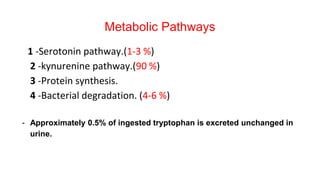
Metabolic Pathways
1 -Serotonin pathway.(1-3 %)
2 -kynurenine pathway.(90 %)
3 -Protein synthesis.
4 -Bacterial degradation. (4-6 %)
- Approximately 0.5% of ingested tryptophan is excreted unchanged in
urine.
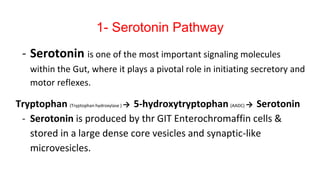
1- Serotonin Pathway
- Serotonin is one of the most important signaling molecules
within the Gut, where it plays a pivotal role in initiating secretory and
motor reflexes.
Tryptophan (Tryptophan hydroxylase ) → 5-hydroxytryptophan (AADC) → Serotonin
- Serotonin is produced by thr GIT Enterochromaffin cells &
stored in a large dense core vesicles and synaptic-like
microvesicles.
- Carcinoid Syndrome , It’s characterized by flushing, diarrhoea,
cramps, skin abnormalities, asthmatic wheezing and valvular heart
disease associated with elevated 5-HT levels , Due to the deficiency
of AADC (Aromatic amino acid decarboxylase).
- Melatonin has important effects in Circadian rhythms , sleep-
wake cycles and other phenomena showing circadian rhythm.
Consequently, it has been reported to have significant effects
on reproduction for some Animals.
- Serotonin (serotonin N-acetyltransferase) → N-acetylserotonin (Methylation) → Melatonin
2- Kynurenine Pathway
- Important in Clearance of excess tryptophan & Regulation of plasma
tryptophan levels.
- Provides :
● Quinolinic acid -> immunoregulatory processes.
● Nicotinamide & Nicotinic acid -> precursors for niacin ( Vit. B3)
● Picolinic acid -> chelating agent.
3- Protein synthesis , Tryptophan is a rate-limiting
amino acid in protein synthesis Due of its limited availability in
food.
4- Bacterial Degradation :
- Approximately 4–6% of tryptophan undergoes bacterial
degradation yielding indole, indican, and indole acid
derivates.
- The main bacterial breakdown product of tryptophan is
indole.

Tryptophan Metabolism

  • 1.
  • 2.
    Tryptophan - It’s anessential amino acid that is made from plant or animal sources. - Tryptophan is important to the functions of many organs in the body. - Tryptophan is essential for the production of the B vitamin, niacin. - It is used by the brain to produce serotonin, a necessary neurotransmitter that transfers nerve impulses from one cell to another. Consequently, tryptophan helps to depression and insomnia and to stabilize moods
  • 3.
    Metabolic Pathways 1 -Serotoninpathway.(1-3 %) 2 -kynurenine pathway.(90 %) 3 -Protein synthesis. 4 -Bacterial degradation. (4-6 %) - Approximately 0.5% of ingested tryptophan is excreted unchanged in urine.
  • 4.
    1- Serotonin Pathway -Serotonin is one of the most important signaling molecules within the Gut, where it plays a pivotal role in initiating secretory and motor reflexes. Tryptophan (Tryptophan hydroxylase ) → 5-hydroxytryptophan (AADC) → Serotonin - Serotonin is produced by thr GIT Enterochromaffin cells & stored in a large dense core vesicles and synaptic-like microvesicles.
  • 5.
    - Carcinoid Syndrome, It’s characterized by flushing, diarrhoea, cramps, skin abnormalities, asthmatic wheezing and valvular heart disease associated with elevated 5-HT levels , Due to the deficiency of AADC (Aromatic amino acid decarboxylase). - Melatonin has important effects in Circadian rhythms , sleep- wake cycles and other phenomena showing circadian rhythm. Consequently, it has been reported to have significant effects on reproduction for some Animals. - Serotonin (serotonin N-acetyltransferase) → N-acetylserotonin (Methylation) → Melatonin
  • 6.
    2- Kynurenine Pathway -Important in Clearance of excess tryptophan & Regulation of plasma tryptophan levels. - Provides : ● Quinolinic acid -> immunoregulatory processes. ● Nicotinamide & Nicotinic acid -> precursors for niacin ( Vit. B3) ● Picolinic acid -> chelating agent.
  • 7.
    3- Protein synthesis, Tryptophan is a rate-limiting amino acid in protein synthesis Due of its limited availability in food. 4- Bacterial Degradation : - Approximately 4–6% of tryptophan undergoes bacterial degradation yielding indole, indican, and indole acid derivates. - The main bacterial breakdown product of tryptophan is indole.