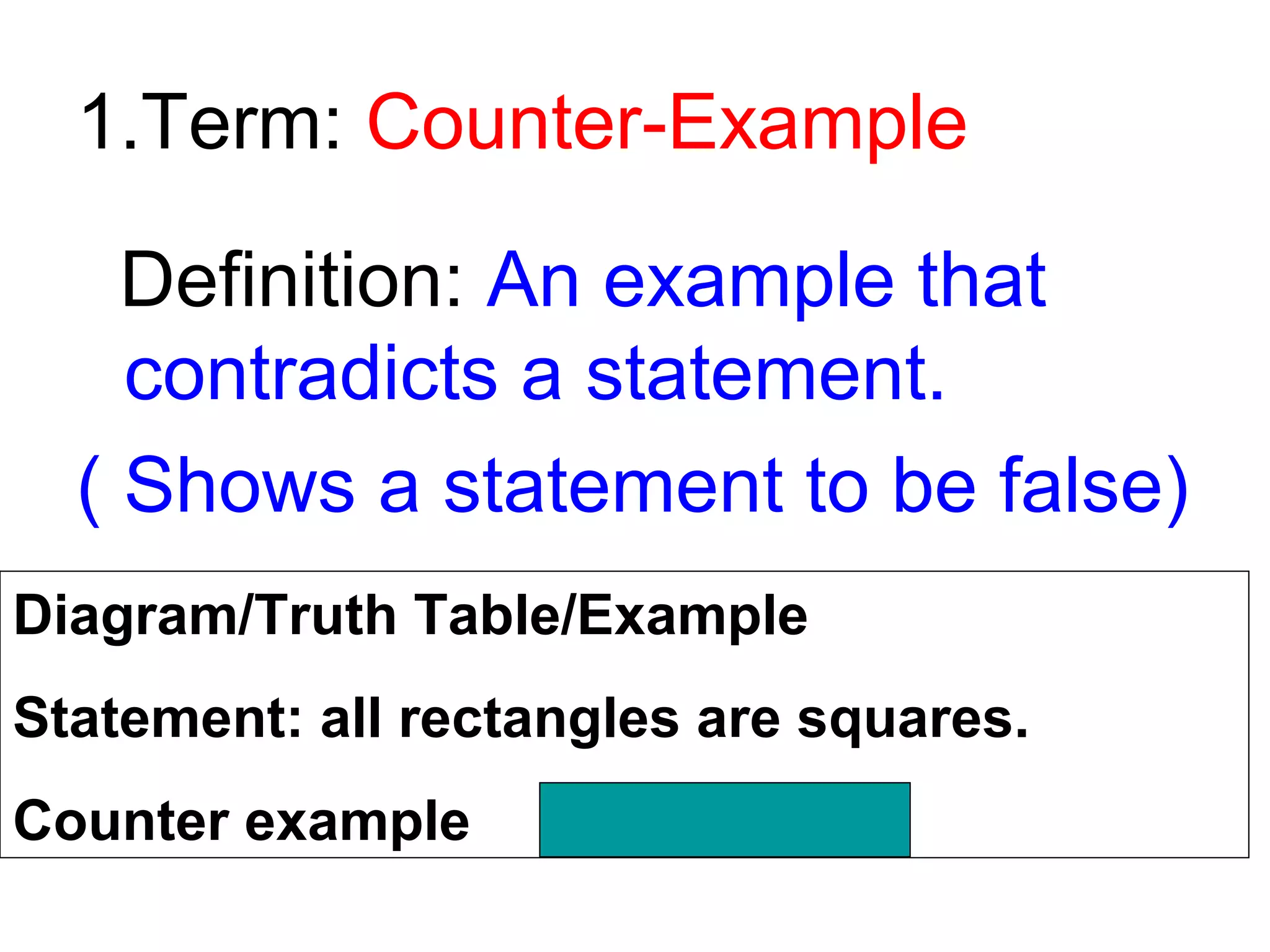
1.Term: Counter-Example
Definition: An example that
contradicts a statement.
( Shows a statement to be false)
Diagram/Truth Table/Example
Statement: all rectangles are squares.
Counter example
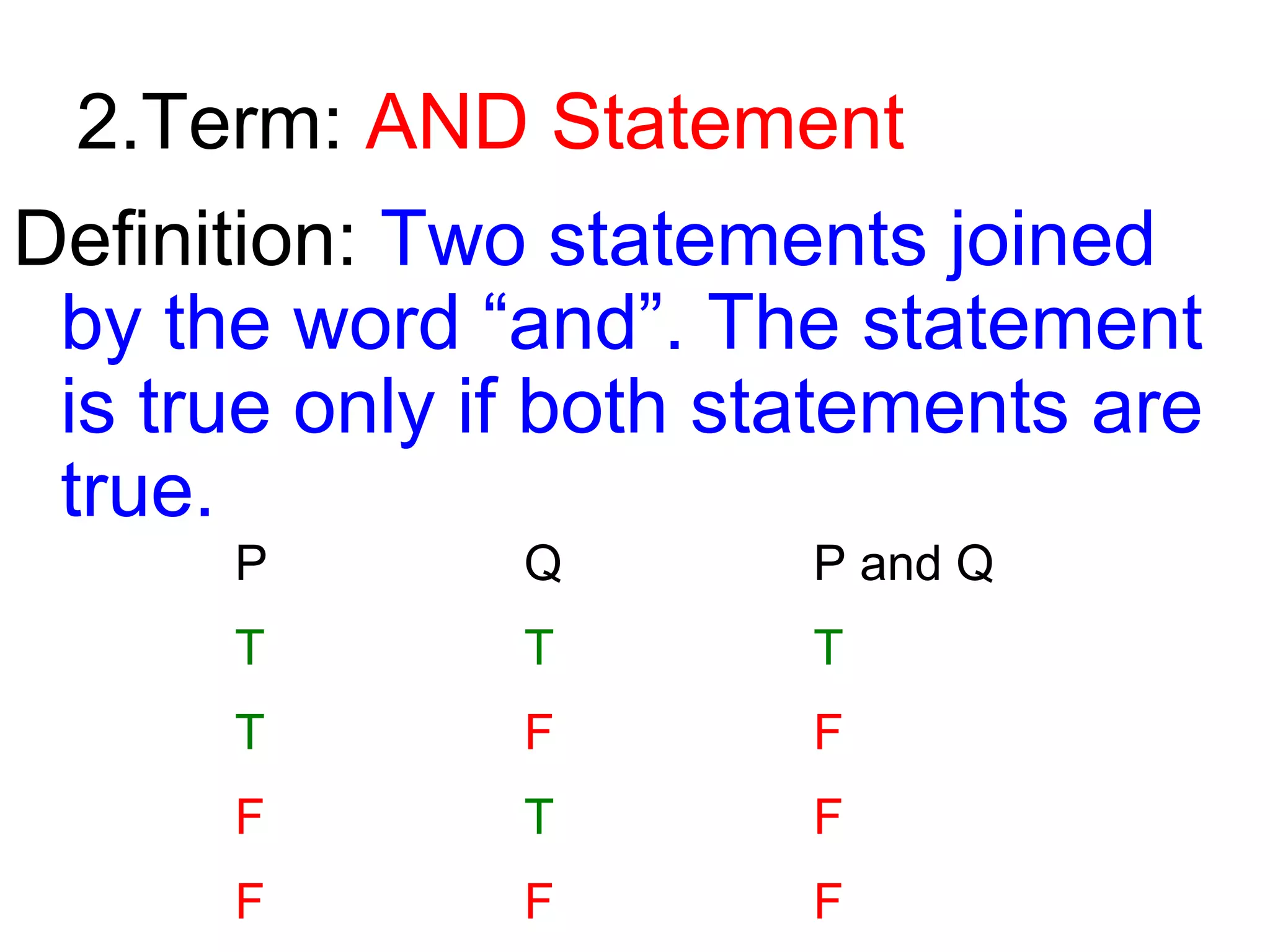
2.Term: AND Statement
Definition: Two statements joined
by the word “and”. The statement
is true only if both statements are
true.
P

Q

P and Q

T

T

T

T

F

F

F

T

F

F

F

F
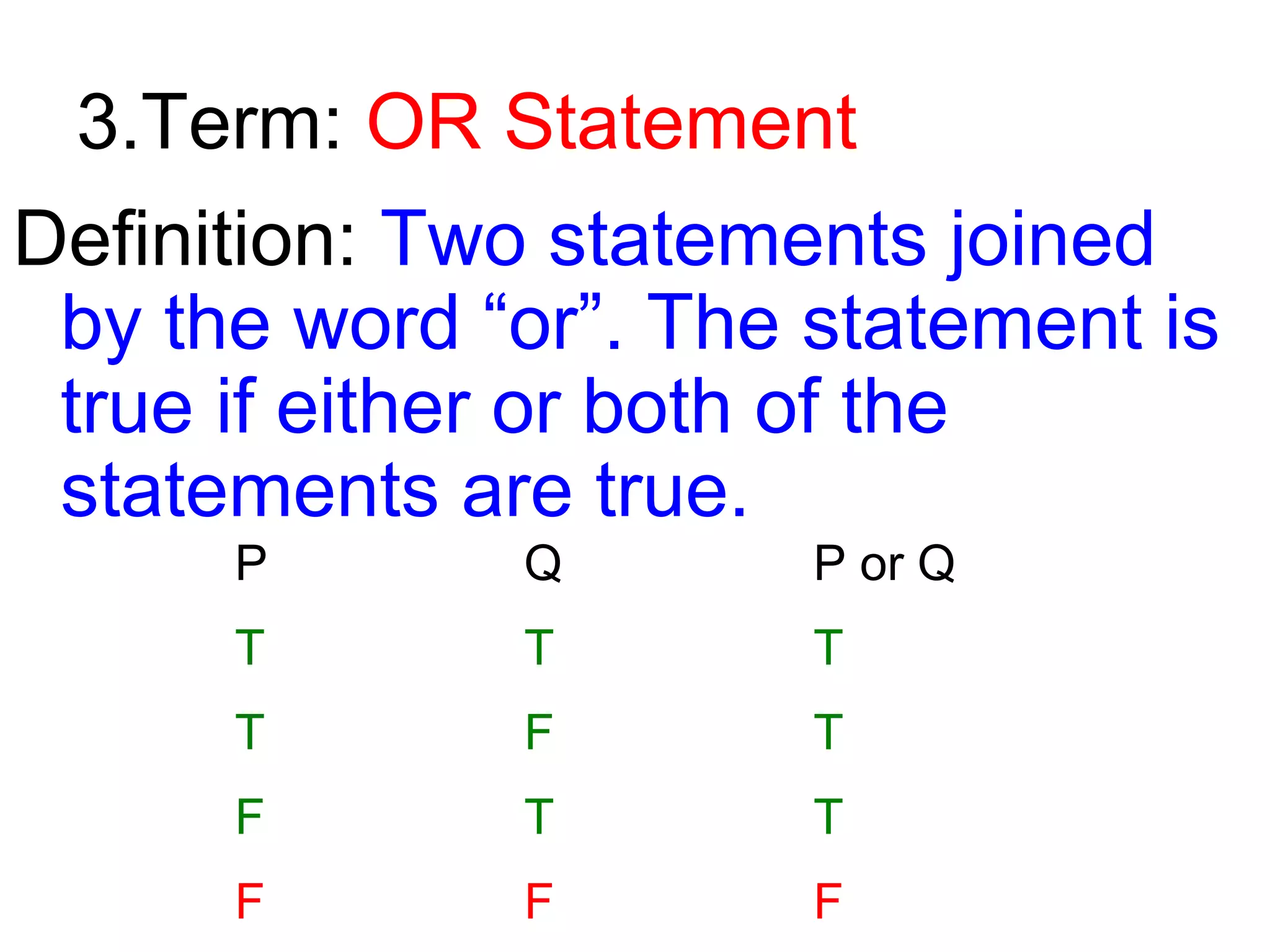
3.Term: OR Statement
Definition: Two statements joined
by the word “or”. The statement is
true if either or both of the
statements are true.
P

Q

P or Q

T

T

T

T

F

T

F

T

T

F

F

F
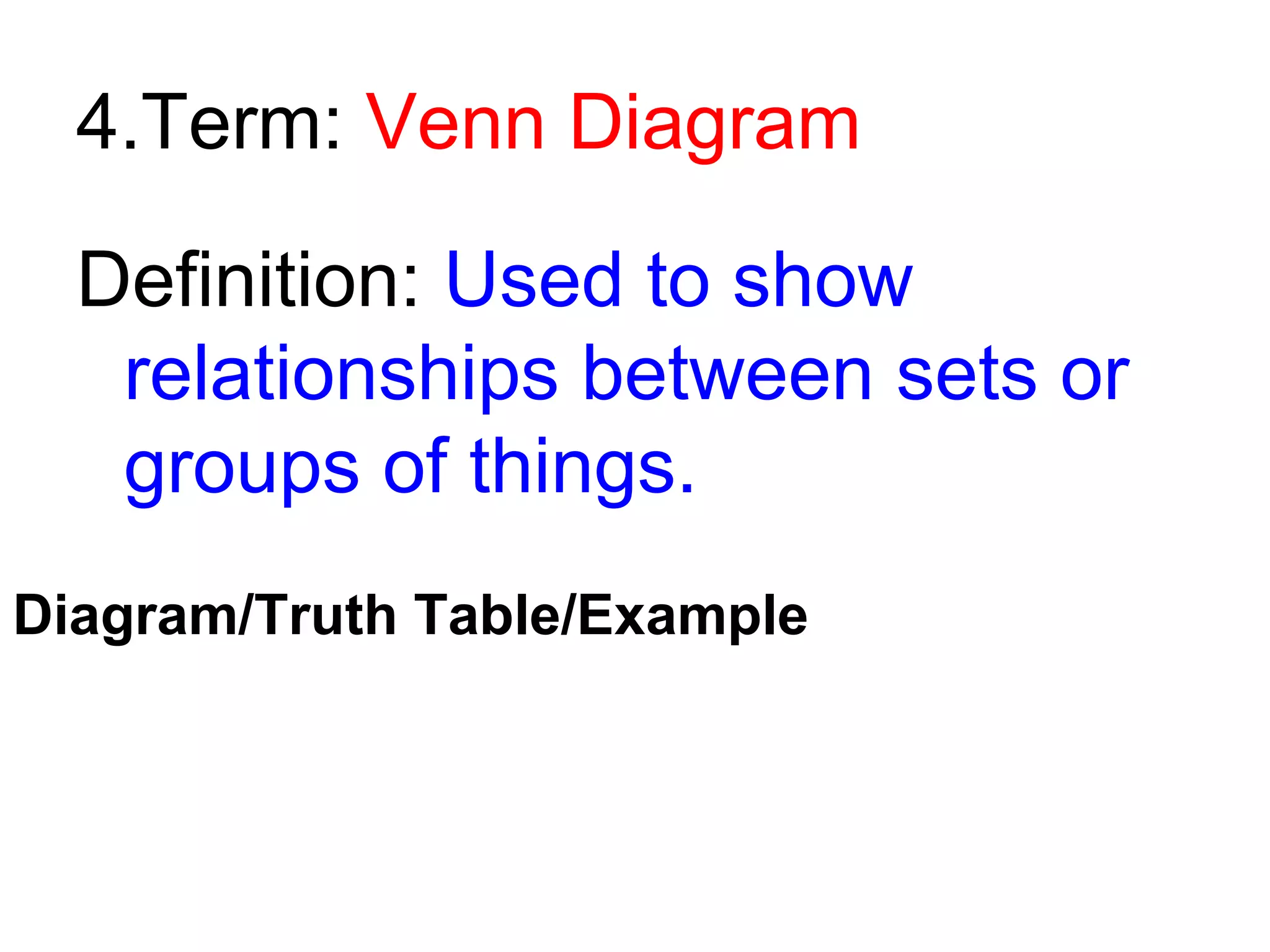
4.Term: Venn Diagram
Definition: Used to show
relationships between sets or
groups of things.
Diagram/Truth Table/Example
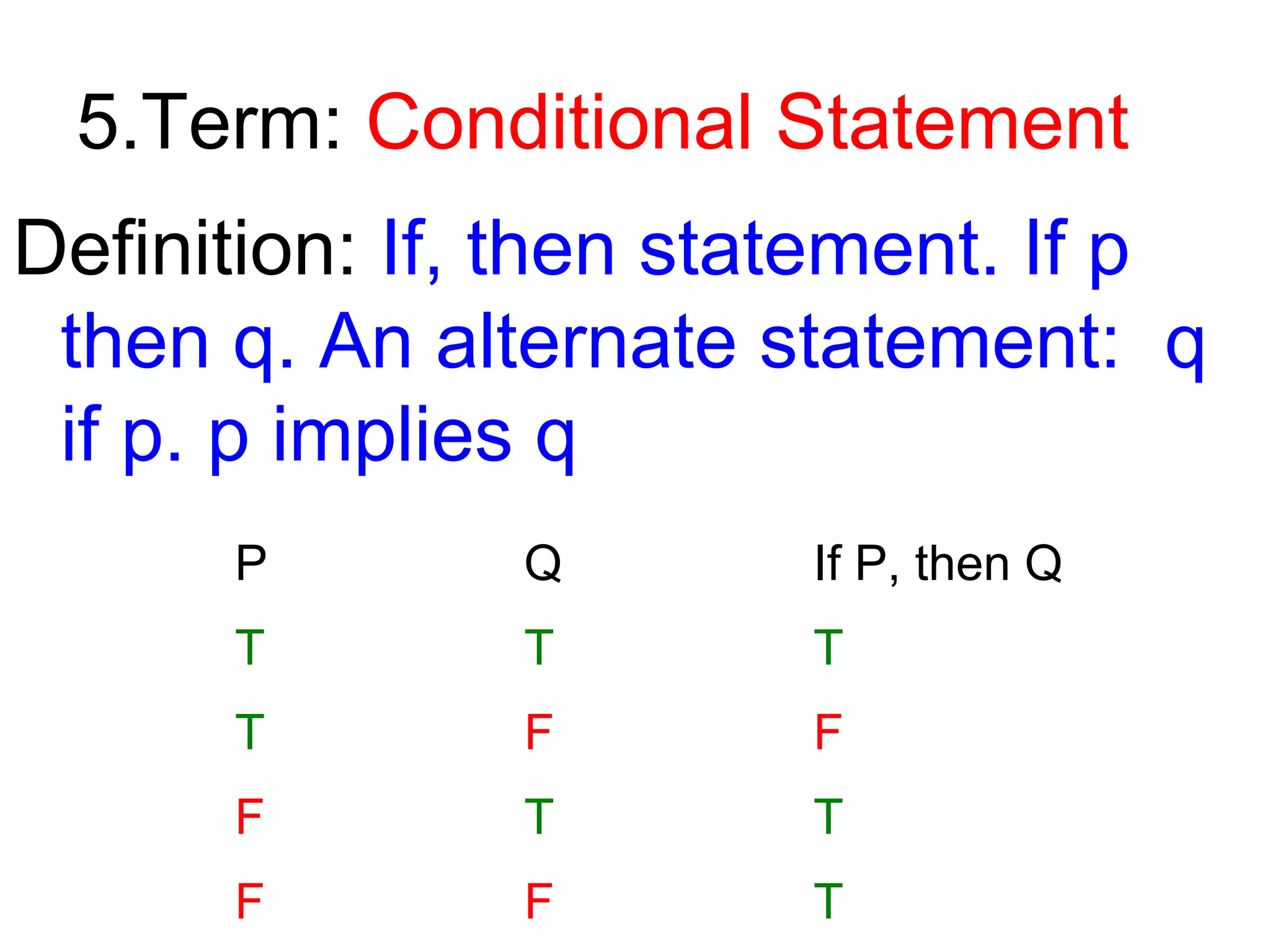
5.Term: Conditional Statement
Definition: If, then statement. If p
then q. An alternate statement: q
if p. p implies q
P

Q

If P, then Q

T

T

T

T

F

F

F

T

T

F

F

T
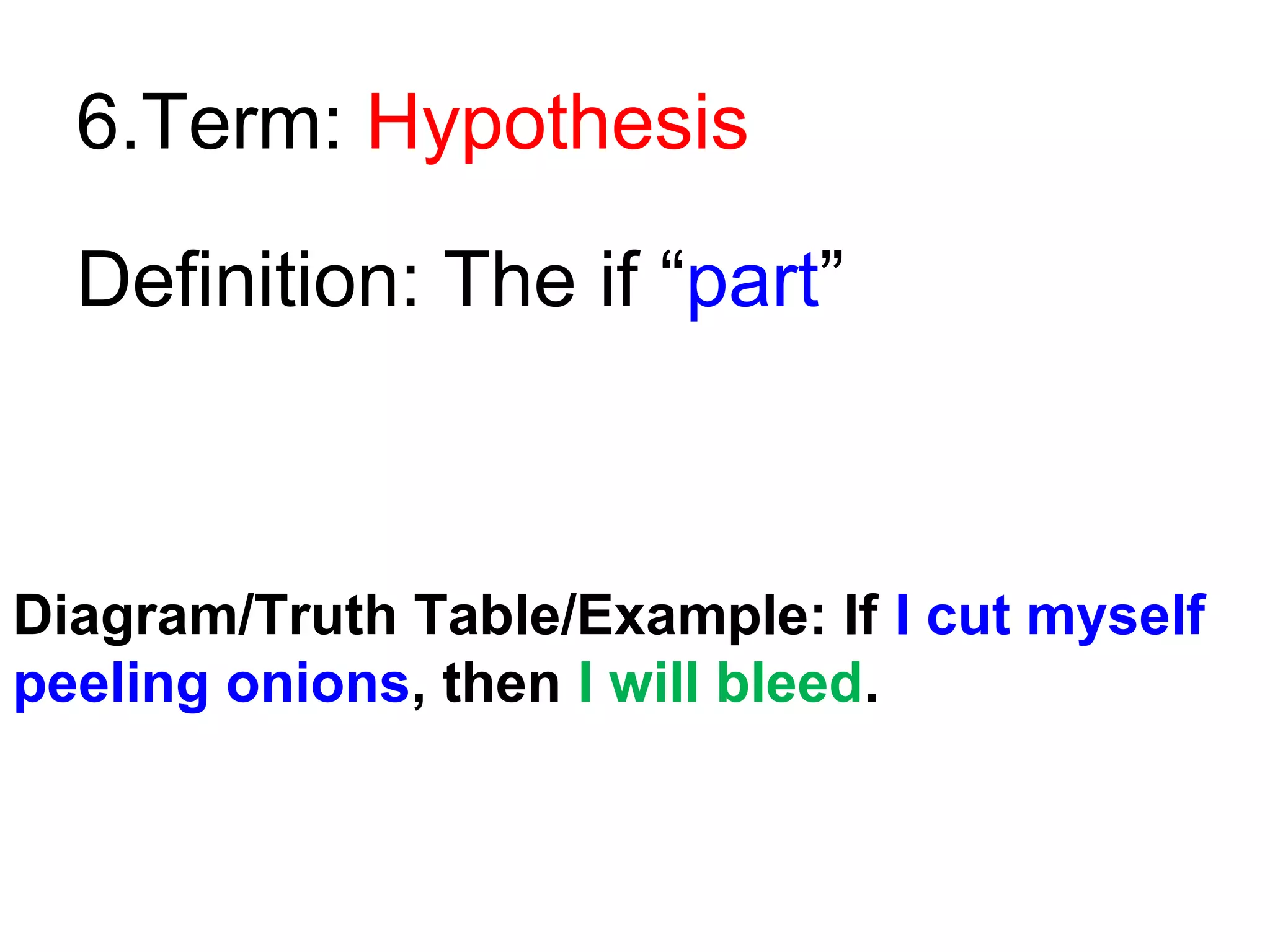
6.Term: Hypothesis
Definition: The if “part”

Diagram/Truth Table/Example: If I cut myself
peeling onions, then I will bleed.
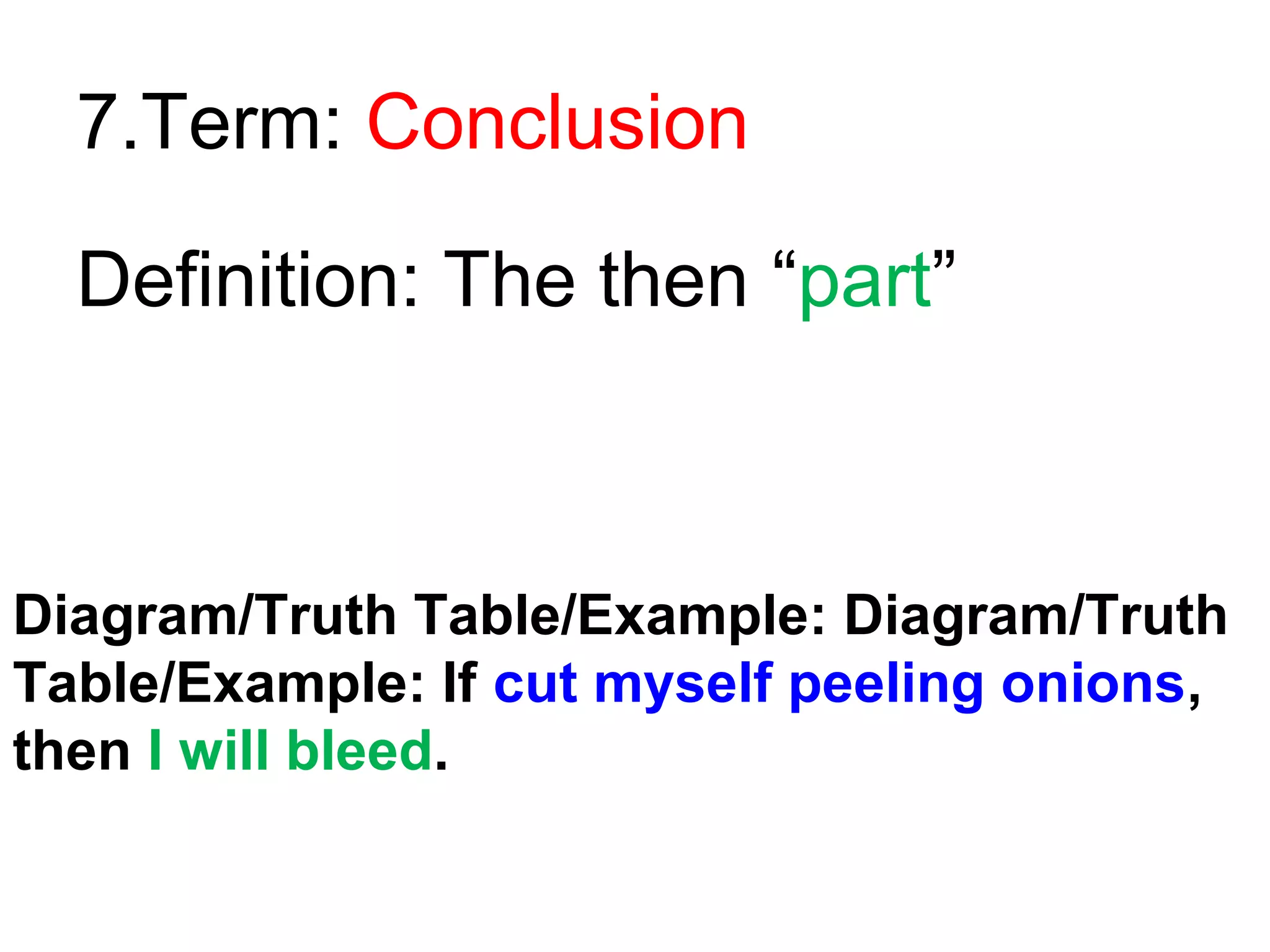
7.Term: Conclusion
Definition: The then “part”

Diagram/Truth Table/Example: Diagram/Truth
Table/Example: If cut myself peeling onions,
then I will bleed.
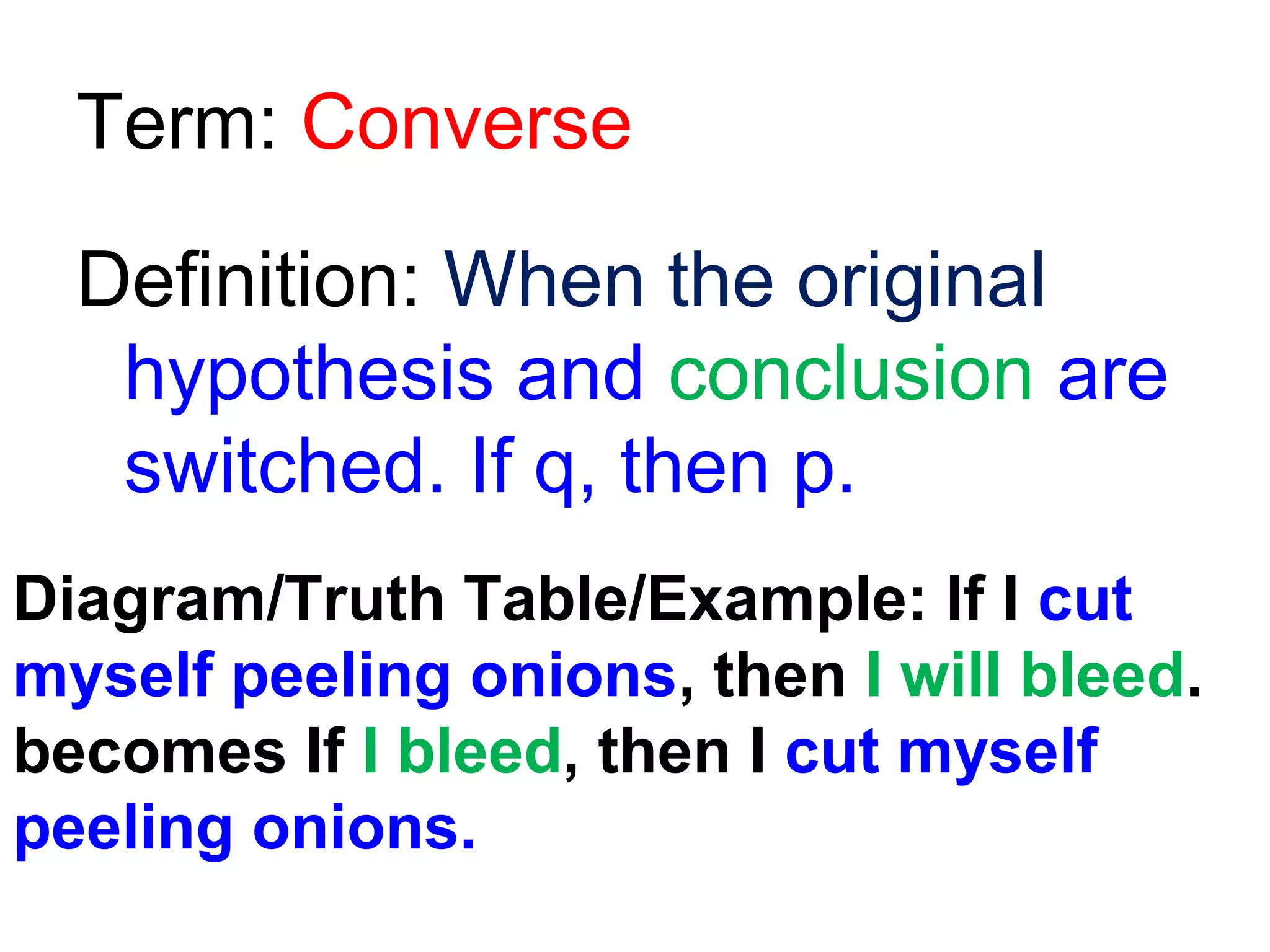
Term: Converse
Definition: When the original
hypothesis and conclusion are
switched. If q, then p.
Diagram/Truth Table/Example: If I cut
myself peeling onions, then I will bleed.
becomes If I bleed, then I cut myself
peeling onions.
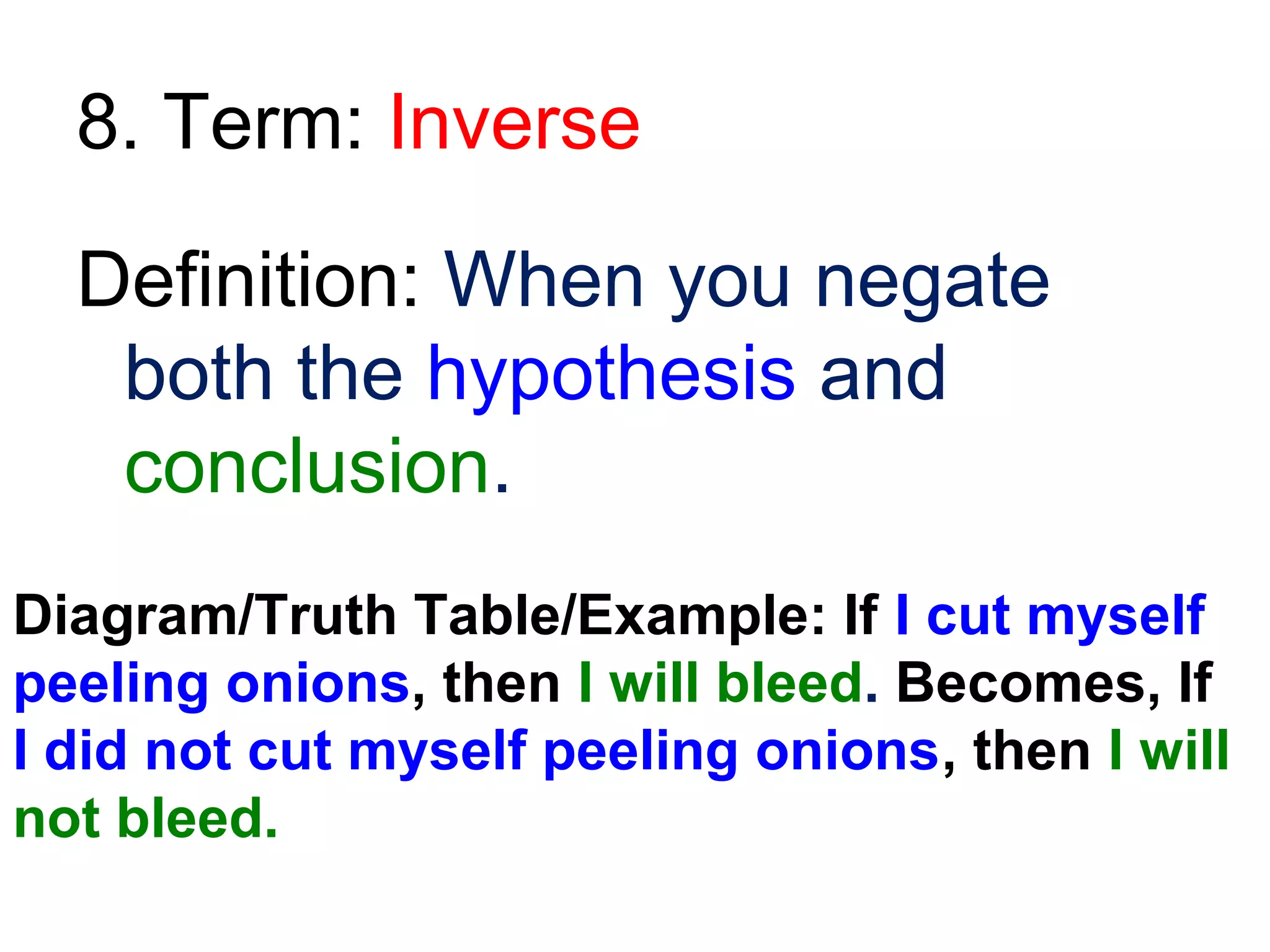
8. Term: Inverse
Definition: When you negate
both the hypothesis and
conclusion.
Diagram/Truth Table/Example: If I cut myself
peeling onions, then I will bleed. Becomes, If
I did not cut myself peeling onions, then I will
not bleed.
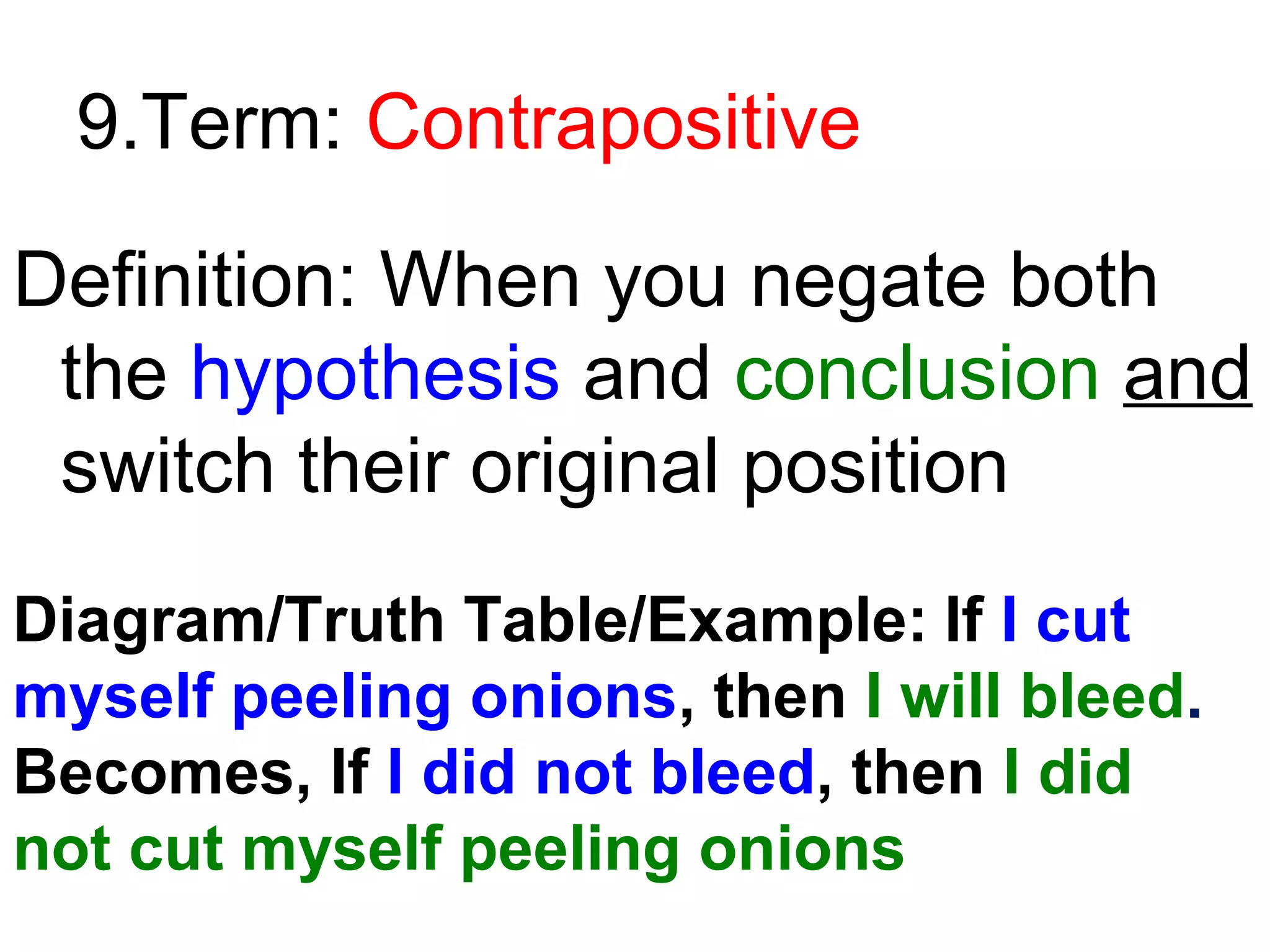
9.Term: Contrapositive
Definition: When you negate both
the hypothesis and conclusion and
switch their original position
Diagram/Truth Table/Example: If I cut
myself peeling onions, then I will bleed.
Becomes, If I did not bleed, then I did
not cut myself peeling onions
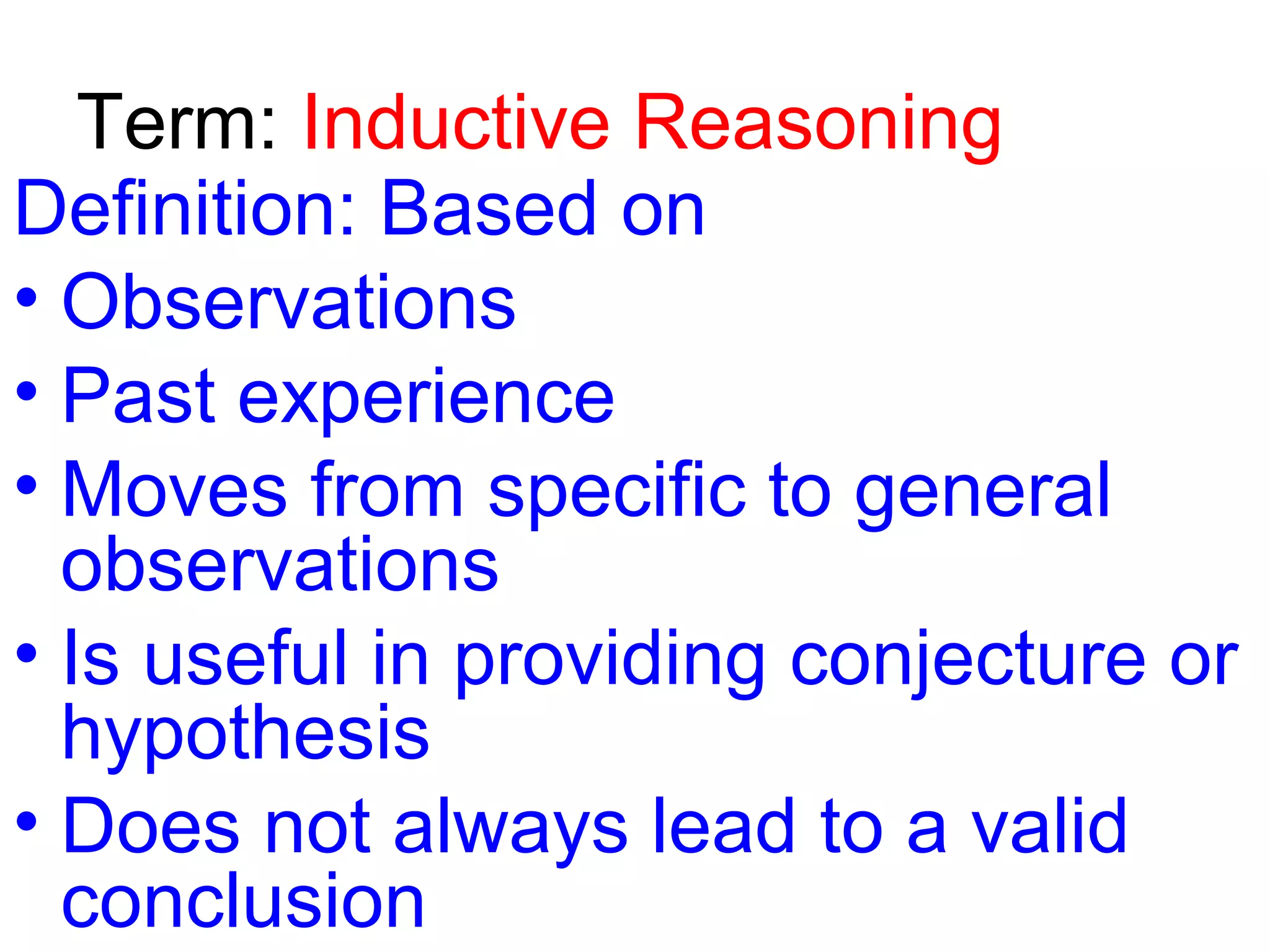
Term: Inductive Reasoning
Definition: Based on
• Observations
• Past experience
• Moves from specific to general
observations
• Is useful in providing conjecture or
hypothesis
• Does not always lead to a valid
conclusion
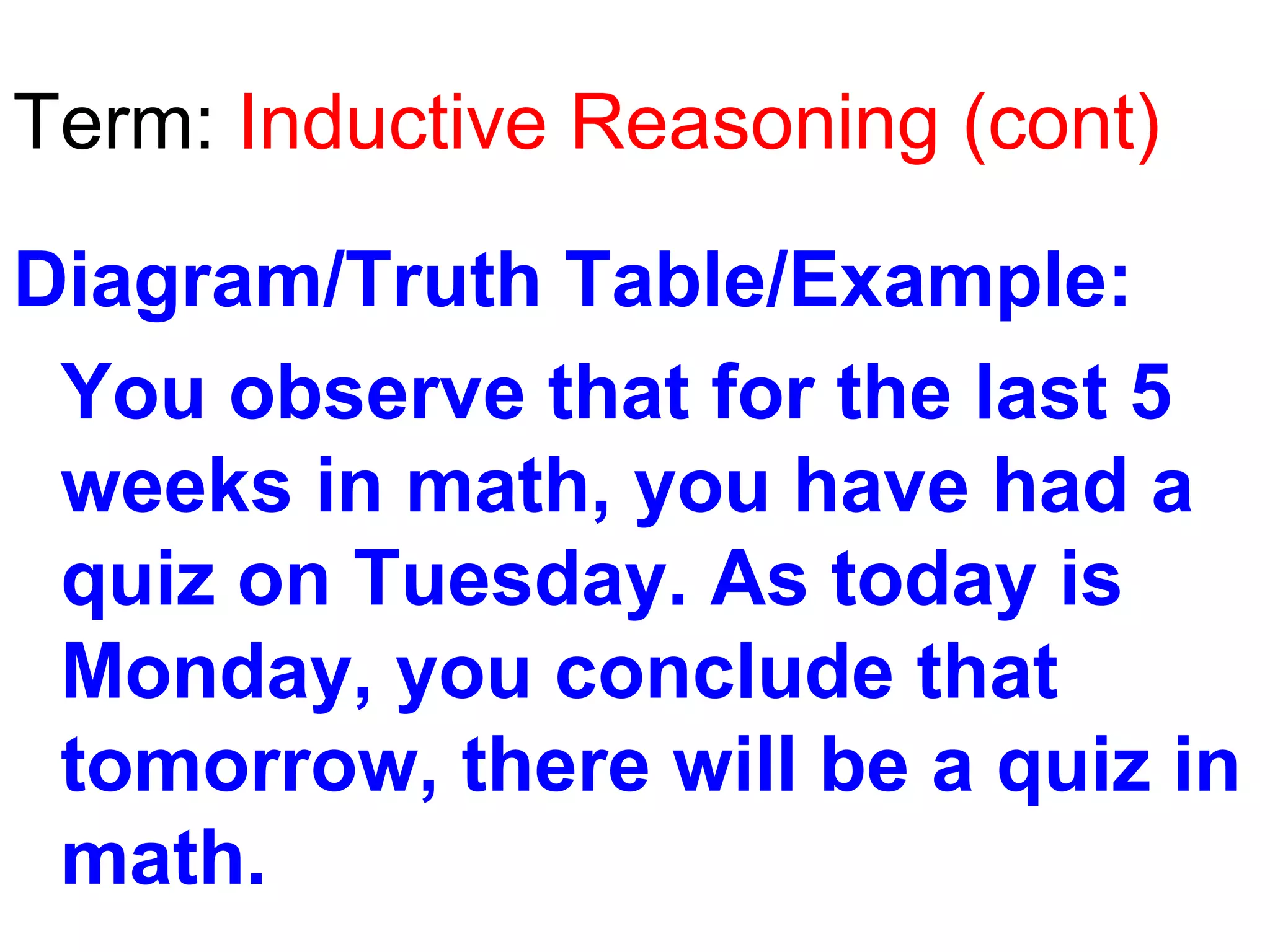
Term: Inductive Reasoning (cont)
Diagram/Truth Table/Example:
You observe that for the last 5
weeks in math, you have had a
quiz on Tuesday. As today is
Monday, you conclude that
tomorrow, there will be a quiz in
math.
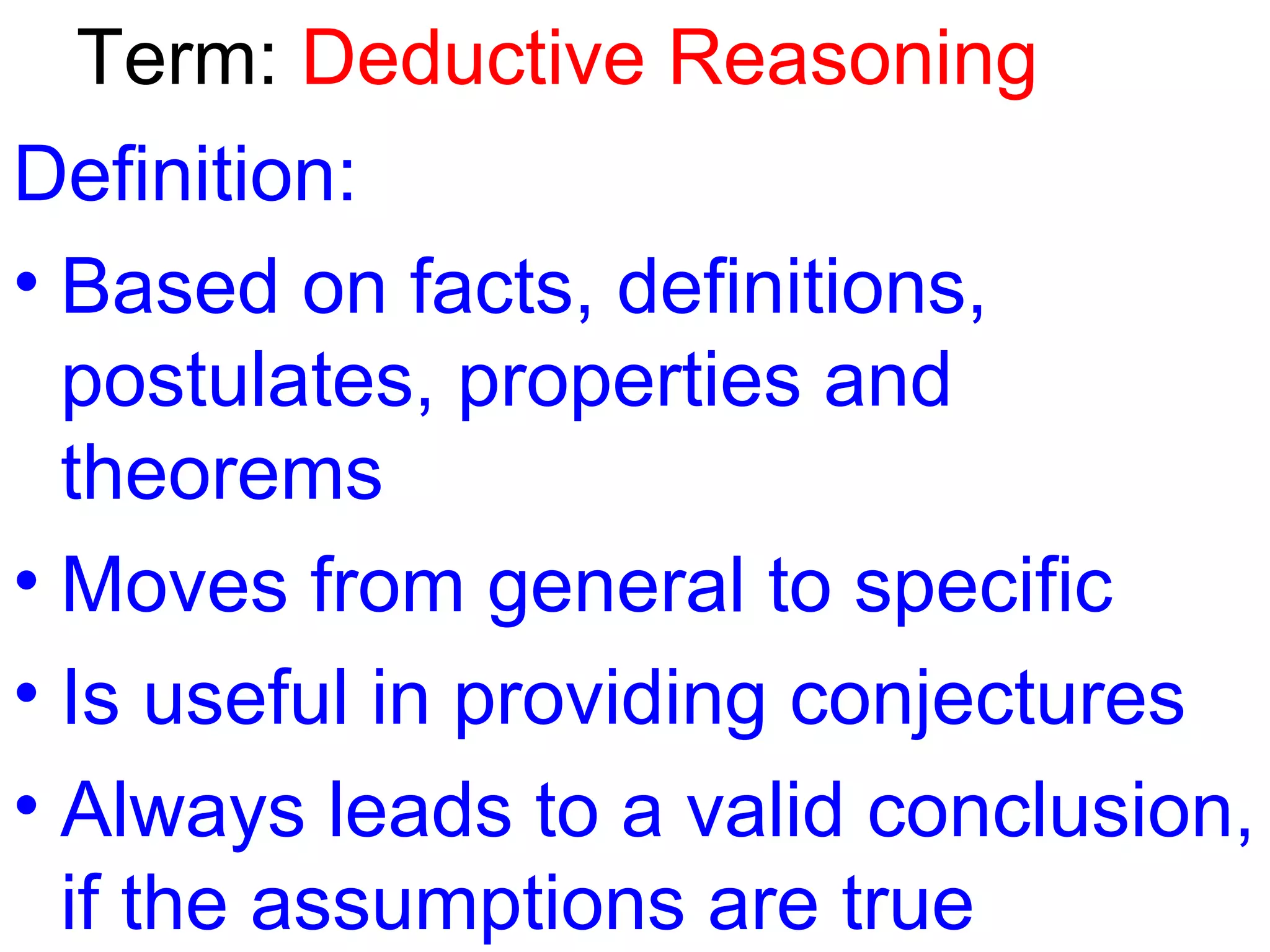
Term: Deductive Reasoning
Definition:
• Based on facts, definitions,
postulates, properties and
theorems
• Moves from general to specific
• Is useful in providing conjectures
• Always leads to a valid conclusion,
if the assumptions are true
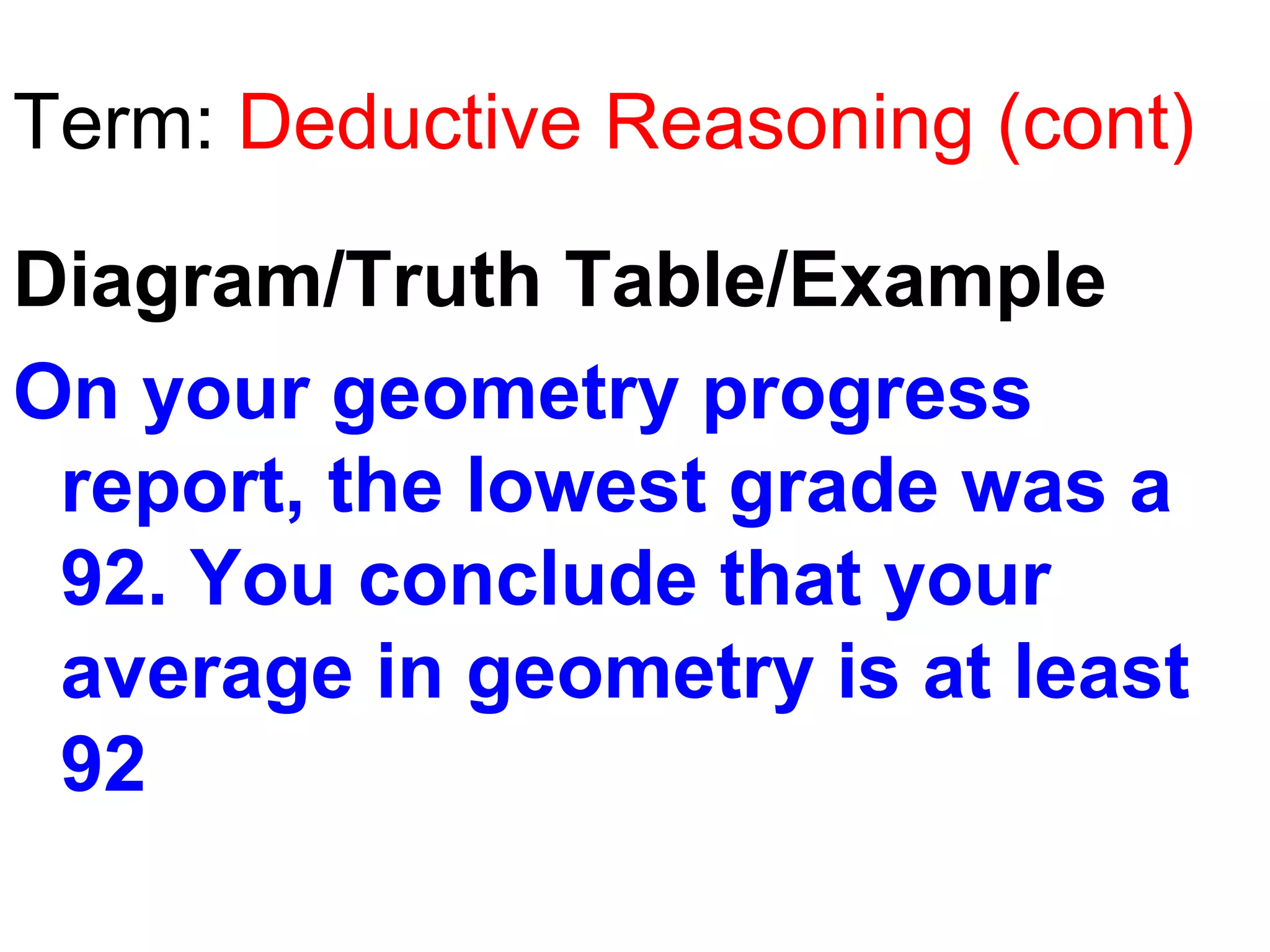
Term: Deductive Reasoning (cont)
Diagram/Truth Table/Example
On your geometry progress
report, the lowest grade was a
92. You conclude that your
average in geometry is at least
92
Term:
Definition:

Diagram/Truth Table/Example

Unit 5 Geometry Logic Vocabulary

  • 2.
    1.Term: Counter-Example Definition: Anexample that contradicts a statement. ( Shows a statement to be false) Diagram/Truth Table/Example Statement: all rectangles are squares. Counter example
  • 3.
    2.Term: AND Statement Definition:Two statements joined by the word “and”. The statement is true only if both statements are true. P Q P and Q T T T T F F F T F F F F
  • 4.
    3.Term: OR Statement Definition:Two statements joined by the word “or”. The statement is true if either or both of the statements are true. P Q P or Q T T T T F T F T T F F F
  • 5.
    4.Term: Venn Diagram Definition:Used to show relationships between sets or groups of things. Diagram/Truth Table/Example
  • 6.
    5.Term: Conditional Statement Definition:If, then statement. If p then q. An alternate statement: q if p. p implies q P Q If P, then Q T T T T F F F T T F F T
  • 7.
    6.Term: Hypothesis Definition: Theif “part” Diagram/Truth Table/Example: If I cut myself peeling onions, then I will bleed.
  • 8.
    7.Term: Conclusion Definition: Thethen “part” Diagram/Truth Table/Example: Diagram/Truth Table/Example: If cut myself peeling onions, then I will bleed.
  • 9.
    Term: Converse Definition: Whenthe original hypothesis and conclusion are switched. If q, then p. Diagram/Truth Table/Example: If I cut myself peeling onions, then I will bleed. becomes If I bleed, then I cut myself peeling onions.
  • 10.
    8. Term: Inverse Definition:When you negate both the hypothesis and conclusion. Diagram/Truth Table/Example: If I cut myself peeling onions, then I will bleed. Becomes, If I did not cut myself peeling onions, then I will not bleed.
  • 11.
    9.Term: Contrapositive Definition: Whenyou negate both the hypothesis and conclusion and switch their original position Diagram/Truth Table/Example: If I cut myself peeling onions, then I will bleed. Becomes, If I did not bleed, then I did not cut myself peeling onions
  • 12.
    Term: Inductive Reasoning Definition:Based on • Observations • Past experience • Moves from specific to general observations • Is useful in providing conjecture or hypothesis • Does not always lead to a valid conclusion
  • 13.
    Term: Inductive Reasoning(cont) Diagram/Truth Table/Example: You observe that for the last 5 weeks in math, you have had a quiz on Tuesday. As today is Monday, you conclude that tomorrow, there will be a quiz in math.
  • 14.
    Term: Deductive Reasoning Definition: •Based on facts, definitions, postulates, properties and theorems • Moves from general to specific • Is useful in providing conjectures • Always leads to a valid conclusion, if the assumptions are true
  • 15.
    Term: Deductive Reasoning(cont) Diagram/Truth Table/Example On your geometry progress report, the lowest grade was a 92. You conclude that your average in geometry is at least 92
  • 16.