6.4 Truth Tables for Arguments
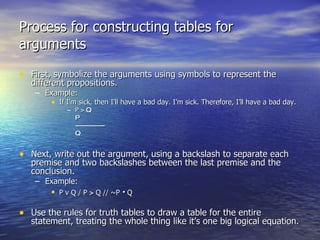
Process for constructing tables for arguments First, symbolize the arguments using symbols to represent the different propositions. Example: If I’m sick, then I’ll have a bad day. I’m sick. Therefore, I’ll have a bad day. P  > Q P -------------- Q Next, write out the argument, using a backslash to separate each premise and two backslashes between the last premise and the conclusion. Example: P v Q / P  >  Q // ~P  ·  Q Use the rules for truth tables to draw a table for the entire statement, treating the whole thing like it’s one big logical equation.
Process, continued Lastly, see if there’s at least one line where all of the premises are true and the conclusion is false. If there is, then the whole equation is invalid. If  no line exists  with true premises and a false conclusion, then the argument has to be valid.
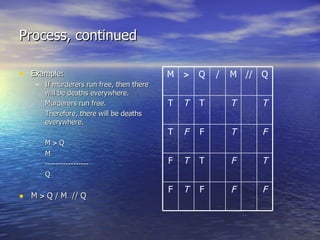
Process, continued Example: If murderers run free, then there will be deaths everywhere. Murderers run free. Therefore, there will be deaths everywhere. M  >  Q M ----------------- Q M  >  Q / M  // Q F F F T F T F T T F F T F F T T T T T T Q // M / Q > M
Miscellaneous points on validity An argument with inconsistent premises is always valid, regardless of the conclusion. Inconsistent = No line with all true premises. Invalid = True premises, false conclusion. So, No true premises = no invalidity. An argument with a tautologous conclusion is also always valid, regardless of its premises. Tautologous = Always true. Invalid = True premises, false conclusion. So, always true conclusion = no chance of invalidity.
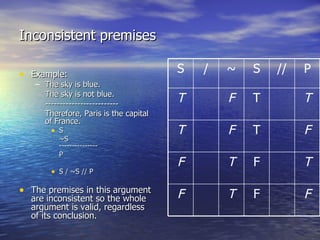
Inconsistent premises Example: The sky is blue. The sky is not blue. ------------------------- Therefore, Paris is the capital of France. S ~S --------------- P S / ~S // P The premises in this argument are inconsistent so the whole argument is valid, regardless of its conclusion. T F T F P // S ~ / S F F T F F T F T T T F T
Tautologous conclusion Example: Bern is the capital of Switzerland.  ------------------------- Therefore, it is either raining or it is not raining. B ---------------- R v ~R B // R v ~R The conclusion here is tautologous, so the whole argument is valid regardless of its premises. F T T F F T F T T F F T T F T T F T T T R ~ v R // B

6.4 Truth Tables For Arguments

  • 1.
    6.4 Truth Tablesfor Arguments
  • 2.
    Process for constructingtables for arguments First, symbolize the arguments using symbols to represent the different propositions. Example: If I’m sick, then I’ll have a bad day. I’m sick. Therefore, I’ll have a bad day. P > Q P -------------- Q Next, write out the argument, using a backslash to separate each premise and two backslashes between the last premise and the conclusion. Example: P v Q / P > Q // ~P · Q Use the rules for truth tables to draw a table for the entire statement, treating the whole thing like it’s one big logical equation.
  • 3.
    Process, continued Lastly,see if there’s at least one line where all of the premises are true and the conclusion is false. If there is, then the whole equation is invalid. If no line exists with true premises and a false conclusion, then the argument has to be valid.
  • 4.
    Process, continued Example:If murderers run free, then there will be deaths everywhere. Murderers run free. Therefore, there will be deaths everywhere. M > Q M ----------------- Q M > Q / M // Q F F F T F T F T T F F T F F T T T T T T Q // M / Q > M
  • 5.
    Miscellaneous points onvalidity An argument with inconsistent premises is always valid, regardless of the conclusion. Inconsistent = No line with all true premises. Invalid = True premises, false conclusion. So, No true premises = no invalidity. An argument with a tautologous conclusion is also always valid, regardless of its premises. Tautologous = Always true. Invalid = True premises, false conclusion. So, always true conclusion = no chance of invalidity.
  • 6.
    Inconsistent premises Example:The sky is blue. The sky is not blue. ------------------------- Therefore, Paris is the capital of France. S ~S --------------- P S / ~S // P The premises in this argument are inconsistent so the whole argument is valid, regardless of its conclusion. T F T F P // S ~ / S F F T F F T F T T T F T
  • 7.
    Tautologous conclusion Example:Bern is the capital of Switzerland. ------------------------- Therefore, it is either raining or it is not raining. B ---------------- R v ~R B // R v ~R The conclusion here is tautologous, so the whole argument is valid regardless of its premises. F T T F F T F T T F F T T F T T F T T T R ~ v R // B