Truth, Deduction,
Computation
Lecture 4
Monoids
Vlad Patryshev
SCU
2013
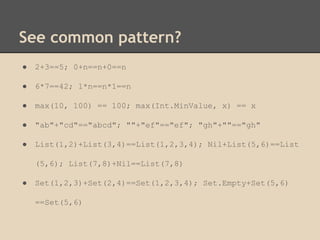
See common pattern?
●

2+3==5; 0+n==n+0==n

●

6*7==42; 1*n==n*1==n

●

max(10, 100) == 100; max(Int.MinValue, x) == x

●

"ab"+"cd"=="abcd"; ""+"ef"=="ef"; "gh"+""=="gh"

●

List(1,2)+List(3,4)==List(1,2,3,4); Nil+List(5,6)==List
(5,6); List(7,8)+Nil==List(7,8)

●

Set(1,2,3)+Set(2,4)==Set(1,2,3,4); Set.Empty+Set(5,6)
==Set(5,6)
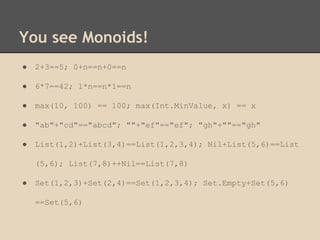
You see Monoids!
●

2+3==5; 0+n==n+0==n

●

6*7==42; 1*n==n*1==n

●

max(10, 100) == 100; max(Int.MinValue, x) == x

●

"ab"+"cd"=="abcd"; ""+"ef"=="ef"; "gh"+""=="gh"

●

List(1,2)+List(3,4)==List(1,2,3,4); Nil+List(5,6)==List
(5,6); List(7,8)++Nil==List(7,8)

●

Set(1,2,3)+Set(2,4)==Set(1,2,3,4); Set.Empty+Set(5,6)
==Set(5,6)
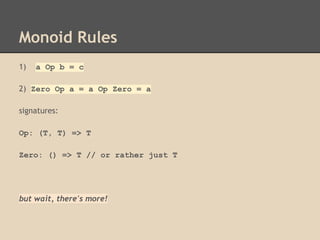
Monoid Rules
1)

a Op b = c

2) Zero Op a = a Op Zero = a
signatures:
Op: (T, T) => T
Zero: () => T // or rather just T

but wait, there's more!
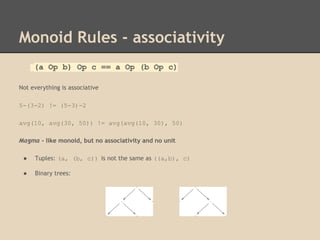
Monoid Rules - associativity
(a Op b) Op c == a Op (b Op c)
Not everything is associative
5-(3-2) != (5-3)-2
avg(10, avg(30, 50)) != avg(avg(10, 30), 50)
Magma - like monoid, but no associativity and no unit
●

Tuples: (a, (b, c)) is not the same as ((a,b), c)

●

Binary trees:
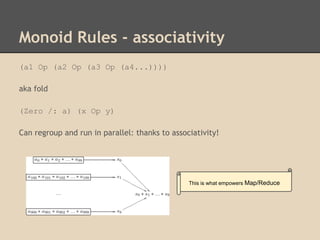
Monoid Rules - associativity
(a1 Op (a2 Op (a3 Op (a4...))))
aka fold
(Zero /: a) (x Op y)
Can regroup and run in parallel: thanks to associativity!

This is what empowers Map/Reduce
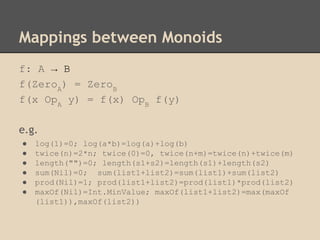
Mappings between Monoids
f: A → B
f(ZeroA) = ZeroB
f(x OpA y) = f(x) OpB f(y)
e.g.
●
●
●
●
●
●

log(1)=0; log(a*b)=log(a)+log(b)
twice(n)=2*n; twice(0)=0, twice(n+m)=twice(n)+twice(m)
length("")=0; length(s1+s2)=length(s1)+length(s2)
sum(Nil)=0; sum(list1+list2)=sum(list1)+sum(list2)
prod(Nil)=1; prod(list1+list2)=prod(list1)*prod(list2)
maxOf(Nil)=Int.MinValue; maxOf(list1+list2)=max(maxOf
(list1)),maxOf(list2))
Free Monoid
any type

a monoid

take any function, f: A → B
this is equivalent to specifying...
f': List[A] → B
where
f'(Nil) = ZeroB
f'(list1 + list2) = f'(list1) OpB f'(list2)
List[A] is a Free Monoid on A
Free Monoid - example
Suppose we have...
object WeekDay extends Enumeration {
val Mon, Tue, Wed, Thu, Fri, Sat, Sun = Value
}
and a function
WeekDay=>Int = (Mon->1, Tue->1, Wed->1, Thu->1, Fri->1,
Sat->0, Sun->0)
If we have a monoid (Int, 0, +), we can automatically extend this
mapping to List[WeekDay]->Int
which counts the number of working days.
Reduce
reduce: List[A] → A
with properties:

●
●

reduce(Nil) = ZeroA
reduce(list1+list2) = reduce(list1) OpA reduce(list2)

(This defines an algebra over the functor List[_].)
This is exactly what we did on the previous page, reduce.
That's almost it
Monoids are simple, are not they?
Let's throw in more properties...
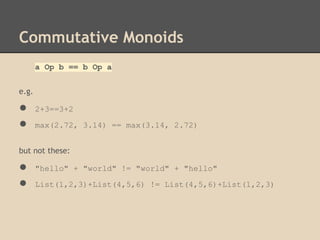
Commutative Monoids
a Op b == b Op a
e.g.

●
●

2+3==3+2
max(2.72, 3.14) == max(3.14, 2.72)

but not these:

●
●

"hello" + "world" != "world" + "hello"
List(1,2,3)+List(4,5,6) != List(4,5,6)+List(1,2,3)
Commutative Monoids
How can we create one?
e.g.
"abracadabra" -> "aaaaabbcdrr"
Order does not matter; numbers matter.
Free commutative monoid on A: a collection of possibly duplicates, order
does not matter.
It is called Bag[A]
Commutative Monoids
Bag[A]
<script language=”javascript”>
var bag =
{
"partridges in a pear tree": 1,
"turtle doves": 2,
"french hens": 3,
"calling birds": 4,
"golden rings": 5
//etc
}
</script>
Commutative Monoids
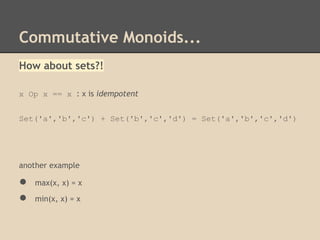
How about sets?!
Commutative Monoids...
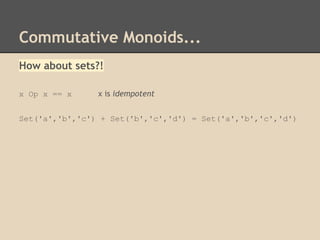
How about sets?!
x Op x == x

x is idempotent

Set('a','b','c') + Set('b','c','d') = Set('a','b','c','d')
Commutative Monoids...
How about sets?!
x Op x == x : x is idempotent
Set('a','b','c') + Set('b','c','d') = Set('a','b','c','d')

another example

●
●

max(x, x) = x
min(x, x) = x
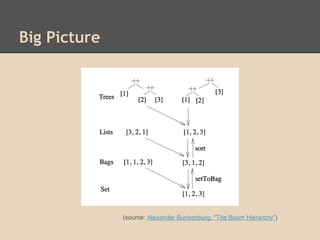
Big Picture

The Whole Picture

(source: Alexander Bunkenburg, "The Boom Hierarchy")
Questions?

http://vpatryshev.blogspot.com/2009/06/why-monoids.html (with Java examples)
http://blog.safaribooksonline.com/2013/05/15/monoids-for-programmers-a-scala-example/

Truth, deduction, computation; lecture 4

  • 1.
  • 2.
    See common pattern? ● 2+3==5;0+n==n+0==n ● 6*7==42; 1*n==n*1==n ● max(10, 100) == 100; max(Int.MinValue, x) == x ● "ab"+"cd"=="abcd"; ""+"ef"=="ef"; "gh"+""=="gh" ● List(1,2)+List(3,4)==List(1,2,3,4); Nil+List(5,6)==List (5,6); List(7,8)+Nil==List(7,8) ● Set(1,2,3)+Set(2,4)==Set(1,2,3,4); Set.Empty+Set(5,6) ==Set(5,6)
  • 3.
    You see Monoids! ● 2+3==5;0+n==n+0==n ● 6*7==42; 1*n==n*1==n ● max(10, 100) == 100; max(Int.MinValue, x) == x ● "ab"+"cd"=="abcd"; ""+"ef"=="ef"; "gh"+""=="gh" ● List(1,2)+List(3,4)==List(1,2,3,4); Nil+List(5,6)==List (5,6); List(7,8)++Nil==List(7,8) ● Set(1,2,3)+Set(2,4)==Set(1,2,3,4); Set.Empty+Set(5,6) ==Set(5,6)
  • 4.
    Monoid Rules 1) a Opb = c 2) Zero Op a = a Op Zero = a signatures: Op: (T, T) => T Zero: () => T // or rather just T but wait, there's more!
  • 5.
    Monoid Rules -associativity (a Op b) Op c == a Op (b Op c) Not everything is associative 5-(3-2) != (5-3)-2 avg(10, avg(30, 50)) != avg(avg(10, 30), 50) Magma - like monoid, but no associativity and no unit ● Tuples: (a, (b, c)) is not the same as ((a,b), c) ● Binary trees:
  • 6.
    Monoid Rules -associativity (a1 Op (a2 Op (a3 Op (a4...)))) aka fold (Zero /: a) (x Op y) Can regroup and run in parallel: thanks to associativity! This is what empowers Map/Reduce
  • 7.
    Mappings between Monoids f:A → B f(ZeroA) = ZeroB f(x OpA y) = f(x) OpB f(y) e.g. ● ● ● ● ● ● log(1)=0; log(a*b)=log(a)+log(b) twice(n)=2*n; twice(0)=0, twice(n+m)=twice(n)+twice(m) length("")=0; length(s1+s2)=length(s1)+length(s2) sum(Nil)=0; sum(list1+list2)=sum(list1)+sum(list2) prod(Nil)=1; prod(list1+list2)=prod(list1)*prod(list2) maxOf(Nil)=Int.MinValue; maxOf(list1+list2)=max(maxOf (list1)),maxOf(list2))
  • 8.
    Free Monoid any type amonoid take any function, f: A → B this is equivalent to specifying... f': List[A] → B where f'(Nil) = ZeroB f'(list1 + list2) = f'(list1) OpB f'(list2) List[A] is a Free Monoid on A
  • 9.
    Free Monoid -example Suppose we have... object WeekDay extends Enumeration { val Mon, Tue, Wed, Thu, Fri, Sat, Sun = Value } and a function WeekDay=>Int = (Mon->1, Tue->1, Wed->1, Thu->1, Fri->1, Sat->0, Sun->0) If we have a monoid (Int, 0, +), we can automatically extend this mapping to List[WeekDay]->Int which counts the number of working days.
  • 10.
    Reduce reduce: List[A] →A with properties: ● ● reduce(Nil) = ZeroA reduce(list1+list2) = reduce(list1) OpA reduce(list2) (This defines an algebra over the functor List[_].) This is exactly what we did on the previous page, reduce.
  • 11.
    That's almost it Monoidsare simple, are not they? Let's throw in more properties...
  • 12.
    Commutative Monoids a Opb == b Op a e.g. ● ● 2+3==3+2 max(2.72, 3.14) == max(3.14, 2.72) but not these: ● ● "hello" + "world" != "world" + "hello" List(1,2,3)+List(4,5,6) != List(4,5,6)+List(1,2,3)
  • 13.
    Commutative Monoids How canwe create one? e.g. "abracadabra" -> "aaaaabbcdrr" Order does not matter; numbers matter. Free commutative monoid on A: a collection of possibly duplicates, order does not matter. It is called Bag[A]
  • 14.
    Commutative Monoids Bag[A] <script language=”javascript”> varbag = { "partridges in a pear tree": 1, "turtle doves": 2, "french hens": 3, "calling birds": 4, "golden rings": 5 //etc } </script>
  • 15.
  • 16.
    Commutative Monoids... How aboutsets?! x Op x == x x is idempotent Set('a','b','c') + Set('b','c','d') = Set('a','b','c','d')
  • 17.
    Commutative Monoids... How aboutsets?! x Op x == x : x is idempotent Set('a','b','c') + Set('b','c','d') = Set('a','b','c','d') another example ● ● max(x, x) = x min(x, x) = x
  • 18.
    Big Picture The WholePicture (source: Alexander Bunkenburg, "The Boom Hierarchy")
  • 19.
    Questions? http://vpatryshev.blogspot.com/2009/06/why-monoids.html (with Javaexamples) http://blog.safaribooksonline.com/2013/05/15/monoids-for-programmers-a-scala-example/