Monads are
no Nomads
By João Esperancinha
2024/10/08
Unlocking the basics
Talking Points
● Functors
● Monoids
● Monads
Functors
● Mapping function: fmap in Haskell, map in Kotlin
● Functor Laws:
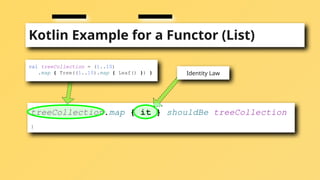
● Identity Law: F<X>.map(::identity) == F<X>
● Composition Law:
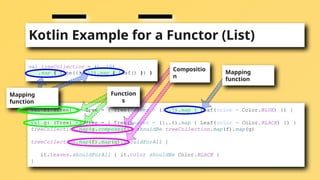
F<X>.map(f.compose(g)) == F<X>.map(g).map(f) == F(X).map {g(f(it)}
Sources: https://wiki.haskell.org/Functor
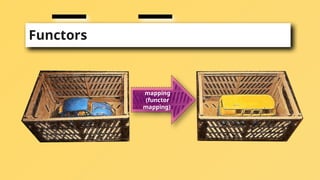
Functors
mapping
(functor
mapping)
Haskel Example for a Functor (List)
print (fmap addOne (Just 5))
print (fmap addOne Nothing)
print (fmap addOne [1, 2, 3, 4, 5])
print (fmap square [1, 2, 3, 4, 5])
print ([1,2,3,4,5])
print (fmap identityFunction [1,2,3,4,5])
print (fmap (addOne . square) [1,2,3,4,5] == (fmap addOne . fmap square)
[1,2,3,4,5])
addOne :: Int -> Int
addOne x = x + 1
square :: Int -> Int
square x = x * x
identityFunction :: Int -> Int
identityFunction x = x
Identity law
Compositio
n
Mapping
function
Kotlin Example for a Functor (List)
treeCollection.map { it } shouldBe treeCollection
}
val treeCollection = (1..10)
.map { Tree((1..10).map { Leaf() }) } Identity Law
Kotlin Example for a Functor (List)
val f: (Tree) -> Tree = { Tree(leaves = (1..5).map { Leaf(color = Color.BLUE) }) }
val g: (Tree) -> Tree = { Tree(leaves = (1..6).map { Leaf(color = Color.BLACK) }) }
treeCollection.map(g.compose(f)) shouldBe treeCollection.map(f).map(g)
treeCollection.map(f).map(g).shouldForAll {
it.leaves.shouldForAll { it.color shouldBe Color.BLACK }
}
val treeCollection = (1..10)
.map { Tree((1..10).map { Leaf() }) }
Compositio
n
Mapping
function
Mapping
function
Function
s
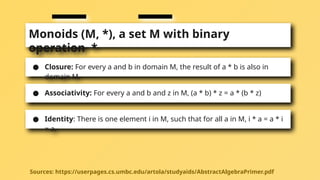
Monoids (M, *), a set M with binary
operation *
● Closure: For every a and b in domain M, the result of a * b is also in
domain M.
● Associativity: For every a and b and z in M, (a * b) * z = a * (b * z)
● Identity: There is one element i in M, such that for all a in M, i * a = a * i
= a.
Sources: https://userpages.cs.umbc.edu/artola/studyaids/AbstractAlgebraPrimer.pdf
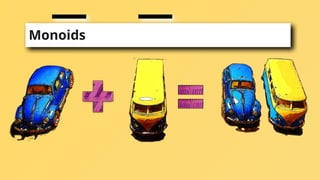
Monoids
Haskel Example for a Monoid (List)
let list1 = [1, 2, 3]
list2 = [4, 5, 6]
combinedList = list1 <> list2
list1Empty = list1 <> mempty
list2Empty = mempty <> list2
putStrLn $ "List 1: " ++ show list1
putStrLn $ "List 2: " ++ show list2
putStrLn $ "List 1 with empty: " ++ show list1Empty
putStrLn $ "List 2 with empty: " ++ show list2Empty
putStrLn $ "Combined List: " ++ show combinedList
putStrLn $ "Identity: " ++ show (mempty :: [Int])
putStrLn $ "Associativity 1: " ++ show ((list1 <> list2) <> list1)
putStrLn $ "Associativity 2: " ++ show (list1 <> (list2 <> list1))
Associativit
y
Identity
Closure
Binary
Operator
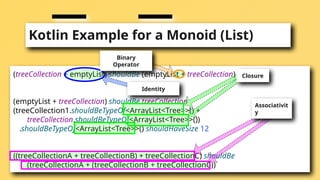
Kotlin Example for a Monoid (List)
(treeCollection + emptyList) shouldBe (emptyList + treeCollection)
(emptyList + treeCollection) shouldBe treeCollection
(treeCollection1.shouldBeTypeOf<ArrayList<Tree>>() +
treeCollection.shouldBeTypeOf<ArrayList<Tree>>())
.shouldBeTypeOf<ArrayList<Tree>>() shouldHaveSize 12
((treeCollectionA + treeCollectionB) + treeCollectionC) shouldBe
(treeCollectionA + (treeCollectionB + treeCollectionC))
Associativit
y
Identity
Closure
Binary
Operator
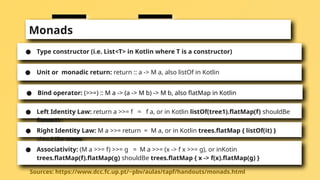
Monads
● Type constructor (i.e. List<T> in Kotlin where T is a constructor)
● Unit or monadic return: return :: a -> M a, also listOf in Kotlin
● Bind operator: (>>=) :: M a -> (a -> M b) -> M b, also flatMap in Kotlin
Sources: https://www.dcc.fc.up.pt/~pbv/aulas/tapf/handouts/monads.html
● Left Identity Law: return a >>= f = f a, or in Kotlin listOf(tree1).flatMap(f) shouldBe
f(tree1)
● Right Identity Law: M a >>= return = M a, or in Kotlin trees.flatMap { listOf(it) }
shouldBe trees
● Associativity: (M a >>= f) >>= g = M a >>= (x -> f x >>= g), or inKotin
trees.flatMap(f).flatMap(g) shouldBe trees.flatMap { x -> f(x).flatMap(g) }
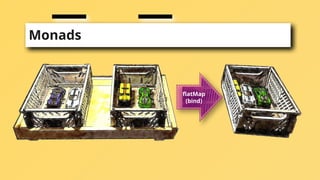
Monads
flatMap
(bind)
Haskell example for a Monad
createTwoElementFunction :: Int -> [Int]
createTwoElementFunction x = [x, x + 1]
createDoubleElementFunction :: Int -> [Int]
createDoubleElementFunction x = [x * 2]
leftIdentityTest :: Int -> Bool
leftIdentityTest a = (return a >>= createTwoElementFunction) == createTwoElementFunction a
rightIdentityTest :: [Int] -> Bool
rightIdentityTest m = (m >>= return) == m
associativityTest :: [Int] -> Bool
associativityTest m = ((m >>= createTwoElementFunction) >>= createDoubleElementFunction) ==
(m >>= (x -> createTwoElementFunction x >>= createDoubleElementFunction))
main :: IO ()
main = do
let testValue :: Int
testValue = 5
let testList :: [Int]
testList = [1,2,3]
let listOfLists :: [[Int]]
listOfLists = [[1, 2, 3], [4, 5, 6], [7, 8, 9]]
putStrLn $ "Used the unit operation (" ++ show (return testValue :: [Int]) ++ "): "
putStrLn $ "Just a flatMap operation (" ++ show testList ++ "): " ++ show (testList >>= (x -> [x * 2]))
putStrLn $ "Another flatMap operation (" ++ show listOfLists ++ "): " ++ show (listOfLists >>= (x -> x))
putStrLn $ "Left Identity (" ++ show testValue ++ "): " ++ show (leftIdentityTest testValue)
putStrLn $ "Right Identity (" ++ show testList ++ "): " ++ show (rightIdentityTest testList)
putStrLn $ "Associativity (" ++ show testList ++ "): " ++ show (associativityTest testList)
Type Constructor
Monadic Return
Bind operator
Left identity Law
Right identity Law
Associativity Law
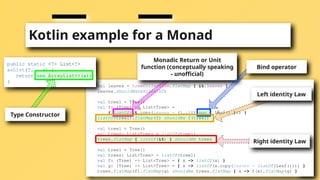
Kotlin example for a Monad
val leaves = treeCollection.flatMap { it.leaves }
leaves.shouldHaveSize(100)
val tree1 = Tree()
val f: (Tree) -> List<Tree> =
{ listOf(it.copy(leaves = (1..10).map { Leaf() })) }
listOf(tree1).flatMap(f) shouldBe f(tree1)
val tree1 = Tree()
val trees: List<Tree> = listOf(tree1)
trees.flatMap { listOf(it) } shouldBe trees
val tree1 = Tree()
val trees: List<Tree> = listOf(tree1)
val f: (Tree) -> List<Tree> = { x -> listOf(x) }
val g: (Tree) -> List<Tree> = { x -> listOf(x.copy(leaves = listOf(Leaf()))) }
trees.flatMap(f).flatMap(g) shouldBe trees.flatMap { x -> f(x).flatMap(g) }
public static <T> List<T>
asList(T... a) {
return new ArrayList<>(a);
}
Type Constructor
Monadic Return or Unit
function (conceptually speaking
- unofficial)
Bind operator
Left identity Law
Right identity Law
Questions?
I am an inquisitive
cat
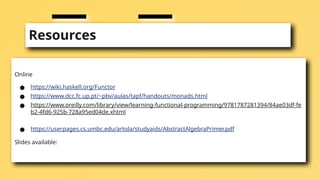
Resources
Online
● https://wiki.haskell.org/Functor
● https://www.dcc.fc.up.pt/~pbv/aulas/tapf/handouts/monads.html
● https://www.oreilly.com/library/view/learning-functional-programming/9781787281394/84ae03df-fe
b2-4fd6-925b-728a95ed04de.xhtml
● https://userpages.cs.umbc.edu/artola/studyaids/AbstractAlgebraPrimer.pdf
Slides available:
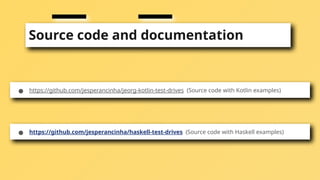
Source code and documentation
● https://github.com/jesperancinha/jeorg-kotlin-test-drives (Source code with Kotlin examples)
● https://github.com/jesperancinha/haskell-test-drives (Source code with Haskell examples)
About me
● Homepage - https://joaofilipesabinoesperancinha.nl
● LinkedIn - https://www.linkedin.com/in/joaoesperancinha/
● YouTube - JESPROTECH
■ https://www.youtube.com/channel/UCzS_JK7QsZ7ZH-zTc5kBX_g
■ https://www.youtube.com/@jesprotech
● Bluesky - https://bsky.app/profile/jesperancinha.bsky.social
● Mastodon - https://masto.ai/@jesperancinha
● GitHub - https://github.com/jesperancinha
● Hackernoon - https://hackernoon.com/u/jesperancinha
● DevTO - https://dev.to/jofisaes
● Medium - https://medium.com/@jofisaes
Thank you!
By João Esperancinha
2024/10/08
Monads
are no
Nomads

Monads are no Nomads - Unlocking the basics

  • 1.
    Monads are no Nomads ByJoão Esperancinha 2024/10/08 Unlocking the basics
  • 2.
  • 3.
    Functors ● Mapping function:fmap in Haskell, map in Kotlin ● Functor Laws: ● Identity Law: F<X>.map(::identity) == F<X> ● Composition Law: F<X>.map(f.compose(g)) == F<X>.map(g).map(f) == F(X).map {g(f(it)} Sources: https://wiki.haskell.org/Functor
  • 4.
  • 5.
    Haskel Example fora Functor (List) print (fmap addOne (Just 5)) print (fmap addOne Nothing) print (fmap addOne [1, 2, 3, 4, 5]) print (fmap square [1, 2, 3, 4, 5]) print ([1,2,3,4,5]) print (fmap identityFunction [1,2,3,4,5]) print (fmap (addOne . square) [1,2,3,4,5] == (fmap addOne . fmap square) [1,2,3,4,5]) addOne :: Int -> Int addOne x = x + 1 square :: Int -> Int square x = x * x identityFunction :: Int -> Int identityFunction x = x Identity law Compositio n Mapping function
  • 6.
    Kotlin Example fora Functor (List) treeCollection.map { it } shouldBe treeCollection } val treeCollection = (1..10) .map { Tree((1..10).map { Leaf() }) } Identity Law
  • 7.
    Kotlin Example fora Functor (List) val f: (Tree) -> Tree = { Tree(leaves = (1..5).map { Leaf(color = Color.BLUE) }) } val g: (Tree) -> Tree = { Tree(leaves = (1..6).map { Leaf(color = Color.BLACK) }) } treeCollection.map(g.compose(f)) shouldBe treeCollection.map(f).map(g) treeCollection.map(f).map(g).shouldForAll { it.leaves.shouldForAll { it.color shouldBe Color.BLACK } } val treeCollection = (1..10) .map { Tree((1..10).map { Leaf() }) } Compositio n Mapping function Mapping function Function s
  • 8.
    Monoids (M, *),a set M with binary operation * ● Closure: For every a and b in domain M, the result of a * b is also in domain M. ● Associativity: For every a and b and z in M, (a * b) * z = a * (b * z) ● Identity: There is one element i in M, such that for all a in M, i * a = a * i = a. Sources: https://userpages.cs.umbc.edu/artola/studyaids/AbstractAlgebraPrimer.pdf
  • 9.
  • 10.
    Haskel Example fora Monoid (List) let list1 = [1, 2, 3] list2 = [4, 5, 6] combinedList = list1 <> list2 list1Empty = list1 <> mempty list2Empty = mempty <> list2 putStrLn $ "List 1: " ++ show list1 putStrLn $ "List 2: " ++ show list2 putStrLn $ "List 1 with empty: " ++ show list1Empty putStrLn $ "List 2 with empty: " ++ show list2Empty putStrLn $ "Combined List: " ++ show combinedList putStrLn $ "Identity: " ++ show (mempty :: [Int]) putStrLn $ "Associativity 1: " ++ show ((list1 <> list2) <> list1) putStrLn $ "Associativity 2: " ++ show (list1 <> (list2 <> list1)) Associativit y Identity Closure Binary Operator
  • 11.
    Kotlin Example fora Monoid (List) (treeCollection + emptyList) shouldBe (emptyList + treeCollection) (emptyList + treeCollection) shouldBe treeCollection (treeCollection1.shouldBeTypeOf<ArrayList<Tree>>() + treeCollection.shouldBeTypeOf<ArrayList<Tree>>()) .shouldBeTypeOf<ArrayList<Tree>>() shouldHaveSize 12 ((treeCollectionA + treeCollectionB) + treeCollectionC) shouldBe (treeCollectionA + (treeCollectionB + treeCollectionC)) Associativit y Identity Closure Binary Operator
  • 12.
    Monads ● Type constructor(i.e. List<T> in Kotlin where T is a constructor) ● Unit or monadic return: return :: a -> M a, also listOf in Kotlin ● Bind operator: (>>=) :: M a -> (a -> M b) -> M b, also flatMap in Kotlin Sources: https://www.dcc.fc.up.pt/~pbv/aulas/tapf/handouts/monads.html ● Left Identity Law: return a >>= f = f a, or in Kotlin listOf(tree1).flatMap(f) shouldBe f(tree1) ● Right Identity Law: M a >>= return = M a, or in Kotlin trees.flatMap { listOf(it) } shouldBe trees ● Associativity: (M a >>= f) >>= g = M a >>= (x -> f x >>= g), or inKotin trees.flatMap(f).flatMap(g) shouldBe trees.flatMap { x -> f(x).flatMap(g) }
  • 13.
  • 14.
    Haskell example fora Monad createTwoElementFunction :: Int -> [Int] createTwoElementFunction x = [x, x + 1] createDoubleElementFunction :: Int -> [Int] createDoubleElementFunction x = [x * 2] leftIdentityTest :: Int -> Bool leftIdentityTest a = (return a >>= createTwoElementFunction) == createTwoElementFunction a rightIdentityTest :: [Int] -> Bool rightIdentityTest m = (m >>= return) == m associativityTest :: [Int] -> Bool associativityTest m = ((m >>= createTwoElementFunction) >>= createDoubleElementFunction) == (m >>= (x -> createTwoElementFunction x >>= createDoubleElementFunction)) main :: IO () main = do let testValue :: Int testValue = 5 let testList :: [Int] testList = [1,2,3] let listOfLists :: [[Int]] listOfLists = [[1, 2, 3], [4, 5, 6], [7, 8, 9]] putStrLn $ "Used the unit operation (" ++ show (return testValue :: [Int]) ++ "): " putStrLn $ "Just a flatMap operation (" ++ show testList ++ "): " ++ show (testList >>= (x -> [x * 2])) putStrLn $ "Another flatMap operation (" ++ show listOfLists ++ "): " ++ show (listOfLists >>= (x -> x)) putStrLn $ "Left Identity (" ++ show testValue ++ "): " ++ show (leftIdentityTest testValue) putStrLn $ "Right Identity (" ++ show testList ++ "): " ++ show (rightIdentityTest testList) putStrLn $ "Associativity (" ++ show testList ++ "): " ++ show (associativityTest testList) Type Constructor Monadic Return Bind operator Left identity Law Right identity Law Associativity Law
  • 15.
    Kotlin example fora Monad val leaves = treeCollection.flatMap { it.leaves } leaves.shouldHaveSize(100) val tree1 = Tree() val f: (Tree) -> List<Tree> = { listOf(it.copy(leaves = (1..10).map { Leaf() })) } listOf(tree1).flatMap(f) shouldBe f(tree1) val tree1 = Tree() val trees: List<Tree> = listOf(tree1) trees.flatMap { listOf(it) } shouldBe trees val tree1 = Tree() val trees: List<Tree> = listOf(tree1) val f: (Tree) -> List<Tree> = { x -> listOf(x) } val g: (Tree) -> List<Tree> = { x -> listOf(x.copy(leaves = listOf(Leaf()))) } trees.flatMap(f).flatMap(g) shouldBe trees.flatMap { x -> f(x).flatMap(g) } public static <T> List<T> asList(T... a) { return new ArrayList<>(a); } Type Constructor Monadic Return or Unit function (conceptually speaking - unofficial) Bind operator Left identity Law Right identity Law
  • 16.
    Questions? I am aninquisitive cat
  • 17.
    Resources Online ● https://wiki.haskell.org/Functor ● https://www.dcc.fc.up.pt/~pbv/aulas/tapf/handouts/monads.html ●https://www.oreilly.com/library/view/learning-functional-programming/9781787281394/84ae03df-fe b2-4fd6-925b-728a95ed04de.xhtml ● https://userpages.cs.umbc.edu/artola/studyaids/AbstractAlgebraPrimer.pdf Slides available:
  • 18.
    Source code anddocumentation ● https://github.com/jesperancinha/jeorg-kotlin-test-drives (Source code with Kotlin examples) ● https://github.com/jesperancinha/haskell-test-drives (Source code with Haskell examples)
  • 19.
    About me ● Homepage- https://joaofilipesabinoesperancinha.nl ● LinkedIn - https://www.linkedin.com/in/joaoesperancinha/ ● YouTube - JESPROTECH ■ https://www.youtube.com/channel/UCzS_JK7QsZ7ZH-zTc5kBX_g ■ https://www.youtube.com/@jesprotech ● Bluesky - https://bsky.app/profile/jesperancinha.bsky.social ● Mastodon - https://masto.ai/@jesperancinha ● GitHub - https://github.com/jesperancinha ● Hackernoon - https://hackernoon.com/u/jesperancinha ● DevTO - https://dev.to/jofisaes ● Medium - https://medium.com/@jofisaes
  • 20.
    Thank you! By JoãoEsperancinha 2024/10/08 Monads are no Nomads