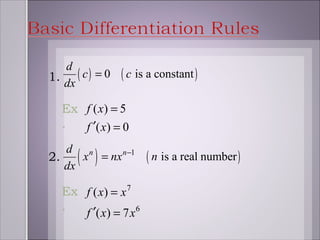
![d d
3. dx ( cf ( x) ) = c dx ( f ( x) ) ( c is a constant )
8
Ex f ( x) = 3 x
( )
. f ′( x) = 3 8 x 7 = 24 x 7
d d d
4. dx f ( x ) ± g ( x ) = dx [ f ( x)] ± dx [ g ( x) ]
Ex f ( x) = 7 + x12
. f ′( x) = 0 + 12 x11 = 12 x11](https://image.slidesharecdn.com/ms2powerrule-130120120240-phpapp02/85/MS2-POwer-Rules-3-320.jpg)
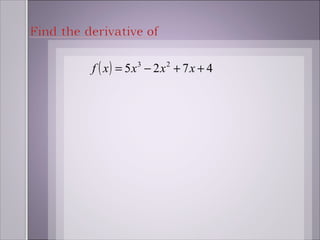
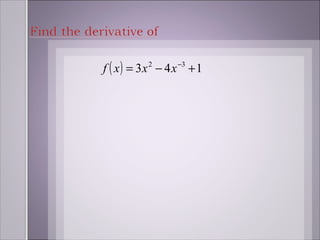
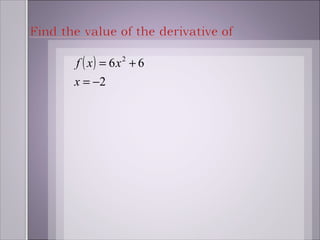
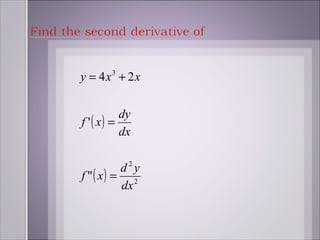
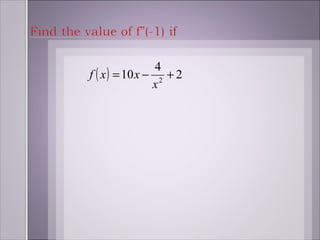
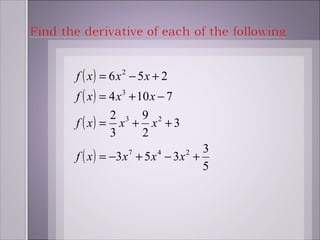
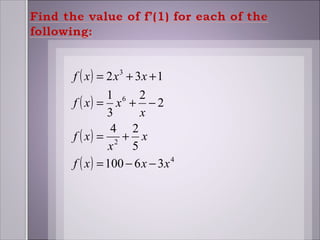
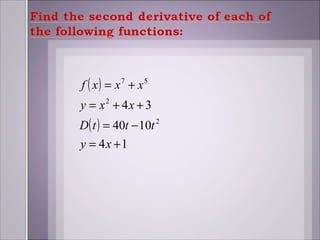
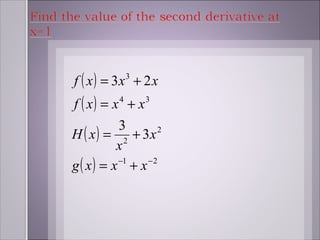
1. The document provides examples of calculating derivatives of various functions using the power, constant multiple, sum and difference, and chain rules of differentiation. 2. Examples include finding the derivatives of polynomials, rational functions, radical functions, and compositions of functions. 3. The four main rules of differentiation are outlined and then applied to specific examples to calculate the derivative of each function.


