Functional Algebra
    Monoids Applied


       Susan Potter


      Nov 10, 2012
OMG, Algebra? FML.. . .


     Figure: Chill! Algebra is just a domain specific language
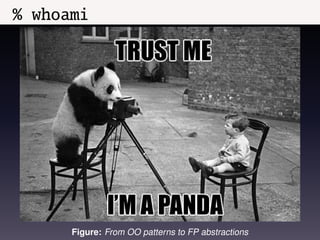
% whoami


      Figure: From OO patterns to FP abstractions
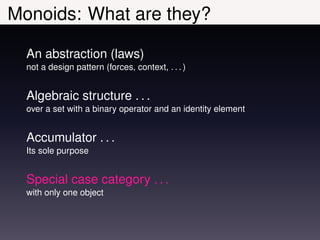
Monoids: What are they?

  An abstraction (laws)
  not a design pattern (forces, context, . . . )


  Algebraic structure . . .
  over a set with a binary operator and an identity element


  Accumulator . . .
  Its sole purpose


  Special case category . . .
  with only one object
Monoids: What are they?

  An abstraction (laws)
  not a design pattern (forces, context, . . . )


  Algebraic structure . . .
  over a set with a binary operator and an identity element


  Accumulator . . .
  Its sole purpose


  Special case category . . .
  with only one object
Monoids: What are they?

  An abstraction (laws)
  not a design pattern (forces, context, . . . )


  Algebraic structure . . .
  over a set with a binary operator and an identity element


  Accumulator . . .
  Its sole purpose


  Special case category . . .
  with only one object
Monoids: What are they?

  An abstraction (laws)
  not a design pattern (forces, context, . . . )


  Algebraic structure . . .
  over a set with a binary operator and an identity element


  Accumulator . . .
  Its sole purpose


  Special case category . . .
  with only one object
Monoids: Typeclasses
           Listing 1: Haskell Monoid Typeclass Definition
1 -- | In Haskell Prelude Data. Monoid
2 class Monoid a where
3   mempty :: a            -- identity
4   mappend :: a -> a -> a -- binary op
5   mconcat :: [a] -> a -- helper

              Listing 2: Scalaz Monoid Trait Definition
1 // Scalaz 7’s Monoid typeclass definition , kinda
2 trait Monoid [A] extends Semigroup [A] { self =>
3   def zero: A                    /* identity */
4   def append(x: A, y: => A): A /* binary op */
5 }
6   // from SemigroupOps [A] ...
7   final def |+|(other: => A): A = A.append(self, other)
Monoids: Typeclasses
           Listing 3: Haskell Monoid Typeclass Definition
1 -- | In Haskell Prelude Data. Monoid
2 class Monoid a where
3   mempty :: a            -- identity
4   mappend :: a -> a -> a -- binary op
5   mconcat :: [a] -> a -- helper

              Listing 4: Scalaz Monoid Trait Definition
1 // Scalaz 7’s Monoid typeclass definition , kinda
2 trait Monoid [A] extends Semigroup [A] { self =>
3   def zero: A                    /* identity */
4   def append(x: A, y: => A): A /* binary op */
5 }
6   // from SemigroupOps [A] ...
7   final def |+|(other: => A): A = A.append(self, other)
Monoids: Typeclasses
           Listing 5: Haskell Monoid Typeclass Definition
1 -- | In Haskell Prelude Data. Monoid
2 class Monoid a where
3   mempty :: a            -- identity
4   mappend :: a -> a -> a -- binary op
5   mconcat :: [a] -> a -- helper

              Listing 6: Scalaz Monoid Trait Definition
1 // Scalaz 7’s Monoid typeclass definition , kinda
2 trait Monoid [A] extends Semigroup [A] { self =>
3   def zero: A                    /* identity */
4   def append(x: A, y: => A): A /* binary op */
5 }
6   // from SemigroupOps [A] ...
7   final def |+|(other: => A): A = A.append(self, other)
Monoids: Typeclasses
           Listing 7: Haskell Monoid Typeclass Definition
1 -- | In Haskell Prelude Data. Monoid
2 class Monoid a where
3   mempty :: a            -- identity
4   mappend :: a -> a -> a -- binary op
5   mconcat :: [a] -> a -- helper

              Listing 8: Scalaz Monoid Trait Definition
1 // Scalaz 7’s Monoid typeclass definition , kinda
2 trait Monoid [A] extends Semigroup [A] { self =>
3   def zero: A                    /* identity */
4   def append(x: A, y: => A): A /* binary op */
5 }
6   // from SemigroupOps [A] ...
7   final def |+|(other: => A): A = A.append(self, other)
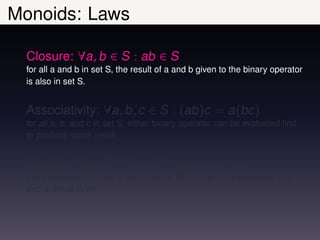
Monoids: Laws

  Closure: ∀a, b ∈ S : ab ∈ S
  for all a and b in set S, the result of a and b given to the binary operator
  is also in set S.


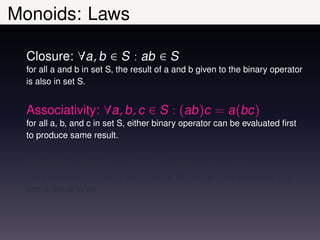
  Associativity: ∀a, b, c ∈ S : (ab)c = a(bc)
  for all a, b, and c in set S, either binary operator can be evaluated first
  to produce same result.


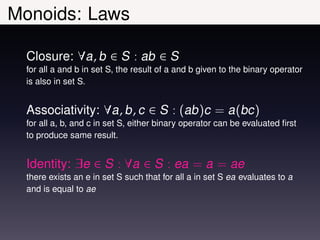
  Identity: ∃e ∈ S : ∀a ∈ S : ea = a = ae
  there exists an e in set S such that for all a in set S ea evaluates to a
  and is equal to ae
Monoids: Laws

  Closure: ∀a, b ∈ S : ab ∈ S
  for all a and b in set S, the result of a and b given to the binary operator
  is also in set S.


  Associativity: ∀a, b, c ∈ S : (ab)c = a(bc)
  for all a, b, and c in set S, either binary operator can be evaluated first
  to produce same result.


  Identity: ∃e ∈ S : ∀a ∈ S : ea = a = ae
  there exists an e in set S such that for all a in set S ea evaluates to a
  and is equal to ae
Monoids: Laws

  Closure: ∀a, b ∈ S : ab ∈ S
  for all a and b in set S, the result of a and b given to the binary operator
  is also in set S.


  Associativity: ∀a, b, c ∈ S : (ab)c = a(bc)
  for all a, b, and c in set S, either binary operator can be evaluated first
  to produce same result.


  Identity: ∃e ∈ S : ∀a ∈ S : ea = a = ae
  there exists an e in set S such that for all a in set S ea evaluates to a
  and is equal to ae
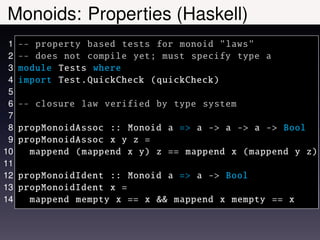
Monoids: Properties (Haskell)
 1   -- property based tests for monoid "laws"
 2   -- does not compile yet; must specify type a
 3   module Tests where
 4   import Test. QuickCheck ( quickCheck )
 5
 6   -- closure law verified by type system
 7
 8   propMonoidAssoc :: Monoid a => a -> a -> a -> Bool
 9   propMonoidAssoc x y z =
10     mappend ( mappend x y) z == mappend x ( mappend y z)
11
12   propMonoidIdent :: Monoid a => a -> Bool
13   propMonoidIdent x =
14     mappend mempty x == x && mappend x mempty == x
Monoids: Simple "Natural" Examples
                            Listing 9: Haskell
1   --      OP      ID      List
2   foldr   (+)    0       [1 ,2 ,3 ,4] -- 10
3   foldr   (*)    1       [1 ,2 ,3 ,4] -- 24
4   foldr   (++)   []      [[1] , [1 ,2]] -- [1 ,1 ,2]
5   foldr   (&&)   True     [True , False , True] -- False
6   foldr   (||)   False   [True , False , True] -- True
7
Monoids: Simple "Natural" Examples
                           Listing 11: Haskell
1   --      OP      ID      List
2   foldr   (+)    0       [1 ,2 ,3 ,4] -- 10
3   foldr   (*)    1       [1 ,2 ,3 ,4] -- 24
4   foldr   (++)   []      [[1] , [1 ,2]] -- [1 ,1 ,2]
5   foldr   (&&)   True     [True , False , True] -- False
6   foldr   (||)   False   [True , False , True] -- True
7
Monoids: Simple "Natural" Examples
                           Listing 13: Haskell
1   --      OP      ID      List
2   foldr   (+)    0       [1 ,2 ,3 ,4] -- 10
3   foldr   (*)    1       [1 ,2 ,3 ,4] -- 24
4   foldr   (++)   []      [[1] , [1 ,2]] -- [1 ,1 ,2]
5   foldr   (&&)   True     [True , False , True] -- False
6   foldr   (||)   False   [True , False , True] -- True
7
Monoids: Simple "Natural" Examples
                        Listing 15: Haskell
1   --     OP    ID      List
2   foldr (+) 0         [1 ,2 ,3 ,4] -- 10
3   foldr (*) 1         [1 ,2 ,3 ,4] -- 24
4   foldr (++) []       [[1] , [1 ,2]] -- [1 ,1 ,2]
5   foldr (&&) True      [True , False , True] -- False
6   foldr (||) False    [True , False , True] -- True
7   mconcat = foldr mappend mempty
Monoids: Simple "Natural" Examples
                         Listing 17: Haskell
1   --     OP    ID      List
2   foldr (+) 0         [1 ,2 ,3 ,4] -- 10
3   foldr (*) 1         [1 ,2 ,3 ,4] -- 24
4   foldr (++) []       [[1] , [1 ,2]] -- [1 ,1 ,2]
5   foldr (&&) True      [True , False , True] -- False
6   foldr (||) False    [True , False , True] -- True
7   mconcat = foldr mappend mempty

                   Listing 18: Same in Scala: WTF?
1   List (1 ,2 ,3 ,4). foldRight (0)(_+_) // 10
2   List (1 ,2 ,3 ,4). foldRight (1)(_*_) // 24
3   List(List (1), List (1 ,2)). foldRight (List[Int ]())( _++_)
4   List(true ,false ,true ). foldRight (true )(_&&_)
5   List(true ,false ,true ). foldRight ( false )(_||_)
Monoids: Define Your Own (Haskell)
                  Listing 19: Haskell Monoid Definition
 1   import Data. Monoid
 2
 3   data Asset = Cash Int
 4               | Receivables Int ...
 5   data Liability = NotesPayable Int
 6                   | AccountsPayable Int ...
 7   -- naive , but illustrative
 8   data BalSheet = BalSheet [ Asset ] [ Liability ]
 9
10   instance Monoid BalSheet where
11     mempty :: m
12     mempty = BalSheet [] []
13     mappend :: m -> m -> m
14     mappend ( BalSheet a1 l1) ( BalSheet a2 l2) =
15       BalSheet ( mappend a1 a2) ( mappend l1 l2)
Monoids: Define Your Own (Scala)
                  Listing 20: Scalaz Monoid Definition
 1   import scalaz ._; import Scalaz ._;
 2
 3   // naive , but illustrative
 4   case class Portfolio ( positions : Seq[ Position ])
 5   object Portfolio {
 6     implicit val portfolioMonoid =
 7     new Monoid [ Portfolio ] {
 8       def append (p1: Portfolio , p2: Portfolio ) =
 9         Portfolio ( append (p1.positions , p2. positions ))
10       def zero = Portfolio (Seq. empty )
11     }
12   }
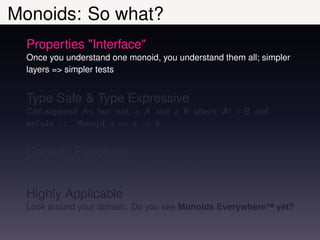
Monoids: So what?
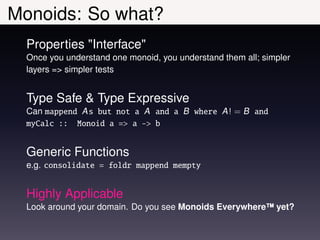
  Properties "Interface"
  Once you understand one monoid, you understand them all; simpler
  layers => simpler tests


  Type Safe & Type Expressive
  Can mappend A s but not a A and a B where A ! = B and
  myCalc :: Monoid a => a -> b


  Generic Functions
  e.g. consolidate = foldr mappend mempty


  Highly Applicable
  Look around your domain. Do you see Monoids Everywhere™ yet?
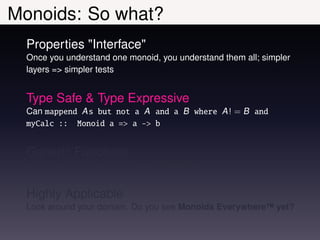
Monoids: So what?
  Properties "Interface"
  Once you understand one monoid, you understand them all; simpler
  layers => simpler tests


  Type Safe & Type Expressive
  Can mappend A s but not a A and a B where A ! = B and
  myCalc :: Monoid a => a -> b


  Generic Functions
  e.g. consolidate = foldr mappend mempty


  Highly Applicable
  Look around your domain. Do you see Monoids Everywhere™ yet?
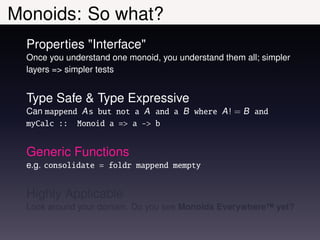
Monoids: So what?
  Properties "Interface"
  Once you understand one monoid, you understand them all; simpler
  layers => simpler tests


  Type Safe & Type Expressive
  Can mappend A s but not a A and a B where A ! = B and
  myCalc :: Monoid a => a -> b


  Generic Functions
  e.g. consolidate = foldr mappend mempty


  Highly Applicable
  Look around your domain. Do you see Monoids Everywhere™ yet?
Monoids: So what?
  Properties "Interface"
  Once you understand one monoid, you understand them all; simpler
  layers => simpler tests


  Type Safe & Type Expressive
  Can mappend A s but not a A and a B where A ! = B and
  myCalc :: Monoid a => a -> b


  Generic Functions
  e.g. consolidate = foldr mappend mempty


  Highly Applicable
  Look around your domain. Do you see Monoids Everywhere™ yet?
Monoids: But . . .

  Types With Multiple Monoids
  More boilerplate though usually manageable. e.g.

             Listing 21: Haskell Monoid Typeclass Definition
    1   import Data. Monoid
    2   toSums = map Sum
    3   mconcat $ toSums [1 ,2 ,3 ,4] -- 10
    4
    5   toAlls = map All
    6   getAll $ mconcat $ toAlls [True , False , True]

  Think!
  Does it make sense to declare Vector as a Monoid in Haskell?
Monoids: But . . .

  Types With Multiple Monoids
  More boilerplate though usually manageable. e.g.

             Listing 22: Haskell Monoid Typeclass Definition
    1   import Data. Monoid
    2   toSums = map Sum
    3   mconcat $ toSums [1 ,2 ,3 ,4] -- 10
    4
    5   toAlls = map All
    6   getAll $ mconcat $ toAlls [True , False , True]

  Think!
  Does it make sense to declare Vector as a Monoid in Haskell?
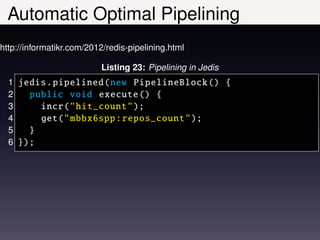
Automatic Optimal Pipelining
http://informatikr.com/2012/redis-pipelining.html

                          Listing 23: Pipelining in Jedis
  1 jedis . pipelined (new PipelineBlock () {
  2   public void execute () {
  3     incr(" hit_count ");
  4     get(" mbbx6spp : repos_count ");
  5   }
  6 });
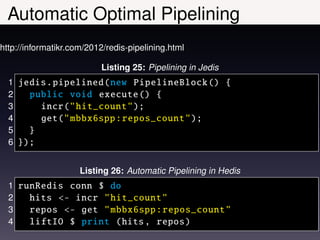
Automatic Optimal Pipelining
http://informatikr.com/2012/redis-pipelining.html

                          Listing 25: Pipelining in Jedis
  1 jedis . pipelined (new PipelineBlock () {
  2   public void execute () {
  3     incr(" hit_count ");
  4     get(" mbbx6spp : repos_count ");
  5   }
  6 });


                     Listing 26: Automatic Pipelining in Hedis
  1 runRedis conn $ do
  2   hits <- incr " hit_count "
  3   repos <- get " mbbx6spp : repos_count "
  4   liftIO $ print (hits , repos )
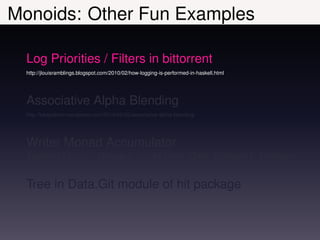
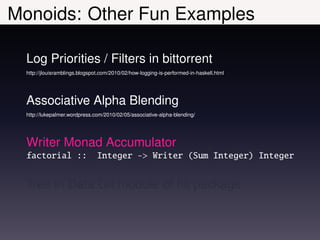
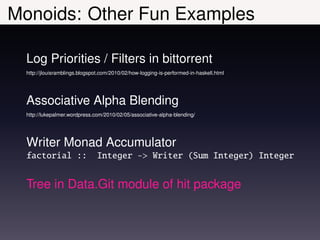
Monoids: Other Fun Examples

  Log Priorities / Filters in bittorrent
  http://jlouisramblings.blogspot.com/2010/02/how-logging-is-performed-in-haskell.html


  Associative Alpha Blending
  http://lukepalmer.wordpress.com/2010/02/05/associative-alpha-blending/


  Writer Monad Accumulator
  factorial ::                  Integer -> Writer (Sum Integer) Integer


  Tree in Data.Git module of hit package
Monoids: Other Fun Examples

  Log Priorities / Filters in bittorrent
  http://jlouisramblings.blogspot.com/2010/02/how-logging-is-performed-in-haskell.html


  Associative Alpha Blending
  http://lukepalmer.wordpress.com/2010/02/05/associative-alpha-blending/


  Writer Monad Accumulator
  factorial ::                  Integer -> Writer (Sum Integer) Integer


  Tree in Data.Git module of hit package
Monoids: Other Fun Examples

  Log Priorities / Filters in bittorrent
  http://jlouisramblings.blogspot.com/2010/02/how-logging-is-performed-in-haskell.html


  Associative Alpha Blending
  http://lukepalmer.wordpress.com/2010/02/05/associative-alpha-blending/


  Writer Monad Accumulator
  factorial ::                  Integer -> Writer (Sum Integer) Integer


  Tree in Data.Git module of hit package
Monoids: Other Fun Examples

  Log Priorities / Filters in bittorrent
  http://jlouisramblings.blogspot.com/2010/02/how-logging-is-performed-in-haskell.html


  Associative Alpha Blending
  http://lukepalmer.wordpress.com/2010/02/05/associative-alpha-blending/


  Writer Monad Accumulator
  factorial ::                  Integer -> Writer (Sum Integer) Integer


  Tree in Data.Git module of hit package
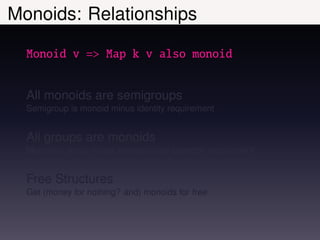
Monoids: Relationships

  Monoid v => Map k v also monoid


  All monoids are semigroups
  Semigroup is monoid minus identity requirement


  All groups are monoids
  Monoid is group minus inverse unary operator requirement


  Free Structures
  Get (money for nothing? and) monoids for free
Monoids: Relationships

  Monoid v => Map k v also monoid


  All monoids are semigroups
  Semigroup is monoid minus identity requirement


  All groups are monoids
  Monoid is group minus inverse unary operator requirement


  Free Structures
  Get (money for nothing? and) monoids for free
Monoids: Relationships

  Monoid v => Map k v also monoid


  All monoids are semigroups
  Semigroup is monoid minus identity requirement


  All groups are monoids
  Monoid is group minus inverse unary operator requirement


  Free Structures
  Get (money for nothing? and) monoids for free
Monoids: Relationships

  Monoid v => Map k v also monoid


  All monoids are semigroups
  Semigroup is monoid minus identity requirement


  All groups are monoids
  Monoid is group minus inverse unary operator requirement


  Free Structures
  Get (money for nothing? and) monoids for free
Monoids: Relationships

Monads & Monoids


                         .
Monoids: Relationships

Monads & Monoids
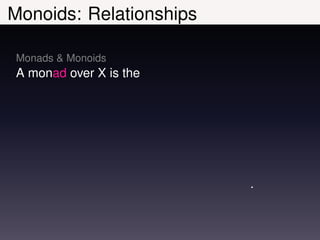
A monad over X is the


                         .
Monoids: Relationships

Monads & Monoids
A monad over X is the

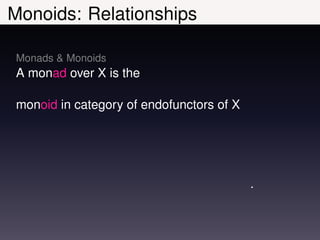
monoid in category of endofunctors of X


                                          .
Monoids: Relationships

Monads & Monoids
A monad over X is the

monoid in category of endofunctors of X

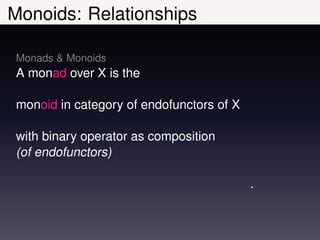
with binary operator as composition
(of endofunctors)

                                          .
Monoids: Relationships

Monads & Monoids
A monad over X is the

monoid in category of endofunctors of X

with binary operator as composition
(of endofunctors)

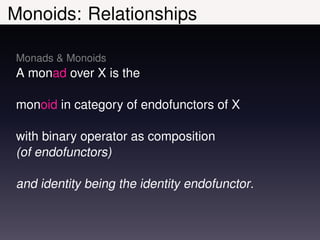
and identity being the identity endofunctor.
Homework


           What is an Endofunctor?
Questions?


        Figure:   http://www.flickr.com/photos/42682395@N04/


         @FunAlgebra
                    @SusanPotter
Bonus: References / Resources
     Channel 9 Lectures (Erik Meijer)
     http://channel9.msdn.com/Shows/Going+Deep/

     Lecture-Series-Erik-Meijer-Functional-Programming-Fundamentals-Chapter-1


     The Catsters
     http://www.youtube.com/thecatsters


     Haskell Reddit
     http://www.reddit.com/r/haskell/


     Haskell Cafe
     http://www.haskell.org/mailman/listinfo/haskell-cafe


     Scalaz Mailing List
     https://groups.google.com/forum/?fromgroups#!forum/scalaz

Functional Algebra: Monoids Applied

  • 1.
    Functional Algebra Monoids Applied Susan Potter Nov 10, 2012
  • 2.
  • 3.
    OMG, Algebra? FML... . Figure: Chill! Algebra is just a domain specific language
  • 4.
    % whoami Figure: From OO patterns to FP abstractions
  • 5.
    Monoids: What arethey? An abstraction (laws) not a design pattern (forces, context, . . . ) Algebraic structure . . . over a set with a binary operator and an identity element Accumulator . . . Its sole purpose Special case category . . . with only one object
  • 6.
    Monoids: What arethey? An abstraction (laws) not a design pattern (forces, context, . . . ) Algebraic structure . . . over a set with a binary operator and an identity element Accumulator . . . Its sole purpose Special case category . . . with only one object
  • 7.
    Monoids: What arethey? An abstraction (laws) not a design pattern (forces, context, . . . ) Algebraic structure . . . over a set with a binary operator and an identity element Accumulator . . . Its sole purpose Special case category . . . with only one object
  • 8.
    Monoids: What arethey? An abstraction (laws) not a design pattern (forces, context, . . . ) Algebraic structure . . . over a set with a binary operator and an identity element Accumulator . . . Its sole purpose Special case category . . . with only one object
  • 9.
    Monoids: Typeclasses Listing 1: Haskell Monoid Typeclass Definition 1 -- | In Haskell Prelude Data. Monoid 2 class Monoid a where 3 mempty :: a -- identity 4 mappend :: a -> a -> a -- binary op 5 mconcat :: [a] -> a -- helper Listing 2: Scalaz Monoid Trait Definition 1 // Scalaz 7’s Monoid typeclass definition , kinda 2 trait Monoid [A] extends Semigroup [A] { self => 3 def zero: A /* identity */ 4 def append(x: A, y: => A): A /* binary op */ 5 } 6 // from SemigroupOps [A] ... 7 final def |+|(other: => A): A = A.append(self, other)
  • 10.
    Monoids: Typeclasses Listing 3: Haskell Monoid Typeclass Definition 1 -- | In Haskell Prelude Data. Monoid 2 class Monoid a where 3 mempty :: a -- identity 4 mappend :: a -> a -> a -- binary op 5 mconcat :: [a] -> a -- helper Listing 4: Scalaz Monoid Trait Definition 1 // Scalaz 7’s Monoid typeclass definition , kinda 2 trait Monoid [A] extends Semigroup [A] { self => 3 def zero: A /* identity */ 4 def append(x: A, y: => A): A /* binary op */ 5 } 6 // from SemigroupOps [A] ... 7 final def |+|(other: => A): A = A.append(self, other)
  • 11.
    Monoids: Typeclasses Listing 5: Haskell Monoid Typeclass Definition 1 -- | In Haskell Prelude Data. Monoid 2 class Monoid a where 3 mempty :: a -- identity 4 mappend :: a -> a -> a -- binary op 5 mconcat :: [a] -> a -- helper Listing 6: Scalaz Monoid Trait Definition 1 // Scalaz 7’s Monoid typeclass definition , kinda 2 trait Monoid [A] extends Semigroup [A] { self => 3 def zero: A /* identity */ 4 def append(x: A, y: => A): A /* binary op */ 5 } 6 // from SemigroupOps [A] ... 7 final def |+|(other: => A): A = A.append(self, other)
  • 12.
    Monoids: Typeclasses Listing 7: Haskell Monoid Typeclass Definition 1 -- | In Haskell Prelude Data. Monoid 2 class Monoid a where 3 mempty :: a -- identity 4 mappend :: a -> a -> a -- binary op 5 mconcat :: [a] -> a -- helper Listing 8: Scalaz Monoid Trait Definition 1 // Scalaz 7’s Monoid typeclass definition , kinda 2 trait Monoid [A] extends Semigroup [A] { self => 3 def zero: A /* identity */ 4 def append(x: A, y: => A): A /* binary op */ 5 } 6 // from SemigroupOps [A] ... 7 final def |+|(other: => A): A = A.append(self, other)
  • 13.
    Monoids: Laws Closure: ∀a, b ∈ S : ab ∈ S for all a and b in set S, the result of a and b given to the binary operator is also in set S. Associativity: ∀a, b, c ∈ S : (ab)c = a(bc) for all a, b, and c in set S, either binary operator can be evaluated first to produce same result. Identity: ∃e ∈ S : ∀a ∈ S : ea = a = ae there exists an e in set S such that for all a in set S ea evaluates to a and is equal to ae
  • 14.
    Monoids: Laws Closure: ∀a, b ∈ S : ab ∈ S for all a and b in set S, the result of a and b given to the binary operator is also in set S. Associativity: ∀a, b, c ∈ S : (ab)c = a(bc) for all a, b, and c in set S, either binary operator can be evaluated first to produce same result. Identity: ∃e ∈ S : ∀a ∈ S : ea = a = ae there exists an e in set S such that for all a in set S ea evaluates to a and is equal to ae
  • 15.
    Monoids: Laws Closure: ∀a, b ∈ S : ab ∈ S for all a and b in set S, the result of a and b given to the binary operator is also in set S. Associativity: ∀a, b, c ∈ S : (ab)c = a(bc) for all a, b, and c in set S, either binary operator can be evaluated first to produce same result. Identity: ∃e ∈ S : ∀a ∈ S : ea = a = ae there exists an e in set S such that for all a in set S ea evaluates to a and is equal to ae
  • 16.
    Monoids: Properties (Haskell) 1 -- property based tests for monoid "laws" 2 -- does not compile yet; must specify type a 3 module Tests where 4 import Test. QuickCheck ( quickCheck ) 5 6 -- closure law verified by type system 7 8 propMonoidAssoc :: Monoid a => a -> a -> a -> Bool 9 propMonoidAssoc x y z = 10 mappend ( mappend x y) z == mappend x ( mappend y z) 11 12 propMonoidIdent :: Monoid a => a -> Bool 13 propMonoidIdent x = 14 mappend mempty x == x && mappend x mempty == x
  • 17.
    Monoids: Simple "Natural"Examples Listing 9: Haskell 1 -- OP ID List 2 foldr (+) 0 [1 ,2 ,3 ,4] -- 10 3 foldr (*) 1 [1 ,2 ,3 ,4] -- 24 4 foldr (++) [] [[1] , [1 ,2]] -- [1 ,1 ,2] 5 foldr (&&) True [True , False , True] -- False 6 foldr (||) False [True , False , True] -- True 7
  • 18.
    Monoids: Simple "Natural"Examples Listing 11: Haskell 1 -- OP ID List 2 foldr (+) 0 [1 ,2 ,3 ,4] -- 10 3 foldr (*) 1 [1 ,2 ,3 ,4] -- 24 4 foldr (++) [] [[1] , [1 ,2]] -- [1 ,1 ,2] 5 foldr (&&) True [True , False , True] -- False 6 foldr (||) False [True , False , True] -- True 7
  • 19.
    Monoids: Simple "Natural"Examples Listing 13: Haskell 1 -- OP ID List 2 foldr (+) 0 [1 ,2 ,3 ,4] -- 10 3 foldr (*) 1 [1 ,2 ,3 ,4] -- 24 4 foldr (++) [] [[1] , [1 ,2]] -- [1 ,1 ,2] 5 foldr (&&) True [True , False , True] -- False 6 foldr (||) False [True , False , True] -- True 7
  • 20.
    Monoids: Simple "Natural"Examples Listing 15: Haskell 1 -- OP ID List 2 foldr (+) 0 [1 ,2 ,3 ,4] -- 10 3 foldr (*) 1 [1 ,2 ,3 ,4] -- 24 4 foldr (++) [] [[1] , [1 ,2]] -- [1 ,1 ,2] 5 foldr (&&) True [True , False , True] -- False 6 foldr (||) False [True , False , True] -- True 7 mconcat = foldr mappend mempty
  • 21.
    Monoids: Simple "Natural"Examples Listing 17: Haskell 1 -- OP ID List 2 foldr (+) 0 [1 ,2 ,3 ,4] -- 10 3 foldr (*) 1 [1 ,2 ,3 ,4] -- 24 4 foldr (++) [] [[1] , [1 ,2]] -- [1 ,1 ,2] 5 foldr (&&) True [True , False , True] -- False 6 foldr (||) False [True , False , True] -- True 7 mconcat = foldr mappend mempty Listing 18: Same in Scala: WTF? 1 List (1 ,2 ,3 ,4). foldRight (0)(_+_) // 10 2 List (1 ,2 ,3 ,4). foldRight (1)(_*_) // 24 3 List(List (1), List (1 ,2)). foldRight (List[Int ]())( _++_) 4 List(true ,false ,true ). foldRight (true )(_&&_) 5 List(true ,false ,true ). foldRight ( false )(_||_)
  • 22.
    Monoids: Define YourOwn (Haskell) Listing 19: Haskell Monoid Definition 1 import Data. Monoid 2 3 data Asset = Cash Int 4 | Receivables Int ... 5 data Liability = NotesPayable Int 6 | AccountsPayable Int ... 7 -- naive , but illustrative 8 data BalSheet = BalSheet [ Asset ] [ Liability ] 9 10 instance Monoid BalSheet where 11 mempty :: m 12 mempty = BalSheet [] [] 13 mappend :: m -> m -> m 14 mappend ( BalSheet a1 l1) ( BalSheet a2 l2) = 15 BalSheet ( mappend a1 a2) ( mappend l1 l2)
  • 23.
    Monoids: Define YourOwn (Scala) Listing 20: Scalaz Monoid Definition 1 import scalaz ._; import Scalaz ._; 2 3 // naive , but illustrative 4 case class Portfolio ( positions : Seq[ Position ]) 5 object Portfolio { 6 implicit val portfolioMonoid = 7 new Monoid [ Portfolio ] { 8 def append (p1: Portfolio , p2: Portfolio ) = 9 Portfolio ( append (p1.positions , p2. positions )) 10 def zero = Portfolio (Seq. empty ) 11 } 12 }
  • 24.
    Monoids: So what? Properties "Interface" Once you understand one monoid, you understand them all; simpler layers => simpler tests Type Safe & Type Expressive Can mappend A s but not a A and a B where A ! = B and myCalc :: Monoid a => a -> b Generic Functions e.g. consolidate = foldr mappend mempty Highly Applicable Look around your domain. Do you see Monoids Everywhere™ yet?
  • 25.
    Monoids: So what? Properties "Interface" Once you understand one monoid, you understand them all; simpler layers => simpler tests Type Safe & Type Expressive Can mappend A s but not a A and a B where A ! = B and myCalc :: Monoid a => a -> b Generic Functions e.g. consolidate = foldr mappend mempty Highly Applicable Look around your domain. Do you see Monoids Everywhere™ yet?
  • 26.
    Monoids: So what? Properties "Interface" Once you understand one monoid, you understand them all; simpler layers => simpler tests Type Safe & Type Expressive Can mappend A s but not a A and a B where A ! = B and myCalc :: Monoid a => a -> b Generic Functions e.g. consolidate = foldr mappend mempty Highly Applicable Look around your domain. Do you see Monoids Everywhere™ yet?
  • 27.
    Monoids: So what? Properties "Interface" Once you understand one monoid, you understand them all; simpler layers => simpler tests Type Safe & Type Expressive Can mappend A s but not a A and a B where A ! = B and myCalc :: Monoid a => a -> b Generic Functions e.g. consolidate = foldr mappend mempty Highly Applicable Look around your domain. Do you see Monoids Everywhere™ yet?
  • 28.
    Monoids: But .. . Types With Multiple Monoids More boilerplate though usually manageable. e.g. Listing 21: Haskell Monoid Typeclass Definition 1 import Data. Monoid 2 toSums = map Sum 3 mconcat $ toSums [1 ,2 ,3 ,4] -- 10 4 5 toAlls = map All 6 getAll $ mconcat $ toAlls [True , False , True] Think! Does it make sense to declare Vector as a Monoid in Haskell?
  • 29.
    Monoids: But .. . Types With Multiple Monoids More boilerplate though usually manageable. e.g. Listing 22: Haskell Monoid Typeclass Definition 1 import Data. Monoid 2 toSums = map Sum 3 mconcat $ toSums [1 ,2 ,3 ,4] -- 10 4 5 toAlls = map All 6 getAll $ mconcat $ toAlls [True , False , True] Think! Does it make sense to declare Vector as a Monoid in Haskell?
  • 30.
    Automatic Optimal Pipelining http://informatikr.com/2012/redis-pipelining.html Listing 23: Pipelining in Jedis 1 jedis . pipelined (new PipelineBlock () { 2 public void execute () { 3 incr(" hit_count "); 4 get(" mbbx6spp : repos_count "); 5 } 6 });
  • 31.
    Automatic Optimal Pipelining http://informatikr.com/2012/redis-pipelining.html Listing 25: Pipelining in Jedis 1 jedis . pipelined (new PipelineBlock () { 2 public void execute () { 3 incr(" hit_count "); 4 get(" mbbx6spp : repos_count "); 5 } 6 }); Listing 26: Automatic Pipelining in Hedis 1 runRedis conn $ do 2 hits <- incr " hit_count " 3 repos <- get " mbbx6spp : repos_count " 4 liftIO $ print (hits , repos )
  • 32.
    Monoids: Other FunExamples Log Priorities / Filters in bittorrent http://jlouisramblings.blogspot.com/2010/02/how-logging-is-performed-in-haskell.html Associative Alpha Blending http://lukepalmer.wordpress.com/2010/02/05/associative-alpha-blending/ Writer Monad Accumulator factorial :: Integer -> Writer (Sum Integer) Integer Tree in Data.Git module of hit package
  • 33.
    Monoids: Other FunExamples Log Priorities / Filters in bittorrent http://jlouisramblings.blogspot.com/2010/02/how-logging-is-performed-in-haskell.html Associative Alpha Blending http://lukepalmer.wordpress.com/2010/02/05/associative-alpha-blending/ Writer Monad Accumulator factorial :: Integer -> Writer (Sum Integer) Integer Tree in Data.Git module of hit package
  • 34.
    Monoids: Other FunExamples Log Priorities / Filters in bittorrent http://jlouisramblings.blogspot.com/2010/02/how-logging-is-performed-in-haskell.html Associative Alpha Blending http://lukepalmer.wordpress.com/2010/02/05/associative-alpha-blending/ Writer Monad Accumulator factorial :: Integer -> Writer (Sum Integer) Integer Tree in Data.Git module of hit package
  • 35.
    Monoids: Other FunExamples Log Priorities / Filters in bittorrent http://jlouisramblings.blogspot.com/2010/02/how-logging-is-performed-in-haskell.html Associative Alpha Blending http://lukepalmer.wordpress.com/2010/02/05/associative-alpha-blending/ Writer Monad Accumulator factorial :: Integer -> Writer (Sum Integer) Integer Tree in Data.Git module of hit package
  • 36.
    Monoids: Relationships Monoid v => Map k v also monoid All monoids are semigroups Semigroup is monoid minus identity requirement All groups are monoids Monoid is group minus inverse unary operator requirement Free Structures Get (money for nothing? and) monoids for free
  • 37.
    Monoids: Relationships Monoid v => Map k v also monoid All monoids are semigroups Semigroup is monoid minus identity requirement All groups are monoids Monoid is group minus inverse unary operator requirement Free Structures Get (money for nothing? and) monoids for free
  • 38.
    Monoids: Relationships Monoid v => Map k v also monoid All monoids are semigroups Semigroup is monoid minus identity requirement All groups are monoids Monoid is group minus inverse unary operator requirement Free Structures Get (money for nothing? and) monoids for free
  • 39.
    Monoids: Relationships Monoid v => Map k v also monoid All monoids are semigroups Semigroup is monoid minus identity requirement All groups are monoids Monoid is group minus inverse unary operator requirement Free Structures Get (money for nothing? and) monoids for free
  • 40.
  • 41.
    Monoids: Relationships Monads &Monoids A monad over X is the .
  • 42.
    Monoids: Relationships Monads &Monoids A monad over X is the monoid in category of endofunctors of X .
  • 43.
    Monoids: Relationships Monads &Monoids A monad over X is the monoid in category of endofunctors of X with binary operator as composition (of endofunctors) .
  • 44.
    Monoids: Relationships Monads &Monoids A monad over X is the monoid in category of endofunctors of X with binary operator as composition (of endofunctors) and identity being the identity endofunctor.
  • 45.
    Homework What is an Endofunctor?
  • 46.
    Questions? Figure: http://www.flickr.com/photos/42682395@N04/ @FunAlgebra @SusanPotter
  • 47.
    Bonus: References /Resources Channel 9 Lectures (Erik Meijer) http://channel9.msdn.com/Shows/Going+Deep/ Lecture-Series-Erik-Meijer-Functional-Programming-Fundamentals-Chapter-1 The Catsters http://www.youtube.com/thecatsters Haskell Reddit http://www.reddit.com/r/haskell/ Haskell Cafe http://www.haskell.org/mailman/listinfo/haskell-cafe Scalaz Mailing List https://groups.google.com/forum/?fromgroups#!forum/scalaz