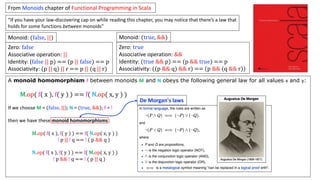
Zero:	false
Associative	operation:	||
Identity:	(false || p)	==	(p	|| false)	==	p
Associativity:	(p	|| q)	|| r	==	p	|| (q	|| r)
Zero:	true
Associative	operation:	&&
Identity:	(true && p)	==	(p	&& true)	==	p
Associativity:	((p	&& q)	&& r)	==	(p &&	(q && r))
A monoid homomorphism f between monoids M and N obeys the following general law for all values x and y:
M.op( f( x ),	f( y ) )	==	f( N.op( x,	y ) )
If	we	choose	M =	(false,	||);	N =	(true,	&&);	f = !
then	we	have	these	monoid	homomorphisms	:
M.op( f( x ),	f( y ) )	==	f( N.op( x,	y ) )
!	p	|| !	q	==	!	(	p	&& q	)
N.op( f( x ),	f( y ) )	==	f( M.op( x,	y ) )
!	p	&& !	q	==	!	(	p	|| q	)
Monoid:	(false,	||) Monoid:	(true,	&&)
De	Morgan's	laws
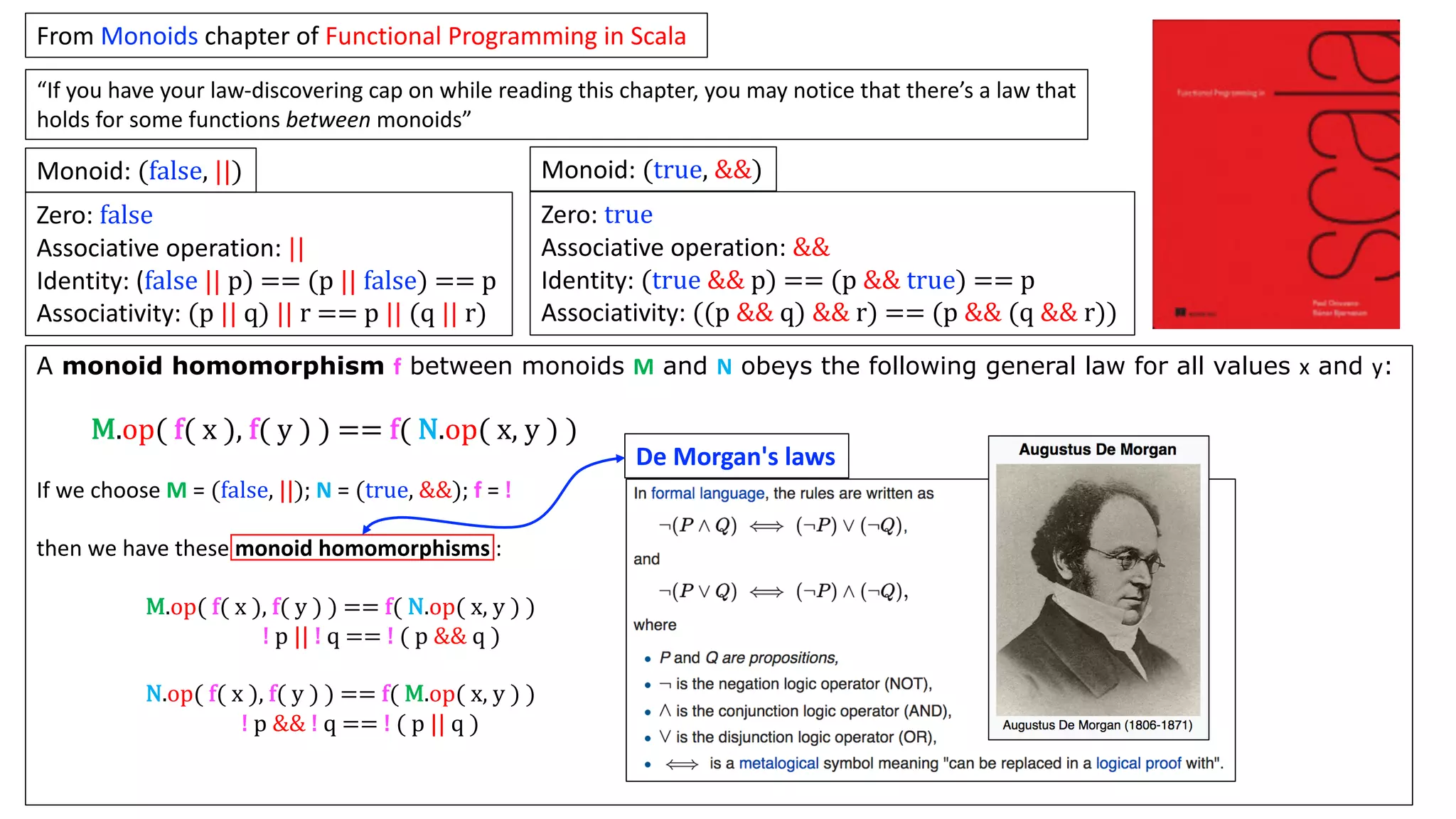
From	Monoids chapter	of	Functional	Programming	in	Scala
“If	you	have	your	law-discovering	cap	on	while	reading	this	chapter,	you	may	notice	that	there’s	a	law	that	
holds	for	some	functions between monoids”

TIL: De Morgan's Laws are Monoid Homomorphisms

  • 1.
    Zero: false Associative operation: || Identity: (false || p) == (p ||false) == p Associativity: (p || q) || r == p || (q || r) Zero: true Associative operation: && Identity: (true && p) == (p && true) == p Associativity: ((p && q) && r) == (p && (q && r)) A monoid homomorphism f between monoids M and N obeys the following general law for all values x and y: M.op( f( x ), f( y ) ) == f( N.op( x, y ) ) If we choose M = (false, ||); N = (true, &&); f = ! then we have these monoid homomorphisms : M.op( f( x ), f( y ) ) == f( N.op( x, y ) ) ! p || ! q == ! ( p && q ) N.op( f( x ), f( y ) ) == f( M.op( x, y ) ) ! p && ! q == ! ( p || q ) Monoid: (false, ||) Monoid: (true, &&) De Morgan's laws From Monoids chapter of Functional Programming in Scala “If you have your law-discovering cap on while reading this chapter, you may notice that there’s a law that holds for some functions between monoids”