PRATT TRUSS (‘N’ TRUSS)
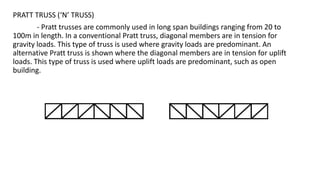
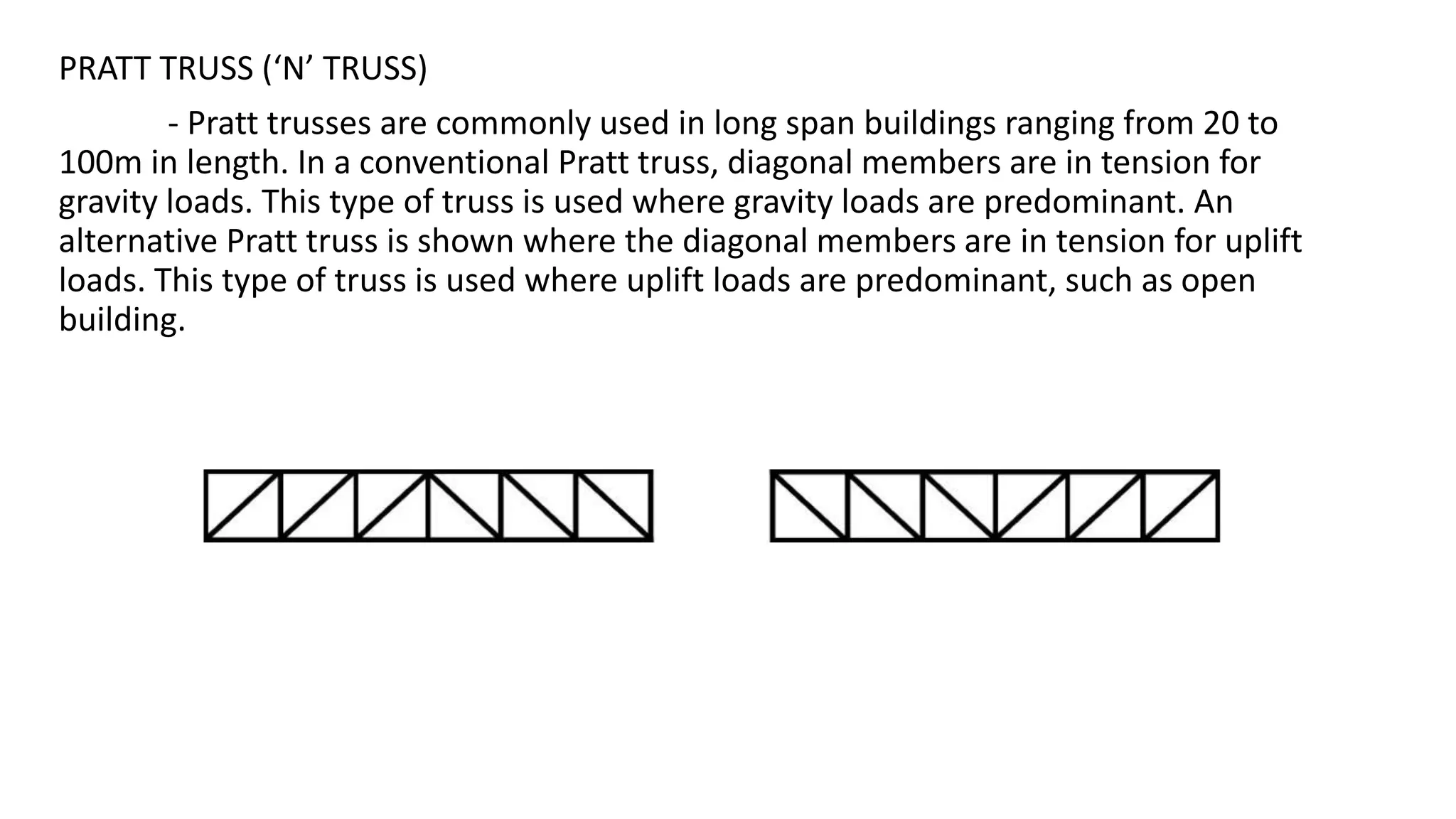
- Pratt trusses are commonly used in long span buildings ranging from 20 to
100m in length. In a conventional Pratt truss, diagonal members are in tension for
gravity loads. This type of truss is used where gravity loads are predominant. An
alternative Pratt truss is shown where the diagonal members are in tension for uplift
loads. This type of truss is used where uplift loads are predominant, such as open
building.
SCISSOR TRUSS
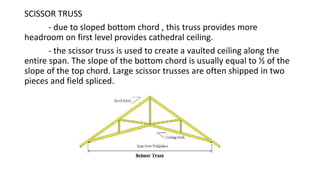
- due to sloped bottom chord , this truss provides more
headroom on first level provides cathedral ceiling.
- the scissor truss is used to create a vaulted ceiling along the
entire span. The slope of the bottom chord is usually equal to ½ of the
slope of the top chord. Large scissor trusses are often shipped in two
pieces and field spliced.
X TRUSS
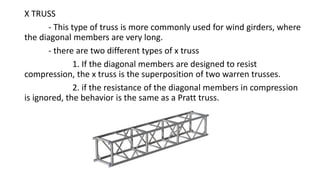
- This type of truss is more commonly used for wind girders, where
the diagonal members are very long.
- there are two different types of x truss
1. If the diagonal members are designed to resist
compression, the x truss is the superposition of two warren trusses.
2. if the resistance of the diagonal members in compression
is ignored, the behavior is the same as a Pratt truss.
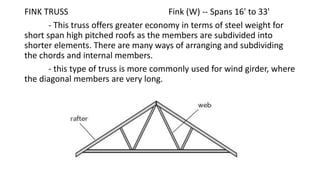
FINK TRUSS Fink (W) -- Spans 16' to 33'
- This truss offers greater economy in terms of steel weight for
short span high pitched roofs as the members are subdivided into
shorter elements. There are many ways of arranging and subdividing
the chords and internal members.
- this type of truss is more commonly used for wind girder, where
the diagonal members are very long.
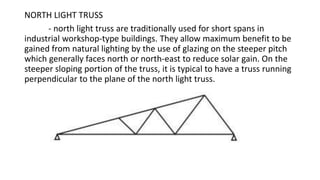
NORTH LIGHT TRUSS
- north light truss are traditionally used for short spans in
industrial workshop-type buildings. They allow maximum benefit to be
gained from natural lighting by the use of glazing on the steeper pitch
which generally faces north or north-east to reduce solar gain. On the
steeper sloping portion of the truss, it is typical to have a truss running
perpendicular to the plane of the north light truss.
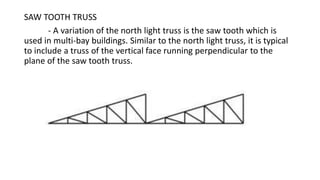
SAW TOOTH TRUSS
- A variation of the north light truss is the saw tooth which is
used in multi-bay buildings. Similar to the north light truss, it is typical
to include a truss of the vertical face running perpendicular to the
plane of the saw tooth truss.
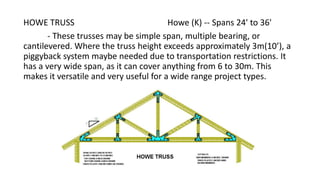
HOWE TRUSS Howe (K) -- Spans 24' to 36'
- These trusses may be simple span, multiple bearing, or
cantilevered. Where the truss height exceeds approximately 3m(10’), a
piggyback system maybe needed due to transportation restrictions. It
has a very wide span, as it can cover anything from 6 to 30m. This
makes it versatile and very useful for a wide range project types.
HIP TRUSS
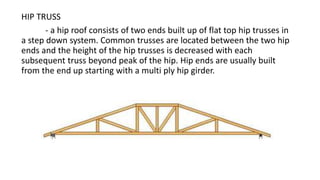
- a hip roof consists of two ends built up of flat top hip trusses in
a step down system. Common trusses are located between the two hip
ends and the height of the hip trusses is decreased with each
subsequent truss beyond peak of the hip. Hip ends are usually built
from the end up starting with a multi ply hip girder.
POLYNESIAN TRUSS
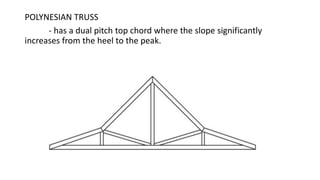
- has a dual pitch top chord where the slope significantly
increases from the heel to the peak.
GAMBREL TRUSS
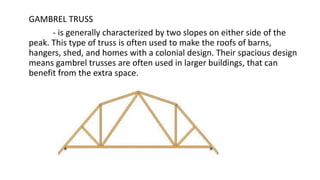
- is generally characterized by two slopes on either side of the
peak. This type of truss is often used to make the roofs of barns,
hangers, shed, and homes with a colonial design. Their spacious design
means gambrel trusses are often used in larger buildings, that can
benefit from the extra space.
Shobe trusses

Shobe trusses

  • 1.
    PRATT TRUSS (‘N’TRUSS) - Pratt trusses are commonly used in long span buildings ranging from 20 to 100m in length. In a conventional Pratt truss, diagonal members are in tension for gravity loads. This type of truss is used where gravity loads are predominant. An alternative Pratt truss is shown where the diagonal members are in tension for uplift loads. This type of truss is used where uplift loads are predominant, such as open building.
  • 2.
    SCISSOR TRUSS - dueto sloped bottom chord , this truss provides more headroom on first level provides cathedral ceiling. - the scissor truss is used to create a vaulted ceiling along the entire span. The slope of the bottom chord is usually equal to ½ of the slope of the top chord. Large scissor trusses are often shipped in two pieces and field spliced.
  • 3.
    X TRUSS - Thistype of truss is more commonly used for wind girders, where the diagonal members are very long. - there are two different types of x truss 1. If the diagonal members are designed to resist compression, the x truss is the superposition of two warren trusses. 2. if the resistance of the diagonal members in compression is ignored, the behavior is the same as a Pratt truss.
  • 4.
    FINK TRUSS Fink(W) -- Spans 16' to 33' - This truss offers greater economy in terms of steel weight for short span high pitched roofs as the members are subdivided into shorter elements. There are many ways of arranging and subdividing the chords and internal members. - this type of truss is more commonly used for wind girder, where the diagonal members are very long.
  • 5.
    NORTH LIGHT TRUSS -north light truss are traditionally used for short spans in industrial workshop-type buildings. They allow maximum benefit to be gained from natural lighting by the use of glazing on the steeper pitch which generally faces north or north-east to reduce solar gain. On the steeper sloping portion of the truss, it is typical to have a truss running perpendicular to the plane of the north light truss.
  • 6.
    SAW TOOTH TRUSS -A variation of the north light truss is the saw tooth which is used in multi-bay buildings. Similar to the north light truss, it is typical to include a truss of the vertical face running perpendicular to the plane of the saw tooth truss.
  • 7.
    HOWE TRUSS Howe(K) -- Spans 24' to 36' - These trusses may be simple span, multiple bearing, or cantilevered. Where the truss height exceeds approximately 3m(10’), a piggyback system maybe needed due to transportation restrictions. It has a very wide span, as it can cover anything from 6 to 30m. This makes it versatile and very useful for a wide range project types.
  • 8.
    HIP TRUSS - ahip roof consists of two ends built up of flat top hip trusses in a step down system. Common trusses are located between the two hip ends and the height of the hip trusses is decreased with each subsequent truss beyond peak of the hip. Hip ends are usually built from the end up starting with a multi ply hip girder.
  • 9.
    POLYNESIAN TRUSS - hasa dual pitch top chord where the slope significantly increases from the heel to the peak.
  • 10.
    GAMBREL TRUSS - isgenerally characterized by two slopes on either side of the peak. This type of truss is often used to make the roofs of barns, hangers, shed, and homes with a colonial design. Their spacious design means gambrel trusses are often used in larger buildings, that can benefit from the extra space.