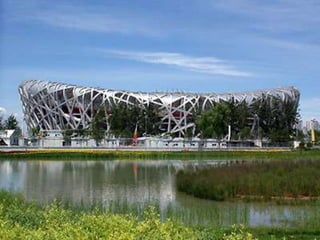
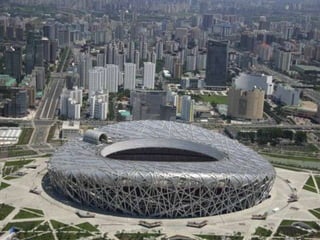
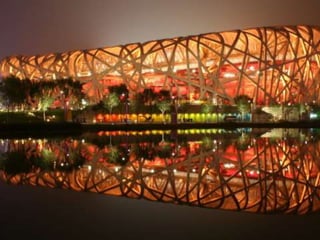
Beijing National Stadium
       Bird’s Nest
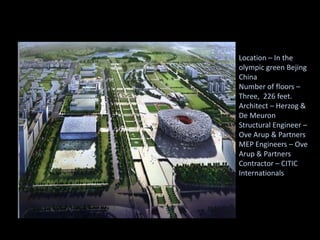
Location – In the
olympic green Bejing
China
Number of floors –
Three, 226 feet.
Architect – Herzog &
De Meuron
Structural Engineer –
Ove Arup & Partners
MEP Engineers – Ove
Arup & Partners
Contractor – CITIC
Internationals
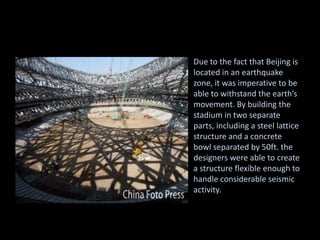
Due to the fact that Beijing is
located in an earthquake
zone, it was imperative to be
able to withstand the earth’s
movement. By building the
stadium in two separate
parts, including a steel lattice
structure and a concrete
bowl separated by 50ft. the
designers were able to create
a structure flexible enough to
handle considerable seismic
activity.
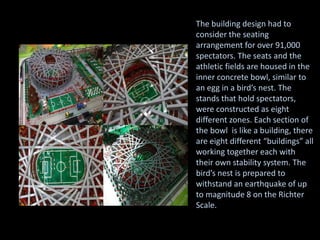
The building design had to
consider the seating
arrangement for over 91,000
spectators. The seats and the
athletic fields are housed in the
inner concrete bowl, similar to
an egg in a bird’s nest. The
stands that hold spectators,
were constructed as eight
different zones. Each section of
the bowl is like a building, there
are eight different “buildings” all
working together each with
their own stability system. The
bird’s nest is prepared to
withstand an earthquake of up
to magnitude 8 on the Richter
Scale.
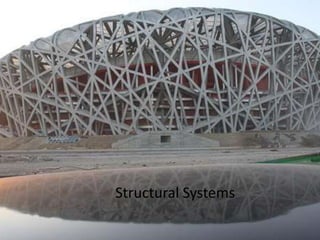
Structural Systems
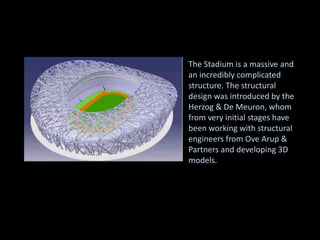
The Stadium is a massive and
an incredibly complicated
structure. The structural
design was introduced by the
Herzog & De Meuron, whom
from very initial stages have
been working with structural
engineers from Ove Arup &
Partners and developing 3D
models.
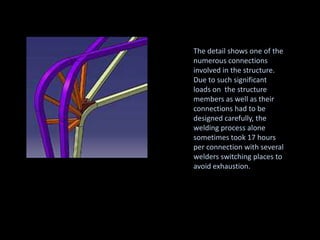
The detail shows one of the
numerous connections
involved in the structure.
Due to such significant
loads on the structure
members as well as their
connections had to be
designed carefully, the
welding process alone
sometimes took 17 hours
per connection with several
welders switching places to
avoid exhaustion.
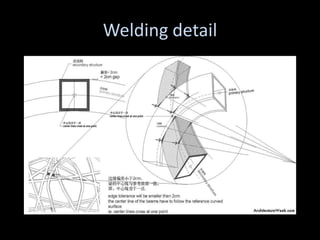
Welding detail
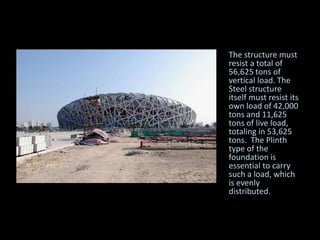
The structure must
resist a total of
56,625 tons of
vertical load. The
Steel structure
itself must resist its
own load of 42,000
tons and 11,625
tons of live load,
totaling in 53,625
tons. The Plinth
type of the
foundation is
essential to carry
such a load, which
is evenly
distributed.
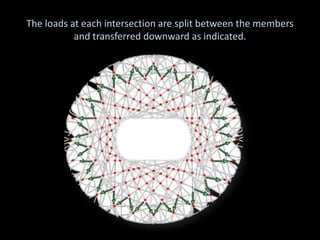
The loads at each intersection are split between the members
           and transferred downward as indicated.
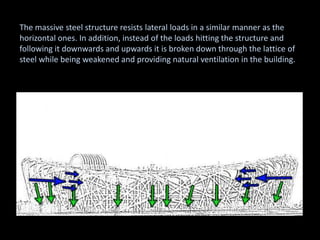
The massive steel structure resists lateral loads in a similar manner as the
horizontal ones. In addition, instead of the loads hitting the structure and
following it downwards and upwards it is broken down through the lattice of
steel while being weakened and providing natural ventilation in the building.
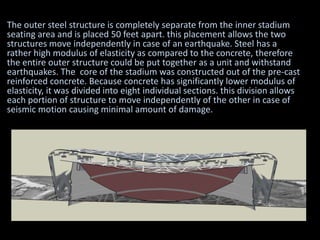
The outer steel structure is completely separate from the inner stadium
seating area and is placed 50 feet apart. this placement allows the two
structures move independently in case of an earthquake. Steel has a
rather high modulus of elasticity as compared to the concrete, therefore
the entire outer structure could be put together as a unit and withstand
earthquakes. The core of the stadium was constructed out of the pre-cast
reinforced concrete. Because concrete has significantly lower modulus of
elasticity, it was divided into eight individual sections. this division allows
each portion of structure to move independently of the other in case of
seismic motion causing minimal amount of damage.
Beijing National Stadium

Beijing National Stadium

  • 1.
  • 2.
    Location – Inthe olympic green Bejing China Number of floors – Three, 226 feet. Architect – Herzog & De Meuron Structural Engineer – Ove Arup & Partners MEP Engineers – Ove Arup & Partners Contractor – CITIC Internationals
  • 3.
    Due to thefact that Beijing is located in an earthquake zone, it was imperative to be able to withstand the earth’s movement. By building the stadium in two separate parts, including a steel lattice structure and a concrete bowl separated by 50ft. the designers were able to create a structure flexible enough to handle considerable seismic activity.
  • 4.
    The building designhad to consider the seating arrangement for over 91,000 spectators. The seats and the athletic fields are housed in the inner concrete bowl, similar to an egg in a bird’s nest. The stands that hold spectators, were constructed as eight different zones. Each section of the bowl is like a building, there are eight different “buildings” all working together each with their own stability system. The bird’s nest is prepared to withstand an earthquake of up to magnitude 8 on the Richter Scale.
  • 5.
  • 6.
    The Stadium isa massive and an incredibly complicated structure. The structural design was introduced by the Herzog & De Meuron, whom from very initial stages have been working with structural engineers from Ove Arup & Partners and developing 3D models.
  • 7.
    The detail showsone of the numerous connections involved in the structure. Due to such significant loads on the structure members as well as their connections had to be designed carefully, the welding process alone sometimes took 17 hours per connection with several welders switching places to avoid exhaustion.
  • 8.
  • 10.
    The structure must resista total of 56,625 tons of vertical load. The Steel structure itself must resist its own load of 42,000 tons and 11,625 tons of live load, totaling in 53,625 tons. The Plinth type of the foundation is essential to carry such a load, which is evenly distributed.
  • 11.
    The loads ateach intersection are split between the members and transferred downward as indicated.
  • 12.
    The massive steelstructure resists lateral loads in a similar manner as the horizontal ones. In addition, instead of the loads hitting the structure and following it downwards and upwards it is broken down through the lattice of steel while being weakened and providing natural ventilation in the building.
  • 13.
    The outer steelstructure is completely separate from the inner stadium seating area and is placed 50 feet apart. this placement allows the two structures move independently in case of an earthquake. Steel has a rather high modulus of elasticity as compared to the concrete, therefore the entire outer structure could be put together as a unit and withstand earthquakes. The core of the stadium was constructed out of the pre-cast reinforced concrete. Because concrete has significantly lower modulus of elasticity, it was divided into eight individual sections. this division allows each portion of structure to move independently of the other in case of seismic motion causing minimal amount of damage.